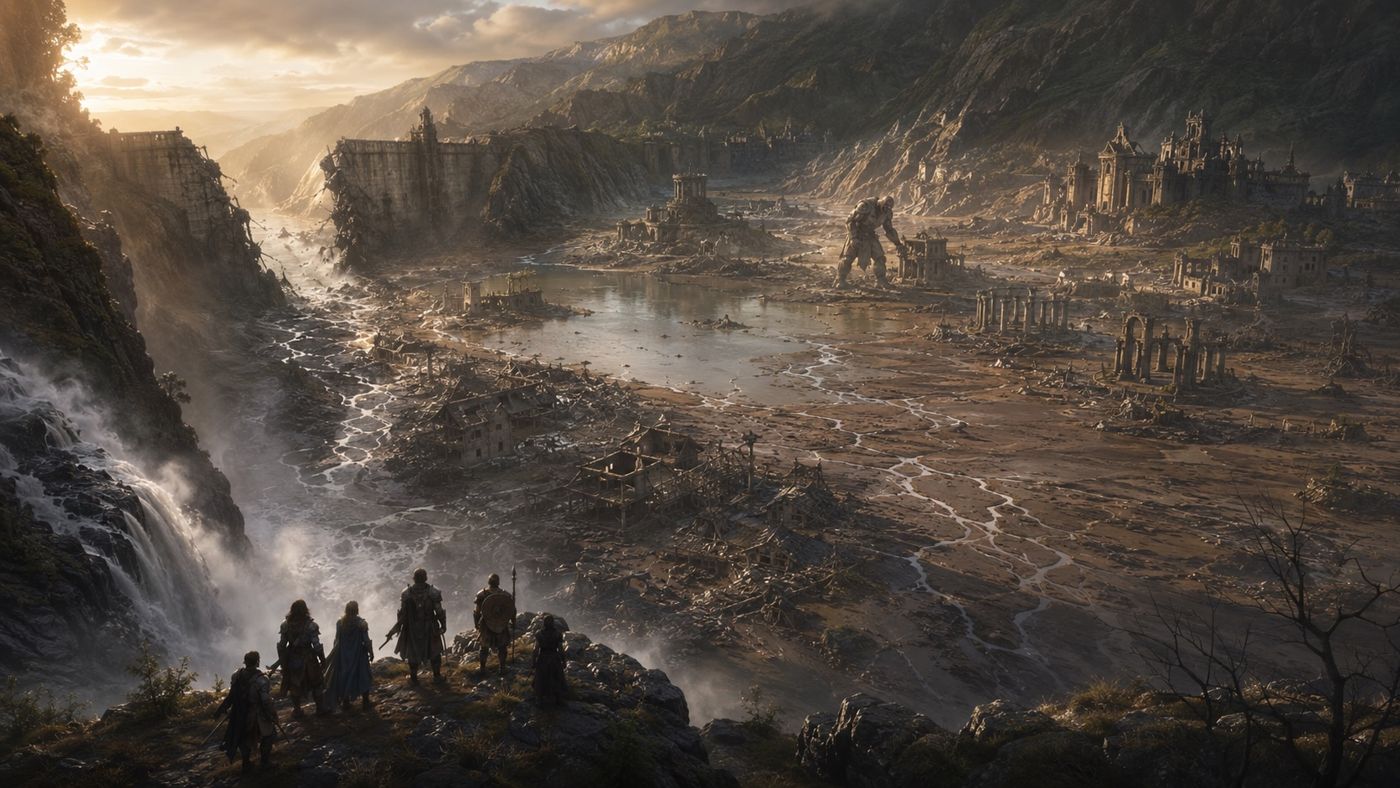
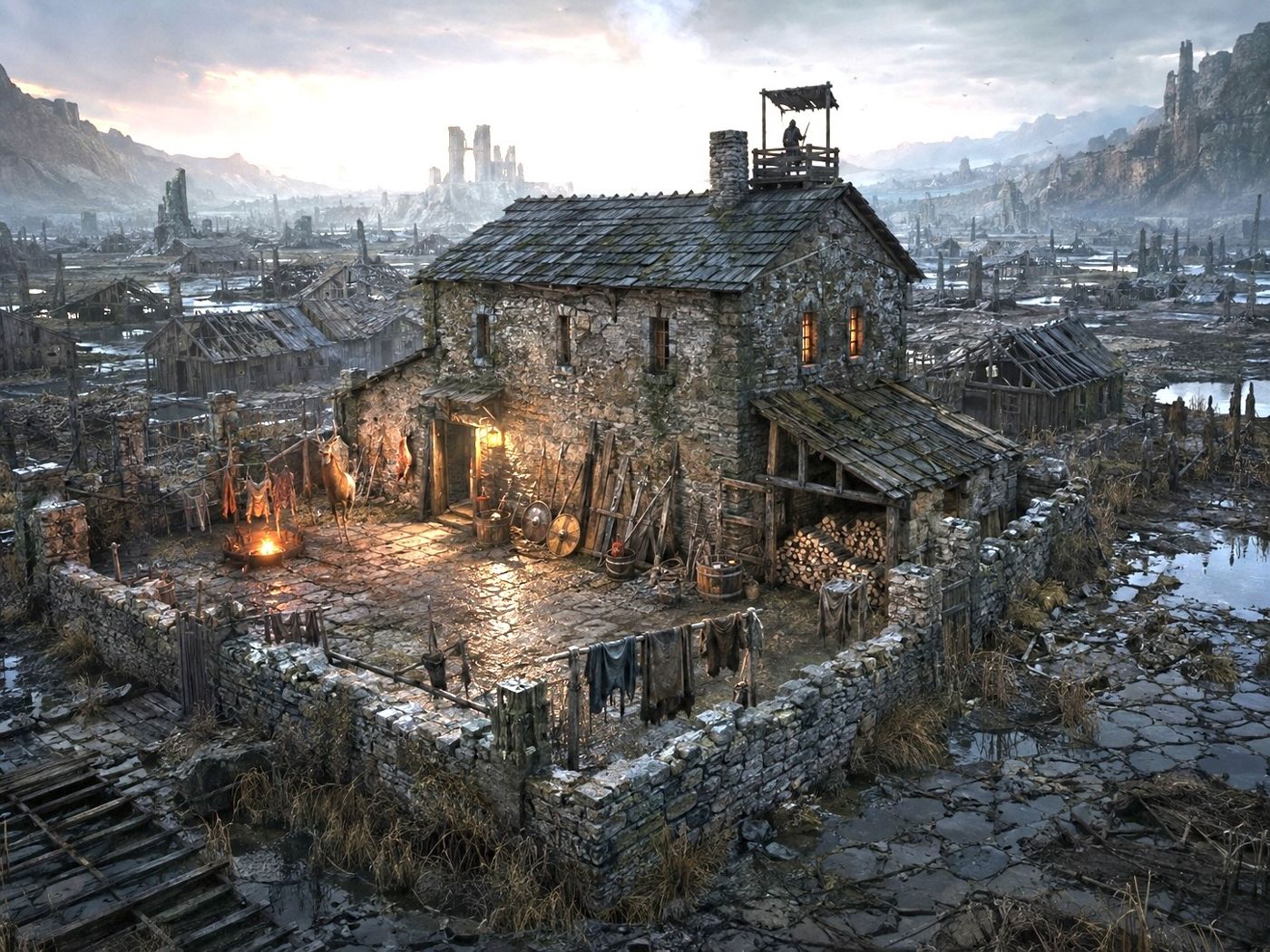
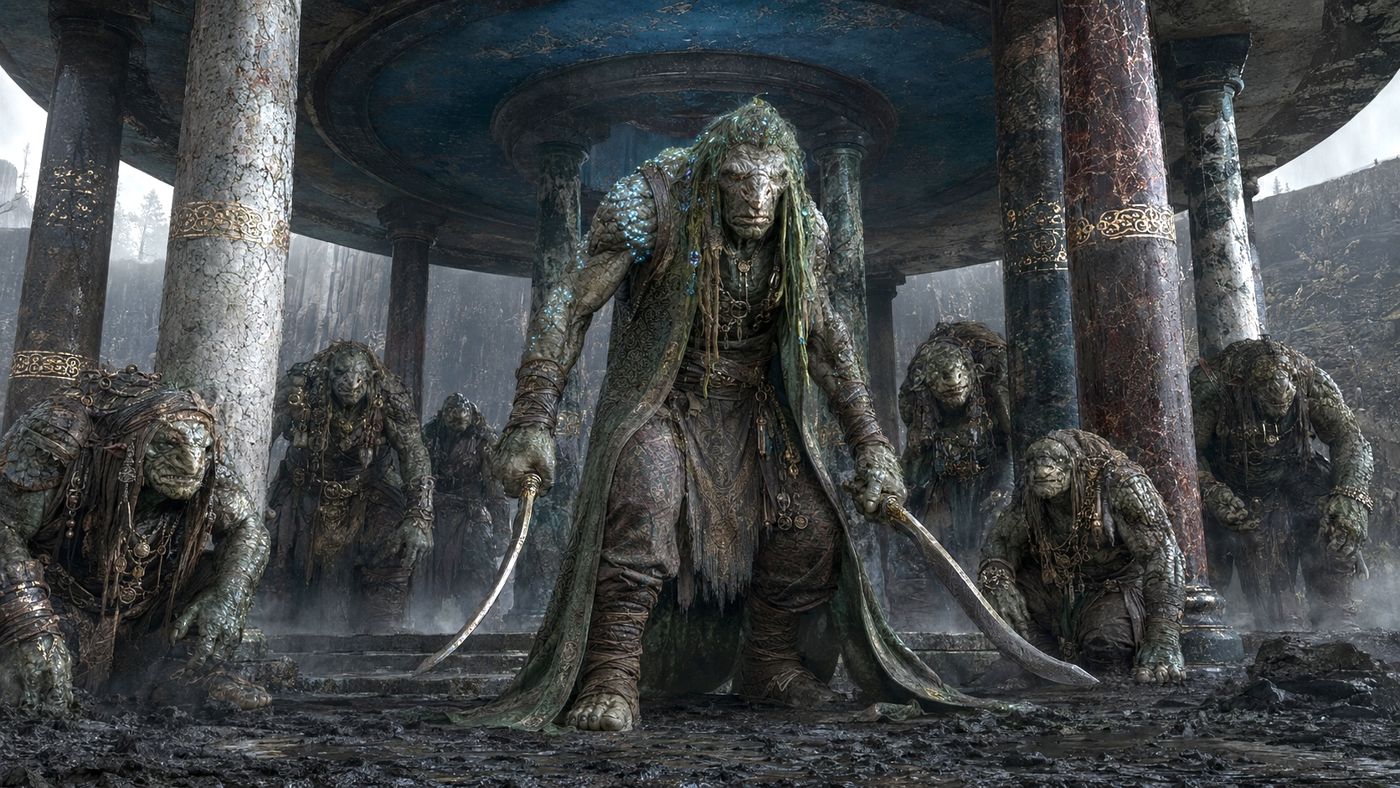
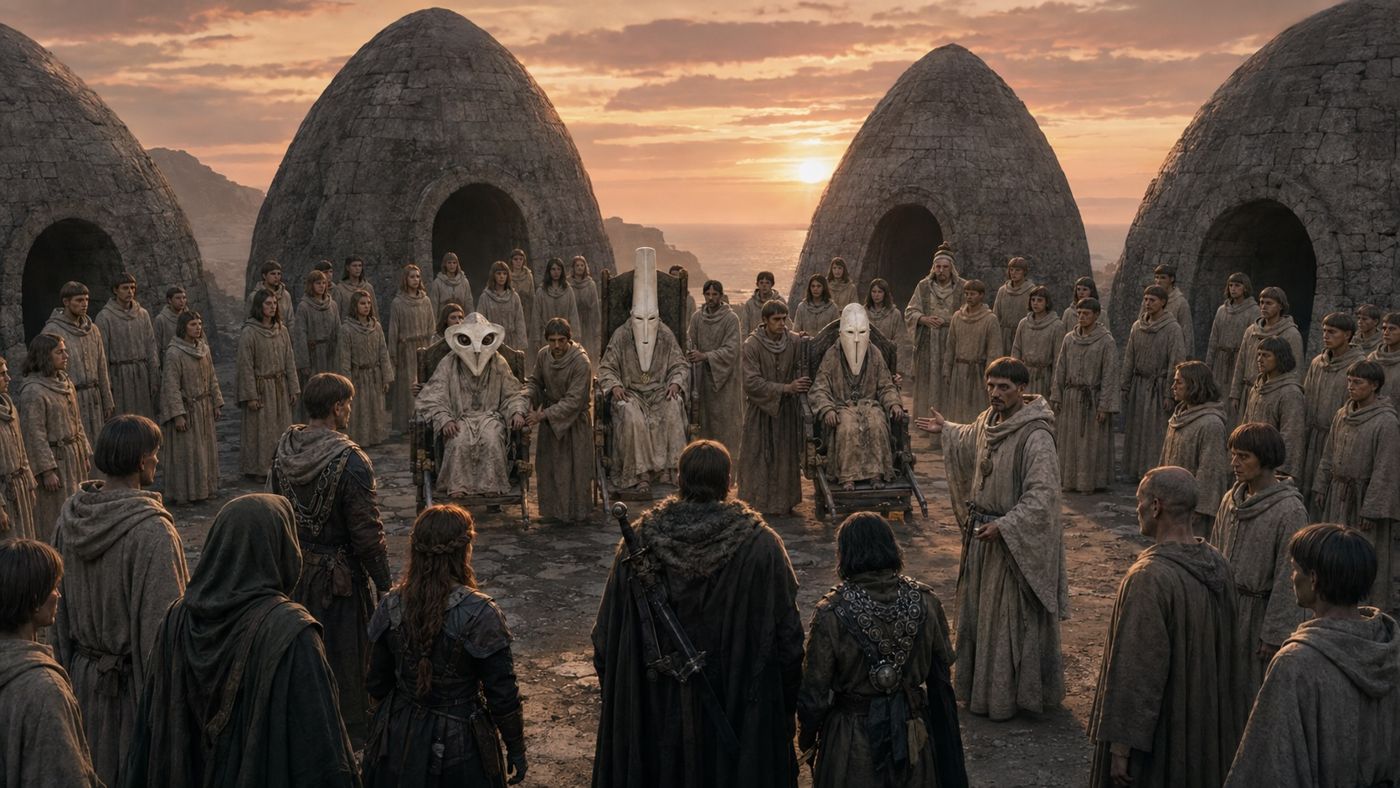
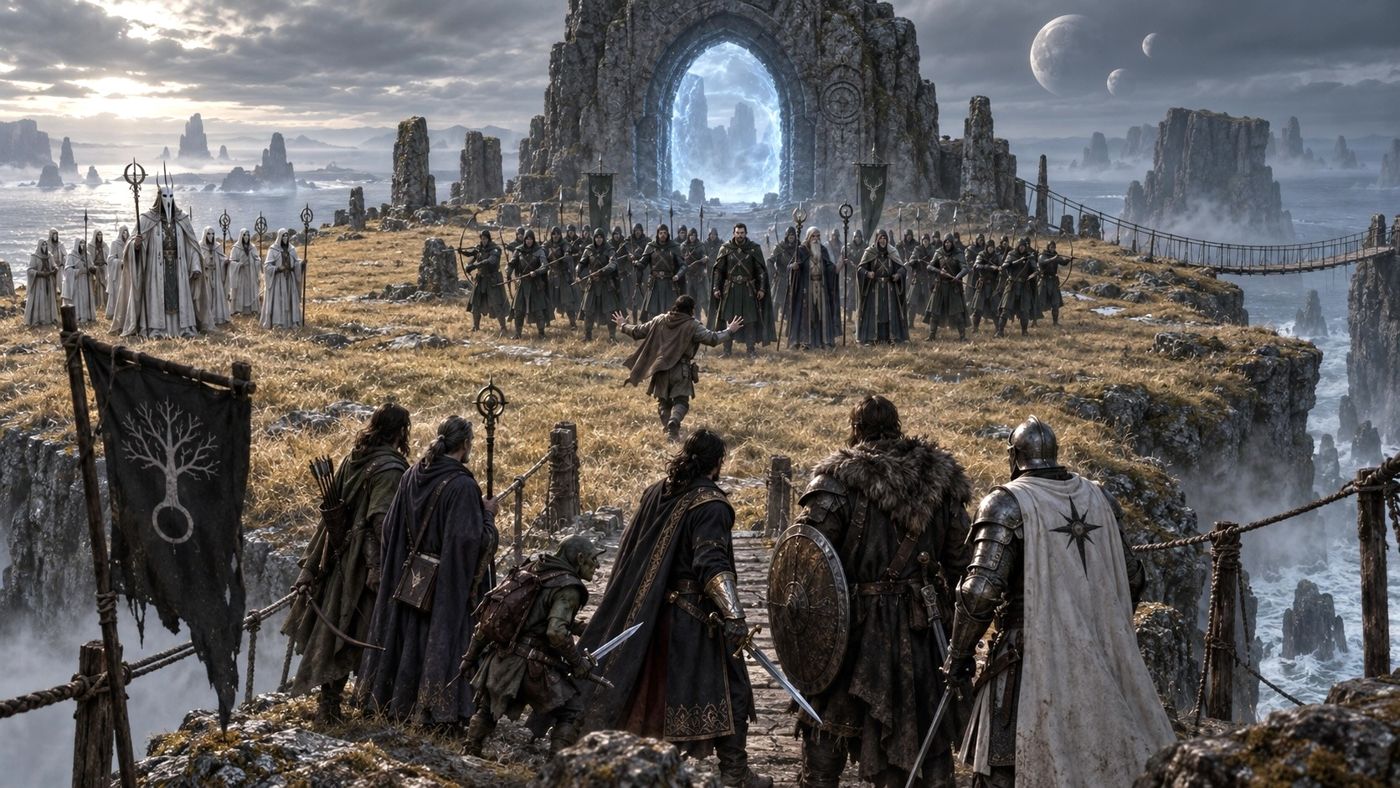
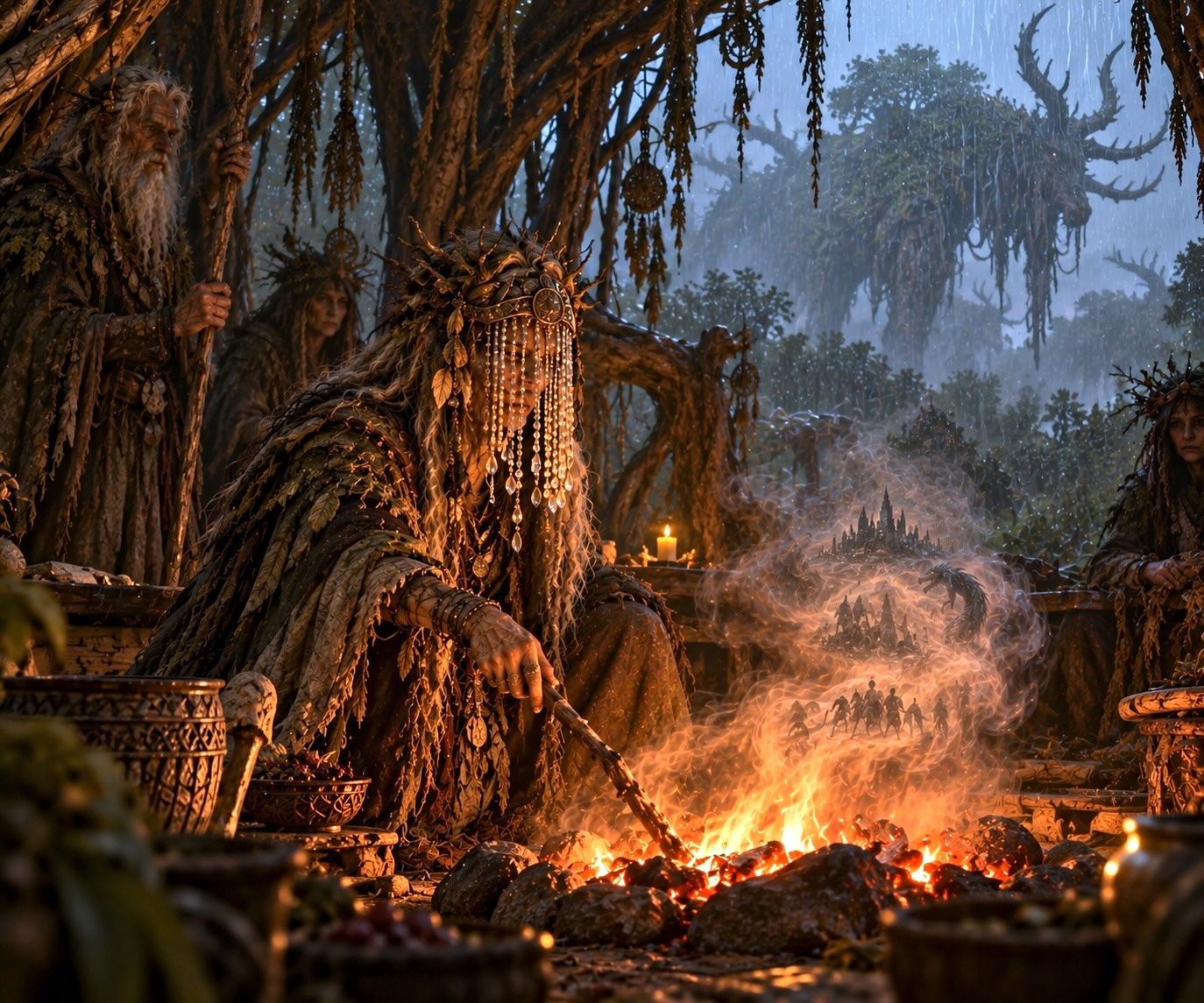
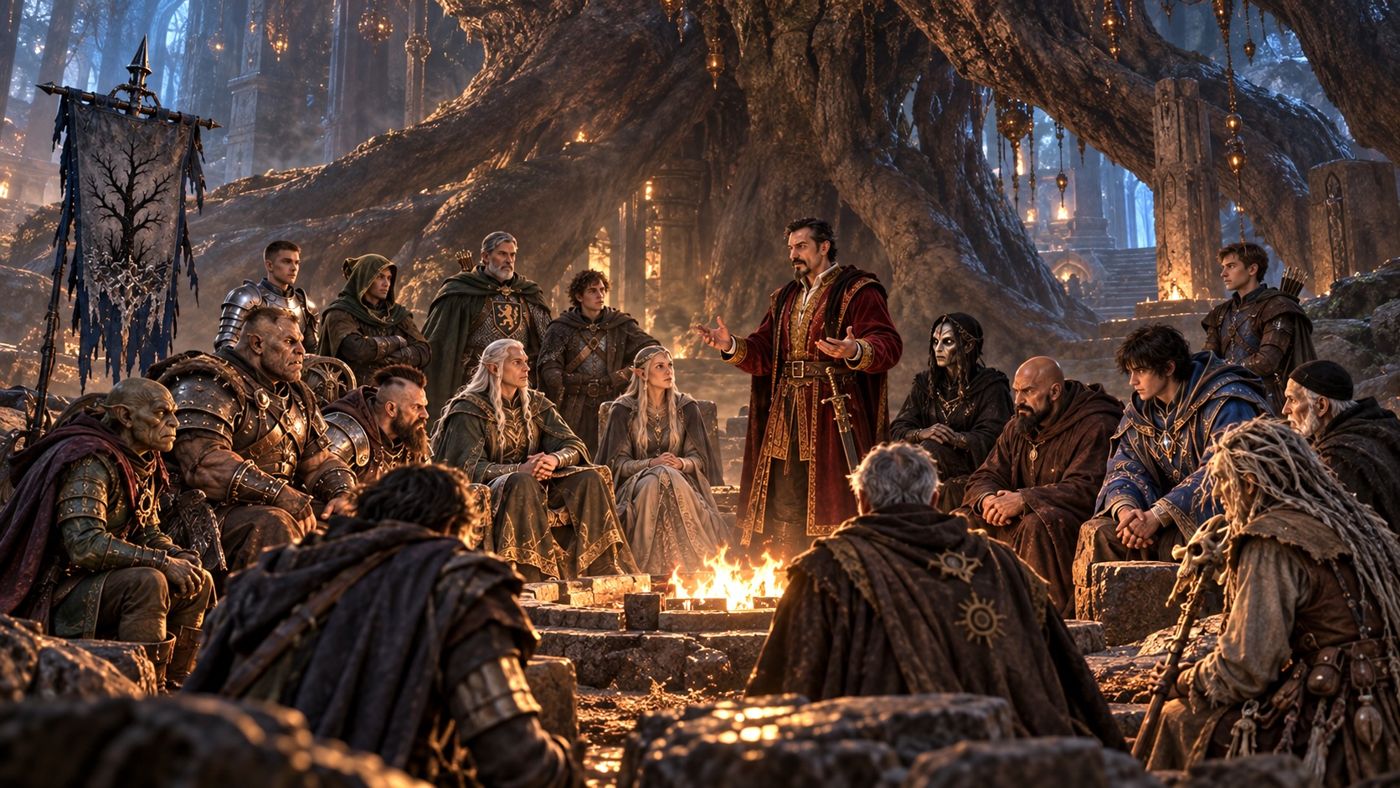
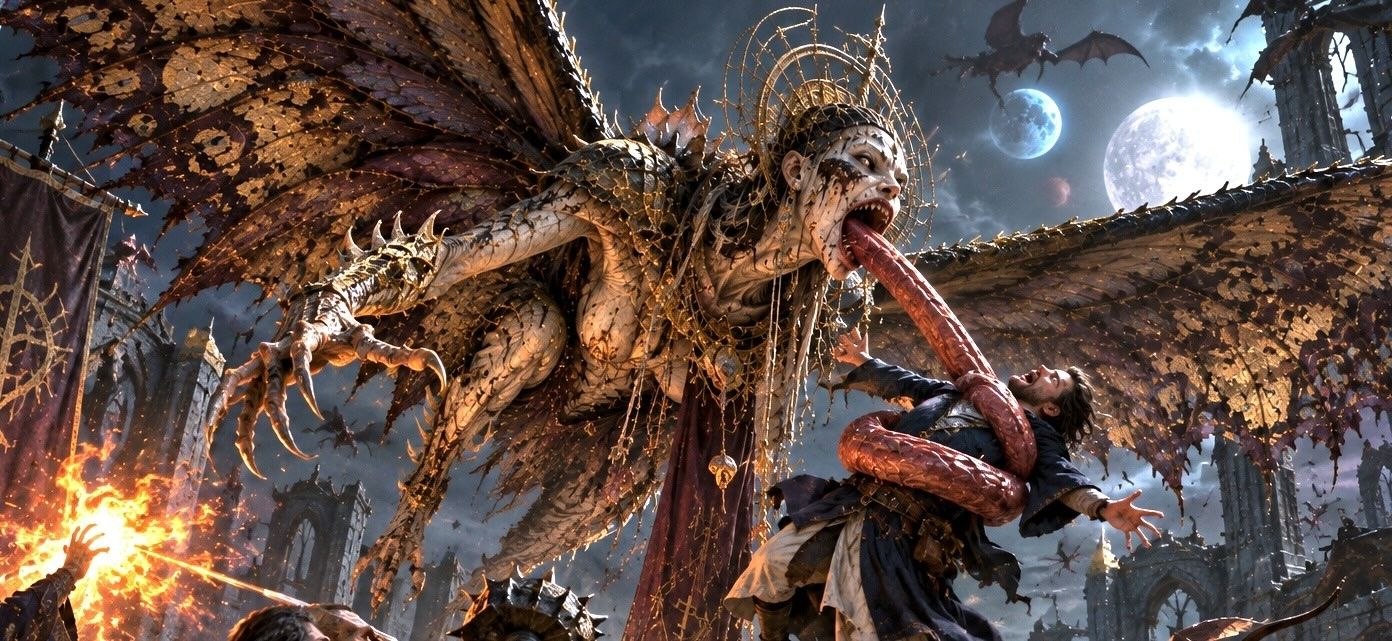
The story of the Ashen Banner, from the woken forest of Ambria to the ruins of Symbar and the Throne of Thorns. It is told by the archivists of Yndaros and was written up week by week as we played.
13 chapters · about 41,000 words
For almost five years my players have fought, schemed and bled their way across Ambria and beyond in our Symbaroum campaign. This is the chronicle of its final arc. I wrote a summary after each session, in the voice of the realm's archivists, who rarely agree with each other. It's here so the story outlives the group chat. — Scott
The Campaign
The Company
We follow the adventures of an ever-changing cast of characters as they navigate the complex politics of Ambria and Davokar.
The Queen seeks the power of the ancient Throne of Symbar. The Church wants to overthrow the Queen and create a theocracy. The old noble families all think they can do a better job. Her uncle and cousins think a childless Queen should give way to their leadership. The barbarians seek revenge. The elves want to stop the corruption from reawakening Symbar's evils. Plots and betrayals abound as the characters seek fame, glory and perhaps even power.
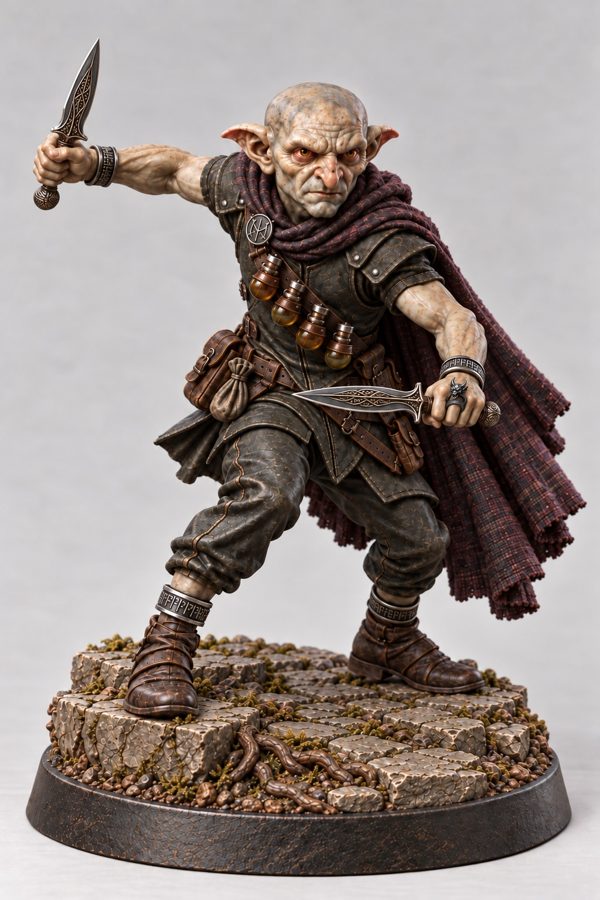
Lord Zik
Baron of Dekanor
A hero of the journeys to Symbar and to Alberetor, and rescuer of the Queen. Rewarded with a barony, he has joined Delio Fausti's expedition to the Throne of Thorns.
Accompanied by Sir Grommock of Dekanor, Ambria's first Ogre Knight, and Huldra Brizznag the Root Babbler, goblin shaman.
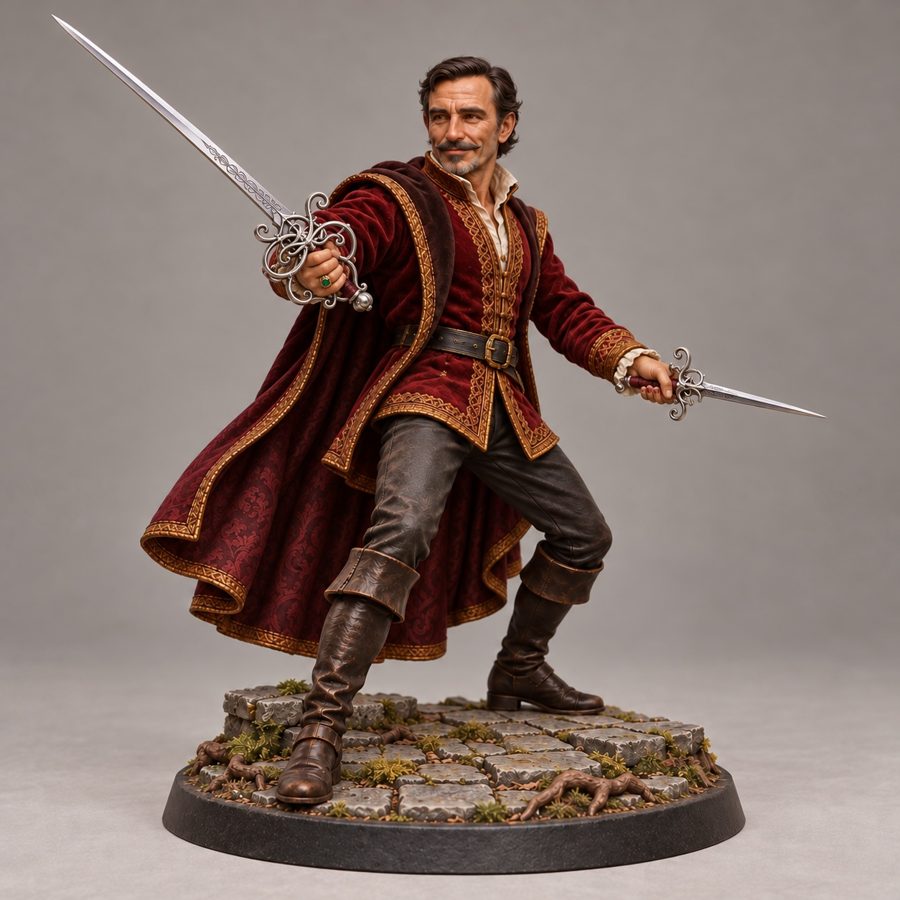
Lord Delio Fausti
Count of Lethona
A hero of the journey to Symbar. He used his riches to build the Gilded Shadow, an opulent gambling hall in the heart of Yndaros, and runs a well-connected spy network. He leads the final expedition back to Symbar.
Accompanied by Halbarad the archer and scout, and Brother Odran, Priest of the Guardian.
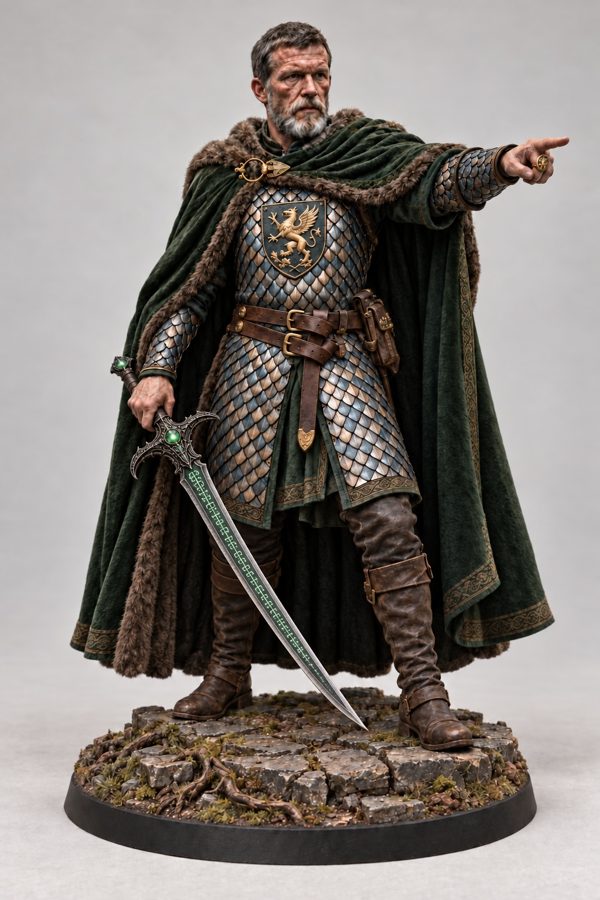
Lord Garridan Veynar
Baron of Loramor
Former Guardmaster at Castle Brigo in Alberetor. He played a key role in rescuing the Queen and was rewarded with the Barony of Loramor. He joins Delio Fausti's final crusade.
Accompanied by his Champion, Sir Roger of Palmyra, and his confessor, Father Kaelen of the Hospice.
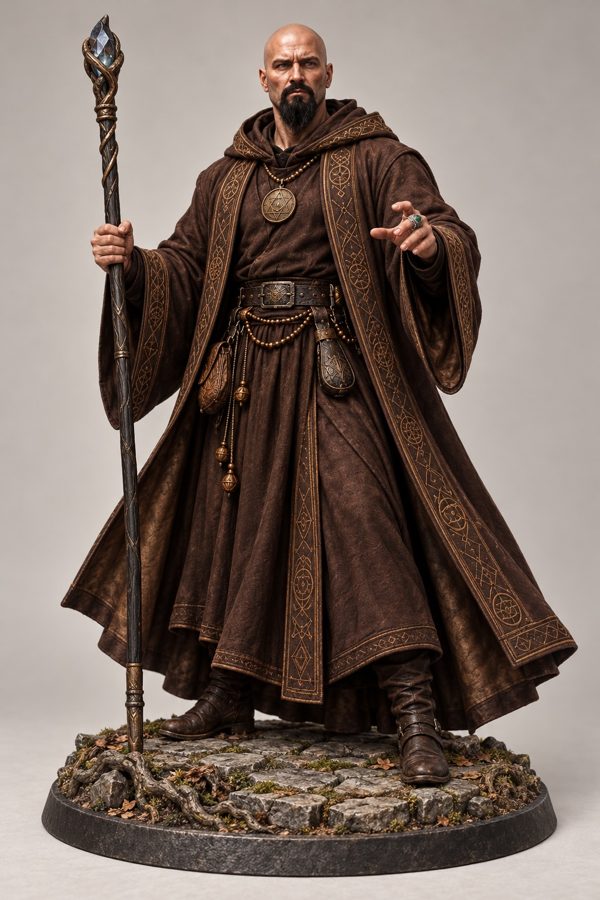
Master Qualis DalHonee
Ordo Magica
A lean, deliberate scholar-warrior who fought openly for the Crown during the civil war. He has become an expert in early human history and in the history, archaeology and languages of Symbar and Ambal Seba.
Accompanied by his apprentice Selviticus and his dwarven bodyguard, Radko Gorst.
Sir Elgai
of House Ardogal
The son of Count Lethona's trusted bailiff. Young Sir Elgai's duty is to protect the Count at all costs.
Accompanied by Hador Gimaldson, huntsman and scout, and his brother, Father Ansel Gimaldson.
Prologue
Prologue
9 min read
Being a Reconciliation of Accounts Concerning the
Southern Expedition and the Matter of Rosáe
By Magister Halivan Trast, Archivist of the Sekretorium,
Yndaros
Prologue: On Sources and Their Contradictions
The events herein recorded are drawn from a fractured body of
testimony: the field accounts of Master Kaston Iago of the Ordo Magica,
the battlefield recollections of sellswords and nobles in service to
Lord Delio Fausti, the irreverent and self-serving tales of goblin
witnesses, and the private correspondence submitted to Fausti
himself.
No two accounts fully agree.
This is not unusual.
What is unusual is the consistency of their
contradictions.
Each witness speaks truth—but never the whole of it. Each preserves
clarity in one matter while obscuring another. Thus, this chronicle does
not present a single voice, but rather an adjudication: a weighing of
testimony, motive, and omission.
I. The Charge Given
It is now beyond dispute that Lord Delio Fausti’s expedition bore two
purposes:
To locate and return Queen Korinthia from the south
To prevent the artifact known as Rosáe from
falling into her possession
These aims, though not incompatible in theory, proved irreconcilable
in practice.
Master Iago himself affirms that he was entrusted with both duties,
though the second was known only to a select few. He understood—at least
in principle—that some relics do not serve those who claim them, but
instead reshape their will.
He would later question whether understanding such a warning is the
same as being able to act upon it.
II. The Journey South
The company crossed the Titans into Alberetor, that land which is
less a ruin than a wound.
They passed through places of layered decay and memory:
Castle Brigo, where death came not by blade but by corruption of
the body
The Convent School, where faith persisted in forms both hollow
and dangerous
The Veiled Library, wherein knowledge endured beneath deathless
custodians
From these places they gathered not merely clues, but a pattern:
The past had not ended. It had only withdrawn.
By the time they reached Bright Haven and the black lake beyond, it
was clear that they were not simply recovering a missing monarch. They
were tracing the outline of something older—an inheritance tied to the
Throne of Thorns itself.
III. The Island and the Arboretum
Beyond the opal storm—mistaken at first for a barrier to all life,
but in truth hostile only to the dead—the company reached the island
where Rosáe grew.
There they found:
Queen Korinthia, resolute and unyielding
Her sister Esmerelda, calculating and deceptive
The artifact itself, growing in quiet defiance of the
ice
The Queen offered terms. Esmerelda offered alternatives. Neither
offered peace.
The company hesitated.
This hesitation is consistently reported across all sources and is of
critical importance. It was not cowardice, but recognition: no
choice before them was clean.
Some sought advantage. Some sought delay. Some hoped the decision
might be taken from them.
They were not disappointed.
IV. The Breaking of the Standoff
The standoff ended not through negotiation, but through
escalation.
Accounts differ on the precise instigator:
Some claim a premature strike by one of the company
Others suggest Esmerelda’s summoning of daemon forces made
conflict inevitable
What is certain is that:
A tear was opened in the fabric of reality
Daemonic entities entered the field
The Arboretum became a battlefield
From that moment forward, intention ceased to matter.
Only action remained.
V. The Battle of the Arboretum
Descriptions of the battle vary in tone but not in substance.
The daemon soldiers were described as heavily armored, resilient
beyond expectation
Several members of the company were incapacitated, paralyzed, or
brought near death
The Queen herself was endangered, though never passive
The goblin accounts—though colored by bravado—confirm a crucial
tactical truth: much of the company initially maneuvered for position,
engaging only when advantage presented itself.
This was not a unified charge. It was a fragmented, opportunistic
engagement.
And yet, in that chaos:
Esmerelda’s physical form was struck down
Her body was human, but Corvin Dusk remains doubtful as to her
fate
More importantly:
Her allies escaped.
They did not flee empty-handed.
VI. The Division of Rosáe
Here lies the central fact upon which all reliable accounts
converge:
Rosáe was not secured. It was divided.
Two claimants emerged from the Arboretum:
Esmerelda’s surviving faction, who escaped
through the rupture in reality
Queen Korinthia, who retained a portion with the
support—or acquiescence—of the expedition
This outcome was not planned. It was the product of collapse—of a
situation in which no party retained full control.
VII. The Decision That Defines the Expedition
The most consequential decision of the expedition was made not in
victory, but in aftermath.
Faced with the reality that Esmerelda’s faction possessed part of
Rosáe, the expedition’s leadership—most notably Master Iago—made a
calculated choice:
The Queen would not be denied her share.
The reasoning is stark:
To deny the Queen entirely would leave her vulnerable
To arm her partially would preserve balance
Thus, the expedition shifted—from recovery to containment
through parity.
Whether this was wisdom or error remains unresolved.
Even those who made the decision do not claim certainty.
VIII. On the Nature of the Queen
Across all accounts—loyal, critical, and self-serving—there is rare
agreement on one point:
Queen Korinthia does not seek power for vanity.
She seeks it with purpose.
She believes she can master what destroyed others. She believes she
can seize the inheritance of Symbaroum and bend it toward restoration
rather than ruin.
This belief is not reassuring.
It is the source of the danger.
For history teaches that the most catastrophic figures are not those
who seek power carelessly, but those who seek it with
conviction.
IX. The Return to Ambria
The expedition returned north with its primary objective
fulfilled:
The Queen lives.
Yet what returned with her was not resolution, but acceleration.
Esmerelda’s agents remain active
The Queen holds enough to act
This is not stability.
It is a poised conflict.
X. Final Assessment of the Sekretorium
The expedition must not be judged a failure.
Nor may it be judged a success.
It achieved its stated aim while undermining its deeper purpose.
It preserved the Queen while failing to protect her—from her enemies,
or from herself.
Most critically, it transformed a singular crisis into a distributed
one:
Where once Rosáe was contested between two rivals, it is now held by
several.
Where once the danger was concentrated, it is now diffused
and therefore harder to contain.
This condition bears troubling resemblance to the final centuries of
Symbaroum, when power was divided among many hands, and restraint
vanished not through intent, but through inevitability.
Epilogue: The Historian’s Judgment
If there is a single truth that may be drawn from these events, it is
this:
The expedition did not resolve the struggle for Rosáe. It ensured that the struggle will continue.
And perhaps that was always the only possible outcome.
Filed for circulation among the learned and the
loyalMagister Halivan TrastSekretorium, Yndaros
A Letter from Delio
To Staff Master Iago and his Companions in the Search for the
Queen, From Delio Fausti, in faithful service to the Crown
Staff Master,
It is with equal measures of pride and sorrow that I set quill to
parchment.
First, know that your deeds have reached even the most burdened halls
of power: you have preserved the life of our Queen and returned
her safely to Ambria. In an age where so much is lost, such an
act stands as a defiant beacon. You and your companions have done what
few in history could claim.
Yet that pride is shadowed by grief.
I have received confirmation of the fall of Lord Severin
Kael, whose name shall be remembered among the great defenders
of the realm. He died as he lived—standing against the darkness, that
others might endure. He is not alone in this honor. Many gave their
lives in that distant crucible, and Ambria owes them a debt that cannot
be repaid.
Still, I would not have this letter speak only of loss. Word has also
reached me of those who joined your company along the way—new allies who
chose, of their own will, to stand beside you in peril. For their
courage, and for the strength they lent to your cause, the Crown is in
their debt as well. In times such as these, loyalty freely given is
rarer than gold.
Take some measure of solace in this: the realm knows what you have
done.
And yet… I must temper praise with warning.
The Queen lives. The Duchess’ faction likewise escaped the island—and
they did not flee empty-handed. The Thorn remains beyond our control,
and where such power endures, conflict will follow. It is my considered
judgment that your services may soon be required again.
While you journeyed through Alberetor and Lyastra, the realm you left
behind has changed—violently and irrevocably.
The Opening of the War
The conflict began in the month of Ynedar, Year 23 after the Victory,
when tensions between the Crown and the Reformists finally broke.
Queen Korinthia, pressed on all sides, moved to secure Templewall
with a garrison—an act perceived as provocation. At the same time, the
Sun Council, supported by Baron Arnon Melion, raised forces in secret
near Ravenia.
When the Queen demanded that Crown Duke Ynedar disband his army, he
refused. War was declared soon after.
The First Blood – Betrayal at the Winter Dunes
The first great clash came at Oralak’s Winter Dunes. What should have
been a Loyalist victory became a rout when mercenaries—bought with
Reformist coin—turned on their allies mid-battle.
Fourteen hours of slaughter followed, ending in a decisive defeat for
the Crown’s forces.
In the aftermath, Duke Gadramei of Seragon declared for Ynedar, and
the conflict deepened into something far more dangerous than a dispute
of crowns—it became a war of belief.
Expansion of the Conflict
The war spread quickly:
Reformist forces advanced on Templewall and Narugor.
Loyalists attempted a river assault toward Ravenia, only to be
crushed by entrenched defenders, cavalry, and barbarian
auxiliaries.
Assassinations, including that of Duke Junio Berakka,
destabilized entire regions and shattered morale.
No victory held for long. No alliance proved certain.
The Winter of Suffering
Then came Istaros.
An unnatural winter froze rivers, halted armies, and starved the
land. Soldiers died in their armor, and entire companies vanished into
the cold.
This period—now called the Hunger Wolf
Winter—claimed more lives than any battle.
A final attempt at peace in Sunflower Village ended in catastrophe
when Ink Soot struck the delegates. Most perished within moments. The
survivors blamed treachery, and all hope of reconciliation was
extinguished.
Renewed War and the Fall of Strongholds
With the thaw came renewed violence:
Parfas fell swiftly to Reformist assault.
Templewall followed after eleven days of brutal siege
warfare.
The war seemed poised to reach its conclusion.
But fate, as ever, had other designs.
The Awakening of the Darkness
Reports spread across the realm:
Abominations rising in Mederen
Undead pouring from Tivra
Blight beasts, trolls, and horrors beyond naming emerging from
Davokar
What had been a civil war became something far worse.
As is now grimly understood, the ancient corruption long fettered
beneath Davokar has begun to stir—a consequence of mankind’s
transgressions reaching back to the fall of Symbaroum
itself.
The Treaty and the Fracturing of Ambria
Faced with annihilation, both sides turned to negotiation.
A treaty was signed, dividing the realm:
The southern territories remain under Queen Korinthia
The north now forms Korianland under Crown Duke Ynedar
Thus ended the civil war—not in triumph, but in necessity.
The Present Reality
Ambria stands divided and diminished:
Cities shift allegiance out of fear or survival
The people grow distrustful of both crown and clergy
Old beliefs stir as faith in Prios falters
And through it all, the darkness advances.
Final Counsel
You return not to peace, but to a realm wounded in body and
spirit.
You have saved the Queen. You have paid for that victory in blood. And others—heroes among them—have paid the ultimate price.
But the struggle continues.
The Thorn remains in play. The factions endure. And the shadow rising from Davokar does not distinguish between Loyalist
and Reformist.
I will not dress this in softer words:
You may yet be called upon again.
When that hour comes, I trust you will answer—as you always have.
For Ambria still stands. And so long as it does, it will need champions.
Delio Fausti In service to the Crown and the survival of Ambria
Book I · Chapter I
The Coming of the Company
5 min read
Recorded by Magister Halvyr Terenius, Last Archivist of
Yndaros
“When the forest woke, it did not roar—it advanced.”
In the waning days of Ambria, when the northern reaches of the realm
lay broken beneath the slow and relentless tide of awakened corruption,
and when even the great River Doudram could no longer be trusted as a
boundary between safety and annihilation, there came to Yndaros a
company of uncommon measure.
They did not come as an army, nor under any single banner.
They came at the summons of Delio Fausti, Comte
d’Lethona—proprietor of the Gilded Shadow, keeper of whispers,
and a man whose influence was most keenly felt where it was least seen.
In those days, when thrones trembled and certainties failed, even the
great and the damned alike answered when Fausti called.
Thus were gathered those who would, by deed or by consequence, shape
the final contest for the Throne of Thorns.
There came Lord Zik, Baron of Dekanor—once a
creature of shadows and narrow alleys, now raised to nobility yet
unchanged in essence; a goblin lord with laughter close to hand and
knives closer still. At his side stood Brizznag, Huldra
of Dekanor, root-touched and whispering of older powers, and Sir
Grommock, an ogre bound by oath and debt, whose silence was
broken only by violence.
There came Master Wizard Qualis DalHonee, a man of
learning and dangerous curiosity, attended by his apprentice
Selviticus, and guarded by Radko
Gorst, a dwarf of blunt loyalty and brutal efficiency—placed in
his service by Fausti himself, which fact alone has stirred no small
speculation among later scholars.
There came Lord Garridan, Baron of Loramor—a knight
of Alberetor, tempered in exile and battle, whose honor had not yet been
worn thin by the compromises of Ambria. With him walked Father
Benito, priest and counselor, and Sir Roger of
Palmyra, newly sworn champion, untested yet unyielding.
And there were others, drawn into the orbit of this gathering.
Halbarad of House Melion, archer and long watcher of
Karvosti’s troubled wilds; Brother Odran, priest of the Guardian; Sir Elgai of House Ardagel, young and earnest, attended
by the twins Father Ansel Grimaldson and Hador
Grimaldson, whose bond of blood would, in time, be tested
beyond all reason.
These, and no few others besides, assembled within the dim-lit
chambers of the Gilded Shadow, where secrets were currency and truth was
a negotiated thing.
It was there that they learned of the Queen.
Not as sovereign—but as fugitive.
Through the labors of the late Corvin Dusk, whose
translations of her private diaries remain among the most contested
documents in the Sekretorium’s sealed archives, it was revealed that
Queen Korinthia had vanished once more into the shadow
of Davokar—seeking not refuge, but dominion.
She was not alone.
An army gathered in secret. A design took shape.
The aim, as later events would grimly confirm, was nothing less than
to force passage through the awakened forest and claim the Throne of
Thorns—whether to wield its power or perish in the attempt, none can say
with certainty.
Before plans could be laid, fate intervened.
Marshal Nidel came in haste, bearing word that a
great host of abominations—no scattered beasts, but a tide—advanced upon
the Doudram crossing. The bridge, a vast construction of timber and
rope, stood as the last defensible line before Yndaros itself.
Aid was demanded.
It was given.
Let it be recorded: the company did not hesitate.
They took their place upon the bridge, as the last defenders before
the fall.
The first assault came swift—fiends, warped and ravening, breaking
ahead of the greater mass. These were met and destroyed with a precision
that speaks to discipline rather than desperation.
But the second wave brought with it something greater.
A giant—corrupted, maddened, and terrible in its ruin—fell upon the
defenders. Here the accounts diverge: some claim it was brute force that
brought it low, others that cunning prevailed. Yet all sources agree on
this point—
Master DalHonee unmade the creature’s will.
Through sorcery—whether of brilliance or of recklessness—the giant
was turned upon its own kind. Amidst the confusion, Halbarad’s arrows
found their mark, and the beast was brought low.
It died standing.
Then came the wave.
No natural force, but a wall of blackened water, swollen with ruin
and memory, swept down the Doudram and shattered the bridge as though it
were kindling. Wood, iron, flesh, and stone were cast alike into the
churning depths.
Many were lost.
Some were not.
When the survivors dragged themselves from the mire in the gray light
of morning, they found the cost of that stand laid bare.
Father Benito was among the dead.
Others—unnamed, uncounted—were scattered along the banks, broken or
drowned or worse.
But what the river yielded was not only death.
The bodies bore markings.
Not merely of corruption—but of identity.
The fallen were revealed to be of the Sovereign’s
Oath, followers of the Blood Daughter—once a people of will and
ferocity, now reduced to a tide of blight-born ruin.
And among them were others still—dead of Ravinia, bearing signs of
attack by vermin twisted beyond nature, suggesting that the wave had
passed through that city with catastrophic force before reaching the
Doudram.
More troubling still were the relics uncovered.
Artifacts drawn from the mud—ancient beyond reckoning—suggesting that
the wave had dredged not only the present, but the buried past. Some
bore markings predating even the Symbarian Empire, a fact that has yet
to be satisfactorily explained.
But it was the chest that would shape what followed.
Within it lay four cylinders of glass, inscribed in a script so
ancient that even DalHonee could not decipher it. Yet he discerned
enough to name their nature:
Rituals—protective, warding, binding.
And tied, unmistakably, to Koaral—that which the
learned name the Power of the Gods, and the fearful call corruption.
Of all living scholars, DalHonee knew of only one who might read such
signs.
Lassifor Nightpitch of Thistle Hold.
If he yet lived.
Thus was the course set.
Not by decree, nor by prophecy—but by necessity.
“Some say the company sought power. Others that they sought
answers.
I find no contradiction between the two.”
And so they turned their steps toward Thistle Hold— into a land already half-lost, bearing with them relics of a past best left buried, and the first fragile thread of a path that might yet lead to Symbar.
Or to its doom.
Thus begins the record of their deeds.
Book I · Chapter II
The Road to Thistle Hold
9 min read
Collected and arranged by Magister Halvyr Terenius, Last
Archivist of Yndaros
“The roads north of the Doudram did not lead into wilderness.
They led into aftermath.”
In the first weeks following the Breaking of the Doudram Bridge, the
Company of Count Delio Fausti journeyed north toward Thistle Hold,
seeking the scholar and Mayor Lassifor Nightpitch, whom
Master Qualis DalHonee believed might decipher the strange cylinders
recovered from the floodwaters.
The kingdom through which they traveled was no longer truly
Ambria.
Villages stood empty beneath circling crows. Entire farmsteads had
collapsed into black mud where floodwater and corruption mingled. The
roads were thick with refugees moving south, and with things that had
once been refugees moving nowhere at all. Forest edges twitched at dusk.
Wells soured overnight. Travelers spoke in whispers of shapes moving
beneath the soil after sunset.
The Company marched north regardless.
Some did so from duty. Some from curiosity. Some from loyalty. And perhaps one or two because the world had become too strange to turn
away from.
The surviving testimonies from this march differ wildly in tone.
Fausti wrote like a statesman in mourning. DalHonee like a jester
pursued by destiny. Garridan like a knight struggling to remember why
honor mattered. Young Elgai of House Ardagel wrote as though the old
world still stood intact somewhere just beyond the next horizon.
Together, their accounts reveal not merely a journey—but the dying
character of a kingdom.
The Refugees of Holm’s Ford
The most sober account comes from Delio Fausti himself, preserved in
damaged fragments among the sealed papers of House Lethona.
Fausti describes the road north as:
“A riverbed of mud, ash, and frightened footprints.”
Near the ruined settlement of Holm’s Ford, the Company encountered a
broken refugee cart half-sunken into a drowned field. A dead ox lay
rotting in its traces. Household possessions—chairs, cookware, a child’s
wooden toy—remained lashed atop the wagon in pathetic testament to the
speed of the family’s flight.
The survivors hid nearby in a drainage ditch beneath strips of
sacking.
A woman. Two children. An old man bleeding from the leg. And a boy of perhaps twelve holding a knife in both hands “as though
willing it to become a sword.”
Fausti’s recollection of the exchange survives almost completely:
“Where are you from?”
“North,” the woman answered.
“Everyone is from north now,” Fausti reportedly replied. “North had
become less a direction than a diagnosis.”
The Company quickly realized something stalked the nearby grain
fields.
The thing that emerged had once belonged to the local militia.
Fragments of coat and boot remained visible beneath the corruption. Its
jaw had split downward through the throat, and black roots dragged from
its fingers into the mud.
When the terrified woman denied it had once been her husband, Fausti
is said to have answered:
“Good. That would have complicated matters.”
The historian notes that many later readers misinterpret this line as
mockery.
It was not.
Fausti belonged to that increasingly rare breed of noble who used wit
the way soldiers use shields.
The creature charged.
Several Company members were prepared to intercept it, yet all
testimonies agree that Fausti moved first despite obvious exhaustion
from the destruction of the bridge. His ribs had been injured. A wound
along his thigh had reopened repeatedly during the march. Yet he met the
abomination personally in the road before it could reach the
children.
The duel was brief and brutal.
Fausti later wrote:
“He had won duels with that blade. Settled insults. Made fools of men
who mistook nobility for softness. Later, he had killed things with it
that had no place in any courtly manual of arms.”
The creature died in the mud.
The family survived.
And afterward, when one of his companions suggested traveling south
rather than onward to cursed Thistle Hold, Fausti reportedly
answered:
“South is wiser. But wisdom and necessity are rarely friends.”
Though other versions preserve the more famous reply:
“It has always been cursed. The difference is that now everyone
knows.”
The Recollections of Master DalHonee
Far less reliable—but infinitely more entertaining—are the
autobiographical recollections of Master Wizard Qualis DalHonee
concerning his accidental entrance into the Ordo Magica.
DalHonee maintained that he became a wizard through fraud, panic,
coincidence, and excessive commitment to theatrical performance.
His account begins not in a tower of learning, but beneath a wagon
outside Thistle Hold while hiding from gambling creditors after what he
termed:
“A misunderstanding involving ravens and horse races.”
Mistaken for a mystic by a passing mercenary company, the young
DalHonee allegedly responded to questioning with the phrase:
“Yes. But only when the moon permits.”
He insists this was intended merely to sound mysterious.
Unfortunately, it succeeded.
The account grows steadily more absurd. DalHonee describes inventing
prophecies, frightening mercenaries with meaningless phrases such
as:
“The roots remember.”
“Night has teeth.”
“Silence bends toward hunger.”
At one point he accidentally “discovers” a missing child merely by
shouting into the woods while panicking.
Yet the account changes in tone near its conclusion.
During an expedition in Davokar, DalHonee was confronted by a genuine
adept of the Order named Serex and commanded to demonstrate his mystical
abilities publicly. Attempting once again to bluff, DalHonee
declared:
“The veil is thin tonight.”
At that exact moment, something screamed deep within Davokar.
The surviving descriptions agree only that:
the sound was immense,
inhuman,
and powerful enough to shake the forest canopy.
DalHonee afterward claimed:
“Something snapped inside my mind and I knew that all I’d pretended
to do I could now do for real.”
Certain copies place the scream before his declaration. Others
after.
The distinction has occupied Ordo scholars for decades.
The Tribunal Near Templewall
The testimony of Lord Garridan of Loramor survives in military
records, oral histories, and several later ecclesiastical
condemnations.
Garridan’s writings during this period are marked by exhaustion and
grief following the death of Father Benito at the Doudram Bridge. He
repeatedly refers to the loss as:
“A phantom limb twitching in my soul.”
Near Templewall, Garridan’s company encountered seven Templars
conducting a roadside tribunal against refugees and a renegade healer
named Father Kaelen.
Kaelen stood shielding a wounded child while projecting what
witnesses described as an amber ward of protective light against the
advancing Templars.
Sir Roger of Palmyra immediately recognized him:
“Father Kaelen the Merciful.”
Garridan initially argued they lacked time to interfere. The fate of
Lassifor Nightpitch—and perhaps all Ambria—depended upon reaching
Thistle Hold swiftly.
Roger’s answer survives in nearly every version of the tale:
“If we leave a man of Prios to be murdered for the crime of healing,
then there will not be a kingdom left worth saving.”
Battle followed immediately.
Garridan describes the Templars as:
exhausted,
fanatical,
and convinced that only violence could preserve the dying order
of the world.
Kaelen himself reportedly fought only to defend others. Witnesses
speak of blood streaming from his nose as he maintained protective wards
against the white fire of the Templars’ cleansing rites.
The Company prevailed.
The surviving Templars retreated toward Templewall.
And Father Kaelen afterward joined the Company.
His theology would later be condemned by surviving Curial authorities
as the so-called Heresy of Mercy. Kaelen himself taught
that:
Prios was dying not from sin,
but from cruelty,
and that the Awakening of Davokar represented nature’s response
to human excess.
Later reformists preserved his gentler phrase instead:
“Seek the light that warms, not the light that burns.”
The Songs of Sir Grommock
Among the stranger stories preserved from the march north is the
encounter between Sir Grommock of Dekanor and the troll called Orm
Brakka-Singir, later known in caravan songs as the Root-Singer.
The Company had entered the shadowed southern reaches of Davokar when
they were surrounded by trolls and forest-things armed for war.
Several accounts claim Garridan had already drawn steel. DalHonee
later insisted he had been “moments away from catastrophic wizardry.”
Fausti himself wrote only:
“The situation appeared unsalvageable.”
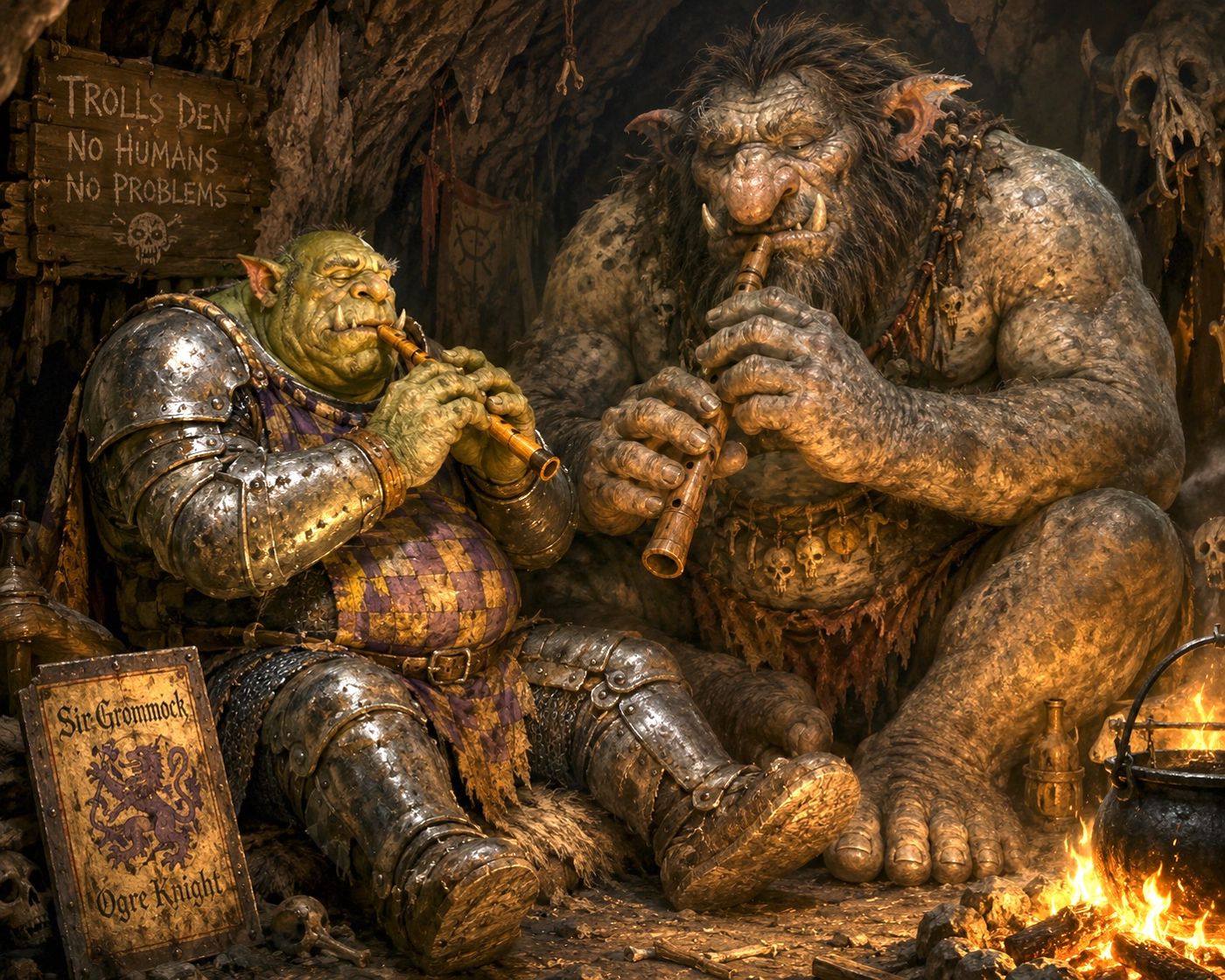
Then Sir Grommock produced a flute.
Witnesses differ wildly concerning what followed.
Some say the ogre played a winter lament known among trolls as
Branches Beneath Snow. Others insist the melody belonged to no
known tradition. One highly suspect account claims even the insects fell
silent.
All agree upon this:
The troll chief halted the attack immediately.
The being identified later as Orm Brakka-Singir reportedly wept upon
hearing the melody and demanded to know where “the little stone-eater”
had learned such songs.
Sir Grommock is said to have answered:
“From kinder folk than men.”
Rather than slaughtering the travelers, the troll escorted them
beneath a forest hill into a vast root-hall lit by green sap-fires.
There the humans slept uneasily in stable lofts while the troll and the
ogre remained awake until dawn exchanging songs and stories.
Among the melodies afterward learned by Grommock were:
The Song of Branches Beneath Snow
The Lay of Stones That Dream
The Hearthfire of Giants
and the mournful Last Road of Eneáno
Certain elves later reacted with visible grief upon hearing these
songs performed.
The historian considers this significant.
The Letter of Sir Elgai
Of all surviving road testimonies, none possesses the sincerity of
the letters written by Sir Elgai of House Ardagel to his father in
Lethona.
Unlike later accounts, they were written before the Company fully
understood the scale of the catastrophe unfolding around them.
Elgai writes with youthful admiration of Halbarad’s archery, Father
Ansel’s growing command of divine power, and even of the unsettling
abilities of Master DalHonee, “whose powers inspire both awe and
unease.”
Most curious, however, is his account of the abandoned village.
After hunting rabbits with Hador Grimaldson, Elgai followed the sound
of hammer-strikes into what appeared a deserted settlement. There the
two encountered a lone smith laboring at a forge.
The stranger sharpened Elgai’s worn blade effortlessly and gifted
wine to the travelers without accepting payment.
When Elgai protested, the smith reportedly answered only:
“One works where one must.”
Later, when the Company returned with others, the forge stood cold
and abandoned, apparently untouched for years.
Father Ansel believed they had encountered an aspect of the
Lightbringer.
Elgai disagreed politely.
The historian remains uncertain.
The Silence of Thistle Hold
At last the Company reached Thistle Hold.
Only months earlier, Halbarad of House Melion had passed through its
gates and found the fortress-city wary but disciplined. Rangers manned
the walls. Guards watched the gates. Smoke rose from taverns and
workshops. Life endured.
Now the gates were shut.
No sentries walked the battlements.
No challenge came from the walls.
Only the distant Beacon still burned against the darkening north.
Far away, figures could be glimpsed gathered near the Ranger
platforms beside the flame, though distance concealed their identity.
And from the upper windows of Nighthome—the Mayor’s wooden palace—light
still flickered faintly.
The city itself remained silent.
Not peaceful.
Waiting.
The Company scaled the unmanned wall near Nighthome and entered the
palace seeking Lassifor Nightpitch and answers concerning the strange
cylinders recovered from the flood.
Instead they found devastation.
Furniture lay smashed. Doors splintered. Entire chambers bore signs
of hurried evacuation and violent struggle. As the Company ascended
toward the upper stories, no servants appeared.
Only at the top of the stair did resistance emerge.
Two raging abominations fell upon them from concealment. Witnesses
later claimed the creatures still wore remnants of noble Thistle Hold
attire. They were swiftly destroyed.
Beyond them lay a series of improvised prison chambers.
One held the corpse of Elmea Rabbit’s Foot within what had once
served as an alchemical laboratory.
Another—the chamber of Erok the Dark—had already been broken open
from within.
A third contained only the dissolving remains of what had once been
Master Goncai of the Ordo Magica.
The fourth still held something living.
Or partly living.
The Company chose not to open that door.
Wisely.
At last they reached the Mayor’s Expedition Room.
There the truth began to reveal itself.
The chamber had clearly suffered some catastrophic eruption of
corruption. Black growths twisted through shattered furniture. Sections
of wall had partially liquefied into slick organic surfaces.
Among the wreckage lay:
a dead cultist woman in rich ceremonial robes,
the corpse of a daemonic trooper,
the Light Globe artifact,
and fragments of a drawer front bearing the same crest found upon
the flood-recovered chest.
Beneath the symbol appeared two words:
Ambal Seba
The name would haunt all who survived the months that followed.
From the rooftop gardens of Nighthome the Company finally beheld the
full fate of Thistle Hold.
The city below teemed with undead and abominations.
Not isolated monsters.
Populations.
Entire streets moved with blight-born life. Markets wandered with the
dead. Rooftops shifted with malformed things crawling through chimney
smoke.
One witness later wrote:
“It was not a city under siege.
It was a city already digested.”
Only the distant Beacon still showed signs of organized
resistance.
And so the Company turned northward along the wall catwalks toward
Toad Square, seeking to discover who—if anyone—still lived within
Thistle Hold.
“Thus ended the road north.
And thus began the descent into the true darkness of Davokar.”
Grommock and his flute
Book I · Chapter III
The Last Breath of Lassifor Nightpitch
10 min read
Collected and arranged by Magister Halvyr Terenius, Last
Archivist of Yndaros
“History remembers kings because they wear crowns.
It remembers conquerors because they redraw maps.
But there are quieter souls upon whom kingdoms truly rest.”
By the time the Company of Count Delio Fausti turned from the
corpse-city of Thistle Hold toward the forest, the age of northern
Ambria had already ended.
The walls still stood. The Beacon still burned. The name of Thistle
Hold still existed in ledgers, reports, and frightened speech. But the
town itself—bold, greedy, reckless, mud-splattered, gold-hungry Thistle
Hold—had passed into memory.
What remained was a question.
If Lassifor Nightpitch yet lived, then some fragment of understanding
might still be recovered from the wreckage. If he had fallen, then the
strange glass cylinders drawn from the flood, marked with the crest of
Ambal Seba, might remain mute forever.
So they entered Davokar.
Not the Davokar of hunters’ boasts and treasure-seekers’ lies. Not
the green-gloomed frontier of earlier years, where death waited but did
not always hurry. This was Davokar awakened: beautiful still in the way
of moonlight on wet moss, but alive now with malice, hunger, and memory.
The old saying that every step beneath its boughs might be one’s last
had ceased to be poetic excess. It had become cartography.
They traveled through mist and rot, beneath branches that seemed to
listen. Somewhere far behind them, the dead city smoldered. Somewhere
ahead lay the Halls of a Thousand Tears, if the old paths had not
failed, and if the elves had left any gate by which humankind might
enter.
It was on that road that they came upon the farmhouse.
The place had once belonged, according to later testimony, to a
disgraced noble line that had sought redemption in the Promised Land by
carving a home from the border of the forest. A stout two-story log
house stood upon a cultivated slope near a pond, its palisade broken and
trampled. Around it gathered the dead.
Dragouls pounded at doors and shutters. Old Symbarian bones stood
beside recently fallen fortune hunters and half-decayed clan warriors.
They struck and clawed at the house with the dumb persistence of
hunger.
The Company might have passed by.
No serious historian can deny this. Indeed, by the logic of the
mission, they should have done so. They were not wardens of every ruin,
nor could they rescue every soul trapped in the devouring north.
Then someone saw the girl on the roof.
She sat with her knees drawn to her chest, small against the gray
timbers and the immense dark of Davokar. She was malnourished, filthy,
and frightened. She was also, as later accounts unanimously agree,
intolerably aware of her noble birth.
Lord Zik is alleged to have observed that lineage had survived in her
more robustly than gratitude. The authenticity of this remark is
disputed, though not its plausibility.
The Company attacked.
They cut through the dragouls in hard, close fighting beneath the
walls of the farmhouse. Halbarad of House Melion and Hador Grimaldson
sent arrows into the press of undead flesh. Sir Grommock shattered
corpses with the grim efficiency of a siege engine. Lord Garridan and
Sir Roger met the dead with steel and shield. The girl was reached,
lifted down, and saved.
There the wiser course would have ended.
But Count Fausti, who had built his life upon the discovery of what
others preferred hidden, chose to look inside the house.
This nearly killed them all.
From within burst a daemon Scorner, dragging with it a fresh knot of
undead and blight-born horrors. What had seemed a rescue became, in a
breath, a rout. The thing came on with the malice of a nightmare given
sinew, and the dead pressed behind it.
It was Brother Odran who made escape possible.
Calling upon the Guardian’s Mantle, he wrapped the retreating Company
in sacred force. The Scorner recoiled before the holy fire, not
destroyed but driven back beyond the invocation’s reach. Halbarad and
Hador loosed volleys into the closing dead while the others withdrew,
step by bloody step, carrying the girl and their wounded from the
farm.
Thus a noble child was saved from the roof of a dead house, and the
Company survived a mistake born not of cowardice, but of curiosity.
The distinction is important.
History is full of men destroyed by both.
The girl accompanied them thereafter through the forest, complaining
of hunger, mud, indignity, insufficient deference, and the general
failure of the world to recognize her station. It is a small mercy that
the records do not preserve her name. Had they done so, later
generations might have mistaken irritation for importance.
The portal to the Halls was not found by map alone.
The path led into a grove of dead gray-brown leaves, where the air
shifted with sudden force. A wind rose where no wind should have been,
lifting leaves, twigs, and forest debris into a circling arch. For a
moment the ruin of the forest shaped itself into a doorway. Beyond lay a
corridor floored in dark volcanic glass, its walls alive with shimmering
algae and its far end hidden by hanging vines.
They had found the Halls of a Thousand Tears.
The Company entered quickly. The portal was already failing.
Within, they found not the armed sanctuary some had imagined, but
desolation.
The Halls were beautiful beyond easy description. Pale blue moss
glowed across vaulted stone. Long threads of algae shimmered from
ceilings like stars reflected in rainwater. Plant mosaics bloomed in
preserved color along the walls. Water murmured somewhere deep within
the rock.
Yet silence ruled.
Prince Elori and most of the Iron Pact had gone north to Symbar,
leaving the Halls nearly empty. The old guardians had abandoned their
refuge for the final battlefield.
Near the entrance, the Company found one of the elven weapon stores.
It must be said, because the sources do not conceal it: they helped
themselves.
Lord Zik took, with evident satisfaction, six elven daggers of
exquisite make. Others selected spears and armor, trading worn human
craftsmanship for older and stranger works of troll-forged beauty.
Whether this was theft, salvage, or wartime necessity depends largely
upon whether one asks an elf, an Ambrian, or a goblin baron.
Deeper within the Halls they found refugees.
Among them was Crueljaw, the ogre once known upon Karvosti. He and
Halbarad of House Melion recognized one another at once. They had stood
upon the plateau in hard years. They had watched the borderlands darken
before the south believed the warnings. They had buried the same kind of
dead.
No elaborate greeting is recorded.
One account gives only this:
“Still alive?” “Apparently.”
Crueljaw agreed to take the rescued girl into the refugee camp. She
informed him, by all accounts, that she was of noble blood.
Crueljaw accepted the responsibility without complaint.
History rarely records what becomes of difficult children. It ought
to.
Halbarad lingered there longer than the others.
This, too, matters.
He had spent years around Karvosti, among warriors, witches, rangers,
ogres, and exiles who understood the forest better than most Ambrian
lords understood their own estates. In Crueljaw’s camp there was work
enough for a ranger. There were refugees to guard, fires to keep, paths
to watch, and old comrades with whom one might face the end of the world
in honest company.
Several testimonies suggest that Halbarad considered staying.
None records what passed between him and Crueljaw in those
moments.
At last the ranger tightened his bowstring, clasped the old ogre’s
arm, and returned to Count Fausti and the others.
Some roads are chosen because they promise hope.
Others because honor leaves no alternative.
It was then that Teara-Téana appeared.
Tall, still, and sorrow-worn, she emerged from the blue gloom like a
judgment the forest had postponed too long. She did not welcome them.
She asked why they had come.
When told they sought Lassifor Nightpitch, she led them without
warmth toward the Chamber of the Well.
Along the way she spoke plainly. The Halls were nearly deserted.
Prince Elori had gone to Symbar. The Iron Pact’s last strength had gone
with him. The Prince hoped to defend Valarai-Aia and prevent the deepest
darkness beneath Symbar from fully waking. He also hoped, with what
Teara-Téana described as the stubbornness of a fool, to convince
humankind not to seize the Throne of Thorns.
The throne, she told them, could not save the world.
It could only tempt it.
When asked why no one had helped Nightpitch, she answered with the
coldness of a people who had spent centuries being ignored:
“He shares the blame for awakening the darkness. Do you?”
It was not accusation.
It was inquiry.
That made it worse.
At the end of the Elder Hall lay the Chamber of the Well.
No king lay there. No conquering hero. No saint of Prios robed in gold.
Only Lassifor Nightpitch, Mayor of Thistle Hold, scholar, schemer,
survivor, and perhaps the last man in Ambria who had spent his life
trying to understand the doom everyone else insisted on exploiting.
He lay near the Well of a Thousand Tears, blood marking the end of
his trail. Around him sat the weeping elves, hooded and silent, their
tears falling into the overflowing basin one heavy drop at a time.
Nightpitch was dying.
His wounds were deep. His body was near empty of blood. His eyes were
filmed with yellow corruption, and a sulfur stench clung to him. He had
been bitten and clawed in the forest before reaching the portal. That he
had come so far at all remains among the lesser miracles of those
days.
The Company roused him for a final time.
He woke in terror, then recognition, and then command.
The old authority returned to him even as his body failed.
“Listen,” he said.
Then came the warning.
“The Duchess. Esmerelda. She has fallen to the darkness. She has an
army. She seeks a path through the forest. She must be stopped. If she
reaches the Throne of Thorns, all is lost.”
Those present understood the magnitude of this at once.
For the Company had killed Esmerelda at Othelia’s Arboretum.
Or believed they had.
At this revelation, Master Qualis DalHonee fell silent. Later
witnesses say that his face changed—not with fear, but with the
unpleasant recognition of a scholar remembering a passage he had hoped
never to need.
He spoke then of a sorcerous working known only in fragments:
phylactery.
The ritual, as DalHonee understood it, allowed a sorcerer of
sufficient power to preserve some portion of essence beyond bodily
death, permitting restoration, resurrection, or return through means not
fully grasped even by the learned. He did not claim certainty. He knew
only enough to be disturbed.
If Nightpitch spoke truly, then the Company had not destroyed
Esmerelda.
They had interrupted her.
When shown the chest and the glass cylinders, Nightpitch’s veiled
eyes widened. His fingers moved across the ornate lid.
“Ambal Seba,” he hissed.
The name unlocked the last strength in him.
He told them what he had long suspected: that Ambal Seba had not been
destroyed, as most histories taught, but drowned. The valley itself, he
believed, lay beneath what later peoples called Deepwater Lake, Volvod
an-Odaar in the Vajvod tongue. The tidal wave that had broken the
Doudram Bridge had not merely carried death. It had torn open
history.
He could not translate the cylinders in his condition.
But he could give them the key.
From within his coat, the Company recovered a small book bound in
speckled red leather. The work represented decades of comparison,
exploration, and scholarship: a translation key by which the ancient
script of Ambal Seba might be rendered into early Symbarian.
Master DalHonee took custody of it.
Others searched Nightpitch’s pack and recovered what could still
serve the living: potions, a bestiary, a lucky coin, and the strange
artifact later identified as Desdemorgos’ Icosahedron.
Teara-Téana did not object.
Nightpitch had one charge left to give.
If Ambal Seba had truly risen from the drowned earth, then all powers
would seek it: Korinthia, Esmerelda, the servants of Wratha, the
remnants of Ambria, and every soul mad enough to believe ancient
knowledge could be mastered without cost.
“You must go there,” he told them. “If you seek weapons or protection
against the darkness, Ambal Seba is your best chance.”
He begged them to warn the Queen.
He begged them to tell Korinthia that Esmerelda lived, that she had
an army, and that she sought the Throne.
Then, as his strength failed, Lassifor Nightpitch—Mayor of Thistle
Hold, servant of a queen who had often failed him, defender of a town
now lost—asked them to tell Korinthia goodbye.
His voice broke before the last of his name could pass his lips.
His head fell back.
His blind eyes stared upward into the starry algae-glow of the
vaulted stone.
Teara-Téana approached the body.
“Leave him here,” she said. “I shall treat him with more dignity than
he deserves.”
So ended Lassifor Nightpitch.
It is fashionable among later writers to call him compromised. This
is fair. It is also insufficient.
He lied. He bargained. He profited. He tolerated horrors at the edge
of civilization because civilization, to him, was worth preserving even
when ugly. Yet when the end came, he spent his last strength not on
absolution, nor legacy, nor comfort, but on warning those who might
still act.
That must count for something.
The Company believed they had come to the Halls seeking answers.
In truth, they inherited a burden.
They left carrying Nightpitch’s book, his warning, elven arms,
ancient relics, and the knowledge that Esmerelda’s death had not ended
her ambition. Behind them remained the refugees, Crueljaw, the noble
girl from the farmhouse, Teara-Téana, and the body of the man who had
known more than most and still not known enough.
The old wardens were gone.
The new ones had not asked for the task.
History seldom waits to ask permission.
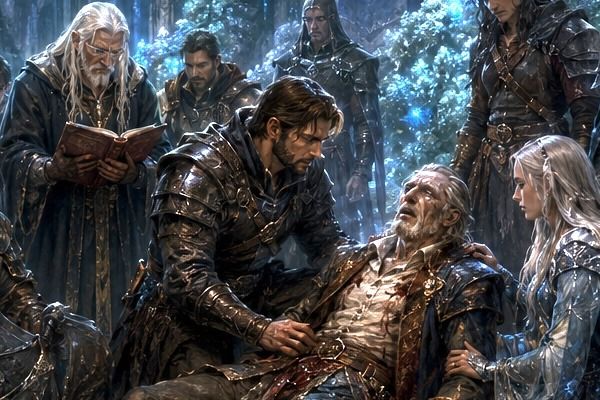
The last breath of Lassifor Nightpitch
Book I · Chapter IV
The Road to the Cradle of Enlightenment
9 min read
Collected and arranged by Magister Halvyr Terenius, Last
Archivist of Yndaros
“The measure of a company is not taken upon the
battlefield. Battles are brief. Journeys reveal character.”
If the Halls of a Thousand Tears represented the last refuge of the
old world, then the road to Ambal Seba belonged wholly to the new.
No map could be trusted there. No ranger, however experienced, could
promise safe passage. The forest itself had become uncertain, its
ancient rhythms broken by the awakening beneath Symbar. Rivers had
shifted. Hills had split. Marshes breathed poison. Creatures that had
hunted one another since before mankind first crossed the Titans now
fled side by side from things greater than either predator or prey.
Yet the Company departed.
They carried Nightpitch’s translation key, the warning of Esmerelda’s
return, arms wrought in forgotten forges, and a burden of knowledge that
belonged to no one else.
Teara-Téana opened for them one of the last remaining portals from
the Halls.
Then the sanctuary closed behind them.
Ahead lay six days of awakened Davokar and, beyond them, the drowned
city that had once defied the Crown of Thorns.
Or so they hoped.
The Poisoned Lowlands
The first day carried them into marshland unlike any described in the
older ranger journals.
The pools were shallow but endless. Black water gathered around
drowned roots, while clouds of insects hovered over every stagnant
hollow. Sweet flowers bloomed in impossible abundance, filling the air
with an almost pleasant fragrance.
That sweetness proved the first warning.
The second came when birds began falling from the trees.
One landed beside Lord Zik with scarcely a splash.
A second struck Sir Roger’s shield.
A third fell almost at Count Fausti’s feet.
Thereafter, they ceased counting.
The Company gathered upon the least-flooded rise they could find
while the poison thickened invisibly around them. The surviving record
of what followed is preserved in several later compilations under the
title The Council in the Marsh.
Count Fausti asked simply:
“Suggestions?”
Lord Zik answered first.
He proposed summoning Akra, the demon bound to his
infernal ring, reasoning that whatever poison lingered close to the
ground would trouble a creature climbing above the canopy less than it
troubled mortal lungs. If birds still lived somewhere in the trees, Akra
need only discover where they roosted and guide the Company toward
cleaner air.
It was, by every practical measure, an excellent suggestion.
Master Qualis DalHonee immediately responded with an extended
discourse concerning the origins of sorcery, the classification of
infernal beings, the contractual ambiguities of demonic service, and the
many historical disasters caused by men who believed themselves clever
enough to command entities from beyond the ordered world.
The lecture continued while the air grew sweeter.
It continued while Grommock developed a headache.
It continued while several members of the Company began to cough.
Sir Grommock eventually interrupted.
According to every surviving witness, the ogre observed that if they
remained much longer in the poisonous marsh, he intended to beat Master
DalHonee to death before the fumes accomplished the same result.
The discussion concluded shortly thereafter.
Count Fausti approved Lord Zik’s proposal.
Akra was summoned.
The demon arrived with visible displeasure. He was said to have
complained that mortals who insisted upon walking into poisonous
wetlands ought at least possess the foresight to construct roads through
them. Nevertheless, he climbed the tallest of the blackened trees and
moved from crown to crown until he found those places where birds still
perched and living insects still clung to the leaves.
From above, he called out a winding path through the poison.
The Company followed.
Master DalHonee then spent the remainder of the crossing delivering
what later became known among his companions as The Marsh
Lecture: a detailed warning to his apprentice Selviticus concerning
the treachery, malice, corrupting influence, metaphysical instability,
and general foulness of demons as a breed.
This instruction continued uninterrupted while the Company was being
guided to safety by a demon.
Selviticus reportedly endured the lesson with admirable patience.
Akra reportedly listened as well.
The historian declines to speculate whether he found it
educational.
By evening they reached higher ground.
Their first camp lay upon a root-covered rise above the poisoned
basin. Fires were lit, wet boots were removed, and what little clean
water remained was rationed.
No birds sang after dusk.
No insects gathered around the fire.
Yet the night was not quiet.
Something heavy moved through the swamp below. Branches cracked.
Water heaved against unseen bodies. Once, a coughing roar rolled between
the trees, deep enough to shake droplets from the leaves.
Weapons were drawn.
The thing did not come closer.
At dawn, Halbarad and Hador found tracks in the mud.
More than one kind.
A great cat had approached from the west. Something heavier, perhaps
scaled, had come from the south. There were claw marks along one root
where a third creature had stopped scarcely thirty paces from the
camp.
All had advanced toward the Company.
All had turned away.
At the time, this was judged fortunate.
It was not yet understood.
The Spider’s Toll
The following morning, the marsh gave way to dense fog.
Visibility narrowed to little more than a score of paces. Sound
wandered strangely beneath the trees. Grommock’s footsteps seemed to
come from behind the column. The creak of Garridan’s armor echoed
somewhere ahead. Several members of the Company heard Count Fausti
speaking softly through the mist, though he had uttered no word.
Halbarad of House Melion and Hador Grimaldson guided the expedition
by touch, broken branches, and lengths of cord tied between the
marchers.
It was Lord Zik who first noticed the web.
Not one web.
Thousands.
Silken strands stretched between the trees, hidden until droplets
formed upon them. Some were fine as thread. Others were thick as
bowstring. Great cables vanished into the canopy, where enormous shapes
shifted almost invisibly among the branches.
The Company had entered the hunting ground of blight-born
spiders.
Yet no attack came.
The spiders were waiting.
Zik, Halbarad, and Hador worked together to trace the pattern of the
web. The hunters identified strands disturbed by wind and those
stretched as alarms. Zik found the spaces between the radial lines and
led the others through one at a time.
Even Grommock was forced to move slowly.
Near the far edge of the webbed ground, one of the great spiders
descended before Zik.
Its body was vast, its limbs jointed at impossible angles, its eyes
reflecting the pale fog in dull, clustered points. Yet it did not spring
upon him.
It spoke.
The spiders hated practitioners of magic.
The Company might pass safely if they surrendered a measure of blood
from one such individual.
The bargain produced remarkably little debate.
Lord Zik volunteered Father Kaelen.
The priest accepted the decision with more grace than some later
commentators believed it deserved.
The spider pierced his flesh and took only a little blood. Yet when
it withdrew, Kaelen staggered. Something in the venom, the ritual, or
the creature’s hatred had reached deeper than the wound.
Those with the sight later judged that the priest had suffered a
permanent stain of corruption.
The spiders withdrew.
The web opened.
The Company passed.
Some later condemned Zik’s decision. Others observed that fifteen
living travelers are often preferable to fifteen principled corpses.
History has rarely offered cleaner choices.
That night the Company again heard creatures approaching.
A pack of hunger wolves circled at the limits of the firelight. Their
eyes gleamed between the trunks, but they did not close.
Something immense moved along a ridge to the north. Its silhouette
appeared briefly against the clouded sky and then vanished.
Before dawn, Grommock woke to find a single vast footprint pressed
into the damp earth beyond the camp.
The creature that had made it had stood there for some time.
Then it had gone another way.
The Pyramid
By the third day, the land itself had changed.
The forest rose and fell in broken ridges where earthquakes had torn
the ancient ground apart. Trees stood pale and dying. Leaves crumbled
into gray powder beneath armored boots. The undergrowth had withered
into stiff stalks that cut at exposed skin.
Near midday, Halbarad saw an extraordinary procession moving through
a distant valley.
Deer.
Jakaars.
Darklings.
Predators and prey alike.
None hunted.
All moved south.
They were fleeing something to the north.
Shortly afterward, three arachs appeared upon a ridge.
Unlike nearly every tale told of their kind, they approached unarmed
and with raised hands.
Through halting troll tongue, they begged the Company for aid.
Winged blood monsters, they explained, had seized the upper chambers
of an ancient pyramid. Their kin remained trapped beneath sealed stone
doors while the beasts attempted to break through. If the monsters were
slain, the arachs would reward the Company with an artifact said to
protect against the darkness of the forest.
The Company debated.
Count Fausti distrusted the offer immediately.
Time was short. Ambal Seba lay ahead. Strangers encountered in the
depths of awakened Davokar did not often offer priceless artifacts
without hidden purpose.
Lord Zik disagreed.
An artifact capable of protecting its bearer from corruption might
determine whether the Company survived what awaited them. To pass such
an opportunity, he argued, would be timidity disguised as prudence.
His argument prevailed.
Whether through courage, greed, calculation, or some mingling of all
three, the Company accepted.
The pyramid proved every bit as terrible as described.
Most of the black structure remained buried beneath collapsed earth
and roots. Within, two immense winged blight beasts stalked among the
bodies of slaughtered arachs. Their hides resembled stone. Their jaws
were made for drinking blood. Small, malformed wings allowed them to
leap and glide through the upper chambers with dreadful speed.
They battered at sealed doors beneath which the surviving arachs
waited.
The battle that followed was among the fiercest of the
expedition.
At first, the Company faltered.
Weapons skidded across stony flesh. The beasts moved through the
broken galleries faster than creatures of their bulk had any right to
move. One came down upon the Company like a falling tower, tearing Sir
Elgai apart with a single stroke. The other tore through Delio, nearly
taking him down.
For a time, the pyramid belonged to the monsters.
Then Halbarad and Hador found the measure of them.
They climbed to broken elevations, watched the rhythm of the
creatures’ movements, and began loosing arrows not at the broad plates
of hide but at joints, eyes, mouths, and the softer places beneath the
wings.
Their volleys slowed the beasts.
Then they began to break them.
Sir Grommock and Radko held one, standing over the dying body of Sir
Elgai, enduring blows that would have crushed a lesser warrior. Halbard
saved Delio with a flurry of arrows. DalHonee and Selviticus and
Brizznagg all flung spells into the battlefield.
At last, the second blood monster fell under a storm of arrows from
Hador.
Silence returned to the pyramid.
The Company spoke then not of glory, but of practical matters.
Wounds required binding.
Potions required uncorking.
Armor required straightening.
Father Odran moved among the injured while Master DalHonee examined
fragments of ancient writing exposed beneath the shattered floor.
Outside, the forest remained unnaturally still.
No scavengers approached the blood.
No carrion birds descended upon the dead.
Creatures that would ordinarily have gathered at such a feast kept
their distance.
The pattern had become too consistent to dismiss.
At first, the Company had believed the beasts of Davokar were
avoiding the corruption, the pyramid, or the winged monsters.
But those creatures were dead.
Still, nothing came.
The oldest law of the forest is simple.
Predators do not waste themselves upon stronger predators.
By the third day, even the beasts of awakened Davokar had begun to
understand what the Company themselves had not.
The most dangerous thing walking beneath the boughs was no longer
hunting them.
It was them.
It was Lord Zik who finally broke the silence.
“Where did those spiders go?”
He looked toward the entrances, then toward the sealed passages
below.
“We want our reward.”
Several witnesses record that Sir Grommock nodded in wholehearted
agreement.
The words had scarcely left the goblin’s mouth when movement stirred
above them.
The three arachs had waiting patiently outside, watched by Lord
Garridan. Now, they approached the Baron.
Inside, the party was no longer alone.
From hidden passages beneath the pyramid came many more of their
kind, poison glistening on their fangs.
The Company had slaughtered the winged beasts.
They had bled.
They had spent their strength.
And now the arachs believed the stronger predator weakened enough to
kill.
One of the Exalted is said to have spoken only a single sentence:
“The great ones leave no reward for the small.”
Thus ended the third day upon the road to Ambal Seba.
The final account preserved from that evening breaks off
abruptly.
Its last notation consists of seven words:
The spiders came from every direction.
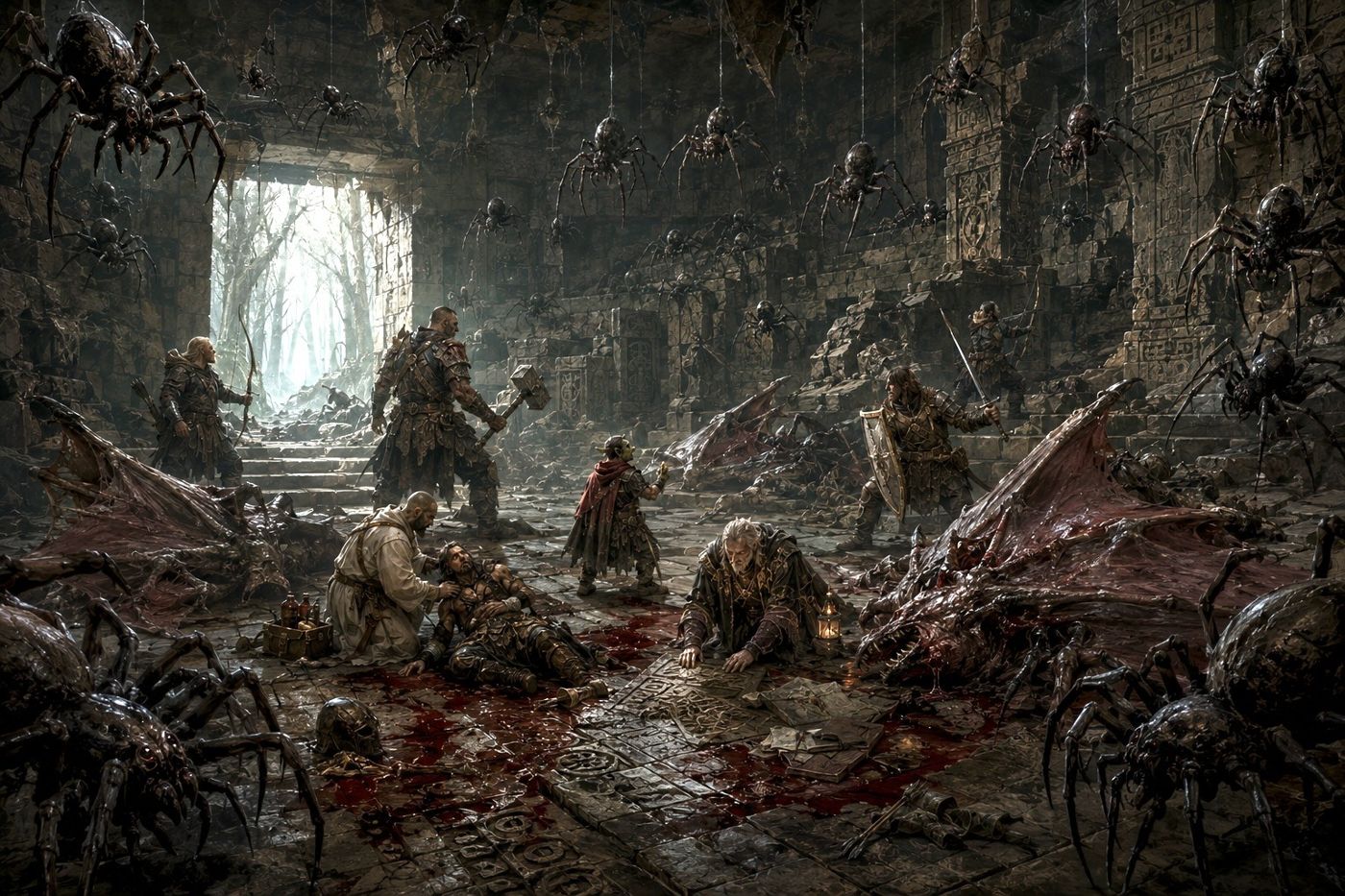
Ambush at the pyramid
Book I · Chapter V
The Drowned Valley
14 min read
Collected and arranged by Magister Halvyr Terenius, Last
Archivist of Yndaros
“There comes a point upon every great journey when the traveler
ceases to ask whether he will reach his destination, and begins instead
to wonder what will remain of him when he does.”
The arachs had chosen their moment well. The Company had only just
finished the hard business of killing the winged blood monsters in the
upper chambers of the buried pyramid, and the place still reeked of
dust, brimstone, old stone, and corrupted blood. One of the beasts lay
collapsed across a shattered gallery, its heavy body twisted over broken
masonry; the other had died near the central shaft, its small wings
crushed beneath a frame far too massive ever to have truly flown. Men
were wounded, mystical powers had been spent, armor was dented, and
everyone had begun the familiar work of surviving victory.
Lord Zik, naturally, had already turned his thoughts toward
payment.
He had just begun asking where the arachs had gone and when they
might expect the promised artifact when the answer came all at once.
Spiders descended from the ceiling, spilled from cracks in the walls,
and emerged from passages the Company had not known existed. The three
arachs who had begged for aid were no longer alone. They had waited for
the greater monsters to die, waited for the Company to bleed, and then
judged the moment favorable.
It was, by their reckoning, an excellent plan.
They had merely misjudged what they were attacking.
Master Qualis DalHonee reacted first. Whatever else might be said of
the wizard—and later generations would say a great deal—his mind had
long since learned to function cleanly in catastrophe. He struck the
attackers with Confusion before the ambush could properly close,
breaking their coordination and turning a carefully prepared assault
into a mass of uncertain movement. Then, as Selviticus later described
it, a “substantial piece of masonry” tore itself free from the pyramid
and flew through the air under DalHonee’s will.
Lord Zik later insisted that it was half a wall.
Sir Grommock maintained that, had it truly been half a wall, DalHonee
would undoubtedly have paused to explain its architectural significance
before throwing it.
Whatever its actual dimensions, the stone struck one arach with
sufficient force to end the scholarly dispute.
Selviticus answered with fire. Brimstone cascaded through the
chamber, casting sulfurous light across the old carvings and sending
spiders shrieking back from the flames. Radko Gorst, Sir Grommock, and
Sir Elgai surged forward together to form the sort of defensive line
peculiar to that Company: a dwarf who enjoyed violence, an ogre who
excelled at it, and a young knight too honorable to retreat. Behind
them, Halbarad and Hador worked with the disciplined rhythm of veteran
archers, choosing eyes, joints, and exposed limbs rather than wasting
arrows into the general confusion.
Inside the pyramid, the ambush began to fail almost immediately.
Outside, it failed more dramatically.
One of the Exalted arachs fell upon Sir Roger of Palmyra and died
beneath a single crushing blow before it had time to discover whether
the young champion was as dangerous as he looked. The second found
better fortune. It struck Lord Garridan of Loramor and drove its venom
deep. The Baron staggered, and for a moment the long years of battle
seemed to leave him all at once. His limbs weakened, his sight blurred,
and the spider closed to finish what its poison had begun.
Brother Odran intervened.
The old priest called upon the Guardian, and sacred light washed over
Garridan. It did not simply erase the venom, but it restored enough of
the man beneath it for the Baron to rise, gather himself, and answer the
creature that had nearly killed him. The arach did not survive that
answer.
With both Exalted leaders dead and the ambush collapsing in
confusion, the remaining spiders lost their appetite for treachery. They
fled into cracks, tunnels, and narrow passages beneath the ancient stone
where even Grommock could not easily follow. The Company, displaying an
unusual burst of wisdom, did not pursue them far.
Lord Zik watched the last of them vanish.
“I’ll never trust a spider again,” he muttered.
History provides no evidence that he ever did.
The Midnightlands
The next day, the forest changed again. The trees grew taller and
closer, their leaves nearly black above and violet beneath, and the
sunlight that reached the ground seemed weak and gray, as if reluctant
to enter. Before long the Company crossed the unmistakable trail of
Garavarax: a straight corridor of destruction driven through the forest
without regard for slope, ruin, or ancient tree. Buried masonry had been
crushed open beneath his feet, roots torn from the earth, and one
footprint was broad enough for several men to lie within it.
Halbarad and Hador judged that the giant had passed east some weeks
earlier. Brizznag, reading the place in another fashion, sensed
something stranger in the trail.
Not hunger.
Grief.
Beyond that scar lay the place later called the Shadowlands or, in
some accounts, the Midnightlands. The name matters less than the
experience. There, darkness did not descend from the sky. It rose from
the earth. Dense strands of shadow seeped upward from hollows and
ravines like black smoke, gathered beneath the canopy, and spread until
even the middle of the day resembled midnight. Torches burned poorly.
Shadows moved without obedience to the bodies that cast them. Voices
called from among the trees, some belonging to living companions and
some to the dead.
DalHonee understood the danger quickly, and for once he did not
precede action with a lecture. He took command. Brother Odran gathered
the Company tightly beneath the Guardian’s Mantle, while Brizznag opened
her Witchsight and searched for the path on which the world remained
most firmly itself. They moved close together, no one straying toward
the voices or the shapes that appeared between the trees. The Company
walked until their legs ached, then until they ceased noticing the ache,
and then through the night.
What Brizznag saw during that passage she never fully recorded.
Perhaps she saw spirits. Perhaps she saw memories. Perhaps she saw paths
leading into places from which no mortal should return. Whatever the
truth, she kept moving, DalHonee held the Company to order, and Odran
kept the darkness from closing over them.
At last, pale morning appeared ahead.
They crossed an invisible boundary, and the world regained its
edges.
Trees became trees again. Shadows obeyed the light. The dead ceased
calling.
Every member of the Company emerged.
Tired, shaken, but whole.
Some victories earn statues. Others consist simply of counting heads
at dawn and finding no one missing.
The Breaking Earth
By the following day, the flood from Ambal Seba had remade the land
around them. Marsh had spread through country that had once been dry
forest, new streams cut across old paths, and water gathered around
roots and through fissures opened by earthquake. The ground itself
seemed exhausted. Every few hours it trembled. Stones shifted without
warning. Trees leaned where they had stood straight for centuries, and
from somewhere far below came long grinding sounds like immense
millstones turning beneath the world.
Then the land broke beneath them.
The earthquake struck while the Company was crossing unstable,
waterlogged ground. Cracks opened. Mud collapsed into hidden cavities.
Roots snapped. Whole shelves of earth shifted downward. In the histories
of great campaigns, commanders always act decisively at such moments,
issuing clear orders while subordinates obey with admirable
precision.
Reality is less obliging.
Lord Garridan, still worn from spider venom and the preceding days,
became disoriented in the chaos. One command contradicted another. One
group moved when it should have stopped, another stopped when it should
have moved, and soon the Company that had defeated demons, undead,
corrupted giants, and arach assassins found itself thoroughly outmatched
by mud, gravity, and poor communication.
Someone fell. Someone else attempted a rescue from the wrong side.
Ropes tangled. Men collided. Boots disappeared into mud. Equipment was
dropped, recovered, and dropped again. At one point, several of the
Company’s most celebrated heroes appeared less like figures from
prophecy and more like fifteen exhausted travelers losing an argument
with the ground.
They survived, but without dignity.
By the time the earth settled, nearly everyone carried some evidence
of the day: sprains, bruises, cuts, swollen joints, dented armor, and
mud in places where mud had no proper business being.
The surviving record describes the affair in only three words:
A bad day.
The historian sees no reason to improve upon the phrase.
Late that afternoon they reached the swollen Doudram and found
something that should not have existed: a new tributary pouring into it
from the northeast, its banks raw cuts through earth and root. The
current carried debris from Ambal Seba—broken timbers, carved stone,
fragments of blue ceramic, pieces of statuary, and the scattered remains
of a city buried beneath water for nearly fifteen centuries. The road
ahead was now a river no map had ever recorded.
The Company turned upstream.
The Rage of the New River
The final day began cold. As the Company followed the tributary
toward its source, the banks revealed more and more fragments of the
drowned city: white stone carved with flowing patterns, green copper
fittings, blue-and-white tiles, old hinges, serene masks, and pale
flowers growing in suspiciously straight rows where submerged gardens
had once lain. The nearer they came to Ambal Seba, the more the
landscape seemed to shed layers of earth and expose an earlier world
beneath.
The air grew colder as they climbed. Wind poured down the new
channel, frost formed on armor and straps, and tempers shortened.
Then the arguing began.
At first it was ordinary enough: someone walked too slowly, someone
else had packed too much, one priest questioned another’s judgment, a
knight objected to taking direction from a goblin, and an old decision
was reopened for criticism. Then the tone changed. Every correction
sounded like insult. Every disagreement became accusation. Old
resentments surfaced, and the Company began saying things they had
previously possessed the wisdom—or affection—not to say.
The malignant force in that place did not invent grievances.
That would have been simpler.
It merely stripped away restraint.
This made it much more dangerous.
Voices rose. Loyalties were questioned. Hands moved toward weapons.
Sir Elgai, perhaps because he was the newest among them and therefore
least entangled in the old resentments being magnified, understood what
was happening before the others did.
Reason would not work.
So he struck several of his companions and ran.
The historical record does not preserve precisely whom he struck, nor
in what order. This omission may have been intentional.
What followed was among the stranger tactical maneuvers ever
attributed to a knight of House Ardagel: Sir Elgai fleeing at speed
through wet forest while a portion of the enraged Company pursued him
with every intention of explaining, forcefully, why striking them had
been a mistake. He crossed broken stone, roots, mud, and shallow water
until the pressure in his own mind lifted.
Then he stopped.
The others caught him.
And the anger faded.
Not entirely. Magic cannot be blamed for everything. But enough.
Elgai explained what he had realized: the place itself had been
feeding their resentments and sharpening them into hostility. Weapons
were lowered. Apologies followed, some sincere, some dutiful, and some
merely postponed.
Lord Garridan remained quiet longer than most.
Then he muttered, “Sometimes the real truth is revealed in
anger.”
No one answered him.
Certain statements are too uncomfortable to dispute.
The Flight from Ambal Seba
As they continued upstream, the Company encountered a procession
moving in the opposite direction: hundreds of creatures, predator and
prey together, all heading south. Deer moved beside jakaars. Foxes
passed near larger hunting beasts without fear. Darklings, goblins,
hunger wolves, small spirits, and stranger things all traveled in the
same direction.
They were fleeing Ambal Seba.
The procession divided around the armed Company. Smaller creatures
avoided their eyes. Larger predators watched them, judged them, and
stepped aside.
By then, this was no longer entirely surprising.
For days, creatures had approached the Company’s camps in darkness
only to stop beyond the firelight and turn away. Davokar had learned
them. Somewhere along the road, without ceremony or proclamation, the
Company had crossed a threshold.
They were no longer merely travelers passing through the forest.
They had become one of the dangerous things within it.
An ancient jakaar stopped before Halbarad and stared north toward the
valley. Brizznag listened in the fashion of witches and later gave its
meaning simply: the stone-walker mourned; the dead city had opened;
small beings were digging where deeper things slept; and the Company was
walking toward it.
Why?
No account preserves their answer.
Perhaps there was no good one.
Ambal Seba
The sound of the new river became thunder as they approached the
valley. Ahead, the great wall that had once sealed Ambal Seba had been
broken open, split downward as if struck by some colossal axe. Through
that wound rushed the water that had imprisoned the valley for nearly
fifteen centuries.
Garavarax had done what scholars, armies, and treasure hunters could
not.
He had opened history.
The Company climbed beside the raging outflow, soaked by spray and
deafened by the waterfall, until at last they reached the ridge and the
land fell away before them.
Ambal Seba lay below.
For generations, many scholars had dismissed the city as myth or
confused tradition. Lassifor Nightpitch had not. He had believed the
valley drowned rather than destroyed, and he had been right.
The basin stretched away beneath gray morning light, roughly two
leagues in length, enclosed by steep walls and mountain slopes. Much of
the old lake had drained, leaving behind a vast expanse of black mud,
standing water, exposed stone, and ancient ruins newly returned to the
sky. A central stream cut through the floor toward the breach in the
wall. Roofs sagged under the weight of centuries. Seaweed hung from
balconies. Algae stained old facades green and brown. Here and there,
intact upper stories rose from the sludge like islands in a dead
sea.
The smell reached even the ridge: wet stone, rotting lake growth, old
mud, and the mineral scent of earth that had not breathed open air since
before Symbar’s rise.
The Company did not descend immediately.
They watched.
They studied.
And slowly, the drowned city began to resolve itself into districts
and landmarks.
To the lower reaches of the valley lay the Agricultural
Cluster, where old terraces, channels, and orderly patterns in
the exposed ground hinted at a civilization that had tried to master
water, soil, and cultivation with the same rigor later peoples applied
to war. Nearby, half-buried streets and separated compounds marked the
City of Strangers, a quarter once built for
ambassadors, envoys, and representatives of distant powers, its
residences standing among enclosed gardens now reduced to mud and broken
walls.
At its center rose the Keep, a massive cylindrical
work of rough granite, severe even at a distance, with its upper stories
still standing clear above the silt. Nearby stood the remains of the
Pavilion, a broad circle of pillars surrounding a
taller central column, its blackened iron fittings and old chains
hinting at some purpose not easily understood from afar.
Beyond these rose the stepped form of the Ziggurat,
its lower levels still half-swallowed by mud while higher entrances
opened darkly into the ruin. On the southeastern slope stood the remains
of the old Academy, its roofless pale buildings once
devoted, according to later translations, to philosophy, history,
natural science, and the systematic study of civilization itself.
Near the heart of the valley lay the circular form of the
Rotunda, broad and strange, like a stone wheel pressed
into the lakebed. Not far from it stood the broken tower later called
the Heart, visibly damaged and already disturbed by
those who had entered the valley before them.
Farther toward the center, stranger structures rose from the ruins.
The Crystal caught the weak light and returned it in
unnatural glints. The Azure Palace, ancient seat of
Cidriana, stood amid the mud with the wounded dignity of something that
had expected never to see the sky again. At the northern end of the
valley, below the steep cliff, rose the Colonnade
Temple, its surviving roof supported by mottled marble pillars
that still stood after centuries underwater.
This was not merely a ruin.
It was a civilization interrupted.
And others had reached it first.
Metal flashed around the Keep and Pavilion—helmets, armor, tools,
ordered movement. The Company judged these to be the Queen’s advanced
party, likely Rangers and retainers sent ahead once Korinthia learned
that Ambal Seba had emerged.
Elsewhere, near the Heart and Rotunda, movement suggested another
force at work.
Esmerelda.
Nightpitch had warned them she lived. Now her people were already
searching the city.
Queen and Duchess had entered the race before the Company had even
reached the valley floor.
Then something enormous moved in the southern part of the ruins.
At first it resembled a collapsing structure.
Then it stood upright.
Garavarax lumbered through the mud, each step dragging at the exposed
lakebed. Even from the ridge, his frustration was unmistakable. He
stopped, threw back his head, and roared across the valley. Then,
apparently enraged by nothing more complicated than the existence of a
nearby building, he began demolishing it.
Stone burst outward.
A wall collapsed.
The giant tore at the ruin as though searching for something lost
beneath it.
The Company watched in silence.
Then Lord Zik looked upward.
High above the valley, a woman circled on bat-like wings.
Zik recognized her.
Helionore.
The Witch Queen of the Beast Clan.
There was a long pause.
Whatever else might be said of Duchess Esmerelda, she had not spent
her resurrection idle.
She had found allies.
Questionable ones.
Powerful ones.
Below the ridge lay the Cradle of Enlightenment, a city older than
Symbar and one that had once stood against the rising Crown of Thorns.
Somewhere within those drowned halls might lie the knowledge the Company
had crossed awakened Davokar to find: a defense against corruption, a
weapon against it, perhaps even an understanding of the darkness deep
enough to survive the road ahead.
But they were no longer alone in seeking it.
The Queen had come.
Esmerelda had come.
The Beast Clan had come.
Garavarax walked among the ruins.
And beneath the mud of Ambal Seba lay things that had slept longer
than Ambria had existed.
Behind the Company lay six days of awakened forest, and the beasts of
Davokar had learned to give them room.
Ahead, nothing appeared inclined to do the same.
And so the Company of Count Delio Fausti stood upon the ridge above
the drowned valley, bruised, poisoned, exhausted, and still moving
forward.
They had found Ambal Seba.
Now they had to decide what to disturb first.
Ambal Seba
Book II · Chapter I
A Hearth Among the Dead
19 min read
Collected and arranged by Magister Halvyr Terenius, Last
Archivist of Yndaros
“The histories of ruined cities concern themselves with the fall
of walls, the death of kings, and the extinguishing of nations. They say
less about the first fire lit among the ruins afterward.
This is an error. A hearth is also a declaration of
conquest.”
The first day of the Company’s descent into Ambal Seba began before
dawn, in the last camp they would make beneath the trees of Awakened
Davokar.
There had been no miracle in the night. Their wounds remained. The
lingering effects of poison, exhaustion, and corruption had not vanished
merely because their destination lay beyond the ridge. Their packs were
almost empty, their armor battered, and their supplies reduced to the
sort of careful inventory in which every strip of dried meat and every
unbroken arrow received serious consideration. Yet those who awoke in
the darkness felt something that had been absent during the worst days
of the journey.
Purpose.
For six days they had struggled eastward through a forest transformed
by powers older than memory. They had endured poisoned marshes, arach
treachery, unnatural darkness, breaking earth, malignant spirits, and
the ceaseless pressure of a wilderness that seemed to be waking from a
long and troubled sleep. Now the Cradle of Enlightenment lay beyond the
mountains above them. Whatever waited there, the Company had at least
reached the place toward which Lassifor Nightpitch’s final purpose had
driven them.
They ate a meager breakfast in the predawn gloom, extinguished their
fires, and broke camp. Then, with the new river roaring somewhere beyond
the trees, they began to climb.
The ascent was arduous. The mountains guarding Ambal Seba had never
offered an easy passage, and Garavarax’s fury had made them more
treacherous still. The Company climbed over shattered ledges and slopes
stripped raw by the flood, with the waterfall thundering to their left
in the north. It was a magnificent and terrible sight: the imprisoned
waters of Deepwater Lake pouring through the wound the giant had smashed
in the mountainside, gathering speed between walls of broken stone, then
plunging into the forest below in a white torrent of spray and mist. No
map showed the cataract. No traveler before the Awakening had ever stood
beside it. Garavarax had not merely opened Ambal Seba.
He had redrawn the land.
Yet as the Company climbed, another change gradually became apparent.
The forest around them was no longer sick.
The transition was subtle at first. Leaves lost their oily darkness.
Moss grew green rather than gray. The black-veined plants of Awakened
Davokar gave way to ferns, berry bushes, flowering groundcover, and
healthy trees filled with birdsong. Rabbits moved through the
undergrowth. Deer tracks crossed the slopes. Once, Halbarad stopped
beneath an oak and listened for some time simply because the calls above
him belonged to ordinary birds behaving as ordinary birds should.
No whispering shadows moved against the light. No corrupted predator
watched from behind a twisted trunk. No invisible malice pressed against
the mind.
The mountain forest was merely alive.
After the lands through which they had passed, this seemed almost
supernatural.
By the time they reached the crest, morning had broken over the
Ravens. Light spilled across the ridge and revealed Ambal Seba below
them: the long valley floor covered in drying black sludge, stagnant
pools, newly exposed roads, and five great clusters of ruins. The
central stream wound southwest toward the breach in the mountains.
Buildings rose from the old lakebed stained with algae and draped in
dying weeds. Walls that had not felt sunlight for nearly fifteen
centuries stood beneath the open sky, while the weak morning light
gleamed upon the Crystal, the Azure Palace, and the distant roof of the
Colonnade Temple.
Nearer at hand lay the southwestern cluster, where the farmers and
herders of ancient Ambal Seba had once lived. Most of its buildings were
small, closely spaced structures of waterlogged wood, many roofless and
sinking into the mud. Among them, however, stood a single stone
farmhouse on slightly higher ground. Its roof appeared largely intact.
Its walls were thick, its windows narrow, and a line of old trees
sheltered it from the worst of the wind blowing across the drained
lakebed.
Count Delio Fausti studied it for some time before reaching his
decision. If the Company intended to explore Ambal Seba, it would
require more than a camp. It needed shelter, defensible ground, stores,
a place for the wounded to recover, and somewhere to which its scattered
parties could return.
The farmhouse would serve.
But first, they would carry abundance into the valley.
Candles and Arrows
Count Delio ordered the Company to prepare for the descent and asked
what supplies would be needed. This produced several practical
suggestions regarding food, medicine, firewood, replacement shafts, lamp
oil, and dry cloth.
Then Master Qualis DalHonee began to answer.
The wizard spoke at some length about the particular difficulties of
illuminating submerged ruins, the scholarly necessity of preserving
written records, the predictable inadequacy of weapons manufactured
under expeditionary conditions, and the folly of entering an ancient
city without a suitable reserve of both candles and arrows. His response
was still gathering momentum when Delio interrupted him.
“Then look for a candle-and-arrow tree.”
The Company laughed.
DalHonee did not.
He gave the Count a long, wounded look, harrumphed with considerable
dignity, and withdrew to the shade of a large tree. There he seated
himself against the trunk, opened Nightpitch’s book, selected one of the
ancient cylinders, and resumed his translations with the determined air
of a man who wished history to record that he had been surrounded by
idiots.
Around him, the rest of the Company went to work.
Radko Gorst unfolded his portable smithing kit and established a
small forge on a shelf of bare stone. Soon the ring of his hammer
sounded across the ridge as he straightened bent blades, closed split
links, replaced buckles, and restored dented armor to something
approaching usefulness. Halbarad and Hador disappeared into the forest
in search of large game, while Lord Zik slipped away alone after rabbits
and birds. The Company’s alchemists spread across the slope, gathering
medicinal herbs, edible roots, nuts, berries, and mushrooms. Those whose
talents were less delicate hauled deadfall, split wood, and bound it
into loads that could be carried into the valley.
The healthy forest rewarded every effort. The creatures driven from
Awakened Davokar had gathered in these mountains in extraordinary
numbers, turning the sheltered slopes into a refuge crowded with life.
Halbarad and Hador returned with enough meat to restore confidence to
even the hungriest members of the Company. Zik brought back a remarkable
collection of rabbits and game birds, though he declined to explain how
many snares he had set or where. Baskets and cloaks were filled with
edible plants. Useful herbs grew in such profusion that the alchemists
became selective.
By midday, weapons had been repaired, meat dressed, provisions
divided, and firewood bundled. The Company that had crawled out of
Awakened Davokar nearly empty-handed now stood ready to descend with
fresh food, medicine, fuel, and the beginnings of a proper supply
store.
No candle-and-arrow tree had been found.
DalHonee regarded this as a failure of leadership.
The Descent
The path down into Ambal Seba crossed slopes choked with wet roots
and shattered masonry before reaching the crust of the old lakebed. From
above, the mud had appeared firm and almost smooth. Underfoot it proved
treacherous, cracking in some places and sagging in others. Water rose
through footprints. The stronger members tested the way ahead with spear
shafts and broken branches while those carrying the heaviest loads
followed in their steps.
As the Company descended, they passed signs of a world only recently
uncovered. A paved road could be seen beneath a shallow pool, its white
stones still laid in a careful pattern. A freestanding bronze door stood
among a cluster of young trees, all traces of the building around it
long since gone. Pale flowers grew in ordered rows where an ancient
garden had somehow survived beneath the waters or returned to life after
their passing. Everywhere lay broken tiles, pieces of carved stone,
green copper fittings, and fragments of ordinary lives interrupted by
catastrophe.
Then Garavarax rose from the ruins.
At first the Company saw only movement in the mud near the southern
reaches of the City of Strangers. What appeared to be a collapsed tower
shifted, lifted, and revealed itself to be held in the giant’s hands.
Garavarax stood knee-deep in the sludge, water and black mud streaming
from his body. The broken structure looked almost small in his
grasp.
He turned toward the mountains.
For a moment his rage left him, and something older appeared upon his
enormous face: grief, bewilderment, perhaps even recognition. When he
spoke, the single word rolled across the valley like distant
thunder.
“Cidriana.”
Then whatever memory had touched him was gone. Garavarax cast the
broken tower aside. It struck the ground with a concussion that shook
mud from nearby walls and sent birds rising from the mountain forest
behind the Company. The giant roared and resumed tearing through the
ruins, searching with the impatience of a creature unable to distinguish
excavation from destruction.
The Company watched until it was clear that his attention lay
elsewhere.
Then they continued toward the farmhouse.
The First House
The stone building had survived better than anything around it, but
survival was not the same as welcome. Its lower rooms were filled with
the damp residue of the old lake. Mud lay thick across the floors. The
hearth was blocked with silt and the nests of small creatures. Several
shutters had rotted from their hinges, one section of roof leaked, and
every surface smelled of wet stone, lake growth, and long
confinement.
The Company entered cautiously, searching first for inhabitants,
hidden dangers, and signs that the structure might collapse around them.
Finding none, they began the harder work of turning a ruin into a
refuge.
Mud was shoveled, scraped, and carried outside in baskets. The hearth
was opened and its chimney cleared. Radko repaired hinges, fitted braces
to the doors, and fashioned bars for the windows. Grommock and the other
strong members shifted fallen beams, hauled stone, and cleared the yard.
Sleeping places were raised above the damp floor. Food was hung or
stacked where rats and moisture could not easily reach it. A room with
the driest walls became the infirmary; another was claimed for stores
and alchemical work. Drainage channels were cut around the house,
firewood piled beneath cover, and lines of retreat marked through the
surrounding ruins.
By late afternoon, smoke rose from the chimney.
That changed everything.
A ruin may possess walls, rooms, and a roof. Smoke declares that
someone intends to remain.
Brizznag then walked beyond the yard and began the Witch Circle
ritual. She moved slowly around the farmhouse, breathing new life into a
place from which life had almost entirely withdrawn. She touched the old
trees, the exposed roots, the stones surrounding the house, and the
first green shoots emerging from the drained earth. Where she passed,
the place seemed to settle around her will. The trees bent closer. Young
plants stirred. The harsh smell of the lakebed softened beneath the
scent of growing things.
When the circle was complete, the farmhouse became difficult for
unfriendly eyes to notice. Those who approached without understanding
would find themselves wandering aside, certain they had chosen their own
path. Within its boundaries, the Company possessed something rare in
Ambal Seba: a place sheltered not only by stone and steel, but by living
magic.
DalHonee contributed last.
While the others worked, he told a story from his youth, when he had
hidden beneath a merchant’s wagon for reasons he described as “both
necessary and intellectually defensible.” There, pressed between an axle
and the road while armed men searched nearby, he had discovered a
concealed compartment built into the wagon’s underside. The incident, he
explained, had taught him that people generally hid their most valuable
possessions where no sensible observer would think to look.
Sir Elgai listened carefully.
The others suspected this was merely DalHonee’s excuse for avoiding
heavy labor.
Nevertheless, the wizard began examining the farmhouse in unlikely
places: beneath shelves, behind stones, inside the chimney breast, and
above a beam concealed by the angle of the roof. There, in a narrow
recess protected from the worst of the water, he found a wind chime.
Eight leaves of colored glass hung from silver chains beneath a copper
sun, their colors passing from pale spring green through summer yellow
to the brown-red of autumn.
DalHonee cleaned it carefully and hung it near a window.
When the evening wind entered the house, the glass leaves moved and
gave off a delicate, bright music.
The farmhouse no longer sounded empty.
That night, with fresh meat roasting over the fire and the first
proper meal in many days nearly ready, the Company began telling
stories.
Halbarad spoke of being born between two peoples, Ambrian and
barbarian, and of belonging wholly to neither. He told them of the
loneliness of that divided inheritance and of the journey by which he
had sought acceptance among the tribe. He did not make the adventure
sound easier than it had been. The forest had tested him, the people had
doubted him, and every step toward belonging had required proof that
others seemed to possess simply by birth.
When he finished, someone across the fire told him, “You’re not alone
now.”
Others repeated it.
For a while Halbarad said nothing. He only looked around the room at
the knights, priests, goblins, nobles, mystics, hunters, dwarf, ogre,
and assorted survivors who had become his companions.
“No,” he finally agreed. “I suppose I’m not.”
Hador spoke next. He told them how he and his brother Ansel had been
orphaned while still young, and how the world afterward had seemed to
consist largely of uncertain roads and closed doors. Then they had found
refuge in a grove sacred to Prios. The memory of reaching that place—of
warmth, food, shelter, and adults who did not intend to send them
away—had remained with him all his life.
That grove was where Ansel discovered his calling to serve Prios. It
was also where the brothers met the young Sir Elgai and became first his
friends, then his companions and protectors. Hador looked around the
farmhouse and confessed that entering it had awakened the same feeling
he remembered from the sacred grove: the sensation that, after a long
and dangerous road, he had finally reached somewhere safe.
Brizznag’s story was less solemn, though no less revealing. She spoke
of her years learning witchcraft among the other initiates and of an
expedition into the forest in search of rare herbs. The tale involved
poor directions, a disagreement over mushrooms, an offended spirit, two
nights spent in a tree, and an initiate who insisted until the very end
that everything had proceeded according to plan. Brizznag’s imitation of
her old teacher was apparently excellent. Even DalHonee laughed, though
he tried to conceal it by drinking.
Outside, Ambal Seba lay drowned in silence. Garavarax moved somewhere
beyond the darkness. Rangers and servants of Esmerelda searched the
ruins. Ancient things slept beneath the mud.
Inside, the wind chimes stirred above the fire.
The Company feasted.
And the farmhouse felt like home.
A Day Without Blood
The first full day in Ambal Seba passed without battle, treachery,
poison, pursuit, or the opening of any tomb containing a hostile
occupant. The Company regarded this as a novelty.
They remained within the Agricultural Cluster, resting and learning
the shape of the ground around their new base. Hunters marked safe paths
across the mud. The alchemists sorted what they had gathered and began
preparing elixirs, medicines, and antidotes. Radko continued his
repairs. DalHonee studied Nightpitch’s key and the cylinders, refining
translations a character at a time. Others searched the nearby homes,
barns, pens, and workshops, recovering small curiosities left behind by
the farmers of Ambal Seba.
Most discoveries were humble: a rusted sickle, pieces of painted
pottery, stone weights, animal carvings, and tools whose purpose could
still be guessed from their shape. Yet even the simplest object carried
the strange intimacy of the place. Ambal Seba had been buried so
thoroughly that scholars had doubted it ever existed. Now the Company
held the possessions of its farmers in their hands.
The dead city was becoming particular.
Not merely a lost civilization, but a place where people had grown
food, raised animals, repaired tools, quarreled with neighbors, taught
children, and hung glass leaves in their windows to catch the wind.
By evening, wounds had begun to close, strength had returned, and the
Company’s supply shelves no longer looked bare. For the first time since
leaving the Halls of a Thousand Tears, they were not merely surviving
the road.
They were preparing for what came next.
The City of Strangers
On the following morning, the Company turned north toward the City of
Strangers.
The journey took them across cracked sheets of drying mud and between
shallow pools in which drowned streets could still be seen. The district
rose gradually before them, a broad collection of some fifty stone ruins
separated by the remains of enclosed gardens. In the days of Ambal Seba,
this had been the quarter of ambassadors, royal envoys, wealthy
petitioners, and representatives of distant powers. Many residences
stood two or three stories high, built with a grandeur meant to
communicate the importance of the people housed within them.
Centuries underwater had stripped away most of that grandeur. Roofs
had collapsed, balconies sagged, and dying algae clung to walls in
green-brown sheets. Seaweed hung from windows. Garden walls enclosed
only mud, twisted roots, and the remains of plants that had not seen
sunlight since the rise of Symbar.
Yet the district was not deserted.
Halbarad noticed the watchers first.
A flash between two windows. A silhouette withdrawing behind a broken
wall. The scrape of a boot where no member of the Company stood. The
Rangers were observing their approach, but not contesting it. As the
Company advanced, the hidden scouts withdrew from one position to
another, always remaining ahead and to the north.
It was not flight.
It was disciplined avoidance.
Colonel Marvello’s soldiers had searched these ruins before the
Company arrived, but they had evidently received no order to begin a war
over them. They yielded ground while recording everything: the Company’s
numbers, its weapons, the direction of its movement, and probably which
members appeared most dangerous.
This last calculation must have occupied them for some time.
The Embassy of the People of the Song
The Company first explored the Pavilion, a wide circle of
twenty-seven stone pillars rising from the mud around a central column
twice their height. Intricate vegetal designs covered the weathered
stone: roots, vines, unfolding leaves, and patterns that seemed to
change when viewed from different angles. Blackened iron loops remained
fixed to the outer faces of the pillars, and through several still ran
lengths of extraordinarily delicate chain.
DalHonee moved among the columns, studying signs worn almost smooth
by the drowned centuries. With Nightpitch’s key, his own learning, and a
generous amount of explanation, he concluded that this had once been the
embassy of Odhex Xargh—the ancient troll kingdom remembered as the
People of the Song.
The discovery altered the character of the place. The pillars had not
supported a temple, nor had the chains bound prisoners. A great
permanent pavilion had once stood there, fashioned for beings larger
than humans. Beneath the mud, the Rangers had uncovered part of a
massive stone table surrounded by benches, along with cups, knives, and
bowls of a size that made their former owners easy to imagine.
Humans had not always treated trolls as beasts lurking beyond
firelight. Once, in Ambal Seba, a troll kingdom had maintained
ambassadors.
The Rangers had excavated the Pavilion with care, but their tools and
abandoned work areas showed that they had withdrawn shortly before the
Company approached. Whatever Marvello thought of the newcomers, he
preferred not to dispute the ruin in person.
Zik searched what the Rangers had left behind.
This was one of his particular gifts. Where others saw a place
already searched, Zik saw evidence that the wrong people had searched
it. Beneath a stone bench and behind the broken edge of the old table,
he uncovered a long, darkened case. Inside lay a troll-sized transverse
flute made of silver and worked with details of pure gold.
He considered it for only a moment before carrying it to
Grommock.
The ogre accepted the instrument with unusual care. It was enormous
by human standards but fit naturally into his hands. After experimenting
with the spacing of its holes and producing several notes of alarming
force, Grommock began to understand it. The sounds softened. Notes found
one another. By the time the Company left the Pavilion, a slow and
unexpectedly lovely melody followed them between the dead gardens.
For the remainder of the day, Ambal Seba possessed music again.
The Spy in the Keep
Near the center of the district rose the Keep, a great cylindrical
structure of roughly hewn granite nearly seventy meters across. It stood
upon buried high ground, though the hill beneath it had vanished under
mud and silt. The upper floors remained accessible through tall, deeply
recessed windows, giving the building the severe appearance of a
military fortress rather than an ambassadorial residence.
The Rangers had been there as well.
Their tracks crossed the upper rooms. Mud had been cleared from
several passages, debris moved, and obvious containers opened. As at the
Pavilion, however, the soldiers withdrew before the Company entered.
Whether this was courtesy, caution, or a deliberate attempt to avoid
revealing what they had found remained uncertain.
The Company searched.
Most found only water-damaged furnishings, fragments of old
containers, and the scattered remains of records reduced to pulp. Sir
Elgai, however, remembered DalHonee’s story beneath the wagon.
People hid important things in places sensible observers
overlooked.
He stopped searching shelves and cabinets. Instead, he studied the
floor.
In a large chamber on the highest surviving level, Elgai found a
stone that did not sit quite evenly beside its neighbors. Beneath it lay
more than a dozen leather cylinders, each roughly the length of a man’s
forearm. Most had been ruined by centuries of seepage. The uppermost had
survived well enough to protect three sheets of parchment.
Even those were badly damaged. Only the opening portion of the
innermost sheet remained legible.
The letter had been written by a spy in Ambal Seba during the last
days of the city and addressed to a king called Aderan-Lo Apak. Its
author warned that Symbar’s promise of peace was a chimera, offered only
to purchase time for some vast undertaking in the east. Rumors claimed
that an army of warriors and slaves was returning from ruined Asbarast,
dragging with it the legendary stone ship Saroklaw.
The message ended in the middle of a sentence.
The rest had been taken by water.
DalHonee read the surviving lines more than once. The letter was not
merely an artifact. It was the testimony of someone who had stood within
Ambal Seba while the final trap closed, who had recognized that peace
was false but had not yet understood the full shape of Symbar’s
plan.
King Symbar had brought Saroklaw west.
Upon it rested the Throne of Thorns.
The spy had witnessed the beginning of the disaster that would drown
the valley, destroy Ambal Seba, and shape the history of every people
who later lived beneath Davokar’s boughs.
Sir Elgai looked down at the loose stone.
DalHonee allowed himself a small smile.
“A most unlikely place,” the wizard observed.
The Banner on the Ziggurat
The afternoon was fading when the Company emerged from the Keep.
Grommock’s flute sounded softly as they crossed the upper level and
looked north.
Beyond the ruined gardens rose the stepped form of the Ziggurat. Its
ground floor remained buried beneath the lakebed, but two upper levels
stood above the mud, their terraced entrances dark against the stone.
Figures were visible at the summit, black silhouettes against the
late-afternoon sun.
Above them flew a red banner.
Colonel Marvello’s banner.
The Queen’s Rangers had withdrawn from the Pavilion. They had yielded
the Keep without confrontation. They had watched the Company’s progress
and allowed them to search what the Rangers had already searched.
But they had not abandoned the City of Strangers.
They had chosen their ground.
Lookouts stood along the upper terrace. More Rangers moved below
them, partially concealed within the Ziggurat. The banner snapped in the
breeze where everyone in the valley could see it.
The message required no translation.
This place is ours.
The Company considered the distance, the failing light, and the long
road back across the mud. No one wished to test Ambal Seba after dark
merely to answer a challenge that had not yet become an attack. Delio
ordered them south.
As they left the City of Strangers, Halbarad looked back toward one
of the Rangers watching from a distant ruin. He raised a hand and
waved.
For a moment, the figure did not move.
Then an arm may have lifted in reply.
Halbarad could not be certain.
The Company returned to the Agricultural Cluster as the sun sank
behind the mountains. Grommock played the golden-worked flute while they
walked, its deep melody carrying across the exposed lakebed. Ahead,
smoke rose from the farmhouse chimney. As they entered Brizznag’s
circle, the last light caught the copper sun above the window, and
DalHonee’s glass leaves chimed in answer to the flute.
The Rangers had their ziggurat.
The Company had a hearth.
It was not yet clear which would prove the stronger claim.
Three files named Pasted text.txt and
SirElgaiLetter1.pdf did not come through successfully.
I used the adventure’s surviving version of the spy letter and the
details in your session account; if you re-upload the handout, I can
check whether it contains anything that should be added or
corrected.
The farmhouse
Book II · Chapter II
The Sentry of the Fifteenth Pillar
14 min read
“By the Dark Lords, must I watch all of you personally?”
—Lord Zik, Baron of Dekanor, Honorary Troll Sentry of the Colonnade
Temple
Collected and arranged by Magister Halvyr Terenius, Last
Archivist of Yndaros
There are places where history lies buried beneath the earth,
awaiting the patient hand of the scholar. There are others where it
stands openly beneath the sky, warning all who pass that the sins of the
dead are neither forgotten nor forgiven.
The Colonnade Temple of Ambal Seba was both.
On the morning after their arrival in the drowned valley, the
companions of the Ashen Banner considered the powers gathering around
them. To the northwest, Colonel Marvello and the Queen’s Rangers
occupied the City of Strangers, serving a monarch whose purposes
remained uncertain. To the east, the Beast Clan and its mystics held the
Academy in the name of darker masters. Somewhere among the ruins
wandered Garavarax, whose footsteps shook dust from walls raised before
Ambria had a name.
Of all the roads open to them, none seemed safe.
They therefore chose the one guarded by trolls.
At the northernmost end of Ambal Seba, beneath the shadow of the
cliffs, the azure roof of the Colonnade Temple could be seen rising
above the mud. The inscriptions preserved upon its pillars might contain
the secret Lasifor Nightpitch had sent them to uncover: the road beyond
the Ravens, the path toward the cradle of Arch Magic, and perhaps the
only means of reaching Symbar before Esmerelda.
To seek an alliance with Marvello risked imprisonment, conscription,
or betrayal. To approach the Beast Clan was to place themselves within
reach of Esmerelda’s servants. The temple, at least, offered an honest
danger.
And so the company set out along the river.
The water ran swift and clear through the dead city, a ribbon of life
cutting across fields of drying sludge. The companions kept close to the
ruins beside it, moving through roofless chambers and along streets
buried to the height of their windows. Once these had been homes,
workshops, gardens, and meeting halls. Now dead weeds hung from their
walls, and gray curtains of dried algae stirred in the wind.
They traveled slowly, watching the valley as much as the ground
ahead.
Garavarax could seldom be hidden completely. At times his head and
shoulders rose above the distant ruins; at others only the violence of
his passage betrayed him. A tower would tremble and disappear. A roar
would roll across the valley. The mud would heave where some enormous
foot had descended into it.
The closer the company came to the City Center, the more carefully
they moved.
The river narrowed between broken walls. Above it leaned the upper
stories of ancient houses, their lower chambers drowned beneath black
silt. The companions crossed through one such ruin at the level of its
second floor, stepping from window ledge to window ledge while the clear
water raced below them.
Then the birds rose.
They erupted from the buildings ahead in a pale, shrieking cloud. A
moment later came the crash of stone and the slow thunder of an
approaching step.
Garavarax appeared between the ruins.
No distant view from a ridge could have prepared them for his size.
From afar he had seemed a titan, certainly, but still something the mind
could measure against mountains and buildings. Here, with scarcely more
than a street between them, comparison failed. His foot was large enough
to crush the chamber in which they stood. His hand could have closed
around a knight and his horse together. Mud poured from his limbs in
black streams, and each breath escaped him like wind through a
cavern.
The company drew back into the deepest shadow they could find.
Garavarax came nearer.
The wall trembled against their backs. Dust drifted from the ceiling.
No one spoke. No one dared shift a boot or loosen a weapon in its
sheath.
Then Radko Gorst froze.
Whether it was terror, exhaustion, or the enormity of the thing
passing before him, no chronicler can say. He stood exposed near the
fractured window, staring upward as Garavarax’s shadow swallowed the
ruin. The giant’s head began to turn.
Selviticus moved when Radko could not.
He caught the warrior by the collar and hauled him backward, drawing
him into the darkness an instant before the giant’s gaze passed across
the opening. Radko’s heel struck a fallen stone. Selviticus seized it
before it could tumble into the river and held it there, both men rigid
beneath the weight of the moment.
Garavarax stopped.
One colossal hand descended upon the neighboring building. Fingers
thicker than ancient oaks closed around its upper wall. Stone groaned,
cracked, and crumbled within his grip. The giant leaned closer, his eye
passing over the broken windows.
For several heartbeats, the companions looked upon a creature that
had walked the world before their oldest kingdoms were conceived.
Then something collapsed across the river.
Garavarax turned toward the noise with a roar. He tore loose what
remained of the wall and hurled it across the ruins, obliterating the
building that had offended him.
The Ashen Banner moved.
They slipped northward through the remains of the City Center,
keeping walls between themselves and the giant. They passed the edges of
great pits where Garavarax had dug into the mud and crossed channels
carved by his dragging feet. Above the rooftops, the irregular towers of
the Azure Palace shone darkly in the morning light, but the companions
did not turn toward them. Knowledge enough awaited at the far end of the
valley.
Beyond the City Center they found a broad avenue running north. Its
paving stones had risen above the sludge, though many were cracked or
tilted. Statues stood at intervals along its length, their faces scoured
away by centuries beneath the water. At its end, beneath a cliff that
seemed to cut the valley from the sky, waited the Colonnade Temple.
Its azure roof rested upon a circle of towering pillars, their marble
mottled white, gray, black, green, and red. The building rose nearly
twelve meters above the mud, though much of its massive foundation
remained buried. Gold still glimmered among the raised inscriptions
winding around the columns.
Figures moved beneath the roof.
The trolls emerged one by one.
They were not the half-starved rage trolls of Ambrian campfire tales.
These were Liege Trolls: enormous, calculating beings clothed in worn
leather, patterned fabrics, jewelry, and relics gathered across lives
far longer than those of men. They spread across the avenue in silence,
their claws lowered but ready.
Last came Xarugh.
The arch troll stood half again as tall as many of his companions.
Long moss-green hair hung around his segmented face, and pale blue light
flickered from the algae clinging to his skin. A trailing green vest
coat brushed the stone behind him. At his sides hung two curved
scimitars.
Xarugh looked upon the approaching company and found no pattern he
understood.
Two goblins and an ogre traveled among Ambrians. Armored knights
walked beside thieves, priests beside mystics, nobles beside creatures
their people ordinarily despised. To the arch troll, who had witnessed
the hunger of human kingdoms and the ruin they left behind them, the
arrangement seemed either a deception or an insult.
He demanded to know why the goblins and the ogre served
destroyers.
The answer displeased nearly everyone.
The goblins denied serving anyone. The Ambrians denied being
destroyers. Several nobles objected to being grouped with thieves, while
certain thieves appeared offended that the distinction mattered. That
two humans could answer Xarugh in the ogre tongue impressed him,
although it did not entirely overcome his suspicion.
Then Master Qualis DalHonee stepped forward.
The learned master spoke of Lasifor Nightpitch, the Halls of a
Thousand Tears, the danger threatening Davokar, and the company’s
desperate need to learn what had been preserved upon the temple pillars.
He spoke of the moral obligations of scholarship, the distinctions
between preservation and plunder, and the duty owed by the living to the
truths entrusted to them by the dead.
He spoke of Arch Magic.
He spoke of the Throne of Thorns.
He spoke of the catastrophic consequences should the knowledge of
Ambal Seba fall first into the hands of those who sought dominion rather
than understanding.
He spoke at such length that the sun appeared to move noticeably
across the temple roof.
Xarugh listened.
The Liege Trolls listened.
The companions listened because escape would have been discourteous
and possibly fatal.
At last DalHonee concluded with a declaration that they had not come
to harm the temple, but to study it—and, through study, perhaps preserve
everything for which Ambal Seba had once stood.
Xarugh considered this.
The speech had answered the question of their purpose. It had not
answered another question of greater importance among trolls.
Were they brave?
Words could disguise cowardice. Scholarship could serve greed. Even
honor could be claimed by anyone with sufficient breath. Courage was
harder to counterfeit.
Xarugh looked past DalHonee and fixed his ancient eyes upon Sir
Grommock of Dekanor.
He challenged the ogre to single combat.
Grommock accepted without complaint.
The companions withdrew between the pillars as the combatants entered
the open space before the temple. Grommock took up Bonebell. Xarugh drew
both scimitars, their curved edges flashing beneath the azure roof.
No terms were debated. None were needed.
Xarugh attacked.
The arch troll moved with impossible speed for a creature of his
size. One scimitar swept high while the other curved low, the twin
blades seeking to trap Grommock between them. The ogre turned aside the
first strike with Bonebell, but the second cut across his armor and
drove him backward.
Grommock did not retreat again.
He answered with a blow that rang through the temple like the
striking of a great iron bell. Bonebell crashed against Xarugh’s side,
staggering the arch troll and drawing a roar of approval from the
watching Liege Trolls. Grommock struck him again, this time across the
shoulder, and pale blue fragments of glowing algae scattered through the
air.
Xarugh smiled.
Then his scimitars found Grommock.
One blade tore across the ogre’s guard. The other struck with such
violence that several among the Ashen Banner stepped forward before
mastering themselves. Blood darkened Grommock’s armor, yet no one
intervened. No arrow was loosed. No prayer became a weapon. No mystic
called power into the world.
The ogre remained standing.
He tightened his grip on Bonebell and prepared to meet the next
attack.
Xarugh crossed his scimitars and called an end to the contest.
Grommock had proven what the arch troll wished to know. He possessed
courage enough to stand before overwhelming strength, and the companions
possessed honor enough to respect the challenge even when their friend
bled beneath alien blades.
Xarugh sheathed his weapons.
The Colonnade Temple was opened to them.
There was, however, a condition. If any other force entered the
temple grounds—Queen’s Rangers, Beast Clan, or whatever armies might yet
descend into the valley—the companions would aid Xarugh in defending
it.
They agreed.
The arch troll then selected the individual whom he considered best
suited to guarantee their conduct.
Lord Zik was separated from the others, lifted effortlessly from the
ground, and held against one of the enormous marble pillars.
“This temple is ancient,” Xarugh told him. “It stood before your
birth and will stand long after ours. It is not to be looted, damaged,
or desecrated.”
Zik, whose pride had survived nobility, exile, battle, and
association with Ambrians, swallowed hard.
“Of course,” he replied. “I would never permit such a thing.”
Xarugh lowered him, straightened his collar, and patted him upon the
head.
He then appointed Lord Zik an Honorary Troll Sentry.
The nearby trolls found this greatly amusing.
Zik did not.
He found it less amusing still when Xarugh explained that if anyone
stole an artifact, scratched a pillar, broke a relic, or otherwise
behaved like an idiot, Zik would answer for it.
Thus did the Baron of Dekanor enter the Colonnade Temple bearing an
office he had not sought and a responsibility he could not safely
ignore.
While the others began their work, Zik patrolled among them with
mounting severity.
“Do not touch that.”
“No, you may not pry gemstones from the sacred masonry.”
“Stop leaning against the three-thousand-year-old pillar.”
By the time darkness fell, the Honorary Troll Sentry was performing
his duties with such devotion that even Xarugh appeared satisfied.
The scholars descended to the buried marble floor and began
uncovering the pillars. What they found was not merely a collection of
inscriptions, but the testament of an entire civilization.
Fourteen of the fifteen pillars formed a deliberate account of Ambal
Seba’s history, principles, failures, and hopes. The first commanded its
readers to remember Aon Aarou, the ancient capital beneath three moons,
where emperors and palaces had stood in the shadow of corruption. The
second recalled the Paradise: the landing of a stone ship in the country
east of the Ravens, then green, fertile, and full of promise.
The third told of Asbarast and the rise of Saroklaw, named in
different passages as the city’s heart, its will, and its ruler. The
fourth remembered the Cataclysm—the murdered lands, the hunger and
thirst, and accusations that Cidriana’s rebels had named Saroklaw evil
and sent crawling harbingers of death against Asbarast.
The fifth described the Exodus. It recorded starvation, disease,
beasts haunting the mountain valleys, and vengeful spirits pursuing the
refugees. Its broken lines suggested that one traveler in three had died
before reaching safety.
The sixth recounted the Division, when the survivors separated into
some fifty companies and went forth beneath different leaders in search
of freedom. Here Garavarax appeared in the record as the Lord of the
Cliff: a colossal butcher who had destroyed settlements and slain those
who crossed his domain.
The seventh preserved the memory of Cidriana, the title borne by
Ambal Seba’s leaders. It told how the first had brokered peace with the
Lord of the Cliff and described those who followed her—not by their
victories or monuments, but by the qualities of their characters.
The eighth warned against repeating the crimes of Aon Aarou and
Asbarast. Though badly damaged, its surviving passages spoke again and
again of promises not to awaken evil, death, or corruption.
The ninth set forth the Rules: control hunger, deny desire, love
adversity, accept death, and quell pride.
The tenth named the Prohibitions. Many referred to forgotten people
and vanished places, but one command remained unmistakable: corruption
was not to be awakened, caused, or used.
The eleventh proclaimed the Goals of Ambal Seba. Humanity must submit
itself to nature rather than provoke its wrath. The wounds already
inflicted upon the world must be healed—but only on nature’s own
terms.
The twelfth pillar had been destroyed.
The fourteenth recorded Achievements: a pact with the People of the
Song, the precise restatement of some essential truth, and the capturing
of corruption’s nature in both text and melody.
The fifteenth bore no inscription at all. Its gray-white surface had
always been blank.
The future, it declared through silence, remained unwritten.
But it was the thirteenth pillar that held them through the
night.
Unlike the others, it had not been scarred by water or time. Its
marble remained beautifully mottled in black, gray, and white. Its gold
lettering shone untarnished. Symbols circled it from roof to buried
floor without title or heading.
The companions dug until the whole inscription stood revealed. Using
Nightpitch’s translation key, the scholars transcribed its countless
lines while Zik watched them with the vigilance of a troll and the
disposition of an overburdened clerk.
During the first hours they recognized the structure of a ritual
codex.
Later they understood its purpose.
The ritual would open a portal.
Its destination lay far to the east, beyond the Ravens. The name
Arlantor appeared repeatedly, although whether it referred to a
person, a vessel, or both could not yet be determined.
As the final sections yielded to their study, the true importance of
the pillar became clear. The portal led to a place described as the
unsullied cradle of Arch Magic.
And that place was inhabited.
The inscription named its people the Guardians of Arch Magic.
While the scholars worked below, a different history was being
recovered beneath the stars.
Grommock sat beside a small fire with Brizznag and Xarugh. The ogre
had brought out the troll flute once given to him by Lord Zik, and
Xarugh, learning that Grommock had met Oramox, commanded him to play the
old songs.
Grommock began with The Song of Branches Beneath Snow, a
patient melody of winter forests and the life enduring beneath them.
Xarugh corrected his tempo, observing that Oramox had played it more
slowly, as though he possessed all the centuries in the world.
Next came The Lay of Stones That Dream, which told of
mountains older than memory and halls sleeping beneath the earth. As the
melody passed among the marble pillars, Xarugh recalled that his
grandmother had claimed great stones remembered every footfall and every
kingdom raised around them.
Brizznag remarked that the temple pillars must therefore have heard
more lies than any goblin alive.
The laughter awakened several trolls.
Then Grommock played The Hearthfire of Giants.
Brizznag sprang up to dance. Charms, bones, pouches, and
unidentifiable objects clattered about her as she turned around the
fire, her robes threatening at every moment to come apart. Xarugh
clapped to the rhythm. The awakened Liege Trolls hummed along from
beneath the temple roof.
Between songs, the three traded stories of Oramox, forgotten
monsters, frozen mountains, Ambrian roads, goblin shamans, and
adventures that became steadily more heroic each time Grommock recounted
them.
Last came The Final Road of Eneáno.
The song told of a lonely journey after the fall of Ambal Seba: of
companions claimed by time, cities abandoned, promises remembered, and
roads walked beneath fading stars.
Even Brizznag grew still.
When the final note faded, Xarugh supplied verses Oramox had taught
him. Brizznag remembered fragments preserved among goblin lorekeepers.
Grommock repeated passages learned during his travels.
A troll’s song completed a goblin tale. A goblin proverb illuminated
an ancient custom. Memories divided among three peoples were joined
again beside the dying fire.
What began in suspicion became fellowship.
And so the old songs of Ambal Seba were heard beneath its azure roof
once more, while below them the Ashen Banner uncovered the road to a
place no human army had yet despoiled.
Dawn found the company exhausted.
The full inscription had been transcribed. A working ritual lay
within their grasp. Before them stood a choice: open the portal and
leave Ambal Seba immediately, or remain in the valley and search its
other wonders while time remained.
The first light touched the cliff above the temple.
Xarugh and Grommock sat beside the embers. Brizznag had finally
ceased dancing. Zik emerged from the excavated hall with the grave
bearing of a goblin who had successfully prevented an entire company of
Ambrians from damaging his temple.
Then a horn sounded from the southern heights.
It was answered by another.
And another.
Soon a discordant chorus of horns, trumpets, and shrill whistles
rolled down into Ambal Seba.
The trolls rose.
Far across the valley, Garavarax lifted his head.
And every ancient pillar seemed to remember what had happened the
last time an army came to the Cradle of Enlightenment.
Xarugh
Book II · Chapter III
The Road Beneath Three Moons
16 min read
“I have always maintained that fortune favors the bold. On this
occasion, fortune apparently mistook boldness for a personal
insult.”
—Delio Fausti, Comte d’Lethona
Collected and arranged by Magister Halvyr Terenius, Last
Archivist of Yndaros
The horns that sounded across Ambal Seba at dawn belonged to an
army.
From the southern ridge came standards of hide, bone, and blackened
metal. Rank after rank appeared against the brightening sky until the
entire crest seemed alive with them. More than three thousand warriors
gathered above the valley: fleshcrafted fighters of the Beast Clan,
disciplined demonic troopers, robed cultists, enslaved soldiers, and the
dead compelled to march beside the living.
At their rear, borne upon the shoulders of servants, rested the
palanquin of Duchess Esmerelda.
Beside it stood Saarufag.
Even across the valley, the arch demon could be distinguished from
those surrounding him—a dark, terrible presence amid a substantial
personal guard of demonic soldiers and cultists. Above the advancing
host circled winged scouts, while horns, whistles, and inhuman cries
passed from one formation to another.
Then the army began its descent.
Garavarax saw them.
The giant had been wandering among the ruins near the City Center. At
the first sound of the horns he raised his head. At the sight of the
descending host, he straightened to his full and awful height.
The roar that followed shook the azure roof of the Colonnade
Temple.
The army answered.
Its orderly ranks dissolved into a rushing tide. Beast Clan warriors
surged down the slope, vaulting shattered walls and racing across the
hardened mud. Demonic troopers advanced behind them in disciplined
blocks. Winged creatures swept ahead of the host, while arrows and black
bolts rose in ragged clouds above it.
Garavarax stooped and tore an immense slab from a ruined
building.
He hurled it into their midst.
Warriors vanished beneath an eruption of earth, shattered armor, and
broken bodies. Before the debris had fallen, the giant had wrenched
loose another mass of masonry. He advanced to meet the army, each stride
leaving a crater in the valley floor.
The battle reached the plain south of the City Center.
From the Colonnade Temple, the companions could see only portions of
it: Garavarax rising above the dust, the dark swarm gathering around his
legs, winged beasts darting at his face, and entire formations
scattering before the sweep of one immense hand. Each time the giant
struck the earth, the pillars beneath the party’s feet trembled.
Yet Esmerelda’s soldiers kept coming.
Elsewhere in the city, the Queen’s Rangers had also heard the horns.
Small groups emerged from the City Center and the surrounding ruins,
abandoning watch posts and excavations as they ran westward. Armor
flashed between shattered walls. Whistles called out stragglers. All
were retreating toward the Ziggurat, where Colonel Marvello’s advance
party prepared to defend itself against the newly arrived host. Ambal
Seba had ceased to be a ruin awaiting exploration. It had become a
battlefield.
For the Ashen Banner, the decision was made. They would open the gate
inscribed upon the thirteenth pillar and pass beyond the Ravens.
Whatever waited at the unsullied cradle of Arch Magic could hardly be
more perilous than remaining between Esmerelda, Saarufag, Garavarax, the
Queen’s Rangers, and the armies certain to follow. Master DalHonee
immediately began arranging the transcription and preparing the ritual.
Brizznag set about constructing a witch circle around the temple. She
paced its circumference, marking mud and stone with signs known only to
the witches, hanging little bundles of feathers, bones, roots, and
colored thread between the outer pillars. Whether these were essential
protections or merely precautions against the irresponsibility of
mystics was never entirely clear.
Then someone remembered the farmhouse.
In their haste to reach the Colonnade Temple, the company had left
behind several items too important to abandon. There was no time for the
entire party to return, and every additional traveler increased the
chance of discovery.
Delio Fausti and Lord Zik volunteered. The Comte and the goblin
slipped southward into the ruins while the battle thundered across the
center of the valley. It was not a journey either would later
recommend.
They kept west of the broad avenues, moving through broken courtyards
and the upper floors of buildings whose foundations remained buried
beneath the mud. The roar of battle concealed their footsteps, but it
also concealed every other sound. Dust rolled between the ruins. Shadows
passed overhead whenever the Beast Clan’s winged scouts crossed the
morning sun.
Delio and Zik reached the farmhouse without encountering the enemy.
They gathered the abandoned possessions, divided the burden, and
immediately began the return journey.
By then the battle had shifted northward. Garavarax stood in the
center of the plain, surrounded by attackers. Beast warriors clung to
his legs and hacked at him with axes and hooked blades. Others lay
crushed beneath his feet. Black projectiles struck his body in bursts,
raising flashes of corrupted light. The giant staggered, recovered, and
brought both fists down upon the earth.
The blow flattened everything near him. The shock ran through the
buried city. Walls groaned. Ancient roofs collapsed. Along the southern
reaches, Esmerelda’s soldiers poured into the valley as fast as
Garavarax could destroy them.
Delio and Zik turned away from the spectacle and hurried north. They
never saw the scouts descend. There were three of them, fleshcrafted
warriors borne aloft upon dark, leathery wings. They swept low between
the ruined buildings, using the noise and dust of the battle to hide
their approach. Zik glimpsed a shadow crossing the stones. Without
ceremony, the Baron of Dekanor disappeared into a narrow hollow beneath
a collapsed stairway. There were few arts in which Lord Zik did not
consider himself accomplished, but among them concealment held a place
of particular distinction. Delio threw himself behind a wall.
The wall fell over.
It did not collapse toward his enemies, as a wall governed by justice
or elementary good manners might have done. It collapsed away from him,
leaving the Comte standing alone amid a cloud of dust with three winged
killers bearing down upon him.
Delio drew the Fausti Blade and his parrying dagger.
Then he reached for his Lucky Coin.
Perhaps he meant to touch it for reassurance. Perhaps he meant to
toss it and let fortune choose the manner of his defense. Accounts
differ regarding the precise ritual Delio had developed around the
heirloom. They agree upon the result.
The coin slipped from his fingers, struck the pommel of his dagger,
bounced from a broken stone, rolled in a perfect circle around his left
boot, and vanished into a crack beneath the fallen wall. All three
scouts attacked. What followed was among the finest displays of
swordsmanship ever performed by a man whom fate had decided to murder
through inconvenience.
Delio caught the first descending blade upon his dagger and turned it
aside. As he riposted, his rear foot slipped upon a fragment of painted
plaster. The Fausti Blade passed beneath the scout’s arm rather than
through its heart. The second attacker swept in from his right. Delio
twisted under its claws just as a gust of wind drove sand into his eyes.
He fought half-blind. A third scout landed behind him, wings folding
close as it thrust with a barbed spear. Delio heard the weapon rather
than saw it. He pivoted, trapped the shaft between his blades, and
kicked the creature backward. His boot caught in a loop of ancient
rope.
The kick became a stumble. The stumble became a turn. The turn
carried him beneath the first scout’s slashing weapon and placed the
Fausti Blade precisely where it needed to be to prevent the second from
opening his throat. Delio would later insist that every movement had
been deliberate. Lord Zik, observing from concealment, knew otherwise.
He also knew that even the Comte could not continue fighting three
enemies indefinitely while the stones, sand, wind, and discarded rubbish
of Ambal Seba conspired against him. Zik took an alchemical grenade from
his equipment, armed it, and lobbed it away from the fight. The grenade
struck behind a cluster of rocks and burst with a flash. One of the
scouts turned at once. Suspecting another enemy hidden among the ruins,
it leapt into the air and sailed toward the blast. Delio was left facing
only two opponents. For most warriors, this would not have constituted
an improvement. For Delio Fausti, it was sufficient. The Comte became a
whirl of silk, steel, and ill fortune. He deflected one blow, ducked
another, and drove the Fausti Blade into the first scout as it
overextended. Its dying wing struck him across the face, nearly knocking
him beneath the weapon of the second. He fell to one knee.
The second scout lunged. Delio caught its blade between sword and
dagger, turned it aside, and rose inside its guard. His return stroke
opened the creature from hip to breastbone. Behind the rocks, the third
scout found no hidden company.
It found a second grenade. The explosion threw fragments of stone and
flesh high above the ruins. Zik emerged from his hiding place, adjusted
his garments, and looked upon the three dead scouts with
satisfaction.
Delio searched the crack beneath the wall until he recovered his
coin. Neither spoke of the fact that Zik had escaped the battle without
a scratch while Delio’s clothing had been torn, scorched, muddied, and
decorated with blood, sand, and fragments of masonry. Certain truths
serve no useful purpose when stated aloud.
They returned to the Colonnade Temple as Garavarax and Esmerelda’s
army fought across the plain. The giant had been driven to his knees,
but the bodies around him lay in heaps. Rangers continued to stream
toward the Ziggurat, pursued in places by winged scouts. Above the
battlefield, Helionore circled against the morning sky. Beneath the
azure roof, the ritual was nearly complete.
Brizznag’s witch circle enclosed the temple in a web of charms and
painted symbols. The Liege Trolls stood between the pillars, watching
the gathering armies with grim expressions. Xauraugh held his twin
scimitars ready, although his attention remained fixed upon DalHonee and
the inscription of the thirteenth pillar. Zik returned to his post long
enough to confirm that the temple had suffered no damage in his absence.
Then DalHonee spoke the final words. The ancient signs blazed with
light.
All around the thirteenth pillar, the gold lettering ignited in
sequence, symbols racing upward from the buried floor toward the roof.
The marble beneath the companions’ feet vibrated. A tone deeper than
Grommock’s flute passed through the temple, the pillars, and the bones
of everyone standing there. Above them, the air changed. A circular
darkness formed against the underside of the roof. Its edges shimmered
like heat over stone, and within it appeared a staircase rising toward
another sky.
Behind them, Garavarax roared.
Whatever final words passed between the company and Xauraugh were
lost to history. The surviving accounts mention clasped arms, grave
nods, and Lord Zik’s solemn resignation from the office of Honorary
Troll Sentry. One Liege Troll later maintained that no resignation had
been accepted and that the appointment therefore remained in force.
The Ashen Banner climbed.
One by one, the companions passed through the ceiling of the
Colonnade Temple and vanished from Ambal Seba. They emerged beneath a
darker sun. Hot wind struck them, carrying sand that rasped against
skin, armor, and cloth. They stood upon a lifeless plain of rock and
dust beneath a yellow light dimmer than that of their own world. The
land rolled away before them in dry, shallow ridges, like the floor of
some immeasurable sea from which the waters had been drained.
The corruption of the place entered them with their first breath.
Ahead stood a vast triumphal arch of black stone, ornamented in red
and dark blue. It possessed three openings, the central one shimmering
with the unmistakable distortion of a portal. Behind them and far below,
through curtains of dust, lay Aon Aarou.
The ancient capital spread across the distant plain on a scale that
defeated understanding. Its buildings were larger than fortresses.
Rust-red and blood-dark structures crowded together beneath pale towers
that rose like spears into the dim sky. At its heart gleamed a golden
ziggurat so immense that it remained visible across the impossible
distance.
Winged things circled several of the towers. Even at that distance
they appeared large. Above the dead city hung three moons: one pale, one
touched with blue, and a third leaden disk near the horizon. Some among
the company remembered those moons from the mosaics of Saroklaw. All
understood what they meant. This was not some distant corner of their
own world. This was the world humanity had already destroyed.
There was no time to contemplate it. A cloud of dust was moving
across the plain. Within it ran great four-legged shapes, low and
powerful, their bodies plated like stone. Corrupt fluid dripped from
their tusks and spattered the ground as they charged. The blight boars
had caught the company’s scent. The Ashen Banner ran for the arch. The
first dead hands burst from the sand before they had crossed half the
distance. Withered fingers seized at boots and ankles. Ancient weapons
shifted beneath the thin crust as the fallen stirred in their forgotten
thousands. The companions tore one another free, hacked through grasping
arms, and dragged the slower among them onward. Every moment spent
struggling brought the dust cloud closer. Then the wind began to
scream.
Columns of sand rose from the battlefield, twisting into forms tall
enough to look down upon men. Within the whirlwinds moved fragments of
armor, broken blades, teeth, and the black gleam of corrupted spirits.
The whirlwraiths swept toward them.
The company did not stop to fight. They scattered around the
trembling patches of sand, shouted warnings, and forced a path between
the rising spirits. Claws formed from dust tore at cloaks and armor.
Corruption burned through the wounds they left behind. Behind the
companions came the thunder of the blight boars, close enough now that
they could hear their breath.
The triumphal arch filled the horizon. Its central opening shimmered.
One by one, the Ashen Banner plunged through.
The last of them crossed as the leading boar lowered its tusks. The
desert vanished.
Sunlight, salt air, and the scent of seaweed replaced it. They stood
upon pale yellow grass beneath a monumental arch of plain gray granite.
A deep, rolling rumble filled the world. Ahead, the ground ended at the
edge of a cliff. Beyond it lay a rocky island covered in trees,
connected to their own by a long suspension bridge. To the left, another
bridge stretched toward an island dotted with rounded stone huts.
Farther beyond stood an enormous stone ship, its hundred-meter hull
resting upon a rocky isle with bow and stern extending over the cliffs.
The sun raced across a flawless blue sky. Outside the hidden boundary of
the islands, waves rose and broke with unnatural speed. Their roar
arrived stretched into a vast, low pulse that seemed less heard than
felt. Clouds hurried along the horizon. Yet within the archipelago,
grass bent gently beneath an ordinary breeze.
The companions had reached Landfall.
The ringing of a bell announced the approach of its inhabitants.
Across the bridge came a procession of twelve robed disciples led by an
impossibly old man. All wore coarse garments of unbleached wool and
shared the same severe bowl-cut hair. Only their leader wore a mask. It
was narrow, white, and unnaturally long, beginning high above his head
and descending almost to his heart. Tiny slits had been cut for the eyes
and mouth. In one hand he carried a wooden staff; in the other, a censer
that swung slowly as he walked. This was Sirvandel. Master DalHonee
attempted to question him. He tried Ambrian. He tried the elder tongue.
He tried the language of scholars, the language of ritualists, and the
universal language of gesturing toward the portal while speaking more
loudly and slowly. Sirvandel answered none of it. DalHonee therefore
attempted a more comprehensive question. Then another. The procession
continued walking. At length, even Master DalHonee was forced to
acknowledge the possibility that Sirvandel did not intend to respond.
The visitors were escorted across the bridges to the inhabited island
and brought to a vacant stone hut. Waiting outside was a man named
Vindel, one of Landfall’s Watchers and one of the few inhabitants who
spoke Ambrian with any fluency. Through him, Sirvandel finally asked
three questions.
Who were they?
What did they want?
Why had they come?
The company answered, although the completeness of DalHonee’s reply
appeared to test the old priest’s commitment to inaction. Sirvandel
merely nodded and departed with his disciples, leaving the strangers in
Vindel’s care. Vindel explained that the high priests would consider
their arrival. Until summoned, the visitors could travel freely among
the islands. He offered them turnip-and rainwater juice, berry compote,
and what he described as warm thoughts. He also explained the sun. Time
within Landfall passed at one-seventh its ordinary pace. A full day
lasted only three and a half hours. The sun crossed the sky with
alarming speed. Beyond the protection of the Ascetic Hymn, waves,
clouds, and birds moved seven times faster than they should. Every hour
the companions spent upon Landfall cost seven elsewhere. Worse, the hymn
did more than alter time. From the outside, the islands could not be
seen at all. Anyone looking toward them perceived neither rock,
darkness, nor empty sea, but an absence beyond ordinary sight. Those
attempting to cross the boundary without using one of the priests’
portals ceased to exist. Only wind, rain, and sound could pass
through—and even these were distorted. There was no leaving Landfall
alive unless the priesthood allowed it.
During the two short days that followed, the Ashen Banner explored
the archipelago. They crossed the swaying bridges to the Farming Isle,
where broad sections of turnips were cultivated in rotation according to
methods selected chiefly for requiring the least possible effort. They
walked beneath the fruit trees of the Forest Isle, gathering glimpses of
mushrooms and berries among woods planted by refugees more than two
thousand years before. They visited the Isle of Life, where hundreds of
ascetics dwelled in rounded stone huts and attempted, with varying
degrees of success, to conduct their lives without acting. Most watched
the strangers with brief curiosity before returning to contemplation,
food gathering, or sitting very still. On the Animal Isles they saw
horned, sheep-like grutes and the six-legged creatures called galts,
many marked by generations of isolation. On the eastern Stone Isles they
found old quarries and ascetics who had reduced the doctrine of inaction
to its most severe conclusion. Upon the Crown Isle stood the larger huts
of the priesthood, arranged around a broad, dusty meeting ground. The
companions saw the four high priests from a distance, each attended by
disciples. They appeared terribly frail, their bodies diminished by
centuries of life and the repeated use of Arch Magic.
The Ashen Banner also visited the Isle of Arlantor. The stone ship
rested there like a vessel cast ashore by the ending of the world. Its
vast hull leaned slightly to port. Within it, day and night, the
Officiants maintained the Ascetic Hymn whose power enclosed the islands.
Their voices could be felt as a faint vibration in the stone. The
companions saw the singers but could not converse with them. Their
concentration could not be broken without threatening everything
protected by the hymn. Near the ship they met Officiant Orgeron. He was
as ancient and physically ruined as the high priests, moving only with
great difficulty beneath the constant pain imposed by Arch Magic. Yet
there remained an alertness in him absent from many of the islanders. He
watched the visitors closely and seemed to weigh questions he did not
ask. The meeting was brief. Whatever Orgeron thought of the strangers,
this was not yet the time for him to say it.
Vindel proved more forthcoming. He spoke of the Watchers, trained for
decades in the discipline of detached observation before being sent
through hidden portals to study the outside world. Each served only a
handful of missions before retiring, lest prolonged contact with
ordinary humanity compromise the distance Landfall demanded. He spoke of
their reports to Kundegast. He spoke of the principle called Puaran
Evidha: the Pure Life, founded upon restraint, the denial of
desire, and the conviction that human action inevitably brought
corruption and ruin. Yet when Vindel spoke of the outside world,
detachment sometimes left his voice. He asked as many questions as he
answered. He wished to know what had happened in Thistle Hold, Karvosti,
and the depths of Davokar. He asked what the companions believed waited
in Symbar. He listened carefully whenever they spoke of the Throne of
Thorns. The historian must note that Master DalHonee was delighted to
discover a man who both possessed secret knowledge and was willing to
entertain questions Vindel may not have shared that delight in equal
measure.
At sunset on the second Landfall day, Sirvandel’s bell sounded once
more. The same procession came to collect them. This time Vindel
accompanied the company as interpreter. They crossed to the Crown Isle
while the sun plunged visibly toward the western horizon. In the meeting
ground between the four great stone huts waited Kundegast, Morelma,
Garbor, and Sirvandel. Each wore a white mask of a different shape.
Their disciples stood in a three-quarter circle around the open space.
Sirvandel joined the other priests, and his followers closed the
remaining gap behind the visitors. The Ashen Banner stood surrounded by
silent ascetics beneath a racing sun.
Kundegast stepped forward.
She was a withered figure beneath woolen robes, her breath emerging
in a thin, tortured wheeze. Yet no one who looked upon her could mistake
frailty for weakness. Behind the strange mask remained the will of the
priest-mage who had defied Aon Aarou, stolen a stone ship, founded the
philosophy of Ambal Seba, and created a form of magic that did not
poison the world. She gestured for the visitors to sit upon the grass.
Then she spoke in a hoarse and hissing tongue.
Vindel listened.
The last edge of the sun touched the distant landmass.
The Watcher turned toward the Ashen Banner.
“We have come to a decision…”
The first audience
Book II · Chapter IV
The Stillness Broken
6 min read
Rangers at the gate
There are places where men go to escape the world, and rarer places
where the world follows them. Landfall had endured for centuries by
refusing history. Its people watched kingdoms rise and perish, studied
war without marching to it, corruption without wielding it, and ambition
without surrendering to it. They lived beneath three moons, among stone
huts and rope bridges, beside the silent Arch that opened only when
summoned by powers few living men understood. For a brief time, the
Ashen Banner rested among them.
Their stay began in earnest with the First Audience. Kundegast sat
beneath her white triangular mask, ancient beyond mortal reckoning,
while Sirvindel stood nearby in his long white mask and Garbor and
Morelma completed the semicircle of the Priesthood. Attendants waited in
ordered silence behind them. The exchange was unlike any council the
Ashen Banner had known. There were questions, but few answers; courtesy,
but little warmth. The Priesthood had not forgotten what happened when
men acted too freely upon the world. Aon Aarou had died from such
action, and Symbaroum had nearly followed. Landfall existed because its
founders believed that salvation lay not in greater power, but in
restraint.
To the men of the Ashen Banner, who had crossed half the world by
sword, spell, wit, and stubbornness, the philosophy was difficult to
accept. Yet none could deny that those who spoke it had watched
civilizations vanish.
Afterward, Vindal escorted the Banner back toward their hut. There
was nothing unusual in his manner until, near the end of the walk, he
handed Delio, Comte d'Lethona, a bowl of blueberries and remarked only
that they were especially tasty just then. Delio accepted the gift, and
only later found the note hidden beneath the fruit.
At midnight, five figures slipped quietly from the sleeping
settlement: Delio, Lord Zik of Dekanor, Lord Garridan of Loramor, Master
Qualis DalHonee, and Sir Elgai of House Ardagal. They followed the
instructions into the forest, where Vindal waited with Ania and Ogoron.
What followed would later be remembered by those present simply as the
meeting of the Traitors, for treason was what it was—not treason against
a king or nation, but against an idea.
Vindal told them the history of Landfall. He spoke of Aon Aarou's
death, of Arlantor, and of Kundegast and those who abandoned their dying
world not merely to survive, but to create another way of living. He
told them of the belief that action itself carried danger, that
civilization's hunger to shape, command, build, conquer, and possess
would inevitably wound Creation until Creation struck back. Landfall had
been their answer: observe, preserve, and interfere as little as
possible.
But Vindal and the others had watched too long. They had seen cruelty
triumph because no one opposed it, restraint harden into indifference,
and the balance of Davokar fail while those who understood the danger
remained apart. They had come to a conclusion the Priesthood could not
accept: sometimes refusing to act was itself an action.
At the center of that dilemma stood the Throne of Thorns. Its power
was beyond question, and its danger greater still. Whoever claimed it
might command forces sufficient to reshape the fate of Davokar and, in
doing so, condemn the world to another cycle of ruin. The Ashen Banner
had heard many arguments about the Throne: who should possess it, who
could be trusted with it, whether the Queen might use it to save Ambria,
or whether some other claimant might use it more wisely. Vindal offered
a different answer. No one should possess it.
There was, he told them, a way to break its link to the Yonderworld.
The path would be difficult. It would require them to travel again
through realms never meant for mortal feet, master ancient rituals,
reach the source of the Throne's power, and sever the connection on
which it depended. Delio listened closely. For some time he had been
speaking privately with Halbarad of Melion, who had grown increasingly
despondent over what he saw as the failure of the Iron Pact. Davokar was
awakening, the old safeguards were collapsing, and the struggle for the
Throne threatened to turn every surviving faction against the others at
the very moment unity was most needed.
Delio had not abandoned his loyalty to the Queen, but he had begun to
believe that there were outcomes more important than any crown. When
Vindal told him that the Throne could be stripped of its power, Delio
did not hesitate.
“It is music to my ears.”
The next morning brought the Second Audience. This time the Ashen
Banner stood before Kundegast and the others carrying the secret of the
Traitors with them. There was tension in the exchange, but no
accusation. At last the Banner agreed that they would leave Landfall,
though not immediately. They were exhausted, their equipment had
suffered, and their bodies carried the accumulated punishment of
Davokar, Ambal Seba, and the passage into the Yonderworld. They asked
for time to rest and refit, and the Priesthood permitted it.
So began the final quiet days. For some, rest meant sleep; for
others, preparation. Ogoron opened to them one of the oldest and most
dangerous secrets of Landfall: Arch Magic, a discipline built upon the
principle that magic need not wound Creation if the mystic was willing
to bear the wound instead. Master DalHonee, Father Ansel, and Father
Kaelen all attempted to learn it. Kaelen could not master the
discipline, but DalHonee and Ansel succeeded and learned its first
secrets.
Elsewhere, other mystics studied older and darker lore, learning the
rituals they would need if Vindal's plan were ever to succeed: the means
to travel into the Yonderworld and the ritual required to break the
Throne's link. Briznagg of Dekanor found her own answer to the coming
problem and acquired a ritual tome containing the secret of Quick
Growth. When asked why, she offered only that it was “just in case.”
Perhaps she imagined the ancient Throne buried beneath a sudden living
mass of Rosáe. With Briznagg, such possibilities were never entirely
theoretical.
The days passed. Strength returned, armor was repaired, blades were
sharpened, and the strange rhythms of Landfall almost began to feel
familiar. The triple moons crossed their impossible sky, the Watchers
watched, the Priests debated, and the Arch remained silent.
Then the bell began to ring.
Its sound carried across every island, sharp and urgent enough to
break the stillness at once. Doors opened, heads turned, and Vindal
froze before crying out, “The portal is opening!”
The Ashen Banner moved immediately. Weapons were seized, armor
buckled, packs thrown over shoulders, and the company followed Vindal
across the bridges toward Arch Island. As they crossed the northern
bridge, they saw what waited beyond.
The great Arch stood alive with pale blue light, and before it stood
soldiers.
A full platoon of seasoned Queen's Rangers had emerged onto the
island and formed a disciplined line before the portal. At their head
stood Lieutenant Voss, with three Master Wizards among the formation.
The Rangers were exhausted, armed, frightened, and ready. They had come
from the world the Ashen Banner had left behind—from Davokar, from war,
from history itself.
To the east, Sirvindel had already arrived with his acolytes. The
Rangers were shouting questions, demands, and warnings at him, but
Sirvindel stood motionless. He did not answer because he could not. The
words of Ambria meant nothing to him. The shouting grew louder as
weapons shifted in nervous hands. The Rangers saw only a masked priest
refusing to respond, while the acolytes saw armed strangers pouring into
the sacred heart of Landfall.
The Ashen Banner formed at the end of the northern bridge. For a long
moment, no one moved. Then Vindal ran across the yellow grass toward the
two groups, waving his arms and shouting as he went.
“He cannot understand you! I can translate!”
The Arch glowed behind them. Sirvindel turned his long white mask
toward the soldiers. Lieutenant Voss raised one hand, and the Rangers
tightened their formation while the acolytes closed around their
priest.
For centuries, Landfall had survived by keeping the world at a
distance. Now the world stood beneath its Arch with weapons drawn, and
the Watchers could do nothing but watch.
I also corrected the structure to Book II, The Cradle of
Enlightenment, Chapter Four.
Book II · Chapter V
The City of the Throne
9 min read
Later chroniclers would write that the Ashen Banner came to Symbar as
conquerors come: armed, hardened by battle, and bearing knowledge that
could change the fate of kingdoms. This is true, as far as it goes. It
is perhaps more accurate to say that they came to Symbar after an
argument about turnips.
Their final hours in the Yonderworld began with two armed companies
facing one another across the Arch Isle. Lieutenant Kel and the
surviving Queen’s Rangers had formed a defensive crescent around the
gate, their weapons ready, while the Ashen Banner stood opposite them.
Between the two forces waited Vindel, whose sudden discovery that he
could translate between them had transformed an impossible confrontation
into a merely dangerous one.
Count Delio d’Lethona went forward to parley, accompanied by Master
DalHonee and Sir Roger of Palmyra. Kel came to meet them with her own
masters. For a time, Delio considered doing what Delio had so often done
successfully before: telling his adversaries whatever version of the
truth seemed most useful at the moment. Sir Roger reminded him that he
was a Count, and so, perhaps against instinct, Delio simply told the
truth. The Ashen Banner was not the enemy of Queen Korinthia. They
remained loyal nobles of Ambria. They intended to travel to Symbar and,
in Delio’s carefully chosen words, to “act in the Queen’s best
interests.”
The lieutenant regarded him skeptically, and Delio admitted that he
was not a smart man.
“Colonel Marvello says you’re the cunningest man in the Kingdom,” Kel
replied.
“Cunning, perhaps,” said the Count. “But not smart.”
Master DalHonee, meanwhile, found familiar ground with the Rangers’
mystics. He knew some of them and spoke openly about Arch Magic and
about the wonders and terrors of the strange world in which they now
found themselves. Lord Zik contributed his own assessment of Landfall’s
prospects. There was, he assured the Rangers, no treasure here worth
mentioning, and if they intended to remain they had better develop a
taste for turnips.
In the end, reason prevailed. The Ashen Banner agreed to heal the
Rangers’ wounded and to take one of their number through the gate so
that Colonel Marvello could learn what had happened to his missing
soldiers. Kel, for her part, explained the necessity plainly: “I can’t
let a new force appear without warning on the Queen’s flank.” It was a
soldier’s argument, and one the Banner could respect.
Thus, with the affairs of Landfall settled as well as they were
likely ever to be, the Ashen Banner passed beneath the ancient Arch and
left the Yonderworld behind.
The Ranger sent with them took one look at Symbar and ran. Halbarad’s
bow was in his hand almost before anyone noticed. He drew, sighting upon
the fleeing scout, but Delio saw what he intended and waved him down.
The arrow was never loosed. The Ranger disappeared among the ruins,
carrying news toward the Queen’s camp that the Ashen Banner had
arrived.
Only then did they truly look upon Symbar.
The legendary capital of the fallen empire stretched before them, but
it was not the dead city they had expected. Vast portions had been
transformed. Pale buildings stood where ruins should have been. Streets
and monuments had emerged from beneath the ancient devastation,
fountains flowed again beneath the gray sky, and towers long broken had
somehow been restored. Yet other quarters remained strangled beneath
roots, mycelium, and the accumulated corruption of a thousand years. The
old city and the reborn city stood beside one another like two different
moments in history forced to occupy the same ground.
The Banner quickly reached the same conclusion: the Emperor’s ghost
was rebuilding his city. Whether this was a miracle or another
catastrophe had yet to be determined.
Brizznag needed no time at all to judge Castle Thorn. To her sight,
the northern fortress did not merely bear corruption; it blazed with
darkness. Whatever had taken possession of the Throne of Thorns had
turned the castle into a beacon of corruption visible to anyone capable
of perceiving such things.
Elsewhere were the living contenders. Korinthia’s banners flew above
one great encampment. Across the city stood the forces of her sister
Esmerelda, and high overhead the unmistakable form of Helionore circled
upon her dark wings. The banners of the Blood-Daughter could also be
seen among the competing camps. Armies, mystics, cultists, elves,
witches and things far worse had all reached the same place.
Everyone had come to Symbar.
The Ashen Banner, however, had not come for the Throne. Their
immediate purpose remained the passage to the Yonderworld. From their
vantage they could see, rising in the distance, the domed spire of the
temple they believed concealed the way to the other world. Before
seeking it, however, they decided they must first find Elori and the
remnants of the Iron Pact at the Mother Tree.
Lord Zik, having learned something from the sight of Helionore
circling above the city, instructed Sir Grommock to keep watch upon the
skies. It was therefore Grommock who first saw the approaching shape. He
pointed upward with the certainty of a man who had successfully
completed the task assigned to him.
“That’s a Big Bird!”
It was.
The great eagle descended toward them, landed, and became Miralba.
The witch wasted little time. Yeleta wished to see them. Given the
forces gathering throughout Symbar, the Ashen Banner judged that
refusing an invitation from the Huldra would accomplish little, and
Miralba spared them another journey through the ruins by carrying them
by Dimension Walk directly to the witches’ refuge.
There, within the impossible sanctuary the witches had carved from
the corruption, the Banner came before Yeleta. The Huldra did not begin
by telling them what she knew. She asked them what they
knew.
So the Ashen Banner told its story. They spoke of Awakened Davokar
and Ambal Seba, of the lost city and what they had learned there. They
spoke of Landfall, the Arch, the strange people who had survived beyond
the world, and the civilization whose greatness had ended beneath dead
skies. Most importantly, they told Yeleta what they had learned about
the Throne of Thorns and the source of its power.
When they had finished, Yeleta told them of Symbar. Korinthia had
come to claim the Throne and use its power against the darkness.
Esmerelda had come with Helionore and Saarufag, intending to place their
dead mother Abesina upon it and resurrect an empire. The Blood-Daughter
had her own ancient claim. The Staff Mages dreamed of restoring
Symbaroum beneath a new emperor. Aluin remained an uncertainty of almost
unimaginable power. Elori and the remnants of the Iron Pact guarded the
Mother Tree while the ancient fetters beneath Symbar weakened. At Castle
Thorn, Alisabeta Vearra and her undead Templars guarded the monstrosity
that had once been Iakobo Vearra, while corrupted blood elves prowled
the surrounding darkness.
No faction was strong enough to act without exposing itself to the
others. Korinthia might break the defenders of Castle Thorn, only to
leave her weakened army at Esmerelda’s mercy. Esmerelda faced the same
calculation. The lesser factions watched both sisters and one another,
each seeking allies, advantage, or simply some way to survive what was
coming.
So they waited.
Then Yeleta spoke of what came afterward. She was not convinced that,
when the moment came, the Ashen Banner would truly destroy the
connection between the Throne of Thorns and its source in the
Yonderworld. It was one thing to renounce power while discussing
philosophy beside a fire. It was another to do so while thousands died
for want of that power.
The Huldra told them that she had seen two futures.
In the first, someone claimed the Throne. Perhaps it was Korinthia.
Perhaps another. Perhaps even someone whom the Ashen Banner themselves
judged worthy. With the power of the Throne, the new ruler could sweep
the abominations from the land, crush the undead, save Ambria, restore
order to Davokar and perhaps even reclaim the wonders of Symbar. The
starving would eat. Refugees would return home. Roads would open. Cities
would be rebuilt. The horrors pouring from the awakened forest could be
driven back, and civilization might enter an age of peace and prosperity
greater than any living person had known.
It would be a new dawn.
If the ruler were wise, even the lessons of Ambal Seba might be
remembered. The new emperor might understand that Creation could not
forever be consumed to satisfy the desires of civilization. Laws might
restrain the use of the Throne. Witches and elves might be heard. The
mistakes of Symbaroum might be studied rather than repeated. Perhaps
such wisdom would endure for years, for decades, even for
generations.
But Yeleta had seen where that road ended. Each generation would
discover another worthy reason to use the power. Another enemy that must
be defeated. Another famine that must be ended. Another wilderness that
could be made fertile. Another danger that could be removed. What began
as restraint would yield to necessity; necessity would become
convenience, convenience would become entitlement, and eventually the
lessons of Ambal Seba would become stories told about foolish
restrictions imposed by frightened ancestors.
The golden age would darken. The power that had saved civilization
would become the power upon which civilization depended, and in the end
the world would become what the Ashen Banner had already seen beyond the
Arch: a dead and blasted land beneath alien skies, the remains of
another people who had believed themselves wise enough to command
Creation.
Then Yeleta described the second future.
The Throne was dead. Its connection to the Yonderworld had been
severed, and no emperor sat upon it. There was no golden age waiting on
the other side of that choice. There was blood.
The ancient restraints upon the darkness would fail. Monsters and
abominations would sweep across the land. The dead would walk.
Settlements would burn, trade would collapse, crops would fail, and
hunger and pestilence would follow war. The people now living in Ambria
and Davokar would pay the price for a future they would never see.
Hundreds of thousands might die, and those who survived would have every
reason to curse the people who had possessed the power to save them and
had chosen instead to destroy it.
Years would pass before the slaughter ended. Decades might pass
before anything resembling normal life returned. Perhaps generations
would be required before the peoples of the region again knew peace and
prosperity. Yet eventually the darkness would recede. Without the Throne
feeding the old cycle, corruption would diminish and the wounds in
Creation could begin to heal. Humans, elves, goblins, trolls and the
other cultured peoples might finally learn from the ruins of Symbaroum
and the lessons of Ambal Seba. They might build something that did not
require the domination of Creation to sustain itself.
The generation now living would inherit the darkness. Their
descendants might inherit the dawn.
Yeleta offered them no comfort and no answer. She merely told them
that these were the choices she saw before them: save the people who
lived now and risk the world of their descendants, or break the cycle
forever and condemn countless people now living to suffer for a future
they would never know. For all the battles the Ashen Banner had fought,
perhaps no enemy had ever presented them with a more terrible
choice.
But Yeleta told them they were not yet ready to make it. They must
rest, and then they must go to the Mother Tree. Elori was waiting there
among the remnants of the Iron Pact, guarding ancient secrets beneath
the roots of Symbar. He knew things even Yeleta did not, and before the
Ashen Banner decided the fate of the Throne of Thorns, they needed to
hear what the old elf had to say.
And so, beneath the living shelter of the witches, surrounded by
armies gathering for the last struggle of Symbaroum, the Ashen Banner
rested. For perhaps the first time in their long journey, the question
before them was no longer whether they could save the world.
It was which world they were willing to save.
Yeleta
Book II · Chapter VI
The Breaking of the Throne
23 min read
In which the Ashen Banner learns the last and darkest secret of the
Iron Pact, the rulers of the age are weighed against the fate of the
world, and a company of mortals accomplishes what kings, queens,
witches, and emperors could not.
I. The Last Prince of the Iron Pact
In the waning days of the Year 56, as the armies of queens and
pretenders gathered beneath the ancient boughs of Davokar, the Ashen
Banner came at last to the Mother Tree. The witch Miralba bore them
through the folds of the world, delivering them into the darkness that
still held dominion over the oldest quarters of Symbar. There, beneath a
roof of interwoven roots and pale mycelium, the ruined palaces of
forgotten nobles lay strangled by the forest. A black stream wound among
the stones, and beyond it rose the stepped pyramid of Haman, its ancient
terraces watching over a city that had outlived its gods.
At the center of this desolation stood Valarai-Aiá, the Mother Tree,
whose immense trunk filled the square where it had been planted in the
first age of Symbaroum. Her roots reached beneath the city, through
stone and soil and the buried works of vanished civilizations, while her
upper reaches disappeared into the tangled canopy far overhead. Beneath
her shelter the last warriors of the Iron Pact maintained their
desperate vigil. Fewer than three dozen elves and their surviving allies
guarded the tree against the undead and abominations that gathered ever
more thickly in the surrounding ruins. The mighty Pact, which had once
held the ambitions of kingdoms in check, had dwindled to a handful of
defenders around a dying hope.
There the Banner was received by Prince Elori, ancient even among his
kind, towering above the company in his plain linen tunic. His long,
pale hair framed a face of almost unearthly beauty, though his ice-blue
eyes held the dreadful knowledge of ages. The prince bore himself with
the dignity of a king, yet there was neither crown nor court remaining
to him. His warriors were exhausted, his people scattered or slain, and
the darkness he had spent centuries resisting was breaking free beneath
his very feet.
Halbarad, who had long served the Iron Pact and lately spoken with
increasing bitterness of its failures, saw in the prince and his
diminished company the final proof of all he had feared. Yet Elori had
not surrendered to despair. Though the Pact had failed in its ancient
purpose, the prince remained determined that its last strength should
not be wasted.
The Ashen Banner told him of their journey beyond the world, of
Landfall and the Watchers, of the ancient city of Aon Aarou, and of the
discovery that the Throne of Thorns drew its terrible power from a
distant node in the Yonderworld. They spoke of the ritual by which that
connection might be severed, rendering the Throne powerless forever.
Elori listened without interruption. For a moment, something like
hope entered his dreadful eyes. Then he looked toward the immense trunk
of the Mother Tree, and sorrow returned to his countenance.
"It would be a blessing," he told them, "but a costly one."
For the prince now revealed the darkest secret of the Iron Pact. The
Mother Tree, whose roots and mystical weave sustained the ancient
fetters beneath Symbar, had long ago become dependent upon the very
power the elves had sought to deny to mankind. Valarai-Aiá drew her
strength from the Throne of Thorns itself. Through roots and mycelium,
through the foundations of Castle Thorn and the deep stone beneath the
city, the Tree had stolen a portion of that terrible power to sustain
the prison of the darkness below.
Thus the Throne had become its own jailer.
For centuries the Iron Pact had condemned the ambitions of those who
would claim the Throne, even as the Mother Tree secretly depended upon
its continued existence. The contradiction was bitter, but the necessity
had been absolute. Without that stolen power, the fetters would fail.
The Tree would perish, and the darkness imprisoned beneath Symbar would
be released upon the world.
And beneath the city there slept a horror greater than any the Banner
had yet encountered.
Her name was Uron.
In the earliest ages she had been known as the Serpent of Creation,
sister to the colossal Garavarax whose fury the company had witnessed at
Ambal Seba. But the ages had not been kind to Uron. Corruption had
consumed her, transforming that ancient wonder into a creature of
boundless hatred and terrible appetite. Beneath Symbar she had lain
imprisoned for centuries, her monstrous servants fettered alongside her.
Should the power of the Throne be extinguished, Uron would awaken, and
with her would rise the unspeakable things that the Iron Pact had
sacrificed so much to contain.
The Ashen Banner had come seeking a means to save the world. They had
found one, but its price would be paid in blood, suffering, and the
deaths of multitudes who would never know the names of those who had
chosen their fate.
II. The Council Beneath the Mother Tree
Prince Elori summoned Huldra Yeleta and Master Sinufer to the Mother
Tree, that the last great decision might be considered by those whose
peoples would bear its consequences. The ancient Huldra came wearing the
white bone mask of Ygba's Ward, its broad eyeholes and crimson runes
concealing a face made frail by years and sorcery. Master Sinufer, bald
and severe beneath his brown monk's cowl, brought the authority of the
Staff Mages and the learning of a civilization that had spent centuries
dreaming of Symbaroum restored.
Around the fire beneath the roots of Valarai-Aiá, the three elders
took counsel with the leaders of the Ashen Banner. Count Delio Fausti,
Lord Zik of Dekanor, Lord Garridan of Loramor, Sir Elgai of House
Ardagal, and Master Qualis DalHonee had traveled too far and sacrificed
too much to surrender the decision to others. The surviving companions
of the Banner stood with them, witnesses to a debate whose consequences
would extend beyond the lifetimes of everyone present.
Yeleta spoke first for the preservation of the Throne's power without
its occupation. She proposed a great conference among the rival
claimants: Queen Korinthia, Duchess Esmerelda, and the Blood-Daughter.
Let them be told that the Throne could be destroyed, and let that
knowledge persuade them to accept a settlement by which Symbar would
become a forbidden and neutral domain, guarded by the elves and witches,
its ancient power left untouched and its seat forever vacant. The Mother
Tree would live, the fetters would endure, and the peoples of the world
might turn their armies against the corruption already ravaging Davokar
and Ambria.
It was a noble proposal, and perhaps the last opportunity to preserve
the peace without unleashing the horrors beneath the city. Yet Prince
Elori could see no hope in it. The Iron Pact was too weak to defend such
an agreement, and neither the elves nor the witches possessed the
strength to withstand the ambitions of three women who had brought
armies across half a continent to claim the Throne. Even should the
claimants agree, and even should they keep their word, what of the
generations to come? What of the kings and queens yet unborn, who would
hear the legends of Symbar's power and dream of possessing it?
At the suggestion that the rival sovereigns might faithfully honor
such a compact, Count Delio could not conceal his skepticism. The prince
needed no further argument. He had watched the promises of rulers rise
and fall for centuries.
Lord Zik, whose resourcefulness had so often confounded the
expectations of wiser and more solemn men, proposed an alternative. If
the elves could no longer defend Symbar, why not entrust the forbidden
city to the goblins? Let them establish themselves there and guard the
ancient precincts against the ambitions of mankind. It was a suggestion
that introduced into the council a possibility few of the great powers
of the age would ever have considered, though none could deny that
goblins had long survived where mightier peoples had perished.
Elori nevertheless remained unmoved. The Throne must be destroyed, he
argued, and the world must endure the darkness that followed. Better to
face a terrible enemy that could be fought and slain than preserve a
temptation that would corrupt generation after generation until
civilization itself was extinguished.
"The elves are ever ready to embrace a sad fate," he observed.
Master Sinufer offered a third course. The Throne was not merely a
weapon or a source of corruption, but the seat of an empire. Let a
worthy claimant occupy it, and let that ruler govern with the
enlightened counsel of the Staff Mages, the witches, and the elves. Such
a sovereign might wield the power of Symbaroum to defeat the undead,
restore order, and protect the world from the darkness now rising
against it.
Indeed, Sinufer proposed that the Ashen Banner itself might seize the
Throne. A swift and secret strike against Castle Thorn, before
Korinthia, Esmerelda, or the Blood-Daughter could intervene, might place
one of their own upon the seat of imperial power. Who better to rule
than those who had discovered its secrets, understood its dangers, and
demonstrated their willingness to sacrifice themselves for the common
good?
The temptation was considerable. Lord Garridan, whose seal and
station had long carried the obligations of noble authority, declined
the prospect. Count Delio likewise refused. Neither man had crossed the
darkness of Davokar and the deserts of another world merely to exchange
the ambitions of one sovereign for those of another.
Lord Zik again advanced the claims of the goblins, suggesting that if
an emperor must be found, a goblin might prove a better choice than any
human monarch. The chronicles do not record whether Master Sinufer found
this argument persuasive, but it may be safely assumed that the prospect
of a goblin emperor had not featured prominently in the ancient plans of
the Staff Mages.
It was Master Qualis DalHonee who gave the debate its decisive
direction. The learned mystic, whose investigations had carried the
Banner through mysteries that had defeated generations of scholars, rose
in vigorous opposition to preserving the Throne in any form. His
argument was eloquent, forceful, and uncompromising. The world had
suffered enough from the ambition to master powers that ought never to
have been wielded. The terrible lesson of Ambal Seba, the ruin of
Symbaroum, and the corruption spreading through Davokar all testified to
the same truth. To leave the Throne intact was to leave the cause of
those calamities untouched. Whatever ruler occupied it, however noble
the intentions or wise the counselors, the temptation would endure.
Count Delio then spoke of the duty that had guided him through the
long years of the campaign. He remained, as ever, a loyal servant of
Queen Korinthia. Yet loyalty, he understood, was not the same as
obedience, nor did the service of a sovereign require a man to stand
idle while that sovereign approached destruction.
He would serve his Queen, even if that service required him to save
her from herself.
In that declaration lay the answer to the council's dilemma. The
Banner would not seize the Throne, nor would it entrust the future of
Creation to the promises of rival monarchs. The company would return to
Aon Aarou and sever the link that sustained the Throne's power. They
would condemn themselves, and perhaps all the peoples of Ambria and
Davokar, to a season of darkness, but they would end the ancient cycle
that had brought civilization after civilization to ruin.
Yeleta accepted the decision, though she remained troubled by the
suffering it would bring. She asked whether the rival claimants should
be warned of what was to come, so that their armies might prepare for
the horrors soon to be unleashed.
Delio offered one final piece of counsel: "If you do tell them, don't
tell them until we have left for the Yonderworld."
Thus was the decision made. The Queen's loyal servant would deny her
the greatest prize of her reign, the nobles of the Banner would refuse
an empire, and the mystics would undertake a ritual that might destroy
the very foundations of the world they hoped to save.
III. The Temple of Arian
Under the protection of the witches and the surviving warriors of the
Iron Pact, the Ashen Banner departed the Mother Tree and made its way
through the ruined northwestern quarter of Symbar. Their destination was
the ancient Temple of Arian, dedicated to the principle of secrecy and
discretion, where the Watchers of Landfall had told them they might find
a passage to the source of the Throne's power.
The city remained dark beneath its covering of roots. Pale mycelium
spread across the paved streets, climbing the foundations of deserted
buildings and creeping through the broken chambers of the dead. Here and
there the remnants of noble houses stood among the ruins, their
once-grand facades hidden behind moss, fungus, and the patient growth of
a forest that had consumed an empire. The escorts kept watch for the
undead and the abominations that haunted the district, but no enemy
barred the company's passage.
They found the Temple of Arian beside the massive Embalmatory, a
three-story tower crowned by a cracked dome of faded blue. Only a narrow
stretch of mycelium-covered ground separated the two structures. The
temple itself was surprisingly well preserved, its weathered facade
retaining traces of ancient blue paint. On either side of its gaping
entrance the company discerned the symbol of Arian, a capital T enclosed
within a diamond, worked so discreetly into the ornamentation that
centuries of explorers might have passed without recognizing it.
Within, the temple stood silent and abandoned. Its halls were choked
with the debris of ages, and the passage to the lower chambers lay
buried beneath fallen masonry. The warriors of the Banner, accustomed to
facing monsters and armies, now lent their strength to the less glorious
labor of clearing the way. Sir Grommock's prodigious power was well
suited to the task, while the others worked to expose the ancient stairs
without bringing the ruins down upon their heads.
Below the temple they found the catacombs, their floors laid in great
marble slabs marked with the symbols of the forgotten principles of the
Church of Haman. Among them was the sign of Koaral, the ancient
principle associated with corruption. Here, as the Watchers had
instructed, the very taint that had brought so much misery to the world
became the key to opening the hidden way. The proper touch awakened the
ancient mechanism, and a marble slab dissolved to reveal a steep
stairway descending into the darkness.
The company followed it downward, some forty or fifty meters beneath
the ruined streets, until the stairs opened into a chamber of
astonishing beauty.
Nearly fifty meters across and more than ten meters high, the
circular Ritual Chamber had survived the passing of an age. A ring of
immense columns supported the ceiling, their shafts carved in winding
forms that resembled serpents climbing toward the heavens. Beneath the
dust of centuries, the smooth floor had been painted to resemble the
darkening sky of evening. Above, the ceiling displayed a night sky
filled with stars, and among those stars hung three crescent moons: one
white, one blue, and one the dull gray of lead.
The walls were covered in a magnificent mosaic of colored stone. Here
the lost city of Aon Aarou appeared in all its ancient splendor, its
streets bordered by towering buildings of rust, crimson, and purple,
with pale towers rising beyond them. Directly opposite the entrance
stood the image of a vast golden ziggurat, its shining terraces
dominating the painted city.
The Banner had seen those strange moons before. They had crossed the
Yonderworld on their journey to Landfall, fleeing its horrors beneath
that alien sky. Now they understood that the chamber was more than a
monument to another world. It was a doorway.
The mystics began the ritual of Dimension Walk. As their companions
kept watch among the serpent columns, the words of sorcery echoed
beneath the three painted moons. Slowly the familiar world loosened its
hold upon them. The chamber, the columns, and the ancient mosaics seemed
to recede into immeasurable distance, until the company stood once more
beneath the dreadful heavens of the Yonderworld.
IV. The City of the Daemons
The Ashen Banner emerged upon a circular podium beneath the open sky
of Aon Aarou. Around them rose the colossal buildings of House Saroklaw,
their ancient towers and palaces stretching away in every direction. The
city seemed endless, a monument to powers and ambitions that had
flourished in another age and another Creation. Above it hung the three
moons, cold witnesses to a realm whose inhabitants had long since
surrendered themselves to corruption.
The air itself was poison.
No sooner had the company arrived than the corruption of the
Yonderworld assailed them, seeping into flesh and spirit with every
breath. It was not merely the presence of evil creatures or defiled
places; the very atmosphere of Aon Aarou had become an instrument of
corruption. The Banner had faced such dangers before, but here there was
no clean air, no sanctuary among the streets, and no time to linger.
Their destination was plain. Far across the city rose the Golden
Ziggurat, the great structure they had seen depicted upon the walls of
the Ritual Chamber. Within it lay the Temple of the Node, and within
that temple the power by which the Throne of Thorns had brought ruin to
the world.
They ran.
Through the immense avenues of Aon Aarou the Banner raced, their
footsteps striking the black granite while the towers of the dead city
loomed overhead. Hador and Halbarad kept their bows ready, watching the
rooftops and the mouths of the alleys. Sir Elgai and Sir Roger guarded
the company against whatever might descend upon them, while Grommock's
great maul promised a violent answer to anything that came within reach.
The nobles and mystics pressed forward together, knowing that speed was
now their greatest defense.
But Aon Aarou was not empty.
The creatures of the Yonderworld sensed the intruders. Daemons
emerged from the shadows, their shrieks carrying across the deserted
streets. Great winged horrors wheeled above the buildings, and monstrous
shapes appeared upon balconies and rooftops. The city stirred with the
movement of things that had once served its ancient masters and now knew
only hunger, malice, and the delights of destruction.
From every quarter the pursuit gathered strength. The Banner ran
beneath the terrible sky as the cries of the daemons multiplied behind
them. What began as scattered hunters became a converging host, and soon
the very avenues seemed to awaken with the movement of their
enemies.
At last the company reached the vast square before the Golden
Ziggurat. Its immense golden flanks rose above them, dwarfing even the
great buildings of Aon Aarou. A broad avenue passed beneath the
structure through an opening of extraordinary size, guarded by two
colossal golden statues of Haman Dakh. Their sculpted figures stood with
closed eyes and upturned palms, as though offering judgment or
benediction to those who entered.
The Banner plunged beneath the ziggurat, and the daemons stopped.
At the threshold the pursuing horrors recoiled, shrieking and clawing
at the air but refusing to cross into the darkness beyond. The
oppressive corruption that had weighed upon the company since their
arrival suddenly fell away. The air was clean. The terrible pressure
upon their spirits lifted, and for the first time since entering Aon
Aarou they could draw breath without feeling the poison of the world
around them.
Some ancient power had preserved this place against the corruption
that consumed the city. Whether its makers had intended such a
sanctuary, or whether the strange purity of the Node itself produced the
effect, the Banner could not know. They knew only that the daemons would
not follow.
The company had reached the heart of the enemy's world, and there,
beneath the Golden Ziggurat, they had found refuge.
V. The Heart of the Throne
The passage descended into a hall of almost unimaginable proportions.
Its ceiling was a natural vault of stone, hung with immense stalactites
more than fifty meters above the floor. The walls and columns had been
carved directly from the living rock, their surfaces covered in
intricate winding patterns. Row upon row of simple stone benches flanked
a broad central aisle, giving the chamber the solemn aspect of a temple
built for a congregation of giants.
At the far end, nearly two hundred meters away, stood a raised
podium.
Upon it rested the Node.
It was a gemstone of such enormous size that it might have filled a
two-story house, a raw and ancient crystal that bathed the chamber in a
dim radiance shifting between ice-blue and violet. Deep within its
translucent substance, black streaks moved and coiled like living
things, twisting through the light as though some terrible life were
imprisoned within.
Here was the source of the Throne's power. Here was the ancient
treasure that had sustained emperors, fed the ambitions of kings, and
carried corruption across worlds. Here, at last, the Ashen Banner stood
before the root of the calamity that had consumed Symbaroum and
threatened to devour its successors.
The company gathered before the great crystal and considered what
must be done. They had brought with them the knowledge of the Break Link
ritual, by which the Node might be severed from the Throne. Yet they
also required a means of escape. To remain in the Temple of the Node
would be to await the arrival of the daemonic host gathering beyond its
threshold. To flee through the streets without magical aid would be to
offer themselves to that host.
After much discussion, the mystics settled upon their course. Master
DalHonee would perform the ritual to break the link. Father Kaelen would
assist him. Father Ansel Gimaldson would prepare the Dimension Walk that
would return the company to the distant podium where they had first
entered Aon Aarou. From there they would begin the final ritual required
to return to their own world.
The warriors took their places while the mystics worked. Around them
the great hall remained silent, its immense crystal shining upon the
benches and the ancient stone. Beyond the sanctuary, the daemons
gathered in ever greater numbers, their fury carrying faintly down the
long passage beneath the ziggurat.
DalHonee began the Break Link ritual.
For an hour the master labored, directing his knowledge and will
against a connection that had endured through the rise and fall of
civilizations. The task demanded not merely the understanding of
sorcery, but the strength to sever a bond between worlds. The great
crystal continued to shine, its black veins stirring within the shifting
blue and violet light, while the companions waited upon the outcome of a
single mystic's struggle.
At last came the decisive moment.
And Master Qualis DalHonee failed.
His strength deserted him. The ritual slipped beyond his grasp, and
the master collapsed upon the stone floor, unable to complete the
severing. For one dreadful instant the company stood upon the edge of
disaster. Their great undertaking had brought them to the very source of
the Throne's power, and the hand chosen to destroy its connection had
faltered at the last.
But DalHonee had not labored alone.
Father Kaelen, who had stood beside him throughout the ordeal, took
up the work. The theurg's own mastery of the mysteries had been tested
throughout the long campaign, and now, in the greatest moment of his
life, he found the strength his companion could no longer summon. Where
the master had fallen, the priest continued. He completed the final
workings of the ritual, imposed his will upon the ancient bond, and
severed the connection between the Node and the Throne of Thorns.
The deed was done.
No army had conquered the Golden Ziggurat. No emperor had commanded
the crystal to surrender its power. A company of weary travelers, led by
nobles who had refused a throne and served by mystics who had dared the
impossible, had broken a bond that had endured for ages.
The Throne of Thorns was powerless.
And the world would never be the same.
VI. The Last Hour in Aon Aarou
There was no time to celebrate.
As Father Kaelen completed the severing, Father Ansel brought his own
ritual to its conclusion. The familiar chamber beneath the Golden
Ziggurat dissolved around the Banner, and the company was carried across
the intervening streets of Aon Aarou in an instant, returning to the
circular podium upon which they had first arrived.
There the mystics immediately began the ritual that would carry them
home.
But the daemons of Aon Aarou had not forgotten their prey.
The Five Sisters, once high priestesses of the ancient city and now
transformed by forbidden fleshcraft and corruption into monstrous winged
abominations, had gathered their servants for the hunt. Their enormous
scaled wings carried them above the towers, while their terrible jaws
and grasping tongues promised a fate worse than death to any creature
that fell into their power.
When the Banner escaped the Temple of the Node and reappeared upon
the distant podium, the Sisters' fury shook the city. Their screams rose
above the rooftops, dreadful cries of rage and thwarted hunger, and the
daemonic host answered them from every avenue and ruined palace.
One of the Sisters descended upon a nearby building, her vast wings
spreading against the alien sky. From her perch she shrieked commands to
the creatures below, and the answering cries rolled through Aon Aarou
like the gathering of a storm.
The city was coming for the Ashen Banner.
The ritual required an hour. An hour upon an exposed podium in the
heart of a city filled with daemons, while monstrous hunters gathered
their servants and descended upon the last mortals who had dared to defy
them. There would be no sanctuary beneath the ziggurat this time, no
purifying threshold to hold back the enemy. Only stone, steel, sorcery,
and the courage of those who had come too far to surrender.
Count Delio Fausti drew his blade, the steel catching the strange
light of the Yonderworld. Beside him Sir Grommock hefted his mighty
maul, prepared to answer the first charging horror with the strength
that had carried him through so many battles. Halbarad and Hador bent
their bows, testing their strings and searching the rooftops for the
first enemy to come within range. Sir Elgai and Sir Roger prepared to
meet whatever might break through, while Lord Garridan and the other
warriors of the company took their places about the mystics.
Master DalHonee, exhausted by his ordeal, had lived to see the work
completed. Father Kaelen had accomplished what had seemed beyond their
power, and Father Ansel now bore the burden of bringing them home.
Brother Odran and the other faithful companions of the Banner stood
ready to defend the ritual, as they had defended one another through the
darkness of Davokar and the ruins of Symbar.
Then Lord Zik stepped into the center of the podium.
He carried the standard of the Ashen Banner, that emblem beneath
which the company had endured so many perils and buried so many friends.
In the sight of the gathering daemons, beneath the three moons of the
Yonderworld, he planted the banner upon the ancient stone.
It stood there above the mystics and the warriors, a declaration that
the company had not come to Aon Aarou as fugitives or supplicants. They
had come to accomplish a purpose, and that purpose had been
fulfilled.
Around them the cries of the daemons grew louder. Shapes appeared
upon the rooftops. Great wings stirred the air above the streets. The
Sister upon the nearby building raised her hideous head and called again
to her servants, summoning them toward the podium where the Banner made
its final stand.
An hour remained before the ritual could be completed. An hour in
which the warriors must hold against an army of horrors, while the
mystics sought the path that would carry them home.
Yet there was no confusion in the minds of those who stood beneath
the Ashen Banner. They had faced the temptations of kingship and refused
them. They had looked upon the ruin of civilizations and understood its
cause. They had crossed the boundaries of Creation, confronted the
ancient power of the Throne, and broken it.
They knew what awaited their world. Uron would awaken. The Mother
Tree would perish. Armies would march, cities would burn, and the living
would face enemies that had slept beneath Symbar since before the
founding of Ambria. Their victory would not spare their people
suffering. Indeed, it might bring upon them a darkness greater than any
they had yet known.
But the corruption of the Throne of Thorns had been destroyed
forever. Whatever came next, the world would face it free of that
ancient curse.
And so, upon a lonely podium beneath three alien moons, with the
daemonic hordes of Aon Aarou gathering for the assault, the Ashen Banner
prepared to fight its way home.
They had broken the Throne.
Now they must survive their victory.
Postscript: The Hour of the Broken Throne
Far away, beneath the dark canopy of Davokar, the power of the Throne
of Thorns vanished from the world.
In Castle Thorn, where corruption had gathered for centuries like a
storm about the seat of the ancient emperors, the terrible pressure upon
the air suddenly lessened. The darkness that had clung to the stones and
seeped through the halls began to recede. For the first time in living
memory, the castle seemed less a wound in Creation than a fortress of
ancient stone. From somewhere deep within its walls came the furious,
anguished howl of the Throne Beast.
At the Mother Tree, the consequences were more terrible. A tremendous
crack echoed across the ruined square, as though lightning had struck
the immense trunk from crown to root. Valarai-Aiá split, her ancient
wood tearing apart with a sound that carried through the streets of
Symbar. Fire erupted within the wound and climbed upward through the
dying tree, illuminating the roof of roots that had sheltered the last
warriors of the Iron Pact. The guardians watched in horror as the great
work of their people, sustained through centuries of sacrifice, began to
perish before their eyes.
In the camp of Queen Korinthia, the sudden change was greeted first
with astonishment and then with urgent consultation. Masters of the
Order were summoned to explain the strange alteration in the mystical
currents surrounding Castle Thorn. Reports came of the burning Mother
Tree, of the lessening corruption, and of an inexplicable silence where
the dreadful power of the Throne had once been felt. The Queen demanded
answers, and her counselors struggled to provide them.
In the camp of Duchess Esmerelda, astonishment swiftly gave way to
anger. The Duchess perceived that something momentous had occurred, and
that whatever had been done might forever alter her claim to the ancient
seat of power. Orders rang through the encampment. Captains were
summoned, weapons gathered, and the army called to readiness. If Castle
Thorn had become vulnerable, she would not allow her sister to reach it
first.
Among the followers of the Blood-Daughter, despair mingled with
disbelief. The power toward which they had marched, the prize for which
so much blood had been spilled, had changed beyond recognition. Some
refused to believe the reports. Others fell to their knees in dread,
while their leaders struggled to understand what had become of the
destiny they believed awaited them.
And beneath Symbar, far below the burning roots of the Mother Tree,
the ancient fetters began to fail.
In the deepest darkness, something stirred.
Here ends Chapter Six of Book II of The Thornbound Chronicle.
The fate of the Ashen Banner upon the podium of Aon Aarou, the
awakening of Uron, and the last battles for Symbar belong to the final
reckonings of the age.
Council beneath the ancient tree
Book III · Chapter I
The First Hunter
28 min read
In which the destruction of the Throne of Thorns sends its first
terrible consequences through the ancient city of Symbar, the Ashen
Banner makes its stand beneath the three moons of the Yonderworld, and
the first of the Five Sisters discovers that mortals are not always
willing prey.
I. The Hour of Reckoning
In the waning days of the Year 56, the power of the Throne of Thorns
vanished from Creation. No proclamation announced its passing, no herald
carried word of the deed, and no witness in the world of men could say
precisely what had happened. Yet throughout the ancient city of Symbar,
from the highest chambers of Castle Thorn to the deepest vaults beneath
its foundations, the consequences were immediate. Something that had
endured since the age of the emperors had been broken, and the world
itself seemed to recoil from the severing.
Within Castle Thorn, the oppressive presence that had saturated the
stones for centuries began to diminish. The ancient halls, where
corruption had gathered so thickly that even the air seemed burdened by
it, grew strangely quiet. The black stains that crept along the walls
remained, and the terrible works of the Symbarian emperors had not been
undone, but the unseen force that had sustained them was gone. Mystics
accustomed to sensing the currents of power beneath the castle found
themselves reaching into an emptiness they could neither explain nor
comprehend. The Throne of Thorns still stood in its ancient chamber, but
it had become a relic of stone and dead ambition.
From somewhere within the depths of the castle came the furious howl of
the Throne Beast. The sound passed through the deserted corridors and
echoed across the courtyards, rising in a long cry of rage that seemed
almost human in its despair. Whatever ancient bond had sustained the
creature, it knew that something essential had been taken from it. The
great prize for which armies had marched and thousands had died had been
rendered powerless, and the beast that guarded it could do nothing but
rage against the loss.
Beyond the castle, beneath the vast roof of roots and mycelium that
covered the oldest quarters of Symbar, the Mother Tree was dying.
Valarai-Aiá had endured through the rise and fall of kingdoms, through
the long decline of the Iron Pact and the centuries in which the forest
had reclaimed the empire that once sought to master it. Her roots had
penetrated the foundations of the city, binding stone and soil and the
ancient fetters that imprisoned the horrors beneath Symbar. Yet for all
her majesty, the Mother Tree had become dependent upon the power she
helped to contain. When that power vanished, the strength sustaining her
ancient works vanished with it.
The first great fracture had already torn through her trunk, and now the
wound widened. Immense limbs groaned beneath their own weight, splitting
from the dying wood and crashing through the tangled canopy. Fire burned
within the heart of the tree, illuminating the great columns of roots
that supported the forest overhead. Ash drifted through the ruined
square like black snow, settling upon the armor of the surviving
warriors of the Iron Pact.
Prince Elori stood beneath the burning branches and watched the
destruction of the work to which his people had devoted centuries.
Around him, the last defenders of the Pact struggled to withdraw their
wounded and gather what remained of their company. Some looked to the
prince for orders; others gazed upward in disbelief, unable to accept
that Valarai-Aiá, the ancient guardian of their covenant, could truly
perish.
Elori did not mistake the meaning of what he witnessed. He had argued
that the Throne must be destroyed, even knowing the terrible price. He
had urged the Ashen Banner to undertake the deed, and now the
consequence of that counsel stood before him in flame and ruin. His
sorrow was profound, but he did not recall his words. The long deception
by which the Iron Pact had preserved the Throne's power could not have
endured forever. Better, he had judged, that the world confront the
darkness openly than surrender its future to another emperor.
Yet conviction offered little comfort to those who stood beneath the
falling branches.
Farther from the dying tree, the armies gathered around Symbar began to
understand that the balance of power had changed. In the camp of Queen
Korinthia, the reports arrived in fragments, each more troubling than
the last. The corruption surrounding Castle Thorn had diminished. The
Mother Tree was burning. The mystical currents upon which the Staff
Mages had relied were altered beyond recognition. Most disturbing of
all, those who had studied the Throne could no longer sense the immense
power that had drawn the Queen into Davokar.
Korinthia received the reports with the stern composure that had carried
her through years of war and the burdens of a troubled reign. She had
marched into the depths of the forest to claim the ancient seat of
imperial authority, believing that its power might secure the future of
Ambria and establish her dominion beyond the reach of rival claimants.
Now her counselors spoke of a change they could not explain, and the
object of her ambition appeared to have slipped beyond her grasp.
She summoned the masters of her expedition and demanded certainty where
none could be offered. Had the Throne been destroyed? Had another
claimant seized it? Was the change some ancient defense of the castle,
or the work of a rival sorcerer? The answers were uncertain, and
uncertainty was a dangerous thing in the presence of armies already
poised for battle.
The Queen ordered her captains to readiness. Whatever had happened
within Castle Thorn, she would not allow confusion to surrender the
advantage to her enemies. Scouts were dispatched, the surviving
commanders of her advance forces were sought, and the Staff Mages were
commanded to discover the truth. Her soldiers, who had endured the
horrors of Awakened Davokar in pursuit of a prize few had ever seen,
prepared once more to march.
In the encampment of Duchess Esmerelda, the news provoked a different
response. The Duchess had not brought her followers through the forest
to witness her sister claim the inheritance of Symbaroum. Her cause
rested upon the conviction that the ancient blood and the powers of the
old world belonged to those bold enough to seize them. The sudden
weakening of the corruption surrounding Castle Thorn suggested
opportunity, but the possibility that the Throne itself had been
rendered powerless threatened to make a mockery of everything for which
she had fought.
Her commanders received orders to prepare for immediate action. The
warriors of the Sacred of the Old Blood gathered their weapons, while
messengers hurried between the scattered companies that had survived the
march upon Symbar. Esmerelda would not wait upon the explanations of
scholars while Korinthia's soldiers advanced toward the castle. If the
ancient seat could still be claimed, she intended to reach it first. If
it had been destroyed, she meant to discover who had dared deprive her
of it.
Among the followers of the Blood-Daughter, the change carried the weight
of a shattered prophecy. The Throne had been more than an instrument of
power to those who had followed the promises of the old blood. It had
been a destination toward which their hopes, sacrifices, and cruelties
had been directed. Its sudden silence spread confusion through their
ranks, and the leaders who had spoken with certainty of destiny found
themselves confronted by a future that no longer resembled the one they
had promised.
Across Symbar, the three great factions prepared to act, each believing
that the others might yet seize some advantage from the catastrophe.
Their armies remained armed, their rivalries unresolved, and their
commanders unwilling to abandon ambitions that had already consumed so
many lives. The Throne had been broken, but the desires that had driven
them toward it had not vanished with its power.
And beneath them all, far below the burning Mother Tree, the ancient
prison was failing.
The fetters that had bound the deepest horrors of Symbar were woven
through the roots of Valarai-Aiá and sustained by the power of the
Throne. As the tree perished, those bindings began to unravel. Great
chains of sorcery, older than the kingdoms of men, loosened their hold
upon things that had not stirred since the last days of the empire. In
chambers untouched by light, monstrous shapes shifted beneath the weight
of centuries. Buried passages trembled. Stones that had rested
undisturbed since the founding of Symbar cracked under pressures rising
from below.
In the deepest darkness, the Serpent of Creation opened her eyes.
Uron had slept beneath the city for ages, imprisoned by those who
understood too well what she had become. Once a wonder of the earliest
Creation, she had been transformed by corruption into an abomination of
immeasurable hunger and hatred. The long centuries had not diminished
her malice. They had merely given it time to deepen.
Now the bonds that held her were breaking.
The armies above knew nothing of the enormity of what was awakening
beneath their feet. The Queen prepared to secure her claim, the Duchess
gathered her strength, and the followers of the Blood-Daughter struggled
to understand the failure of their promised destiny. None yet grasped
that the prize they had pursued was gone, and that the greatest battle
for Symbar would not be fought over who might sit upon its ancient
Throne.
It would be fought against what rose from beneath it.
Ashaara attacks
II. Beneath the Three Moons
Far beyond the boundaries of Creation, beneath the white, blue, and
leaden moons of the Yonderworld, the men and women responsible for these
events stood upon a lonely podium in the dead city of Aon Aarou.
The Ashen Banner had accomplished what generations of kings, queens,
mystics, and emperors had failed to achieve. In the Temple of the Node
beneath the Golden Ziggurat, Father Kaelen had completed the ritual that
severed the ancient bond sustaining the Throne of Thorns. The deed had
cost Master Qualis DalHonee nearly all his strength, and the company had
escaped the temple only through the timely completion of Father Ansel
Gimaldson's Dimension Walk. Now, returned to the circular platform where
they had first entered the city, they faced a final ordeal that
threatened to consume them before they could ever learn what their
victory had wrought.
Around the podium rose the colossal buildings of House Saroklaw, their
dark facades towering over streets of black granite. Balconies and
shattered parapets projected from the ancient structures, and narrow
openings stared down upon the company like the empty eyes of forgotten
giants. The city extended in every direction, its avenues disappearing
between buildings that had once housed the rulers and servants of a
civilization whose corruption had outlived its glory. Somewhere among
those ruins, the creatures of the Yonderworld were gathering.
The Ashen Banner stood in a circle of pale stone raised above the
surrounding avenues. Broad steps descended toward the streets, offering
the defenders some advantage against enemies approaching on foot, but
the rooftops and open sky left them exposed to attack from above. Their
position was defensible, though hardly secure. There was no wall behind
which they might retreat, no gate they could close, and no friendly army
waiting beyond the next street. If the company was overwhelmed, there
would be nowhere to flee.
At the center of the podium stood the standard planted by Lord Zik,
Baron of Dekanor. The Ashen Banner stirred in the alien wind, its
familiar emblem a small but defiant declaration amid the immensity of
Aon Aarou. Beneath it gathered the companions who had crossed Davokar,
survived Ambal Seba, and ventured beyond the world itself. They were
weary, battered, and far from home, but they had not come so far to
surrender themselves to the monsters of a dead empire.
Huldra Brizznag of Dekanor knelt upon the stone and began the elaborate
preparations for the ritual that would carry them home. She had already
performed a Witch Circle within the sanctuary of the Golden Ziggurat,
and although the circle itself had not accompanied the company through
the Dimension Walk, something of its protective influence had endured.
The oppressive corruption that had assailed them upon their first
arrival in Aon Aarou was strangely diminished within the space
surrounding the podium. The witch's work had granted the Banner a small
sanctuary in a realm where even the air was poisoned.
Now she bent herself to a greater undertaking. With chalk, candles, and
the instruments of her craft, Brizznag marked the ancient stone with the
signs required for Dimension Walk. She worked with the concentration of
one who understood that every misplaced symbol might prove fatal. Father
Ansel stood ready to assume the ritual should necessity demand it, for
both possessed the knowledge required to complete the passage. Yet only
one needed to maintain the working at a time, and Brizznag had
determined to begin.
The others would have to keep the daemons from reaching her.
Father Kaelen and Brother Odran prepared their sacred protections,
calling upon the powers of Prios to strengthen the warriors and turn
back the abominations that approached. Blessed shields of divine
radiance shimmered about chosen companions, while the promise of holy
fire gathered around the priests. Father Ansel prepared his own
defenses, though his greater responsibility remained the ritual that
might become his burden at any moment.
Sir Elgai of House Ardagal and Sir Roger of Palmyra took positions from
which they could meet an assault upon the platform. Lord Garridan of
Loramor stood with them, his long weapon ready to hold an approaching
enemy at bay. Count Delio Fausti prepared his sword and parrying dagger,
the familiar weight of the Fausti Blade steady in his hand. Radko Gorst
loosened his shoulders and tested the grip of Gutspike, his brutal
flail, while Halbarad and Hador Gimaldson searched the distant rooftops
with the practiced eyes of hunters.
Sir Grommock of Dekanor stood near the center of the company, his
immense maul Bonebell resting in his powerful hands. The ogre had fought
beside the Banner through dangers that would have broken lesser
warriors, and now he faced a city full of enemies with the same stubborn
determination that had carried him through every previous trial. Yet
before the fighting began, he offered his companions something more
valuable than the strength of his arm.
He began to sing.
It was an old heroic hymn, its words rising from the ogre's deep chest
and rolling across the stone podium. The song spoke of courage,
endurance, and the fellowship of warriors who stood together against
impossible odds. In the vast silence of Aon Aarou, the sound seemed
almost absurdly small at first. Yet as Grommock continued, the others
felt their spirits strengthen. The hymn reminded them of who they were,
of the companions who stood beside them, and of the countless dangers
they had already overcome.
While he sang, Grommock studied the monstrous figure that had appeared
upon a nearby rooftop. His knowledge of abominations revealed something
of the creature's nature: the formidable scales that protected its
flesh, the unnatural power by which its wounds might close, and the
terrible tongue with which it could seize and devour its prey. Most
importantly, he discerned that the creature's regeneration could be
defeated by fire. The knowledge passed among the defenders, giving them
some hope of overcoming a monster that seemed nearly invulnerable.
For upon the rooftop stood Ashara, the First Hunter.
III. The First Hunter
She was an immense and hideous creature, a monstrous remnant of the
ancient priesthood of Aon Aarou. Her body bore the marks of fleshcraft
and corruption beyond anything the natural world could have produced.
Great scaled wings rose from her shoulders, broad enough to cast a
shadow across the roof beneath her. Her limbs ended in terrible claws,
and her elongated jaws concealed a tongue of unnatural length and
strength, capable of snatching a living victim from the ground and
drawing him into her ravenous mouth.
Ashara looked down upon the mortals gathered around the banner, and what
passed across her monstrous countenance was not fear or caution, but
delight.
"I am Ashara, the First Hunter," she proclaimed, her voice carrying
across the ruined avenue. "You are my offerings. Thank you for
delivering yourselves to me."
She raised her hideous head and called into the streets below. "Children! Gather the offerings!"
The answer came from every quarter. Shrill cries echoed between the
buildings, mingling with the beating of leathery wings and the heavy
tread of creatures moving through the avenues. Shapes appeared among the
distant ruins, some scrambling along the ground, others rising above the
rooftops. The city that had seemed abandoned upon the company's arrival
now stirred with a multitude of horrors.
The first to emerge were the Guardian Daemons, hulking creatures whose
forelimbs had been transformed into long, sharpened bones resembling the
pikes of infantrymen. They advanced from separate approaches toward the
podium, their grotesque weapons extending before them. Above them
wheeled the Vindictive Daemons, lean winged predators whose shrieks
filled the air as they gathered height for their attacks.
Ashara remained upon her rooftop, watching as her servants closed upon
the prey. She appeared content to let the lesser daemons test the
defenders before joining the hunt herself. The Ashen Banner did not wait idly for the assault.
Master Qualis DalHonee, still weakened by his ordeal beneath the Golden
Ziggurat, turned his attention toward the first Guardian Daemon
advancing through an entrance to the square. Though his strength had
failed him in the Temple of the Node, his mastery of sorcery had not
deserted him. He extended his will toward the creature and wove a spell
of confusion about its brutish mind. The effect was immediate. The daemon halted in the passage, its long
bony weapons shifting uncertainly as it searched for an enemy it could
no longer properly perceive. Its eyes wandered across the avenue and the
raised platform beyond, but the purpose that had driven it forward
dissolved beneath DalHonee's enchantment. While its fellows continued
the assault, the creature remained bewildered and useless, effectively
removed from the battle without the need for a single sword
stroke.
It was an important victory. Against the numbers gathering in Aon Aarou,
every enemy denied the opportunity to attack was one less threat to the
ritual.
Count Delio likewise directed his attention toward the advancing
Guardians, marking one as the immediate concern of the defenders. The
company had fought together long enough to understand the value of
concentrating its strength, and the nobles sought to ensure that the
first enemies reaching the steps would be met by more than scattered
blows.
Radko Gorst turned his gaze toward Ashara herself. Rather than attempt
to strike the distant monster, he called down a dark malediction upon
her, surrounding the First Hunter with an invisible cloud of ill
fortune. The curse would make her vulnerable to the attacks of the
Banner when she finally descended from her perch. Ashara gave no sign
that she understood the danger, but the warriors below knew that the
creature's apparent invulnerability had already been challenged.
Then the first Vindictive Daemons came screaming out of the sky.
IV. Fire and Feathers
The winged horrors descended from above the ruined buildings, their long
claws extended as they swept toward the podium. They moved with the
speed and agility of creatures accustomed to hunting prey that could
neither fly nor escape. Their attacks were sudden and vicious, a rush of
wings and talons followed by an equally swift climb back into the air,
beyond the easy reach of swords and axes.
Selviticus was among the first to answer them.
The young mystic raised his hands and called upon the destructive power
of brimstone. A torrent of fire leapt from his fingers toward the
approaching daemons, bursting among them in a blaze of unnatural heat.
One creature was struck so fiercely that its wings faltered and it
tumbled toward the ground, flapping desperately as flames spread across
its body. Others recoiled from the burning sorcery, their shrieks rising
above the crackle of fire.
The sudden fall of the wounded daemon offered Halbarad an opportunity.
The ranger had watched the skies throughout the company's passage
through Aon Aarou, and now his bow answered the mystic's flames. He
loosed an arrow toward the struggling creature, striking it as it fought
to regain control of its flight. The daemon collapsed, its brief attempt
to extinguish the flames ending in death upon the stones.
Hador Gimaldson joined the slaughter, his arrows cutting through the air
toward the winged attackers. The creatures were difficult targets,
darting above the platform and using their height to evade the
defenders, but the yeoman hunter was accustomed to shooting at quarry
that seldom remained still. One of his shafts struck a daemon in the
wing, sending it tumbling earthward in a flurry of pain and
confusion.
The hunters' success quickly drew the attention of the surviving
daemons.
One of the winged horrors swooped toward Halbarad, its claws slashing
across the ranger as it passed. His armor turned much of the blow, but
the attack drew blood before the creature climbed away. Another
descended upon Selviticus, who had made himself conspicuous through his
fiery assault. The mystic was less able to defend himself against such
attacks, and the daemon's talons tore into him before it rose once more
toward the rooftops.
The defenders answered with renewed fury. Selviticus hurled another
cascade of flame into the sky, scorching the winged creatures as they
passed above the platform. Halbarad and Hador continued to loose arrows,
their practiced coordination turning the open sky into a killing ground.
One daemon, already wounded by the hunters, lost control of its flight
and smashed against a stone pillar. Another was struck so decisively
that it fell from the air and skidded across the podium, two arrows
protruding from its broken body, one through an eye and the other
through a wing.
The lesser horrors had expected frightened prey. Instead they found
themselves facing veterans who had survived the darkest reaches of
Davokar and the wars of the living world.
Lord Zik, meanwhile, had grown impatient with the distance separating
him from the enemies below. From the shelter of the podium he hurled an
alchemical grenade toward an approaching Guardian Daemon. The vessel
shattered amid the creature's limbs, spreading burning substances across
its grotesque body. The daemon staggered beneath the sudden agony, its
advance interrupted as it struggled against the flames.
Yet the goblin baron was not content to leave the matter to alchemy.
When an opportunity presented itself, he sprang down toward the steps,
his enchanted daggers flashing in his hands. The blades struck with
deadly precision, bringing down the wounded daemon before returning to
their master's grasp as though drawn by an invisible cord. Zik withdrew
toward the shelter of a stone pillar, satisfied that the enemy had been
dispatched and well aware that the sky above remained full of
dangers.
Nearby, the Guardian ensnared by DalHonee's sorcery continued to wander
in confusion, unable to contribute meaningfully to the assault. The
master maintained his hold upon the creature while the other defenders
dealt with the enemies that had escaped his enchantment.
Brother Odran and Father Kaelen brought their sacred powers to bear as
the fighting pressed closer. Holy radiance flared about the priests,
burning the abominations that ventured within reach. Their divine
protections were not without strain, and the effort of maintaining them
amid the chaos demanded considerable concentration. Yet the light of
Prios offered the Banner another weapon against creatures born of
corruption, and the defenders took heart from the knowledge that even
the foulest daemons could be made to suffer.
The knights held their positions. Sir Roger and Lord Garridan waited
with weapons ready, resisting the temptation to abandon the podium in
pursuit of enemies that could easily draw them away from the ritual. Sir
Elgai likewise remained prepared to meet whatever broke through the
company's outer defenses. Their patience would soon prove as valuable as
the archers' accuracy, for the greatest danger had not yet descended
from the rooftops.
Above them, Ashara watched her servants die.
V. The Hunter Descends
The First Hunter had begun the assault with the confidence of a predator
accustomed to the helplessness of her prey. Her lesser daemons were
numerous, swift, and vicious, and the mortals below had nowhere to
escape. Yet the battle unfolding beneath her was not the slaughter she
had anticipated. The Guardian Daemons had been halted or destroyed, the
winged hunters were falling from the sky, and the little company beneath the banner remained
unbroken.
Ashara spread her enormous wings.
With a terrible cry she launched herself from the rooftop, her scaled
body rising above the avenue as the air thundered beneath her wings. The
defenders looked upward as her shadow passed across the stone. The
lesser daemons had been dangerous enough, but this was a creature of an
entirely different order, a monstrous high priestess whose flesh had
been transformed by ancient sorcery into an instrument of
predation.
Selviticus saw her coming.
The young mystic had already demonstrated that his fire could destroy
the lesser daemons, and now he turned that same power upon the First
Hunter. Flames erupted around Ashara's immense body, scorching her
scales and burning through the unnatural protections that ordinarily
allowed her wounds to close. The fire clung to her flesh, leaving
injuries that her terrible regenerative powers could not repair.
For the first time, the First Hunter knew that these mortals possessed
weapons capable of truly harming her.
Her response was immediate.
Ashara turned in the air, her monstrous eyes fixing upon the blue-robed
mystic who had dared burn her. She swept toward the podium with a speed
that belied her enormous size, her wings beating furiously as she
descended upon Selviticus. Before the young man could retreat, her jaws
opened and a hideous tongue shot forth, extending across the distance
between them with unnatural speed.
It struck him like a living rope.
The slick, muscular appendage wrapped around Selviticus's body, pinning
his arms and crushing the breath from his lungs. He struggled against
its grip, but the strength of the creature was overwhelming. Ashara drew
the tongue taut, lifting him from the stone and dragging him toward her
waiting jaws. The mystic's feet left the podium, his robes twisting
about him as he fought desperately against the constriction.
For a moment, the battle seemed to narrow to that single dreadful sight:
a young man suspended between the stone and the sky, helpless in the
grasp of a monster preparing to devour him.
Selviticus had faced danger before, but nothing in his studies had
prepared him for the sensation of being seized by a creature whose mouth
could swallow him whole. The pressure upon his chest was immense. His
limbs were trapped, his breath came in desperate gasps, and the jaws
toward which he was being drawn promised an end far worse than any wound
inflicted by sword or claw. He could neither cast freely nor reach a
weapon, and his efforts to tear himself loose accomplished
nothing. Ashara shrieked in triumph, the sound echoing between the buildings as
she hauled her victim closer.
But Selviticus was not alone.
VI. The Company Answers
Radko Gorst was among the first to move. Seeing the young mystic caught
in Ashara's tongue, he charged toward the place where the creature
hovered above the podium. Gutspike swung in his hands, the heavy flail
gathering momentum as he closed the distance. The monster was too high
for an ordinary sword stroke, but her extended tongue and enormous body
brought part of her within reach.
Radko struck with all the force he could muster.
The flail smashed into Ashara, tearing at the monstrous flesh and
drawing a cry of pain from the First Hunter. The blow did not free
Selviticus, but it interrupted the creature's triumph and demonstrated
that the warriors below would not permit her to carry off their
companion unchallenged.
Sir Roger of Palmyra rushed forward beside him. His long weapon reached
toward the hovering monster, and he drove a powerful strike into her
scaled body. Ashara recoiled beneath the impact, her wings beating
furiously as she struggled to maintain her position above the platform.
Lord Garridan followed, advancing with the determination of a commander
who understood that the survival of one companion might now depend upon
the immediate action of all.
The knights attacked in succession, their weapons rising toward the
immense creature while Selviticus hung helpless in her grasp. Each blow
forced Ashara to contend with another threat, and each moment she spent
defending herself was another moment in which her victim remained
alive.
The rest of the company joined the struggle. Sir Elgai sought an opening
against the monster, while the archers turned their attention from the
surviving lesser daemons toward the greater danger above them. Halbarad
studied the creature with a hunter's patience, searching for some
vulnerable place beneath the scales. Hador likewise brought his bow to
bear, though the First Hunter's thick hide made her a far more
formidable target than the winged horrors they had already slain.
The priests called upon the sacred flame, seeking to scour the
abomination with the light of Prios. Their attacks met the resistance of
Ashara's unnatural protections, and not every blow or spell found
purchase upon her flesh. The First Hunter was immense, heavily armored
in scales, and strengthened by sorceries that had endured since the
ancient days of Aon Aarou. She could absorb punishment that would have
slain a lesser creature many times over.
Yet she was not invulnerable.
The fire Selviticus had cast upon her continued to mark her body, and
the wounds inflicted by Radko and the knights accumulated faster than
her powers could restore them. The creature's confidence began to falter
as she found herself surrounded by enemies who would not flee and who
answered every attack upon one of their companions with violence of
their own. Still her tongue held Selviticus fast.
The young mystic's strength was failing. His struggles had grown weaker,
and the crushing grip of the monster had left him scarcely conscious.
Ashara needed only a little more time to complete the dreadful act she
had begun. Had she succeeded in drawing him fully into her jaws, the
company might have been forced to watch helplessly as one of its
youngest companions disappeared into the belly of the beast.
It was then that Sir Grommock entered the struggle.
VII. Bonebell
Throughout the battle, Grommock had held his place near the center of
the podium, his great maul ready while the winged daemons remained
beyond his reach. He had watched the archers bring down one enemy after
another, had heard the cries of the wounded and the shrieks of the
dying, and had continued his heroic hymn while the company fought
beneath the Ashen Banner.
Now, at last, there was an enemy worthy of Bonebell.
The ogre saw Selviticus suspended in the grasp of the First Hunter, saw
Radko and the knights struggling to bring her down, and understood that
there was no longer time for caution. He tightened his enormous hands
around the haft of his maul and charged.
The stone seemed to tremble beneath his stride.
Grommock had never been a creature of subtle movements, nor had his
enemies often found comfort in the sight of his approach. He was a
towering warrior of immense strength, and Bonebell had earned its
dreadful name upon the bodies of creatures that had mistaken his size
for clumsiness. Now he brought that strength to bear against the
monstrous priestess of Aon Aarou.
Ashara hovered above the podium, her wings laboring beneath the
punishment she had already suffered. Her tongue remained wrapped around
Selviticus, and her attention was divided among the warriors striking at
her from every side. She had descended to claim an offering. Instead she
found herself surrounded by a company that had no intention of
surrendering one of its own.
Grommock came within reach and swung Bonebell.
The great maul rose in a devastating arc, driven by the full weight of
the ogre's charge. Its head struck Ashara with a force that seemed to
shake the air itself. The impact overwhelmed her remaining strength,
breaking through the defenses that had preserved her against so many
lesser blows. The First Hunter gave a final, terrible shriek as her
enormous body convulsed beneath the strike.
Her wings failed.
For an instant the monstrous creature hung above the podium, her vast
shape silhouetted against the three moons. Then she fell, crashing onto
the ancient stone with a sound like the collapse of a tower. Her scaled
body struck the platform amid a thunder of broken masonry and beating
wings, and the terrible tongue that had held Selviticus slackened at
last.
Ashara, the First Hunter, was dead.
The creature that had commanded the assault from her rooftop, that had
looked upon the Banner as helpless offerings, lay broken upon the stone
at the feet of the warriors she had intended to devour. Her lesser
daemons had been slain or scattered, and the first great assault upon
the podium had failed.
Selviticus was free, though scarcely alive.
The young mystic collapsed as the monster's grip released him, his body
battered and his strength nearly spent. The warriors gathered about him,
and the priests hurried forward to tend his injuries. He had escaped a
death as dreadful as any the company had witnessed in its long campaign,
and only the swift intervention of his companions had prevented the
First Hunter from completing her feast.
Grommock stood over the fallen monster with Bonebell in his hands.
Around him the Banner's warriors drew breath and surveyed the ruin of
their enemies. The ogre's hymn, which had accompanied them through the
assault, had found its answer in the crash of the First Hunter upon the
stones.
The Ashen Banner had held.
VIII. The Silence Between the Storms
For a brief interval, the terrible cries of battle diminished. The last
surviving daemons withdrew among the ruins, and the avenues surrounding
the podium fell strangely quiet. The bodies of the fallen lay upon the
black granite and the pale stone of the platform, their twisted forms
bearing witness to the violence of the assault. Above them, the three
moons continued their slow passage across the alien sky, indifferent to
the deaths of creatures that had inhabited Aon Aarou for ages.
The defenders had survived the first attack with fewer injuries than the
ferocity of the battle might have suggested. Their archers had proved
devastatingly effective against the winged hunters, their mystics had
scattered fire and confusion among the enemy, and the knights had held
their positions until the moment came to strike. Yet the apparent ease
of their victory concealed how close they had come to losing Selviticus.
A single moment's delay in bringing down Ashara might have turned
triumph into tragedy.
Father Kaelen and the other healers set to work upon the wounded.
Selviticus received their immediate attention, for the terrible pressure
of Ashara's tongue had left him weak and barely conscious. Medicinal
herbs, practiced hands, and the restorative powers of sacred magic were
brought to bear upon his injuries. Gradually the young mystic's
breathing steadied, and the color began to return to his face.
Elsewhere the companions examined their own wounds, replenished their
supplies, and prepared to renew the protections that had sustained them
through the first assault. The holy radiance surrounding the priests
began to fade as the immediate danger passed, and those who had relied
upon its protection knew that fresh invocations would be required when
the enemy returned.
Brizznag had never abandoned her work.
Throughout the assault, while daemons wheeled overhead and the First
Hunter fought above the podium, the goblin witch had continued to trace
the signs of Dimension Walk upon the stone. Her candles remained in
place, her chalk marks spread across the ancient surface, and the ritual
progressed beneath her careful attention. The defenders had fought to
preserve not merely their own lives, but the fragile working that
offered their only hope of escape.
Father Ansel remained ready to take her place should the burden become
too great. The company had learned that survival in Aon Aarou depended
upon more than courage or strength of arms. The warriors might destroy
every daemon that came within reach, but without the completion of the
ritual they would remain prisoners of the Yonderworld, surrounded by
enemies whose numbers seemed inexhaustible.
Lord Zik returned to the shelter of the standard he had planted, his
enchanted daggers once more in his possession. Count Delio, Lord
Garridan, and Sir Elgai surveyed the approaches, considering how the
next assault might differ from the first. Halbarad and Hador searched
the rooftops for movement, while Radko and Sir Roger remained close
enough to answer any sudden attack. Grommock rested Bonebell upon his
shoulder, the memory of its last blow still fresh in the minds of his
companions.
Master DalHonee, exhausted but resolute, gathered what strength he could
for the trials ahead. His enchantment had deprived the first assault of
one of its most dangerous warriors, and the company would need every
measure of his remaining power before the hour was done.
The first wave had been defeated. The First Hunter lay dead, her
servants broken, and the Ashen Banner still flew above the podium.
But the city was not finished with them.
From somewhere beyond the towering buildings of Aon Aarou came a scream,
distant at first, then rising into a long and terrible cry that echoed
through the empty avenues. It was deeper than the shrieks of the lesser
daemons, filled with a fury that seemed to shake the very stones. The
sound rolled over the rooftops and across the podium, and every defender
understood its meaning. Another of the Five Sisters had heard the death cry of Ashara.
And she was coming.
Here ends Chapter One of Book III of The Thornbound Chronicle.
The First Hunter has fallen, but four Sisters remain, and the Ashen
Banner must endure the long hour before the passage home can be opened.
In the world they have saved, the ancient prison beneath Symbar is
failing, and the Serpent of Creation begins to awaken.
Book III · Chapter II
The Whisper Behind Teeth
6 min read
The respite after Ashaara’s fall lasted long enough for the Men of
the Ashen Banner to bind their wounds and discover how much of their
strength they had already spent. Briznagg remained among her candles and
chalk marks, continuing the slow work of opening a passage home. Beyond
the enclosing wall, the second Sister’s cries drew nearer. The company
had held the podium against the First Hunger, but the streets of Aon
Aarou still belonged to her kin, and there was much of the hour left to
defend.
Selviticus saw an opportunity at the eastern entrance. A wall of
flame across the gateway might delay the next assault and spare the
defenders another struggle upon the steps. He left the company’s
position and hurried across the open plaza, intending to seal the
approach before the enemy reached it. The Guardian Daemons arrived while
he was still advancing. Their hulking bodies filled the entrance, long
bone claws leveled before them, and the distance he had crossed so
readily became a dangerous stretch of ground between himself and
safety.
He turned back, but the Guardians caught him. Their reach gave him
little room to escape, and their blows brought him down upon the paving
before he could regain the podium. The company’s neat defensive line
began to unravel as companions moved to help him. Brother Odran climbed
high enough to see the fallen fire-caster and called healing across the
plaza; Kaelen’s sacred power followed, burning at the daemons and
sustaining the man beneath their claws. Selviticus lived, though he lay
within reach of the creatures that had struck him down.
Elsewhere, another failure cost the defenders dearly. Qualis DalHonee
reached for his magic and felt the working collapse. For a time, the
faculty upon which he relied deserted him. He could still see the
battle, the approaching enemies, and the companions who needed his aid,
but the world of power had closed itself to him. With no spell answering
his will, he withdrew toward cover while the fighting spread across the
plaza.
The new attackers brought a danger more subtle than the Guardians’
claws. Knowledgeable Daemons sheltered behind the advancing brutes,
beckoning through the confusion with voices that promised welcome. Their
beauty survived the ruin around them, and their invitations found their
way through armor with ease. Grommok resisted the pressure upon his
mind. Others felt it settle more deeply. Above them, Nemei, the Whisper
Behind Teeth, circled the battlefield and offered terms in a voice that
carried over the clash of weapons: surrender, live forever, and
serve.
Selviticus finally brought his own answer into being. Flame rose
across the open ground, cutting through the melee he had hoped to
prevent. The barrier burned around the Guardians and gave him space to
struggle upright and withdraw, but by then friends and enemies had
become intermingled. The fire obscured targets, divided companions, and
forced those who wished to cross the plaza to choose between a long
detour and the flames themselves. What should have guarded the eastern
gate now stood amid a scattered battle.
Delio walked toward it. A Knowledgeable Daemon had caught his will,
and her invitation outweighed the warnings of his companions.
Radko tried to stop him; Garridan moved to restrain him as well.
Delio resisted their interference, turning his weapon against those who
sought to keep him safe. Their armor spared them the worst of his
resistance, but they could not hold him. He pressed on toward the
waiting daemon, passing through the fire as though the pain were an
inconvenience beside the welcome she had promised.
She received him in her arms and put her mouth to his throat. The
promised embrace became a feeding, drawing his life away while he
remained caught beneath her influence. The struggle around him offered
no easy rescue. The wall of flame separated him from his companions, and
any blow struck carelessly at the creature holding him might strike
Delio instead. The daemon had drawn her victim into precisely the place
she wanted him.
Radko went through the fire. Berserk, he drove straight across the
burning barrier rather than spend the time it would take to go around.
Flames caught him as he emerged, but he reached the pair and brought his
fury against the creature feeding upon Delio. The daemon’s embrace was
broken, and the Count was saved before she could finish what she had
begun. Around them, the company pressed its attack upon these smiling
predators. Ansel’s witch hammer struck one hard, and Elgai advanced with
his great sword, paying for the ground he gained in blood.
The battle at the podium continued while the rescue unfolded.
Vindictive Daemons swept over the wall to rake at exposed defenders, and
the Guardians drove their long claws into anyone who came within reach.
Rodger sprang up onto the raised stone to reach a flier threatening
Odran. The priest sent his own sword into the air, fighting by will
where his arm could not reach. Halbarad shifted for a clear shot through
the crowded field, and arrows struck daemons down in pain. Briznagg
continued her ritual as the fighting moved around her, its completion
still the company’s only road home.
Nemei descended into that struggle with terrible force. Her foul
breath washed toward the defenders, and her claws found openings that
the lesser daemons had failed to make. Halbarad fell beneath her
assault. Garridan took two savage blows and went down as well; when
healing gave him strength enough to rise, another Guardian struck him
back to the paving. The wounded lay where their companions could
scarcely reach them, and the Sister passed above the scattered company,
reproaching them for refusing her offer.
Hador turned, dropped to one knee, and drew upon her. His arrows
struck with a precision and force that her size could not protect her
against. Nemei faltered in the air and crashed to the plaza, brought
down by the hunter she had meant to overawe. For a moment, the company
had its great enemy upon the ground. Around her, the remaining daemons
fought on, and the defenders struggled to keep their wounded alive long
enough to share in the victory.
The Sister recovered. Her unnatural flesh endured the punishment, and
she took to wing again, turning her anger upon Hador before sweeping
against Grommok. The hunter survived her attack, badly hurt but still
standing. Grommok met her as she came within reach, yet her claws tore
through his defense and brought him down. He had helped finish the First
Hunger; now he lay beneath the second Sister’s flight while his
companions fought to prevent another death.
Hador kept shooting. The wounds he had opened remained the company’s
best chance, and every arrow forced Nemei to spend more of the strength
that had carried her back into the air. Below her, Ansel resisted a
daemon’s attempt to take his will, and Elgai finished the creature with
his sword. Halbarad, restored by healing, rose and put arrows into a
Guardian. The lesser attackers were dying around the Sister, but she
still flew, and there were too many wounded upon the ground to endure
many more of her passes.
Zik found his moment as she passed within throwing distance. His
knives flashed upward and struck home. Nemei’s flight broke, and the
enormous creature fell for the last time. The Baron hurried toward
Grommok as the crash echoed across the plaza, already claiming that his
throw had saved them the cost of an alchemical grenade. Around him, men
who had been struggling simply to remain alive began to look for
companions they could help.
They had survived the second assault, though several had come close
to ending beneath it. Delio had been pulled from a daemon’s embrace,
Selviticus recovered from his ill-fated advance, and Halbarad, Garridan,
and Grommok still breathed despite the Sister’s claws. The healers moved
between them with herbs, holy water, and what strength remained in their
prayers. Kaelen called upon the Life Giver, easing corruption and
returning a little vitality to those within his sight. At the center of
it all, Briznagg worked on. Beyond the wall, the third Sister began to
scream.