Gamemaster's Section · GM only · Appendix
Place Generators
Using These Tables#
The Gazetteer names the great places of the isles. These tables fill in everything between them: the village where the heroes shelter from the rain, the temple on the next hill, the fencing hall whose signboard someone wants to steal, and the hill fort guarding a pass no map bothers to show.
To build a place:
- Choose its kind: a settlement, a temple, a shrine, a castle, or a school.
- Roll its size on a d20, in the column for the land or setting it stands in.
- Read its tier. The tier gives its people, its leader and the leader's Rank, its lands, its defenders, and what is usually attached to it.
- Roll its type and anything else you want: what fills a town, which kami a shrine serves, which sect owns a temple.
- Give it a name, a face, and a secret (the last section).
A few notes on reading the tables:
- "1 in 6" means roll a d6, and the thing is there on a 1. "1 in 2" and "1 in 3" work the same way.
- Leader's Rank is the Rank to build the leader at, using the archetypes in Chapter 3 or the Extras in Chapter 12.
- Lands are the place's yearly income in koku (Chapter 2, Daily Life).
- Canon comes first. Where the Gazetteer has already described a place, use the Gazetteer. These tables never overrule it.
Settlements#
There are six tiers of settlement, from a hamlet of a few houses to the two great cities of the realm.
Settlement Size#
Roll a d20 in the column that fits the land.
| Settlement | Rice plain or river valley | Hills and mountains | Coast | Great road | Frontier |
|---|---|---|---|---|---|
| Hamlet | 1–6 | 1–10 | 1–6 | 1–3 | 1–14 |
| Village | 7–15 | 11–18 | 7–15 | 4–11 | 15–19 |
| Market or post town | 16–18 | 19 | 16–18 | 12–17 | 20 |
| Castle town | 19 | 20 | 19 | 18–19 | — |
| City | 20 | — | 20 | 20 | — |
| Great city | — | — | — | — | — |
- Frontier means Hate-no-Kuni, the deep forests, and any land a lord claims but doesn't rule.
- A town on a great road is a post town. Elsewhere, roll on Town Type.
- A city is rare. Most provinces have none. If the province has no room for one, take a castle town.
- A great city is never rolled. There are only two, Seikyō and Kanagura, and both are in Gazetteer Part 2.
Settlement Tiers#
| Settlement | People | Ruled by | Leader's Rank | Defenders |
|---|---|---|---|---|
| Hamlet | 1d6 × 5 households (5 to 30), about five people to a household | The head of the oldest family, or the headman of the nearest village | Novice | 1d6 farmers with spears |
| Village | 20 + (1d8 × 10) households (30 to 100) | A headman and the village elders | Novice | 2d6 farmers with spears and bows |
| Market or post town | 1d10 × 500 people | Town elders, or a magistrate (daikan) sent by the lord | Seasoned | 1d6 + 2 constables, plus 2d6 barrier guards in a post town |
| Castle town | 1d4 × 5,000 people | The lord's town magistrate, under the lord in the castle | Veteran (the lord is Heroic) | The castle's garrison (see Castles) and 3d6 constables and watchmen |
| City | 1d4 × 20,000 people | A lord's deputy, a city council, or a great temple | Heroic | Thousands: a city's garrison is its province's Forces line |
| Great city | 100,000 to 150,000 people | The throne or the Shikken (Gazetteer Part 2) | Legendary | See Gazetteer Part 2 |
What Fills a Settlement#
Roll for each line you need, or only the ones that matter for tonight's session. A dash means there are none.
| Hamlet | Village | Market or post town | Castle town | City | Great city | |
|---|---|---|---|---|---|---|
| Wards (machi) | — | — | 1d4 | 2d6 | 4d6 + 10 | 10d6 + 20 |
| Shrines | 1 in 2, a roadside shrine | A village shrine and 1d3 roadside shrines | 1d4 | 1d6 + 2 | 3d6 | 6d6 |
| Temples | 1 in 6, a hermitage | One village temple | 1d4 + 1 | 2d6 | 5d6 | 10d6 |
| Temple schools (terakoya) | — | 1 in 2 | 1d3 | 1d6 | 3d6 | 6d6 |
| Martial schools | — | 1 in 6, a lone master | 1d4 – 1 | 1d4 + 1 | 2d6 + 2 | 4d6 |
| Schools of the arts and learning | — | — | 1 in 2 | 1d4 | 2d6 | 5d6 |
| Inns | — | 1 in 6 | 1d6, or 3d6 in a post town | 2d6, of which 1d3 serve samurai | 6d6 | 100 + 10d10 |
| Teahouses and eating houses | — | 1 in 3 | 2d6 | 4d6 | 10d6 | 100 + 10d10 |
| Bathhouses | — | 1 in 3 | 1d3 | 1d4 + 1 | 3d6 | 6d6 |
| Gambling houses | — | 1 in 6, in a back room | 1d4, or 1d6 in a post town | 1d6 | 3d6 | 6d6 |
| Underworld families | — | — | 1 in 2 | 1d2 | 1d4 + 1 | 2d6 |
| Pleasure quarter | — | — | 1 in 6, or 1 in 3 in a post town | 1 in 2 | One | 1d2 |
| Markets | — | Peddlers only | Market days six times a month | 1d3 market streets | 2d4 markets | 4d4 markets |
| Moneylenders and sake brewers | — | — | 1d3 | 1d6 | 3d6 | 6d6 |
| Swordsmiths | — | — | 1 in 6 | 1d3 | 2d6 | 4d6 |
| Physicians | — | 1 in 6, a healer who knows herbs | 1d2 | 1d4 | 3d6 | 6d6 |
| Fire watchtowers | — | — | One | 1d4 | 3d6 | 6d6 |
| Sakaibito | 1 in 6, the hamlet is sakaibito | 1 in 3, a hamlet nearby | A hamlet at the edge of town | A quarter by the river | 1d3 quarters | 1d4 + 1 quarters |
| Black Book chapel | — | — | 1 in 20 | 1 in 10 | 1 in 6 | 1 in 6, kept secret |
- On Kissaki-jima, near Umikado, a Black Book chapel is far more likely: each chance is one step better (1 in 20 becomes 1 in 10, 1 in 10 becomes 1 in 6, and 1 in 6 becomes 1 in 2).
- Gambling houses are against the law nearly everywhere. They hide behind inns, in temple courtyards where magistrates can't go, and on the riverbank. Each one pays an underworld family, if there is one.
- Underworld families are the gamblers' and peddlers' families of Chapter 2 Society. In a town with more than one, they are at war, or about to be.
Village Type (d12)#
| d12 | Village |
|---|---|
| 1–4 | Rice farmers. Terraced paddies, a granary, and the tax collector every autumn. |
| 5–6 | Fishers. Boats drawn up on the beach and nets drying on racks. On land with no water, take rice farmers. |
| 7–8 | Mountain folk. Charcoal burners, woodcutters, and hunters, who pay their tax in timber and furs. |
| 9 | Potters. A climbing kiln on the hillside. Its tea bowls go to lords who never ask where the clay comes from. |
| 10 | Horse breeders. A lord's pasture, and his horses. Losing one is a crime. |
| 11 | Salt makers or paper makers. Hard, steady work for a merchant in town who owns them in all but name. |
| 12 | Temple or shrine village. The village belongs to a temple or shrine, which collects its tax and protects it. |
Town Type (d10)#
| d10 | Town |
|---|---|
| 1–3 | Market town. A crossroads market and the warehouses of the merchants who run it. |
| 4–5 | Post town. A line of inns along a great road, with a barrier station at one end. On a great road, always take this. |
| 6–7 | Port town. Warehouses, sailors, and moneylenders. Away from the coast, take a river port. |
| 8 | Temple town. The town crowds around the gate of a great temple, which owns it (roll the temple on the Temples tables at great temple). |
| 9 | Mining town. Shafts, smoke, and miners in barracks. Copper, silver, or iron, and a lord who watches every ounce. |
| 10 | Hot spring town. Inns built over steaming water, where wounded soldiers heal and lords meet in secret. |
Settlement Character (d12)#
What a traveler notices first.
| d12 | Character |
|---|---|
| 1 | Every house has a talisman nailed over its door, and nobody will say why. |
| 2 | The headman is a woman, and the lord's men pretend not to notice. |
| 3 | A festival is on: drums, lanterns, sake, and a portable shrine carried through the streets. |
| 4 | Half the houses are empty since the last war, or the last plague. |
| 5 | The people are all one sect, and they ask every traveler which sect they follow. |
| 6 | The place is famous for one thing (a sweet, a sake, a sword, a waterfall) and never stops talking about it. |
| 7 | Soldiers are quartered here, eating the village's rice and courting its daughters. |
| 8 | A rich merchant has built a house grander than the magistrate's, and both of them know it. |
| 9 | A stranger is being held at the headman's house, and the elders are arguing about what to do with him. |
| 10 | Everyone is in mourning for someone the heroes have never heard of. |
| 11 | The place has just changed blossoms, and the old banners are still being burned. |
| 12 | It is far too quiet. |
Temples#
There are five tiers of temple, from a single hermit's hut to the head temple of a great sect.
Temple Size#
Roll a d20 in the column for where the temple stands.
| Temple | Countryside | Town | City | Mountain or holy site |
|---|---|---|---|---|
| Hermitage | 1–8 | 1–3 | 1–2 | 1–8 |
| Village temple | 9–17 | 4–10 | 3–8 | 9–12 |
| Temple | 18–19 | 11–18 | 9–17 | 13–18 |
| Great temple | 20 | 19–20 | 18–20 | 19–20 |
| Head temple | — | — | — | — |
A head temple is never rolled. Each great sect has one, and Raihō-ji of Thunder Peak is the greatest (Chapter 2 and the Gazetteer).
Temple Tiers#
| Temple | Monks or nuns | Led by | Leader's Rank | Lands | Warrior monks (sōhei) | Usually attached |
|---|---|---|---|---|---|---|
| Hermitage | One, and 1 in 3 has 1d2 disciples | A hermit | Roll a d6: 1–3 Novice, 4–5 Seasoned, 6 Veteran | None | None | A spring, a cave, or a grave |
| Village temple | 1d3 | A priest | Novice | None. It lives on funeral fees and gifts. | None | The graveyard, and 1 in 2 a temple school |
| Temple | 2d6 + 2 | An abbot | Seasoned | 1d6 × 100 koku | 1 in 6, 1d6 | Graveyard, bell tower, temple school, and 1d3 villages it owns |
| Great temple | 1d6 × 50, in 2d6 sub-temples | An abbot of clan or court birth | Veteran | 1d10 × 1,000 koku | 2d6 × 10 | A temple town, a library of sutras, and 1d6 villages it owns |
| Head temple | Thousands | The head of the sect | Heroic or Legendary | Tens of thousands of koku | Hundreds to thousands | Canon only |
A hermit's Rank is deliberately hard to guess. The old man in the hut by the waterfall may be exactly what he seems, or he may be the best swordsman of the last war.
Sect (d20)#
| d20 | Sect |
|---|---|
| 1–5 | Thunder Peak. Secret rites, rich patrons, and ties to the court and the mountain ascetics. |
| 6–11 | Western Light. Faith alone saves. Farmers, sakaibito, and the poor, and perhaps a sect league (ikki). |
| 12–14 | Still Mind. Meditation, gardens, and tea, with samurai patrons. |
| 15–17 | Lion's Roar. Drums, street preaching, and armed townsmen. |
| 18 | An older scholarly sect. Learned, wealthy, and quiet. |
| 19 | A small sect or a hermit's own teaching, perhaps a heresy. |
| 20 | The Mountain Way. A temple of the mountain ascetics (yamabushi), half shrine and half temple. |
- In Hotaru, and wherever the leagues are strong, Western Light holds 1–14.
- In Hōzuki and near Seikyō, Thunder Peak holds 1–12.
- In Hagane and Kanagura, Still Mind holds 12–16.
Temple Specialty (d12)#
| d12 | The temple is known for |
|---|---|
| 1 | A healing hall. Its monks set bones, brew medicines, and take in the dying. |
| 2 | A great graveyard, perhaps of a fallen clan whose ghosts are not at rest. |
| 3 | A relic that draws pilgrims and thieves: a tooth, a bone, a robe, or a begging bowl. |
| 4 | A sacred image that weeps, sweats, turns its head, or speaks in dreams. |
| 5 | A library of rare sutras and chronicles, and maybe one book that should have been burned. |
| 6 | Its garden of stone and sand, which a lord would give a province for. |
| 7 | Its tea, grown on its own hills, or its sake, brewed by the monks. |
| 8 | Moneylending. The temple lends to lords and farmers alike, and collects without mercy. |
| 9 | Refuge. A woman who reaches its gate is free of her husband after a stay of two years, and many husbands chase her to the gate. |
| 10 | Its warrior monks, drilled like soldiers, who hire out to whoever pays the temple best. |
| 11 | A haunting. A hall that no monk enters after dark. |
| 12 | A famous master, whom samurai, poets, and lords travel far to question. |
Shrines#
There are five tiers of shrine, from a stone by the roadside to the great shrines of the realm.
Shrine Size#
Roll a d20 in the column for where the shrine stands.
| Shrine | Countryside | Town | City | Holy mountain or sacred place |
|---|---|---|---|---|
| Roadside shrine | 1–10 | 1–6 | 1–4 | 1–4 |
| Village shrine | 11–18 | 7–12 | 5–10 | 5–10 |
| District shrine | 19–20 | 13–19 | 11–18 | 11–17 |
| First shrine | — | 20 | 19 | 18–19 |
| Great shrine | — | — | 20 | 20 |
- A first shrine (ichi-no-miya) is the greatest shrine of its province, where the daimyo prays before war. Each province has only one. If the province already has its first shrine, take a district shrine.
- A great shrine is one of a handful in the realm, like the Great Shrine of Kagaribi. The GM decides whether a new one belongs in the campaign; otherwise, take a first shrine or a district shrine.
Shrine Tiers#
| Shrine | Priests and shrine maidens | Led by | Leader's Rank | Lands | Usually attached |
|---|---|---|---|---|---|
| Roadside shrine | None | Nobody. Passersby keep it. | — | None | A stone, a tiny hut, or a torii, and fresh offerings from someone |
| Village shrine | A part-time priest, and 1d2 shrine maidens at festivals | The headman's family, or a farmer born to the office | Novice | A paddy or two | The village's festival and its council |
| District shrine | 1d4 priests and 1d4 shrine maidens | A priestly family | Seasoned | 1d4 × 10 koku | A sacred grove and a festival that draws the district |
| First shrine | 2d6 priests and 2d6 shrine maidens | A chief priest of an old family | Veteran | 1d6 × 100 koku | 1 in 2, a temple beside it; the daimyo's prayers before war |
| Great shrine | 1d6 × 10 priests and 4d6 shrine maidens | A chief priest as proud as any lord | Heroic | 1d6 × 1,000 koku | A shrine town, a temple, a sacred forest, and grounds that count as Consecrated Ground (HC p. 41) |
The Kami (d20)#
| d20 | The shrine's kami |
|---|---|
| 1–3 | The rice kami, with stone foxes at the gate |
| 4 | The kami of the mountain above the shrine |
| 5 | The kami of the sea, who grants safe voyages and good catches |
| 6 | The kami of a river, a spring, or a waterfall |
| 7 | A dragon who lives in a lake or a pool below the falls |
| 8 | One of the Forging Gods, with an ancient sword among the treasures |
| 9 | A clan's ancestor, honored by the clan that rules here, or the one that used to |
| 10 | A man who died wronged, made a kami to calm his anger |
| 11 | A great tree, bound with a sacred rope |
| 12 | A stone: a fallen star, a shard of the Great Sword, or a rock that grows |
| 13 | The kami of a pass or a crossroads, who guards travelers |
| 14 | The kami of fire and the hearth |
| 15 | A kami of war, to whom samurai pray before battle |
| 16 | A kami of learning and poetry |
| 17 | A kami of disease, worshipped so that it stays away |
| 18 | The kami of a hot spring |
| 19 | A kami of a craft: smiths, potters, carpenters, or brewers |
| 20 | A kami of marriage and childbirth |
The Kami's Mood (d6)#
Every kami has a gentle spirit and a rough spirit (Chapter 2, Faith and the Unseen). This table tells which one is closer to the surface right now.
| d6 | Mood |
|---|---|
| 1–2 | Pleased. Offerings are made, festivals are kept, and the shrine's charms work. |
| 3 | Content, but it wants something small: a festival revived, a gate repaired, or a dance it hasn't seen in years. |
| 4 | Restless. Odd dreams, cracked mirrors, and a shrine maiden who speaks in trance. |
| 5 | Neglected or polluted. Blood was spilled here, or the festival was skipped. Crops fail and children fall ill (Chapter 4, Kegare). |
| 6 | Angry. The rough spirit is loose. Floods, fires, and worse, until someone sets it right. |
In a domain (Chapter 5), an angry or neglected first shrine is a fine reason for low Shrine Favor, and setting it right is a fine Savage Tale.
Castles#
There are four kinds of castle, the same four that Chapter 5 gives for sieges, each with its castle bonus.
Castle Size#
Roll a d20 in the column for where the castle stands.
| Castle | Heartland | Hills and passes | Border | Coast |
|---|---|---|---|---|
| Fortified house (yakata) | 1–10 | 1–5 | 1–4 | 1–8 |
| Hill fort (yamashiro) | 11–16 | 6–17 | 5–16 | 9–15 |
| Castle (hirayamajiro) | 17–19 | 18–19 | 17–19 | 16–19 |
| Great castle | 20 | 20 | 20 | 20 |
A great castle takes a great lord's wealth. If the lord holds less than 300,000 koku, take a castle instead.
Castle Tiers#
| Castle | Castle bonus | Garrison in peace | Held by | Leader's Rank | Usually attached |
|---|---|---|---|---|---|
| Fortified house | +1 | 2d6 retainers, and servants | A retainer or a gentry family | Novice or Seasoned | A village |
| Hill fort | +2 | 1d4 × 50 soldiers | A castellan | Seasoned | A residence in the valley below, where the castellan lives in peace |
| Castle | +3 | 1d6 × 100 soldiers | A senior retainer or a lesser lord | Veteran | A castle town |
| Great castle | +4 | 1d6 × 500 soldiers | A daimyo | Heroic | A castle town or a city |
In war, a castle's garrison swells with the lord's muster, which is set by the province's Forces line in the Gazetteer.
Castle Secret (d12)#
| d12 | The castle hides |
|---|---|
| 1 | A tunnel from the inner ring to the river, known to the lord and one old servant. |
| 2 | A bad well. In a long siege, it will run dry, and the castellan knows it. |
| 3 | A traitor in the garrison, already paid by the other blossom. |
| 4 | A hostage, kept in a locked room, whom the lord's enemies would pay anything to free. |
| 5 | A ghost in the keep: the last lord, killed when the castle fell. |
| 6 | Hidden stores of rice, gold, or guns that the lord hasn't reported to his own lord. |
| 7 | A crack in the stone footings from the last earthquake, hidden behind new plaster. |
| 8 | A forbidden shrine to a kami the lord's sect calls a demon. |
| 9 | A sickness in the barracks that the castellan is hiding from the castle town. |
| 10 | A second gate, disguised as a wall, for sallies by night. |
| 11 | A ledger proving the lord has been cheating his own lord for years. |
| 12 | Nothing at all. But everyone in the province is sure it hides something. |
Schools#
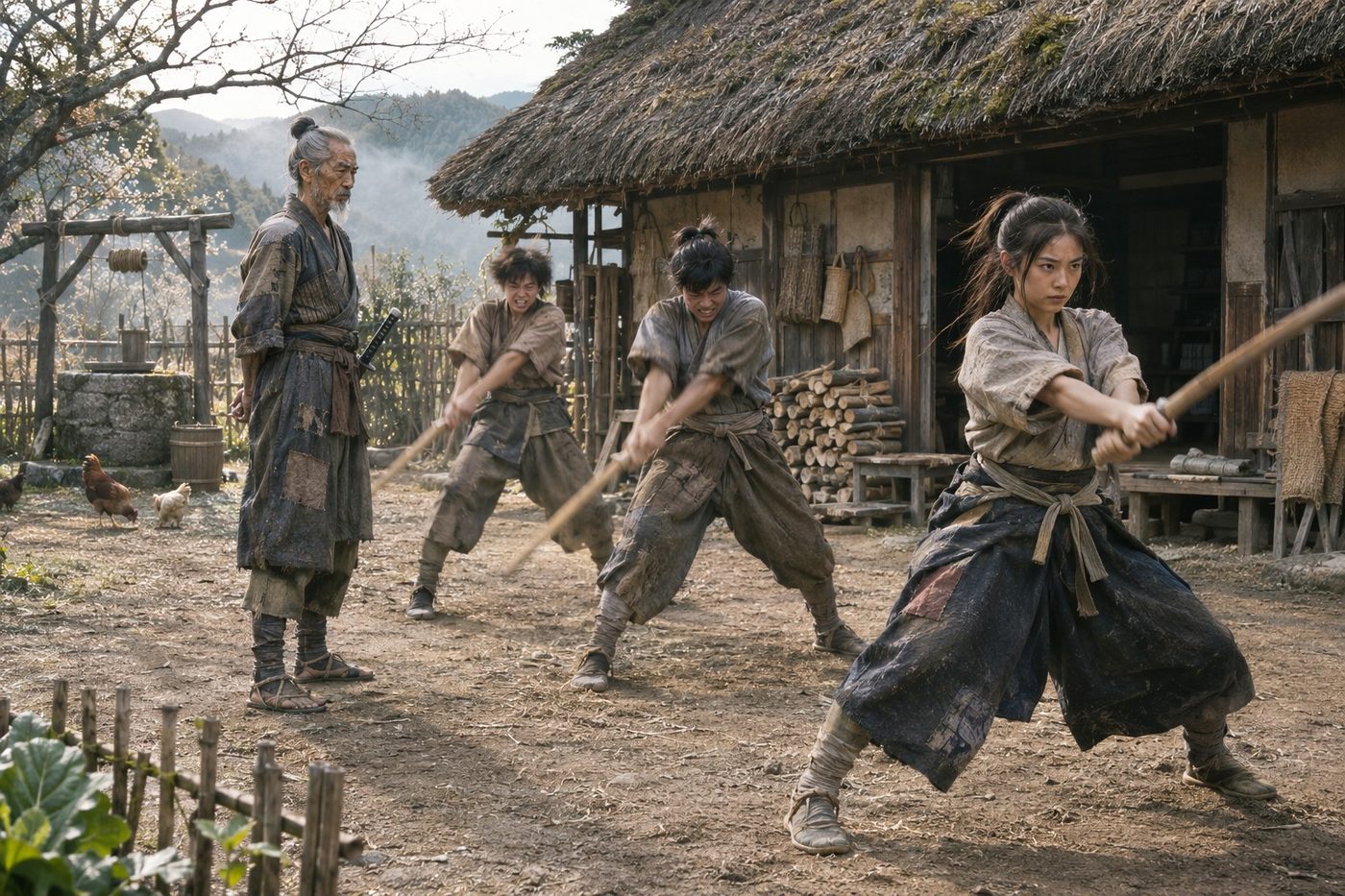
There are four tiers of school, from a lone master with a few students to a great school with halls across the isles.
School Size#
Roll a d20 in the column for where the school stands.
| School | Village | Market or post town | Castle town | City |
|---|---|---|---|---|
| Lone master | 1–17 | 1–10 | 1–6 | 1–4 |
| Hall | 18–20 | 11–18 | 7–15 | 5–12 |
| School | — | 19–20 | 16–19 | 13–18 |
| Great school | — | — | 20 | 19–20 |
The home halls of the eight great martial schools are in the Gazetteer. A great school rolled elsewhere is a school of the arts, of learning, or of a craft, unless the GM wants to found a new martial line.
School Tiers#
| School | Students | Led by | Leader's Rank | Usually attached |
|---|---|---|---|---|
| Lone master | 1d4 | A master, in a rented room, a farmhouse, or a temple yard | Roll a d6: 1–3 Seasoned, 4–5 Veteran, 6 Heroic | Debts, and one student who is better than the master admits |
| Hall | 2d6 + 2 | A licensed master of a school's branch | Veteran | 1d3 senior students (Seasoned) and a signboard at the gate |
| School | 4d6 + 10 | A headmaster | Veteran or Heroic | 1d4 branch halls and a lord's patronage |
| Great school | 1d6 × 50, in all its halls | The headmaster of the line | Heroic or Legendary | 2d6 branch halls across the isles, and the secret scrolls |
School Kind (d6)#
| d6 | Kind |
|---|---|
| 1–3 | Martial. Roll on Martial School. |
| 4 | A temple school (terakoya): reading, writing, and arithmetic. Treat any tier above hall as hall. |
| 5 | The arts. Roll on Arts, Learning, and Crafts (1–6). |
| 6 | Learning or a craft. Roll on Arts, Learning, and Crafts (7–12). |
Martial School (d20)#
A hall of one of the eight great schools teaches its Style Edge (Chapter 3, Edges).
| d20 | The school teaches |
|---|---|
| 1–2 | The Kiritani draw-cut |
| 3–4 | The Ōnuma two swords |
| 5–6 | The Kanemori great sword |
| 7–8 | The Amanoki waiting sword |
| 9–10 | The Sekigawa spear |
| 11–12 | The Asaoka horse archery |
| 13–14 | The Tamaeda glaive |
| 15–16 | The Uchinami armored wrestling |
| 17 | The matchlock, taught by a gunner who learned it at Umikado |
| 18 | The staff or the stick, for those not allowed a sword |
| 19 | An odd weapon: the chain-and-sickle, the iron fan, or the throwing blade |
| 20 | A new style of the master's own, with no Style Edge yet. The master is looking for students worthy of one. |
Arts, Learning, and Crafts (d12)#
| d12 | The school teaches |
|---|---|
| 1 | Tea |
| 2 | Flower arranging |
| 3 | Poetry |
| 4 | Calligraphy and painting |
| 5 | Music, on the lute, the flute, or the drum |
| 6 | Dance, or the masked plays of the court |
| 7 | The Daqian classics and the law |
| 8 | Medicine |
| 9 | The calendar and the stars, and perhaps the Way of Yin and Yang behind closed doors |
| 10 | Swordsmithing or armoring |
| 11 | Lacquer, carpentry, or building |
| 12 | The Black Book's learning: reading, foreign medicine, and the westerners' tongue, taught by a convert (or roll again away from Kissaki-jima) |
Places of Interest#
Not every place is a village or a castle. Roll a d20 for something on the road between.
| d20 | Place |
|---|---|
| 1 | A barrier station, where travelers show their passes and pay their tolls |
| 2 | A ferry with a surly ferryman, or a ford with river porters |
| 3 | A bridge that no one crosses after dark |
| 4 | A ruined castle, burned in the last war |
| 5 | An old battlefield, where bones still turn up under the plow |
| 6 | A hot spring in the woods, used by monkeys, travelers, and something else |
| 7 | A waterfall where mountain ascetics stand under freezing water |
| 8 | A bandit camp in an abandoned temple |
| 9 | An execution ground by the river, with heads on stakes |
| 10 | A mine, worked or abandoned |
| 11 | A burial mound from the age of the first kingdoms |
| 12 | A teahouse at the top of a pass, run by an old woman who knows every rumor |
| 13 | A lone pine where travelers tie paper prayers, and where a famous duel was fought |
| 14 | A charcoal burners' camp deep in the forest |
| 15 | A lord's hunting lodge, guarded even when empty |
| 16 | A shrine gate standing alone in a field, with no shrine behind it |
| 17 | A shipwreck on the rocks, picked clean by the village nearby |
| 18 | A plague village, abandoned and taped off with sacred rope |
| 19 | A crossroads with six stone jizō, one of them always facing the wrong way |
| 20 | A place no map shows, and no one in the next village admits to knowing |
Names, Faces, and Secrets#
Naming a Place#
Clan names come from the land (Chapter 2, Names and Language), so place names do too:
- A village, town, castle, or province feature takes two parts from the Clan table. The same name often belongs to the family that rules it, or used to.
- A temple takes two parts from the Religious table and adds -ji. A hermitage or sub-temple adds -an or -in instead.
- A shrine takes the name of its place, or of its kami, and adds "Shrine."
- A school takes the clan name of its founder.
The Face of the Place#
The leader's name comes from the tables for their birth: Clan and Men or Women for samurai and gentry, Common for commoners, and Religious for clergy. Then roll a d8 for the person the heroes actually meet.
| d8 | They meet |
|---|---|
| 1 | The leader in person, who has been expecting someone else |
| 2 | The leader's deputy, who runs everything and gets credit for nothing |
| 3 | A child who knows every secret in the place |
| 4 | The oldest person in the place, who remembers the last time this happened |
| 5 | A newcomer, an outsider like the heroes, who wants out |
| 6 | A rival, who wants the leader's place and sees the heroes as a way to get it |
| 7 | A servant of the gods: a priest, a shrine maiden, or a wandering monk |
| 8 | Someone the heroes already know, for better or worse |
Every Place Has a Secret (d20)#
| d20 | Secret |
|---|---|
| 1 | The leader is not who they claim to be. The real one died years ago. |
| 2 | The place pays tribute to bandits, and the bandits are its own sons. |
| 3 | A spirit protects the place in return for something no one will name. |
| 4 | The place is hiding a fugitive of the other blossom. |
| 5 | The tax rolls are false, and the lord is being cheated. |
| 6 | Someone here is a shinobi, watching for a lord far away. |
| 7 | The place's founder made a pact with a fox, and the fox has come to collect. |
| 8 | Two leading families are in a blood feud that started three generations ago. |
| 9 | The place secretly follows the Teaching of the Black Book. |
| 10 | A treasure is buried here from the last war, and three people know where. |
| 11 | The well, the river, or the shrine is polluted, and the sickness is spreading. |
| 12 | The leader owes a moneylender more than the place is worth. |
| 13 | A ghost walks every night, and the people leave food out for it. |
| 14 | A sect league is gathering weapons here. |
| 15 | The lord's heir is hidden here, raised as a commoner. |
| 16 | The place was promised to two different lords, and both are coming to collect. |
| 17 | Someone here has seen the Shogun's secret (Chapter 7), and doesn't know what it means. |
| 18 | The sakaibito hamlet nearby holds the only people who know the real story. |
| 19 | The place is not on any map because the lord wants it that way. |
| 20 | There is no secret, and the heroes' suspicion is about to cause a disaster. |