Gamemaster's Section · GM only · Chapter 9
Factions and Personalities
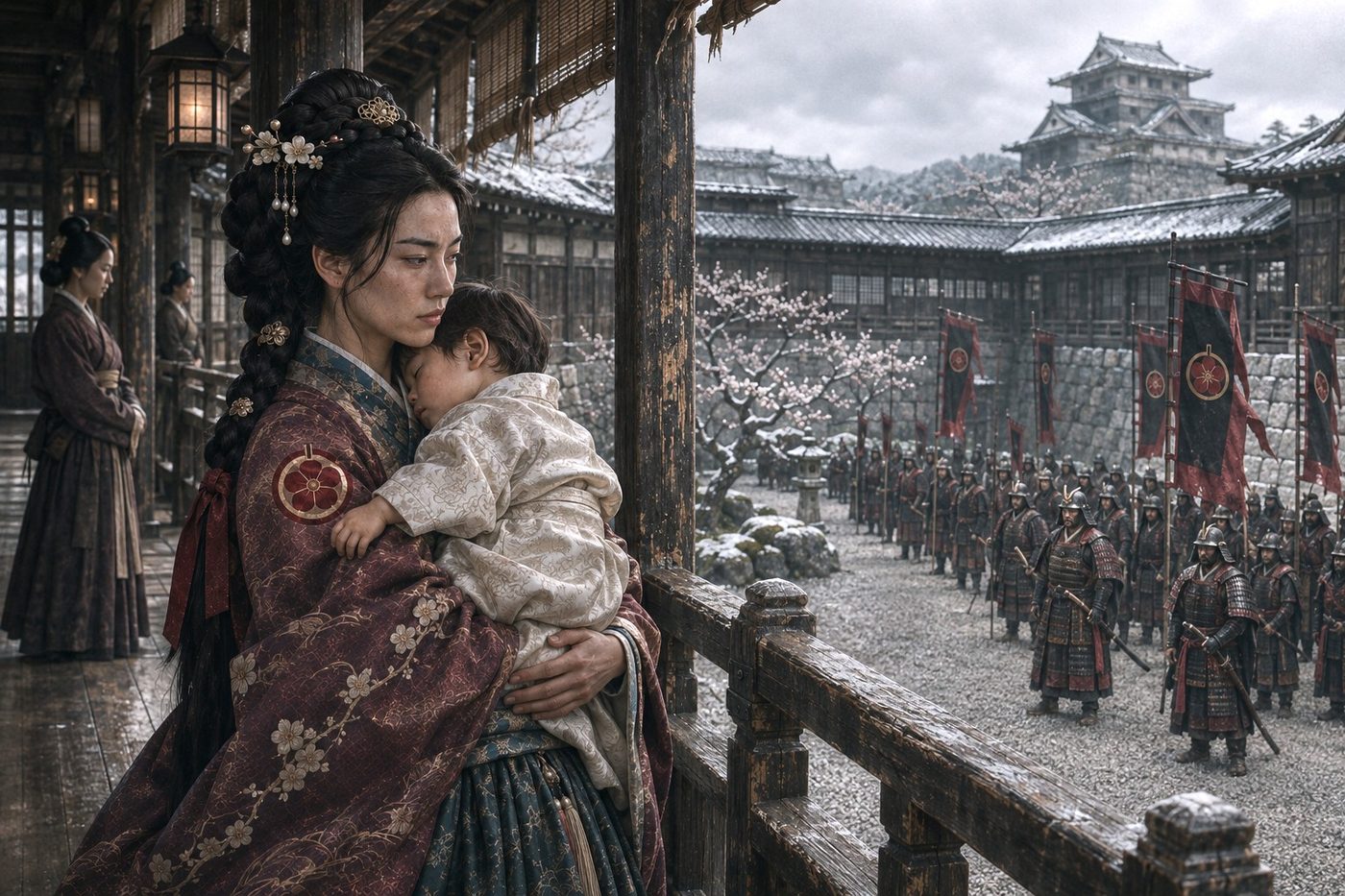
Part 1: Great Clans and Their Daimyo#
The Board#
Chapter 8 tells the GM where things are. This chapter tells the GM who wants what. Every faction below reaches across many provinces, and every one of them needs capable people it can't find in its own ranks. That is where heroes come in.
| Faction | Who they are | Where in this chapter |
|---|---|---|
| The red plum | The Shogun's house, Lady Hyoseon, the Shikken, and the lords who follow them | Part 1 |
| The white plum | Kagamino Sadatsugu and the lords who look to him | Part 1 |
| The court | The Emperor's Regent, the Cloister, and the old court families | Part 1 |
| The wavering | Every lord still waiting to see which blossom wins | Part 1 |
| The third power | The great sects, the warrior monks, and the sect leagues | Part 2 |
| The shrines | The great shrines and the keepers of the shard stones | Part 2 |
| The Black Book | The foreign preachers, their converts, and the great black ships | Part 2 |
| The underworld | Gamblers, peddlers, street champions, shinobi, and sea raiders | Part 3 |
| The law | Magistrates, constables, and thief-takers | Part 4 |
| The hidden ones | The great threats of Chapter 7 | Chapter 7; their statistics are in Part 5 |
Statistics for every person named in this chapter are in Part 5.
How to Read a Faction Entry#
Each faction entry gives the same things in the same order:
- Who they are, in a paragraph.
- Who leads, with their heirs and chief servants.
- Strength: land, soldiers, money, and anything else they can throw at a problem.
- What they want and what they fear.
- What they offer heroes, as a patron (Chapter 5), and what they ask in return.
- Secrets, with pointers to Chapter 7.
- Friends and foes.
- Attitude: how the faction treats heroes it doesn't know.
Optional Rule: Starting Attitudes. Heroes' standing inside their own group comes from Status, Honor, and on (Chapter 4). Their standing with everyone else starts at the Attitude given in each entry, using the reaction levels of SWADE (p. 33): Hostile, Uncooperative, Neutral, Friendly, or Helpful. It sets the starting point for the first Persuasion roll or Social Conflict with any member of that faction who doesn't know the heroes personally. A great service to the faction moves its attitude toward the party one step warmer. A great wrong moves it one step colder, or two for a betrayal. The GM can ignore the steps and simply remember what the heroes have done.
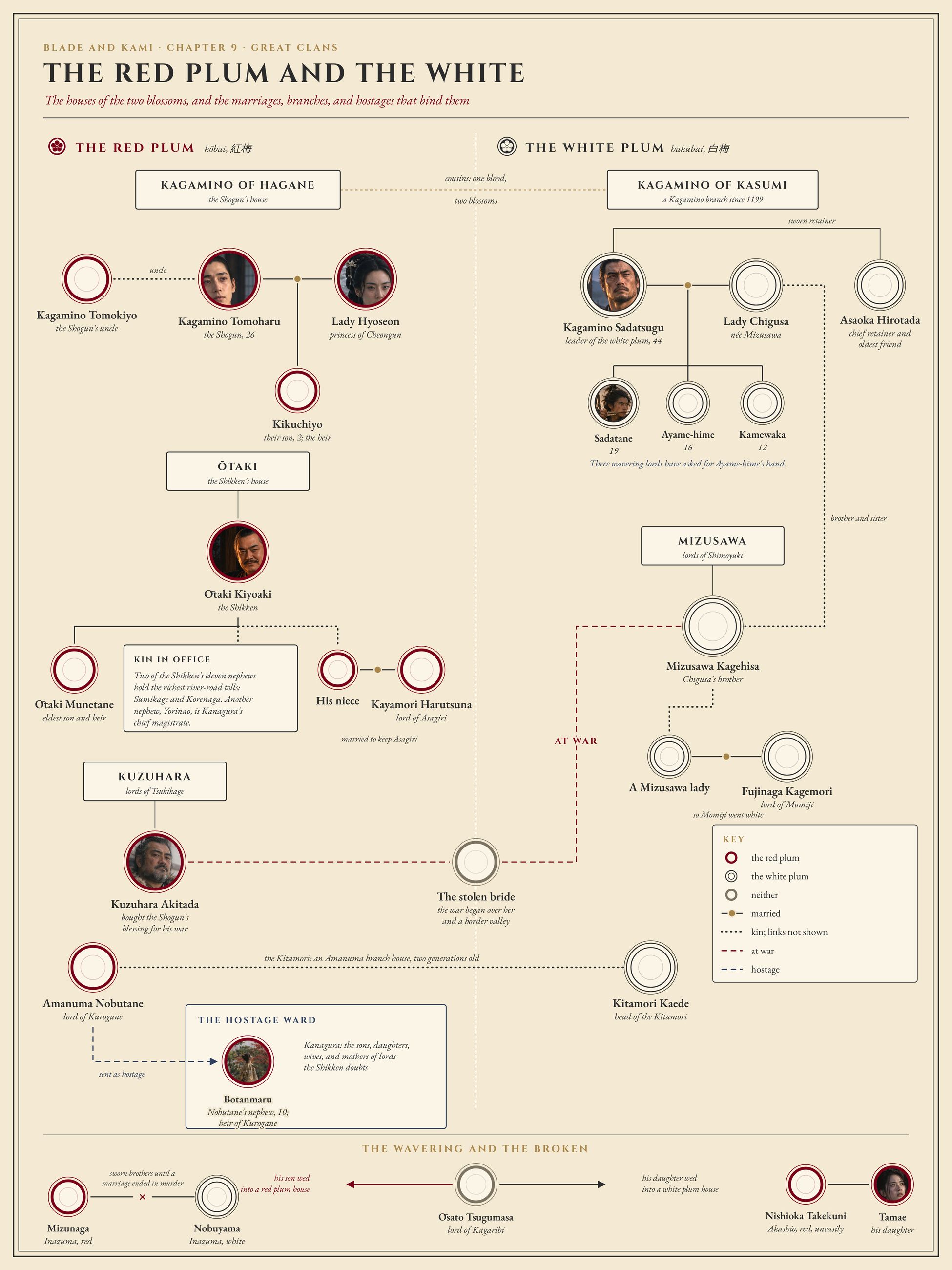
The Red Plum#
The red plum holds the capitals, the money, and the sea. On paper it is twice the size of the white. In truth it has three heads that don't trust each other: a Shogun who would rather pray, a Cheongun princess who wants her son to rule after him, and a Shikken who means to rule instead of either of them. Every great lord of the red plum belongs to one of those three, and most hope that one of the others falls first.
The Kagamino of Hagane (the Shogun's House)#
Who they are. The main line of the Kagamino, Shoguns since the Usurpation of 1199, when Kagamino Tomoyuki deposed his cousin Sadamasa. Tomoyuki ruled well, his son Tomonori ruled brilliantly, and Tomonori's son Tomoharu has ruled hardly at all. The house still holds the Shogun's commission, Hagane Castle, the war fleet, and the old oaths of the housemen (gokenin) whose ancestors swore to the first Shogun. What it lacks is money, soldiers who are paid, and a Shogun who wants to be one.
Who leads.
- Kagamino Tomoharu, the fifteenth Shogun, 26, gentle and pious. He governs nothing and prays every morning. Everyone thinks he is going mad.
- Lady Hyoseon, his wife, a princess of Cheongun, clever and fierce. She keeps her own court in the castle's eastern wing and is the true will of the house.
- Kikuchiyo, their son, two years old. His birth in 1259 shut the door on any peaceful road for Sadatsugu: the Shogunate now has an heir of Tomoyuki's line, and only a war can change that.
- Kagamino Tomokiyo, the Shogun's uncle (his late father Tomonori's younger brother) and former guardian, pushed aside by the Shikken. He lives in the Kagamino mansion in Seikyō, writes poetry, and listens to every noble who hates the Shikken (Chapter 8).
- Hatamori Yoshichika, head of the Samurai-dokoro, and Shimanaga Kageyuki, the admiral, are the house's two great officers (Chapter 8).
Strength. Kazahaya, about 350,000 koku, and about 7,000 soldiers if the housemen answer the summons. The Shogun's mounted housemen (about 1,000 riders), the Sekigawa spearmen of Hagane, and the war fleet of 60 war junks and 100 transports. Half the fleet needs repair, and its sailors are owed six months' pay.
What they want. Tomoharu wants peace, and for the voices to stop. Hyoseon wants her husband well, her son on the throne after him, and the Treaty of the Strait kept. Tomokiyo wants the Shikken gone and his old place back.
What they fear. That the Shikken moves the Shogun to Kanagura "for his safety" and never brings him back. That the housemen ride for Sadatsugu. That the fleet goes to whoever pays its sailors first.
What they offer heroes. The Shogun's name still means something. A hero in the house's service can carry the Shogunate's letters, which open every barrier the Shikken doesn't control, and can be recommended to the court for rank. Lady Hyoseon pays in silver from her own dowry, and she pays well for discretion.
What they ask. Lady Hyoseon's first request is always the same: find out who is poisoning her husband's dreams, without the Shikken learning that anyone is looking (Chapter 8).
Secrets. Tomoharu is an untrained kannagi of great power, not a madman. A curse-worker in his own household, paid by the Shikken, poisons his dreams. The first Shogun's bones lie in a hidden shrine inside Hagane Castle, and his spirit speaks to Tomoharu. Lady Hyoseon knows about the shrine, and suspects her husband isn't mad (Chapter 7).
Friends and foes. Friends: Cheongun, Zenkai-ji (the Shogun's confessor is its abbot, Part 2), and the old housemen who remember Tomonori. Foes: the white plum, the Strait Men, and, though they wear the same blossom, the Ōtaki.
Attitude. Neutral. Friendly to Cheongun veterans who kept faith with the treaty, and to anyone carrying Lady Hyoseon's token.
The Ōtaki (the Shikken's House)#
Who they are. A middling clan of the Inner Provinces that rose in one generation. When the Cheongun War went sour, the Shogun's uncle had to appoint a military regent, and he chose Ōtaki Kiyoaki, a clever, careful lord who promised to end the war and pay its debts. He did both, at the cost of everything the warriors had bled for. Since then he has governed the realm from his own castle-port of Kanagura, filled every office that pays with his relatives, and made himself the richest man in the isles. The Ōtaki wear the red plum in their own shade of it: they serve the Shogun only as long as the Shogun can't rule without them.
Who leads.
- Ōtaki Kiyoaki, the Shikken, greedy, clever, and hated. He believes in ledgers, not omens.
- Ōtaki Munetane, his eldest son and heir, master of Kanagura Castle's guard. Utterly loyal.
- Ōtaki Sumikage and Ōtaki Korenaga, two of the Shikken's eleven nephews, who hold the richest toll stations on the river road. They want Munetane's place, and they started the rumor that he plots against his father.
- Ōtaki Naomochi, a minor kinsman, the Shikken's toll collector at Kurogane Pass (Chapter 8).
- Kuromura Jinzaemon, steward of the Shikken's household and master of his spies (below).
Strength. Miyabi, about 400,000 koku, and about 8,000 soldiers, most of them levies who have never fought. The real strength is the Kanagura castle guard of 1,000 veteran samurai and three companies of matchlock gunners, the greatest castle in the isles, the Hostage Ward, the rice exchange, the Port Commissioner at Umikado, and a toll station on every road that matters. The Council of Ten Houses lends the Shikken money, and the Shikken lends it the law.
What they want. The Shogun at Kanagura, under the Shikken's hand. Sadatsugu ruined without a battle: starved of rice, of allies, and of the Emperor's favor. And more money, always.
What they fear. A battle he can't buy his way out of. Fire in Kanagura's merchant quarter. Proof of any one of his secrets, because a Shikken who is exposed is a Shikken whom even the red plum can afford to drop.
What they offer heroes. Money, offices, and pardons. A hero in the Ōtaki's service never lacks silver or a travel pass, and every magistrate in Miyabi looks the other way. The Shikken also keeps a list of every hostage, every debt, and every weakness in the realm, and shares a line of it with those who serve him well.
What they ask. Quiet work: carry silver, buy a lord, find a missing hostage, burn a forge, or make a problem go away. The Shikken never asks for anything in writing.
Secrets. Four of the darkest in the realm, and he knows only three of them:
- He refused to pay for the present Emperor's Great Tasting in 1256. He doesn't know the rite failed because of it, and wouldn't believe it mattered (Chapter 7).
- He pays the curse-worker poisoning the Shogun's dreams (Chapter 7).
- He had Kurogane's old lord poisoned four years ago (Kurogane's Houses, below).
- He arranged the murder that broke the brotherhood between the lords of Inazuma (Chapter 8), and forged the Daqian letter that names Sadatsugu "King of the Isles" (Chapter 8).
Friends and foes. Friends: the Council of Ten Houses, the Kuzuhara (bought), the Kayamori (by marriage), and the Lion's Roar brotherhoods of Kanagura. Foes: the white plum, the Strait Men, Tomokiyo, the Akebana (who pay his taxes slowly), and in truth most of the red plum.
Attitude. Neutral toward anyone useful. Uncooperative toward Cheongun veterans and anyone known to the Strait Men.
The Shikken's Eyes#
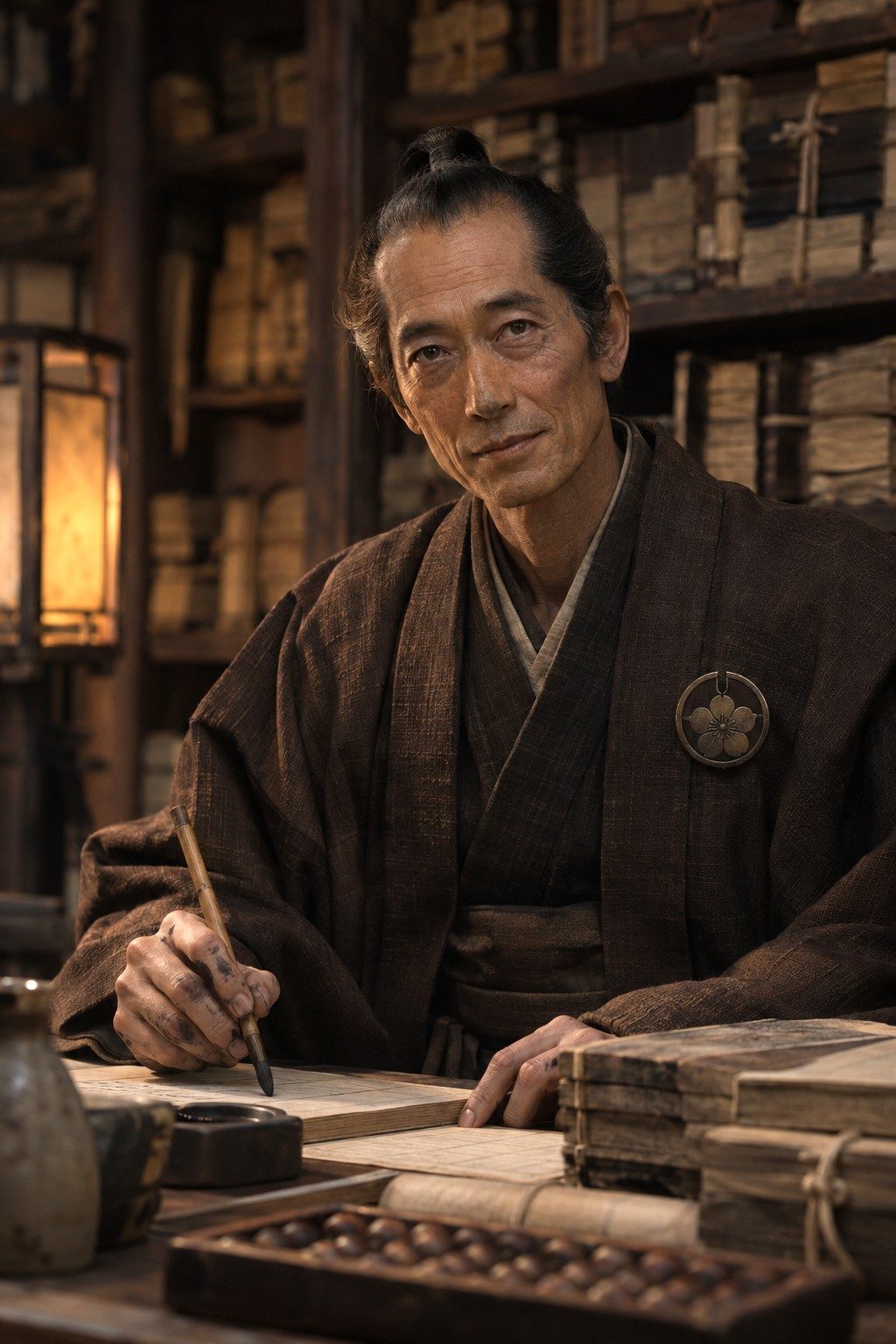
The Shikken doesn't hire shinobi when he can help it, because shinobi sell to everyone. He keeps his own spies, and they are clerks, not killers. Islanders call them the Shikken's Eyes, and few know how many there are.
- Who they are. Toll collectors who record every traveler at every barrier the Ōtaki control (Naomochi's ledger at Kurogane Pass goes to Kanagura each month). Port clerks in Umikado, who copy the Commissioner's register of converts. Maids and stewards in the Hostage Ward. Courtesans in Kanagura's pleasure quarter, paid to remember what officials say. Merchants' clerks who report which lords are borrowing, and how much.
- Who runs them. Kuromura Jinzaemon, steward of the Shikken's household, a soft-spoken man of 50 who never forgets a debt. Every report comes to his counting room in Kanagura Castle, where he files it by name. He is also the steward who carries the Shikken's payments to Ishimura Sayo in Hagane (Chapter 7), which makes him the one man who could prove two of the Shikken's secrets at once.
- How they work. The Eyes watch and write. When the Shikken wants someone hurt, Jinzaemon hires outside help: ronin, a shinobi league that works mostly for Kanagura (Part 3), or a magistrate who owes him a favor.
- Using them. Any hero who passes an Ōtaki barrier is in the ledger. A hero who makes trouble in Miyabi, Kanagura, or the Shikken's toll stations finds that the Shikken already knows their name, their lord, and where their family lives.
The Kuzuhara#
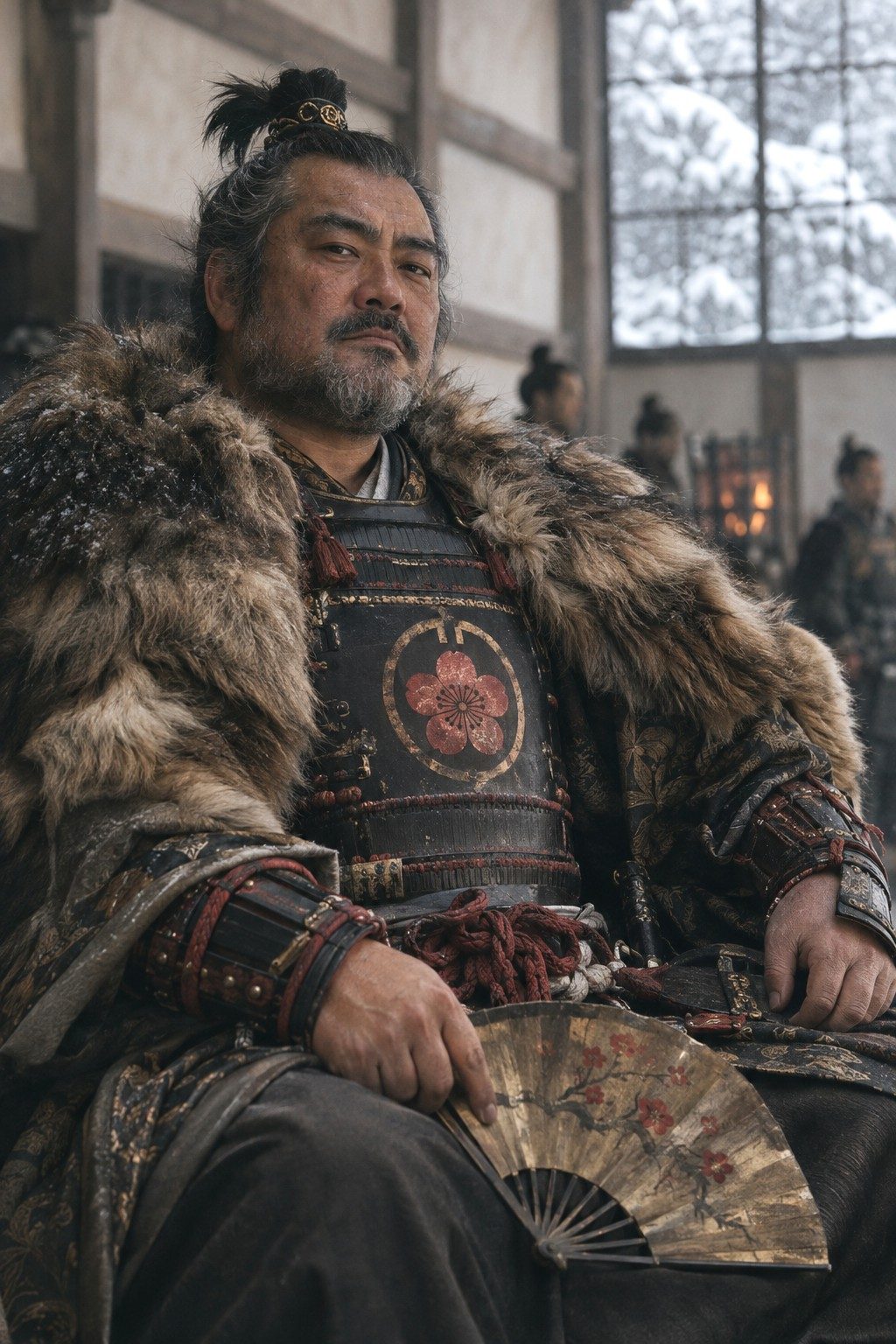
Who they are. The lords of Tsukikage, the largest province in the realm: wide valleys, horse plains, and gold rivers in the cold northeast. The Kuzuhara have always been too far from the capitals to care much who rules there, and too strong for anyone to make them care. Kuzuhara Akitada bought the Shogun's blessing for his war on Shimoyuki through the Shikken, and wears the red plum because it suits him.
Who leads. Kuzuhara Akitada, the most powerful lord in the realm after the Shikken, and some say before him. He means to be Shogun one day. He has told no one, and everyone knows.
Strength. About 450,000 koku and about 9,000 soldiers, with northern horses for 2,000 riders, and gold. Most of his army is fighting in Shimoyuki or guarding his long borders.
What they want. Shimoyuki, then Momiji, then a Shogunate weak enough to take.
What they fear. Sadatsugu holding Kurogane Pass and marching north to save his brother-in-law. Whatever is stirring in the northern forests (Chapter 7).
What they offer heroes. Gold, horses, and land in a province big enough to give it away.
What they ask. Win the war in the north, and find out whether the gold of Hate-no-Kuni is real. His prospectors have angered a forest kami there, and he wants someone to settle it (Chapter 8).
Secrets. Akitada pays the Shikken in gold for every month of his war. The oni in the northern forests are real (Chapter 12), and the old kami of the north are moving south (Chapter 7).
Friends and foes. Friends: the Shikken, for now. Foes: the Mizusawa, the Fujinaga, and Sadatsugu.
Attitude. Neutral. Hostile toward anyone wearing the Mizusawa crest.
The White Plum#
The white plum holds the mountains, the swordsmiths, and the veterans. It is smaller than the red, but harder, and it has one leader where the red has three. Its weakness is that it can't win without Kurogane Pass, and its lords know it.
The Kagamino of Kasumi (Sadatsugu's House) and the Asaoka#
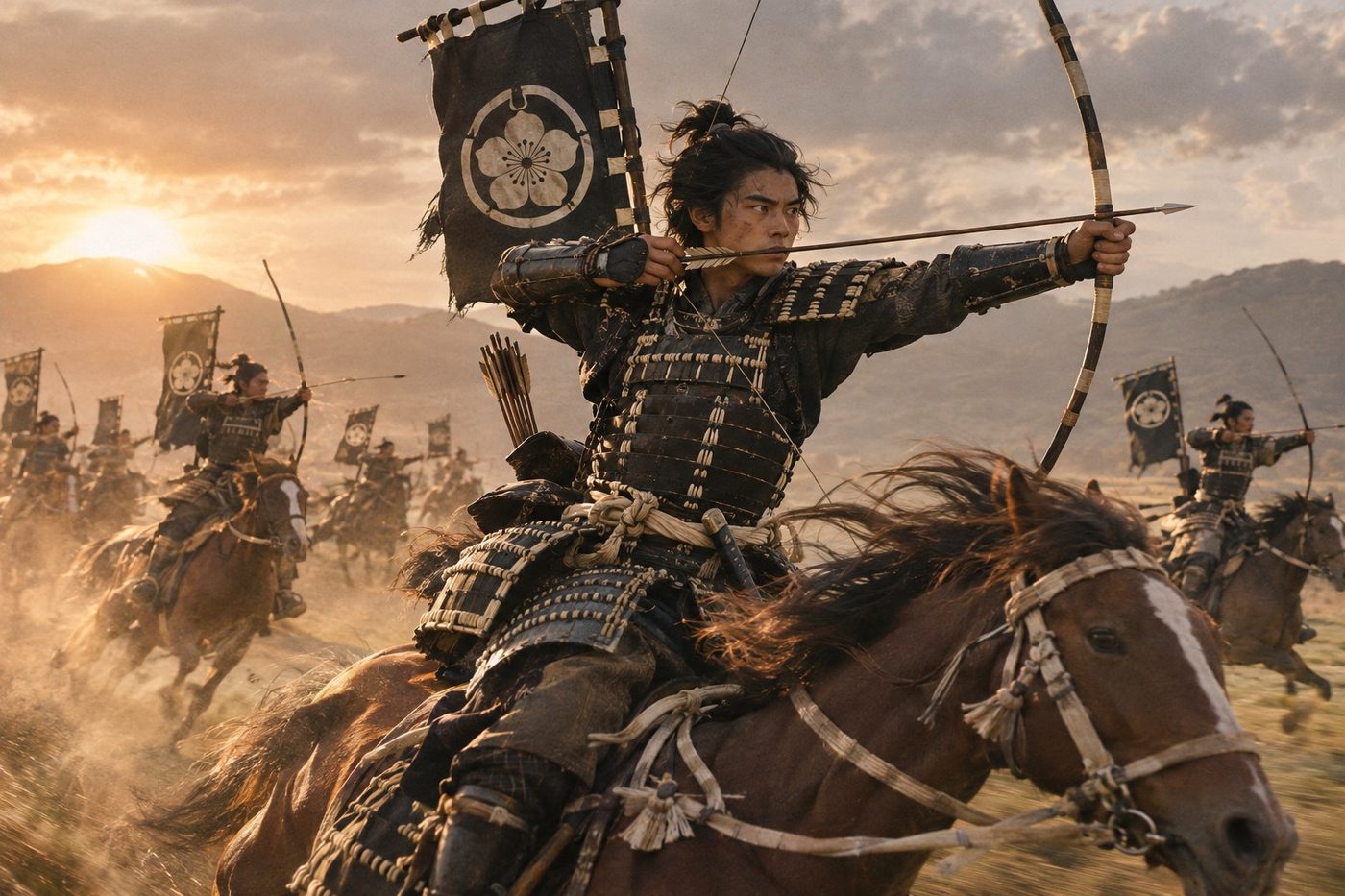
Who they are. A branch of the Kagamino that has held Kasumi since the Usurpation. Kagamino Sadatsugu descends from the deposed Shogun Sadamasa through his mother, so by blood his claim to the Shogunate is arguably better than Tomoharu's. He won command of the army in Cheongun and wanted to fight on. The Shikken starved his army of supplies until the treaty was signed, and he came home to find his veterans unpaid and his cousin married to the enemy's princess. The white plum is his banner, and the hard men of Cheongun are his army.
Who leads.
- Kagamino Sadatsugu, 44, the hero of the Cheongun War: brave, blunt, generous to his soldiers, and hard to like for anyone who isn't one.
- Lady Chigusa, his wife, sister of Mizusawa Kagehisa of Shimoyuki. She runs Shirataki Castle when he is in the field, and writes to her brother every week.
- Kagamino Sadatane, their eldest son, 19, who rides with the Asaoka horse archers and wants a battle before the war is over.
- Ayame-hime, their daughter, 16. Her marriage is the best coin the white plum has, and three wavering lords have asked for it.
- Kamewaka, their younger son, 12, still in his childhood name.
- Asaoka Hirotada, head of the Asaoka clan and of the Asaoka School of the mounted bow, Sadatsugu's chief retainer and oldest friend.
Strength. Kasumi, about 230,000 koku, and about 4,600 soldiers, plus Sadatsugu's own Cheongun veterans (about 2,000) and the Asaoka horse archers, 800 riders, the finest cavalry in the realm. This year Sadatsugu bought every warhorse at the autumn fair. What he lacks is iron, rice, money, and a road to the capital.
What they want. Kurogane Pass, the Kitamori's iron, and the Shogun's commission from the Emperor. Then Hagane, and justice for the veterans.
What they fear. Being named an enemy of the court. A winter siege at Kurogane Pass that he can't feed. His brother-in-law's fall in the north.
What they offer heroes. Respect for any Cheongun veteran, land promised after victory (Sadatsugu has promised a great deal of land), and a place in a cause that feels like justice. The Asaoka teach their school to anyone Sadatsugu trusts.
What they ask. Carry messages through Kurogane, past the barrier. Win over the wavering. Bring the Kitamori iron over the pass. Find someone inside Kurogane Castle who will open a gate.
Secrets. Sadatsugu holds a friendly letter from the Cloistered Emperor that promises nothing (Chapter 8). The Daqian letter calling him "King of the Isles" is the Shikken's forgery (Chapter 8). What the first Shogun's spirit wants may be the Usurpation set right, with the founder's line restored through Sadamasa's blood (Chapter 7, The White Plum Rising).
Friends and foes. Friends: the Mizusawa, the Tokumoto, the Ameyama, the Kitamori, the Strait Men, and every unpaid veteran in the realm. Foes: the Shikken above all, then the Kuzuhara.
Attitude. Neutral. Friendly toward Cheongun veterans. Uncooperative toward anyone wearing an Ōtaki crest.
The Mizusawa#
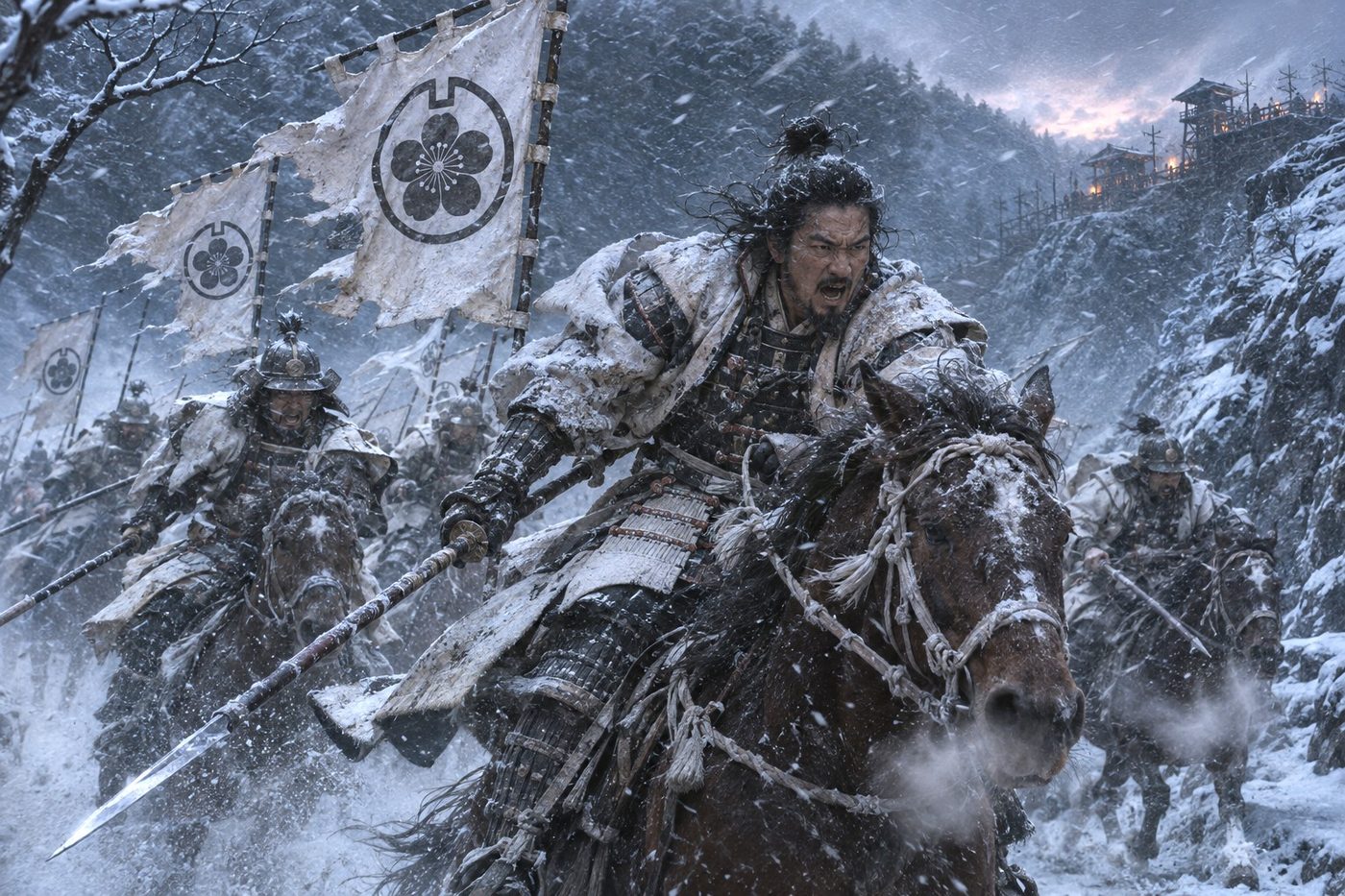
Who they are. The lords of Shimoyuki, the snowbound western half of the north, a clan that keeps to its valleys and fights in winter when no one else can. Mizusawa Kagehisa has been at war with the Kuzuhara for two years over a border valley and a stolen bride, and he is losing slowly.
Who leads. Mizusawa Kagehisa, Sadatsugu's brother-in-law: stubborn, proud, and tired.
Strength. About 200,000 koku and about 4,000 soldiers, half of them hardened by two years of war, and the Mizusawa snow riders, 300 horsemen who fight in deep winter.
What they want. To survive one more winter, and for Sadatsugu to come north.
What they fear. The Kuzuhara taking the snow castle. Sadatsugu deciding the north can wait.
What they offer heroes. Very little money and a great deal of gratitude. The Uchinami School of armored wrestling has its hall in Shimoyuki.
What they ask. Carry messages through the Kuzuhara lines in winter. Find the stolen bride.
Secrets. The stolen bride is alive and living as a nun (Chapter 8). Her testimony could show that neither side began the war honorably.
Friends and foes. Friends: Sadatsugu and the Fujinaga. Foes: the Kuzuhara.
Attitude. Uncooperative toward strangers in wartime. Helpful to anyone who brings food.
The Tokumoto#
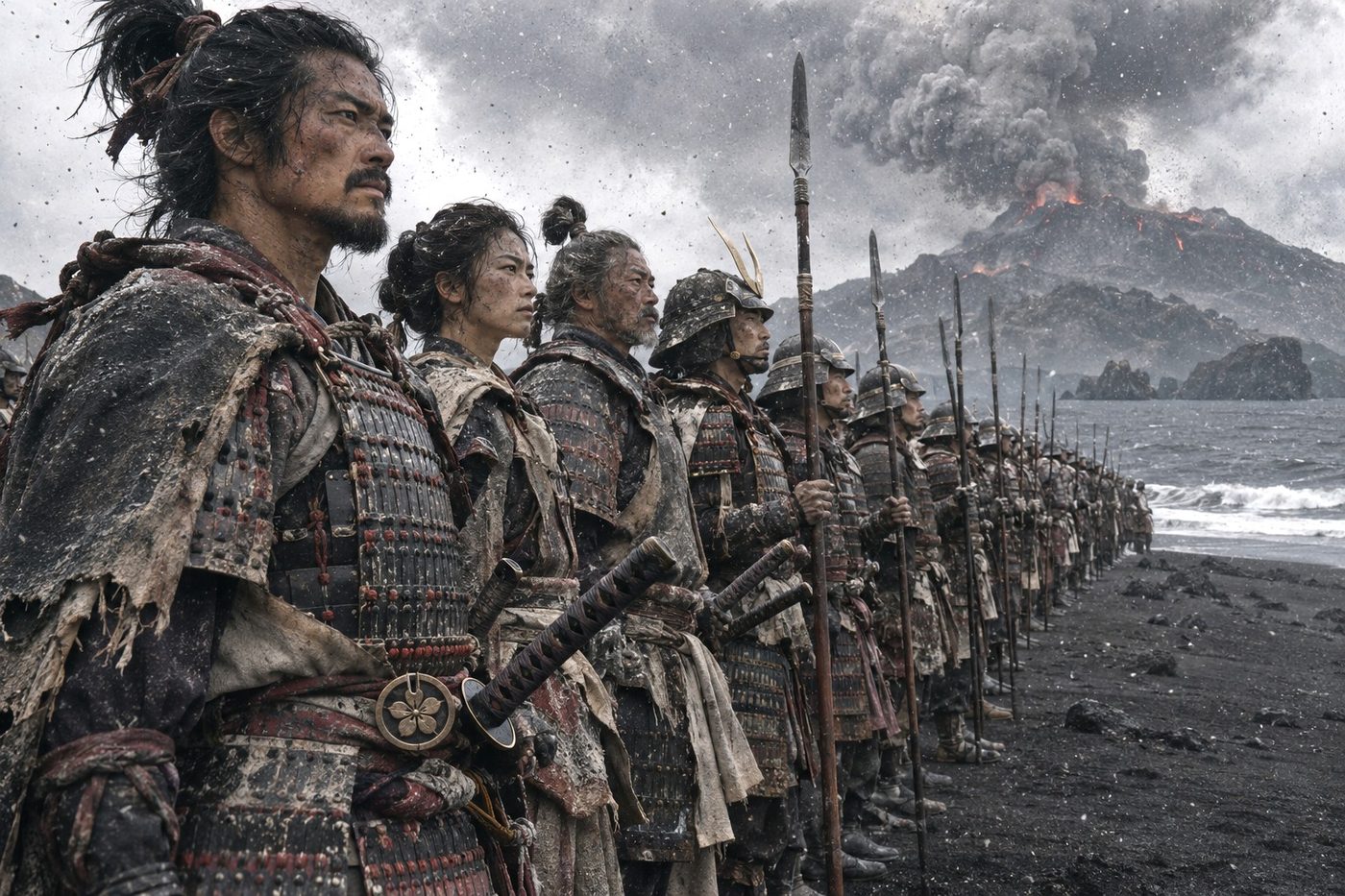
Who they are. The lords of Hinoe, the volcanic south of Kissaki-jima, whose samurai are the hardest fighters in the realm. Half of Tomonori's Cheongun army came from Kissaki-jima, and most of those came from Hinoe. When the treaty gave back what they had bled for, Hinoe never forgave the Shikken. Tokumoto Katsutane was among the first great lords to raise the white plum.
Who leads. Tokumoto Katsutane, a scarred veteran of Cheongun who has never lost a battle and never forgiven one.
Strength. About 180,000 koku and about 3,600 soldiers, nearly all veterans or veterans' sons, and the Tokumoto guard, 500 samurai who have never retreated. Hinoe's sulfur goes to Sadatsugu's powder-makers.
What they want. The Shikken's head, and the veterans paid.
What they fear. Nothing they will admit. In truth, the volcano.
What they offer heroes. A place in the hardest army in the isles, and a welcome for any veteran.
What they ask. Guard the secret meetings at the hot spring town. Get the army across the Inland Sea to Sadatsugu.
Secrets. The treasure of a Cheongun royal temple, looted in the war, is hidden in one of their castles (Chapter 8). Returning it would win Cheongun's gratitude, and shame the Tokumoto.
Friends and foes. Friends: Sadatsugu, the Strait Men, and the Ashiura, who can carry their army. Foes: the Shikken, and the Takanaga of Sakimori, who guard the strait for the Shogunate.
Attitude. Uncooperative toward strangers. Friendly toward veterans, Helpful toward veterans of Hinoe.
The Court#
The court commands no army, but it alone can make power lawful. Its factions are described in Chapter 8 (Seikyō). Here they are as players in the war.
The Akebana (the Regent's House)#
Who they are. The regents' family, older and prouder than the Kagamino, with five branch houses that hold most of the high offices. For centuries they ruled through their daughters, who married Emperors.
Who leads. Akebana Tsunemaro, the Regent, head of the house and the court's chief broker. He sells ranks and titles to any lord who pays, including the same title to two rival lords in one month.
Strength. Offices, ranks, paperwork, and the Emperor's household. The Akebana estates in the hills west of Seikyō, the last of the old court lands. No soldiers worth counting.
What they want. The court's power back, and money, which is the same thing. Above all, that no one ever learns what happened at the Great Tasting.
What they fear. Exposure. The Cloister. A Shogun strong enough to stop needing the court.
What they offer heroes. Court rank, titles, and introductions, which are genuine and expensive.
What they ask. Gifts. Discretion. Silence about anything a hero overhears.
Secrets. Tsunemaro performed the present Emperor's Great Tasting without its offerings, and it failed. He made sure no one present said so. He knows that Tachieda Michimaro, exiled in Hate-no-Kuni, wrote everything down (Chapter 7). The Akebana estates are hiding white plum envoys (Chapter 8): Tsunemaro is buying a future with both blossoms.
Friends and foes. Friends: whoever pays. Foes: the Cloister and the Mitsuhara. The Shikken, who refused him the money.
Attitude. Neutral toward anyone with a gift. Uncooperative toward anyone without one.
The Cloister#
Who they are. The household of the Cloistered Emperor, the reigning Emperor's father, who took vows, left the throne, and kept the power. His decrees (inzen) are obeyed as readily as the throne's, and his brother is the Prince-Abbot of Raihō-ji.
Who leads. The Cloistered Emperor, shrewd and worldly. His steward Mitsuhara Akimaro runs his office, and whoever wants the Cloister's decree must get past Akimaro's door. His brother Prince-Abbot Taishun commands Thunder Peak's warrior monks (Part 2).
Strength. Thunder Peak's warrior monks, several thousand strong, and the sacred palanquin. The reigning Emperor's ear.
What they want. To outlast the Regent, and to keep any Shogun from growing strong enough to ignore the court.
What they fear. A warlord who would burn Thunder Peak.
What they offer heroes. The Cloister's decree, and the protection of the monks.
What they ask. Information about the Regent, and service to Thunder Peak.
Secrets. The Cloistered Emperor knows nothing of the Spoiled Tasting, and has never been told about the Lord of the Demon Gate beneath Raihō-ji. If he sends every monk to the capital with the palanquin, the eternal lamp goes out (Chapter 7). He has written Sadatsugu a friendly letter that promises nothing.
Friends and foes. Friends: Thunder Peak, Tomokiyo. Foes: the Akebana, and the Western Light leagues.
Attitude. Neutral.
The Tachieda#
Who they are. The keepers of ritual precedent. No Imperial rite is performed without a Tachieda master of ceremonies.
Who leads. Tachieda Masunari, frail, old, and the single most important person in every rite of the year. His nephew Tachieda Michimaro lives in exile in Hate-no-Kuni for protesting the Spoiled Tasting (Chapter 7).
Strength. Knowledge. Without them, no rite can be performed correctly.
What they want. The rites kept, whatever it costs. Masunari also wants his nephew home, and knows he can't ask.
What they fear. Masunari's death with no one trained to replace him.
What they offer heroes. Knowledge of every rite, robe, and bow back to the founding of Seikyō. A hero who saves a rite has the Tachieda's gratitude for life.
What they ask. Guard the rites, and the offerings.
Secrets. Masunari knows the Great Tasting failed. He has told no one, because the Regent's silence protects his family (Chapter 7).
Friends and foes. Friends: anyone who keeps the rites. Foes: anyone who would spoil one, and, quietly, the Regent.
Attitude. Neutral. Friendly toward genja and priests.
The Wavering and the Uneasy#
Every other ruling clan is described in Chapter 8. This table gives the GM what matters in the war: where each stands, and what it would take to win it or lose it. The four wavering provinces decide the war, but every uneasy lord can change sides.
| Clan | Province | Lord | Blossom | What would win them | What would lose them |
|---|---|---|---|---|---|
| Amanuma | Kurogane | Amanuma Nobutane | Red | Proof that the Shikken poisoned his brother (below), or Botanmaru brought safely home | Losing the mines or the pass toll for good |
| Kitamori | Kurogane | Kitamori Kaede | White | Botanmaru on Kurogane's seat with Kaede as regent | Sadatsugu bargaining with Nobutane over her head |
| Nishioka | Akashio | Nishioka Takekuni | Red, uneasily | Protection for his daughter and the Black Book converts | The Port Commissioner's register reaching Kanagura |
| Tsuruzaki | Shiranui | Tsuruzaki Haruchika | White | Justice for his two sons, who died in Cheongun | Zhuo Xianfeng's payments stopping |
| Takanaga | Sakimori | Takanaga Morinobu | Red | His oath released by the Shogun's death or abdication | The Shikken ordering him to abandon the Strait |
| Ashiura | Shiokaze | Ashiura Kagenobu | White | Payment, and a pardon for piracy | The Shikken lifting the price on his fleet |
| Kayanuma | Ōgiri | Kayanuma Moritsune | Red | Safe pilgrim roads, and gifts to the circuit temples | Bandits on the circuit that the red plum won't stop |
| Kanezaki | Yūnagi | Kanezaki Takeuji | Red | Trade, and the winning side | Losing Tamaura's loans |
| Kurobishi | Tetsugawa | Kurobishi Hidesada | White | War contracts for his forges | Another smith kidnapped on the road |
| Ōsato | Kagaribi | Ōsato Tsugumasa | Wavering | A sign from the gods at the Tenth Month gathering, or whichever marriage proves wiser | Both blossoms learning he promised Kagaribi to each |
| Ukinami | Mizuchi | Ukinami Nobuhira | Wavering | The dragon priestesses' word | Thunder Peak's monks marching on the dragon cult |
| Kayamori | Asagiri | Kayamori Harutsuna | Red | Protection from the Sekitani League | His Western Light villages rising |
| Hatakura | Tatsumi | Hatakura Michitaka | Red | Gifts to the old temples of Furumiya | Anyone threatening those temples |
| Ameyama | Takane | Ameyama Tadamune | White | Nothing. He fought beside Sadatsugu in Cheongun. | Nothing short of Sadatsugu's death |
| Mizunaga | Inazuma | Mizunaga Sanekuni | Red | The Shogun's payments for his ships | Proof that the Shikken arranged the murder that broke the brotherhood |
| Nobuyama | Inazuma | Nobuyama Hidetsura | White | The shipyards | The same proof, which would turn his hatred on the Shikken instead |
| Fujinaga | Momiji | Fujinaga Kagemori | White | Help against the Kuzuhara raids | The Mizusawa falling |
| Hirasato | Hate-no-Kuni | Hirasato Tatsuoki, Warden of the March | Red | A pardon and a way home | The supply ship failing to come |
Kurogane's Houses#
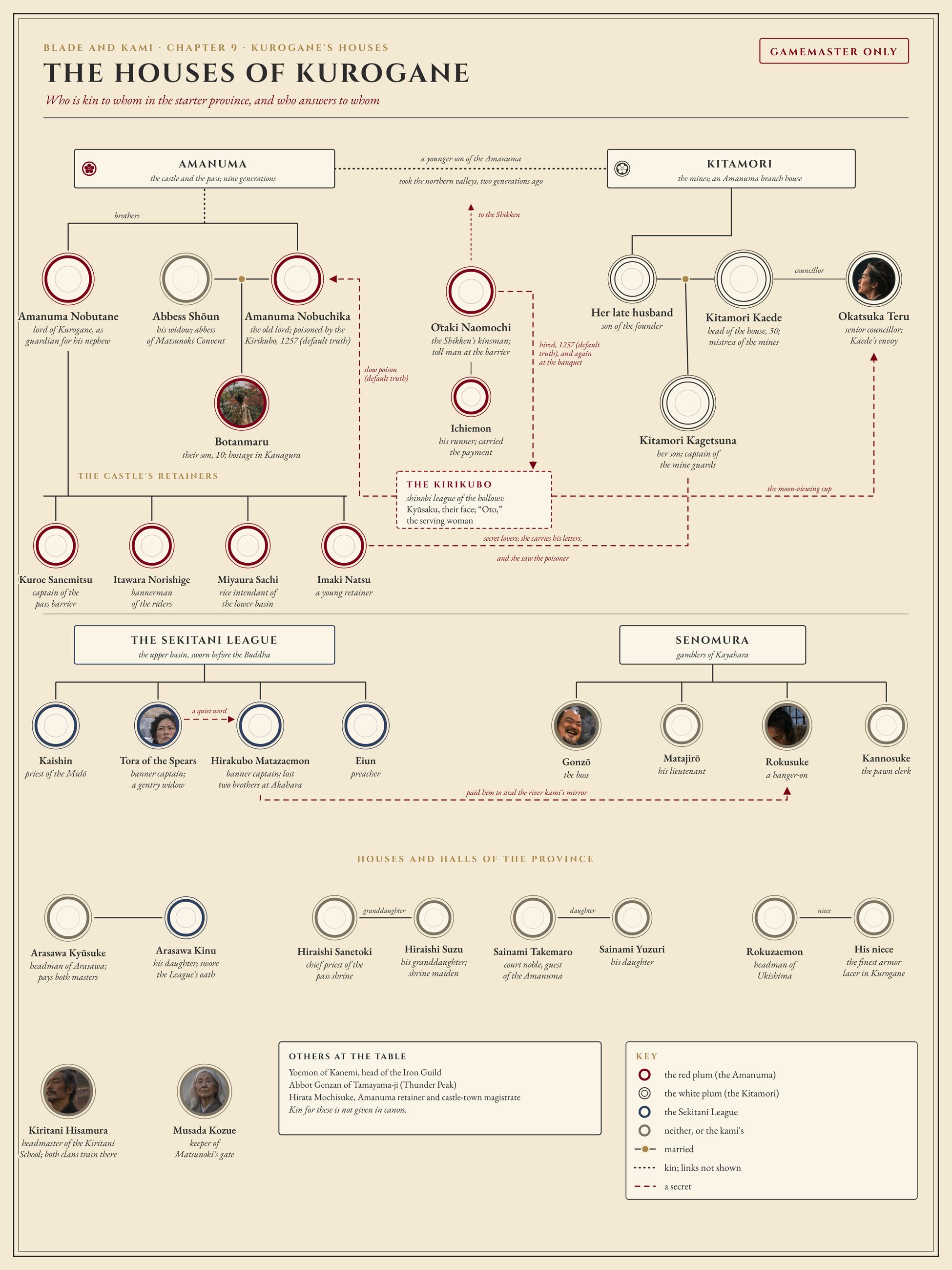
Kurogane is where most campaigns begin (Chapter 8), and it holds two answers the Gazetteer left for this chapter.
Who Poisoned the Old Lord#
Four years ago, in Kenreki 1257, Amanuma Nobuchika, lord of Kurogane, died of what his physicians called a fever. He was the Shikken's problem. He had refused the Shikken's demand for a share of the pass toll, and he had begun to write to Sadatsugu.
The truth. The Shikken gave his kinsman Ōtaki Naomochi a nod and a purse. Naomochi hired the Kirikubo league of the misty hollows (Part 3), and a Kirikubo agent in the castle kitchens fed the lord a slow poison over a month. Within a year, Nobuchika's brother Nobutane sat in his place as guardian of the boy Botanmaru, the boy was a hostage in Kanagura, and Naomochi sat at the barrier collecting the Shikken's share of the toll.
Who knows.
- Ōtaki Naomochi, who arranged it, and the Shikken, who has forgotten it.
- The Kirikubo high masters, who keep the Shikken's sealed commission as insurance. They never sell a client's secret, unless the client tries to silence them.
- Lord Nobutane suspects, and has never dared ask. His guilt is that he profited, and he knows it.
- Abbess Shōun, the widow, believes Nobutane did it, which is why she hasn't spoken to him in four years.
What the proof does. The Kirikubo's sealed commission, or a confession from Naomochi, would show Nobutane that his master murdered his brother. With proof in his hand, Nobutane could turn white, bring his nephew home with the Kitamori's help, and open the pass to Sadatsugu. Kurogane, the first of the wavering provinces, would fall to the white plum without a battle. It is the key that opens the war.
Other Truths. For a darker Kurogane, Kitamori Kaede did it. She meant to make Botanmaru lord with herself as regent, and Nobutane moved faster than she expected. The Kirikubo still hold the proof, and the most sympathetic leader in the province becomes a murderer. What changes:
- The proof is Kaede's own letter to the Kirikubo, not the Shikken's commission. It shows Nobutane that his master is innocent of this one crime, and that his ally is not.
- The suspects. Naomochi and the Shikken know nothing, and say so truthfully. Abbess Shōun's suspicion of Nobutane is still wrong, and now points the heroes away from the Kitamori.
- What the proof does. Kurogane doesn't fall to the white plum without a battle. Nobutane, shown the letter, turns on the Kitamori, and the white plum loses its friend inside the province.
Who Stole the Mirror#
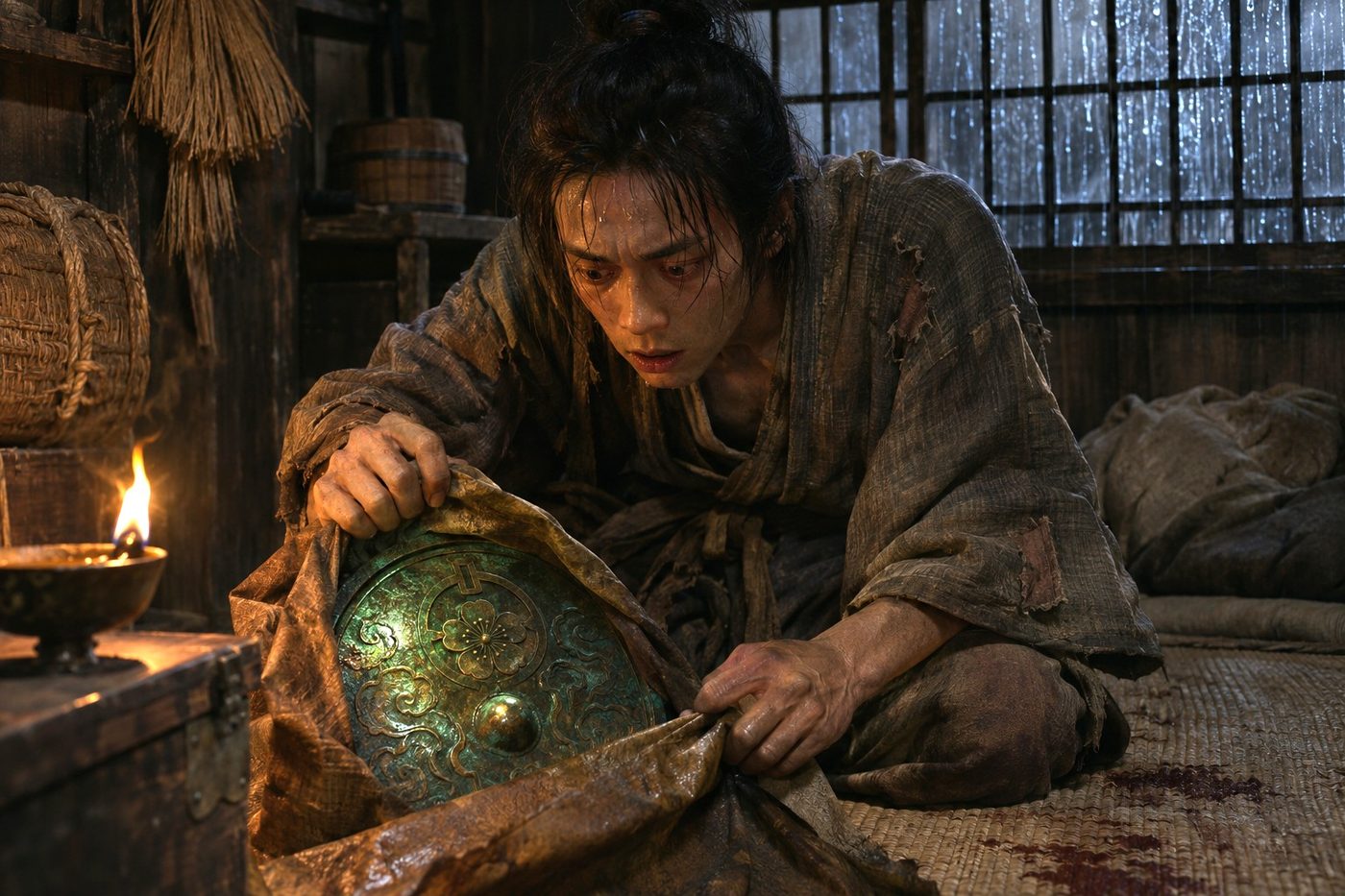
In the spring of 1261, someone stole the sacred bronze mirror of the old river kami of Mizunuma Marsh (Chapter 6), and the blight on the water began to spread. The Kusugawa flows west, toward the castle, so the blighted water falls on Amanuma rice.
The truth. Hirakubo Matazaemon, a League banner captain and gentry farmer who lost two brothers at Akahara, took a quiet word from Tora of the Spears ("I wouldn't weep if the castle's rice failed") as an order. He paid Rokusuke, a hanger-on of the Senomura family in Kayahara, to steal the mirror. Kaishin knows nothing about it. Tora suspects what her words began, and has said nothing.
Rokusuke has the mirror wrapped in oilcloth under a floorboard, and the kami's curse is on him: he is wasting, his hair is falling out, and water won't stay in his mouth. He is trying to sell the mirror in Kayahara before it kills him, which is how it turns up at one of Gonzō's dice houses (Chapter 8). Gonzō doesn't yet know what he has.
What the truth does. Returned to its shrine, the mirror calms the kami and stops the blight (once Akahara's pollution is also cleansed, Chapter 6). If it comes out that the League stole it, the Amanuma have the excuse they need to march on the upper basin, and Kaishin and Tora's alliance breaks.
After Akahara#
A rite to cleanse Akahara needs both the Amanuma and the League (Chapter 6). If the heroes bring it about, each of Kurogane's leaders reacts in their own way.
| Leader | First reaction | If the heroes push for peace | If someone pushes for war |
|---|---|---|---|
| Amanuma Nobutane | Relief, and suspicion: what does the League want? | Agrees to a truce on the lower basin's border, if the League pays a token tax | Sees the League's spearmen gathered for the rite, and wonders if he could catch them unready |
| Kitamori Kaede | Alarm. A peace between the castle and the League leaves her alone. | Asks to join the truce, at a price: the old iron road toll | Offers the League iron for spearheads |
| Kaishin | Joy. The dead are at rest, and the Buddha's mercy has been shown. | Preaches the truce in every village | Refuses to bless any war, which splits the League |
| Tora of the Spears | Grief for the dead, and doubt. Did they die for nothing? | Agrees, if the Amanuma swear before the Buddha | Strikes first, if she believes the Amanuma will |
The GM can let the heroes decide which way it goes, or roll a d6: 1–2, a betrayal (someone strikes during the rite's last night, and the rite still succeeds, but the war begins); 3–4, a cold truce that holds for a year; 5–6, a real peace on the basin, which every daimyo in the region sees, and fears.
Clan Secret Edges#
Each great clan, and each of Kurogane's two houses, keeps a secret of its own. The Edges themselves are in Chapter 3 (Edges, Masters and Clans), so players can see them. To take one, a hero must belong to the clan and hold Status of Trusted or higher within it.
If the Heroes Do Nothing#
The war doesn't wait for the heroes. This table shows what the great factions do over the first year of a campaign that begins in the autumn of Kenreki 1261, if no one interferes. The GM can follow it, bend it, or let the heroes break it, and every event the heroes change changes what comes after. Nothing here ends the war or decides it. The hakobore (Chapter 7) begins at 2, Waking, and each row gives its running total if nothing is done.
| Season | The war | The court and the temples | The hidden ones (Chapter 7) |
|---|---|---|---|
| Autumn 1261 | The Nobuyama attack the Inazuma shipyards. Tokumoto Katsutane marches north to join Sadatsugu after the harvest. The Shikken buys up the rice harvest. In Kurogane, the truce banquet fails, and the blight takes part of the Amanuma harvest. | The Regent sells the same court title to Sadatsugu and to Kuzuhara Akitada. | Master Masuhiro finishes Ryōdan. The Whetstone watches Hiraishi Shrine. |
| End of autumn 1261: Kurogane's marks | Read Kurogane's marks toward war (Chapter 11, The War Clock in One Autumn). One mark: the winter's seasonal event in Kurogane comes in its harsher form. Two or more: Sadatsugu's march on Kurogane Pass comes in spring 1262 instead of summer. The pass's purification deadline moves with it, to the end of spring, and Broken comes as summer 1262 begins (Chapter 7, Part 4). | Hakobore: 2, Waking. | |
| Winter 1261–62 | The Kuzuhara besiege the snow castle, and the snow saves it one more year. In the Eleventh Month, Ichizō marches from Hotaru with the Strait Men, burns the Shogunate's tax registers in Hagane's outer town, and withdraws. | Zhuo Xianfeng takes two tribute ships carrying the western provinces' offerings. The Tasting of the New Rice is performed short, and fails (Chapter 8). | The hakobore rises to 3, Restless. A mayoigami walks the fog valley of Ōgiri. |
| Spring 1262 | Citing Ichizō's raid, the Shikken moves the Shogun to Kanagura "for his safety." Lady Hyoseon refuses to go and holds the eastern wing of Hagane Castle with her son. The admiral, still unpaid, takes half the fleet over to Sadatsugu. | Thunder Peak carries its palanquin to the palace gate to stop the court granting Sadatsugu a title, and the court gives way. | Hiraishi Sanetoki dies. Within a month, Hiraishi Shrine burns "in passing soldiers' fires," and the Whetstone holds a second shard stone. The theft raises the hakobore to 4, Torn. |
| Summer 1262 | Sadatsugu, armed with Kitamori iron, marches on Kurogane Pass. He takes the pass, but not the castle. The war of the two blossoms is open. | The Shikken presses the Emperor to name Sadatsugu an enemy of the court. The Regent names his price. | The dead of the pass lie unpurified. Unless someone cleanses them by the season's end, the hakobore rises to 5, Broken, as autumn 1262 begins. That is the true deadline of the first year (Chapter 7, Part 4: the pass's dated deadline). Broken frees the Lord of the Demon Gate (Chapter 7, Part 3), and he stays free even if the heroes later lower the track. |
Notes#
- The housemen's oath to the first Shogun, the hostage system, and the military regents draw on F. Brinkley, A History of the Japanese People (1915).
Part 2: Temples, Shrines, and Sects#
The Third Power#
Every warlord in Tsurugishima counts three kinds of strength: his own, his enemies', and the temples'. The great sects own more land than most daimyo, keep armies that answer to no lord, and hold the one thing no sword can take: the people's hope for the next life. Lords call them the third power, half in fear and half in envy.
The shrines are different. They hold little land and keep no armies, but they keep the kami, and the kami are waking. A lord can ignore a shrine priest for a hundred years. In the hundred-and-first, the river floods.
This part describes the four great sects, the smaller houses of the Buddha's Law, the Mountain Way, the great shrines and the eight shard-stone shrines, and the Teaching of the Black Book. Each sect entry uses the format in Part 1. Statistics for everyone named are in Part 5.
Optional Rule: The Sacred Palanquin. When warrior monks march on the capital, they carry a portable shrine (shin'yo) holding their temple's guardian kami before them, and dare the court to turn it away. To strike the palanquin is to strike a god. A hero who attacks it, or orders an attack on it, loses 2 Honor and moves one step down the kegare track (Chapter 4). Allied Extras ordered to attack its bearers must make a Spirit roll first, or refuse. In a mass battle, the side that attacks the palanquin subtracts 1 from its Morale rolls (SWADE p. 132) for the rest of the battle. Most lords simply give the monks what they want, which is the point.
The Great Sects#
Thunder Peak (Raihō-shū, 雷峰宗)#
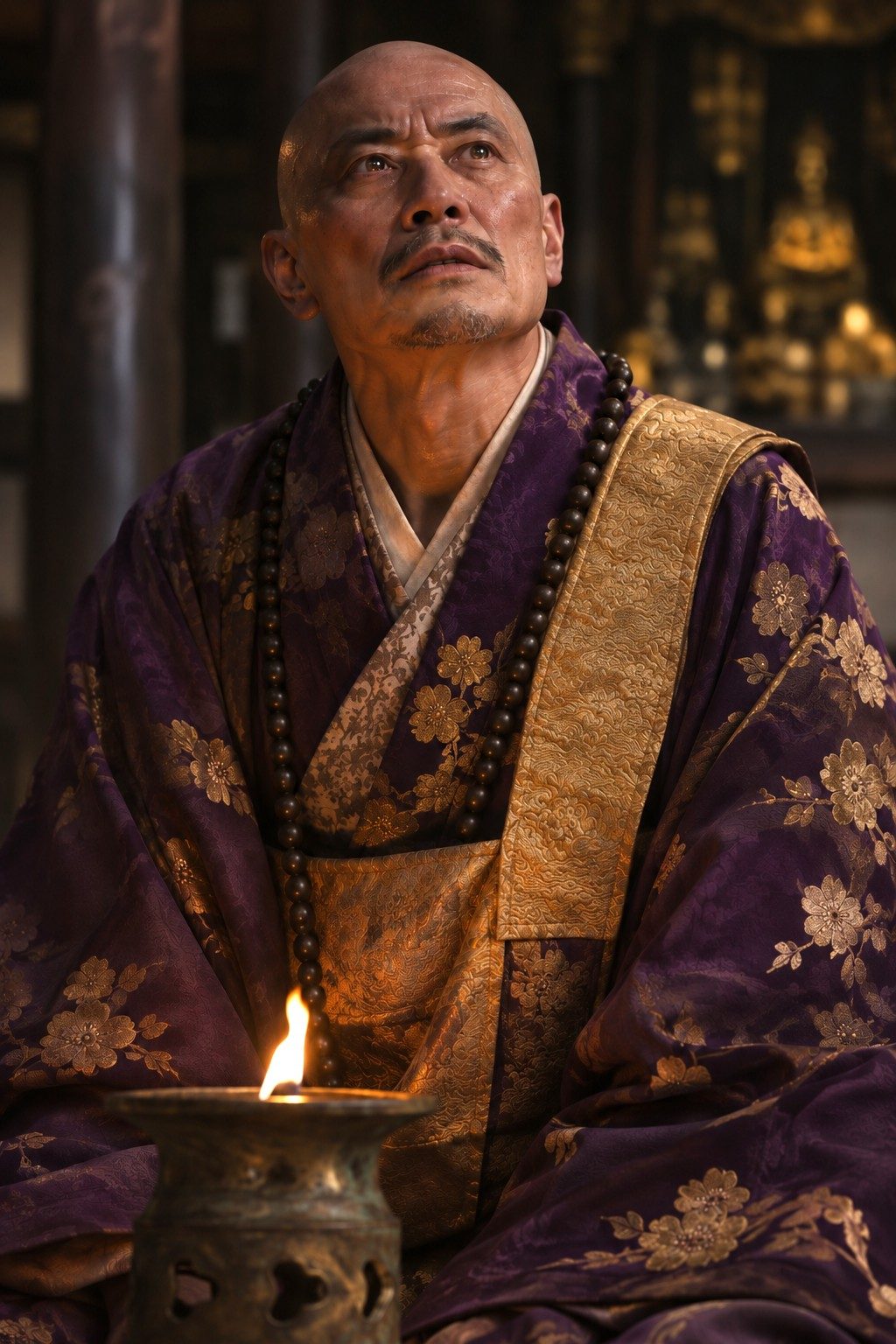
Who they are. The oldest and richest sect in the realm, keepers of secret rites, mantras, hand seals, and fire offerings that only initiates may learn. Its head temple, Raihō-ji, covers the mountain at Seikyō's northeastern demon gate with 3,000 halls, sub-temples, and hermitages. The court, the old noble houses, and most mountain ascetics follow it. Thunder Peak thinks of itself as the realm's spiritual guardian, and it is right, in ways it doesn't fully understand (Chapter 7). It also thinks every other sect is a heresy or a nuisance, and it has burned more than one Lion's Roar temple to prove it.
Who leads.
- Prince-Abbot Taishun, the Cloistered Emperor's younger brother. By custom the Prince-Abbot is always a son of the Imperial house. Taishun is learned, proud, and frightened, because he knows what lies beneath his temple.
- Eisō, master of the warrior monks (sōhei), a scarred giant who fought pirates on the Western Sea before he took vows. He has never lost a fight he started, and he starts a great many.
- Eichi, keeper of the eternal lamp, an old monk who has not left the binding hall in thirty years. He and a handful of monks keep the nightly rites that hold the chains.
- Genzan, abbot of Tamayama-ji in Kurogane (Chapter 8), one of a hundred branch temples that take orders from the mountain.
Strength. Hōzuki, about 150,000 koku in temple lands, and branch temples and estates in every province. About 4,000 warrior monks on the mountain, and as many again at branch temples (count the mountain's monks as elite, Chapter 8). The sacred palanquin. The richest library of secret rites in the isles, which trains more scholar-monks (gakushō) than any other.
What they want. Their lands and privileges kept, the Western Light leagues broken, the Lion's Roar preachers silenced, and the dragon cult of Mizuchi brought under the mountain's rule. Taishun wants something simpler: for no one ever to empty the mountain.
What they fear. A warlord who would burn Raihō-ji. Taishun fears the Cloister's order to march with every monk, because he would have to refuse it, and could never say why.
What they offer heroes. Sanctuary on the mountain, which no lord dares break. Training in the secret rites for a hero with Arcane Background (Gakushō) or (Sōhei) (Chapter 6). Warrior monks as allies, and letters that open every Thunder Peak gate in the realm.
What they ask. Find the monks who went into the Mizuchi marshes and never came back (Chapter 8). Silence a Lion's Roar preacher mocking the mountain in Seikyō's streets. And, if the heroes earn real trust, learn what became of Kūzan, the brilliant scholar-monk who vanished twenty years ago.
Secrets. The Lord of the Demon Gate, a great oni from Yomi, lies bound beneath the mountain. The eternal lamp holds its chains, and the lamp goes out if the temple burns or if every monk leaves the mountain at once (Chapter 7). Only Taishun and the keepers of the binding hall know. That is why, when the War Clock sends the palanquin to the palace gate in the spring of 1262 (Part 1), Taishun quietly keeps the keepers and two hundred monks behind. If Taishun dies, or is replaced by a Prince-Abbot nobody has told, the next march may empty the mountain. Kūzan is now the master of the Whetstone (Chapter 7), and the mountain has no idea. One of the monks lost in the Mizuchi marshes was the Whetstone's agent, sent to find the dragon's shard stone (below).
Friends and foes. Friends: the Cloister, the old court families, the Mountain Way lodge. Foes: the Western Light leagues, the Lion's Roar, the dragon priestesses of Mizuchi, and, quietly, the Regent, who would like the Cloister weaker.
Attitude. Neutral. Friendly to genja of the Mountain Way and to anyone carrying a Thunder Peak temple's letter. Uncooperative to Western Light faithful.
Western Light (Saikō-shū, 西光宗)#
Who they are. The fastest-growing sect in the realm, and the most frightening to lords. It teaches that faith alone saves: anyone who calls on the Buddha of Boundless Light, even a butcher, a sakaibito, or a murderer, is reborn in the Western Paradise. Its priests marry and eat as other men do, and its head abbot's office passes from father to son. Farmers, the poor, and the rural gentry have flocked to it for two centuries. In the last thirty years its faithful have learned something new: that a village that swears an oath before the Buddha can stand together against its lord, and that a hundred villages can drive him out. Those sworn bands are the sect leagues (ikki), and they now rule Hotaru and the upper basin of Kurogane.
Who leads.
- Ryōken, head abbot of Ryōun-ji, the fortified temple city in the marshes of Hotaru. He is the eighth of his line, gentle and shrewd, and he wants peace.
- Ichizō, a former foot soldier of the Cheongun War who leads the Strait Men, about 3,000 unpaid veterans who have joined the leagues. He wants to march on Hagane and burn the Shikken's tax registers (Chapter 8). The leagues are listening to him.
- Kaishin and Tora of the Spears, the priest and the captain of the Sekitani League in Kurogane (Chapter 8).
Strength. Hotaru, about 300,000 koku. About 6,000 sworn league fighters there, and as many more farmers when the temple drums sound, plus Ichizō's Strait Men. The Sekitani League's 1,200 in Kurogane. Secret members in villages across the east and the Inner Provinces, including a third of the levies of Asagiri (Chapter 8). The leagues fight as a Temple League in mass battles (Chapter 5).
What they want. Ryōken wants the leagues to survive, which means no march on Hagane. Ichizō wants justice for the veterans, and is ready to burn the realm to get it. The faithful want to keep their own rice.
What they fear. Thunder Peak's warrior monks, the Lion's Roar brotherhoods, and a great lord, of either blossom, who decides the leagues must be crushed before the war can be won.
What they offer heroes. Shelter. A league village takes in a fugitive, an otazunemono (Chapter 3), a sakaibito, or a ronin with no questions asked, as long as they call on the Buddha and keep the peace. League scouts know every dike path and reed channel in Hotaru.
What they ask. Guard a preacher on the road. Carry a letter from Ryōken that must not reach Ichizō. Or, from Ichizō, find the Shogunate's spy in the veterans' camp.
Secrets. Ryōken has written to the Shikken, promising that Hotaru will stay quiet if the Shogunate recognizes it as temple land. If Ichizō learns of the letter, he will call it betrayal, and the leagues may split. Ichizō, for his part, has met with a white plum officer of Sadatsugu's, who promised the veterans their back pay if they rise at the right moment.
Friends and foes. Friends: the poor, the sakaibito, the Strait Men. Foes: Thunder Peak, the Lion's Roar, the Shikken's tax collectors, and every lord with league villages on his border.
Attitude. Uncooperative to samurai they don't know. Friendly to commoners, to sakaibito, and to anyone who says the Buddha's name with them.
Still Mind (Jōshin-shū, 静心宗)#
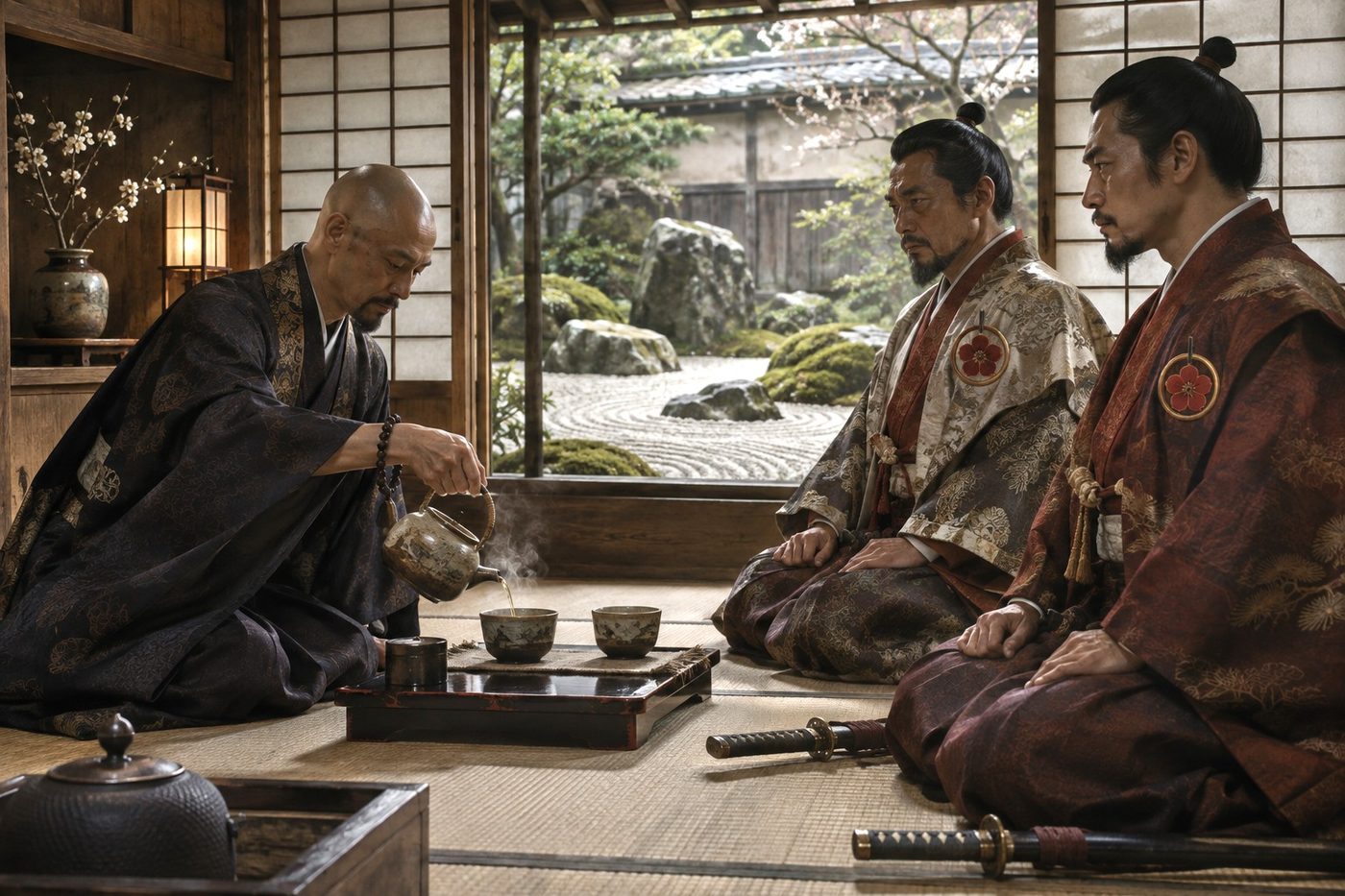
Who they are. The sect of seated meditation, discipline, and sudden insight, taught through riddles, tea, ink, and gardens. It has no armies and few farmers, but it has the warriors. Samurai like its plainness, its courage before death, and its silence. The Shogunate and the great lords give it land and gold, and send their sons to its temples to learn letters, poetry, and calm. Still Mind's two great temples, Zenkai-ji in Hagane and Genten-ji in Kanagura, have become the red plum's two chapels, and they watch each other the way their patrons do.
Who leads.
- Seian, abbot of Zenkai-ji, the Shogun's closest friend and confessor, about sixty, kind, plain-spoken, and a fine painter of bamboo. The Shikken's spies watch everyone who visits him.
- Ryōchi, abbot of Genten-ji, the Shikken's abbot, a polished tea master in his forties who has never once said anything he would regret. The most important business in Kanagura is done in his tea rooms.
Strength. No soldiers to speak of. Rich estates, the realm's best schools, and something better: nearly every great lord of the red plum was taught by Still Mind monks as a boy and still writes to them.
What they want. Seian wants the Shogun well and at peace. Ryōchi wants Still Mind to come through the war whole, whichever blossom wins.
What they fear. A patron's fall. Genten-ji was built with the Shikken's money, and the Strait Men have promised to burn it.
What they offer heroes. Introductions. A letter from either abbot gets a hero a hearing with any red plum lord, and a seat at a tea gathering where real decisions are made. The temples' schools also train heroes in calligraphy, poetry, and the tea ceremony, which count in court intrigue (Chapter 4).
What they ask. From Seian: help for the Shogun, without the Shikken knowing. From Ryōchi: carry a sealed letter to a Still Mind temple in the white plum's lands, and don't ask what is in it.
Secrets. The Shogun has told Seian about the voices. Seian believes they are grief and counsels meditation, which only opens the Shogun wider to them (Chapter 7); the abbot means well and is wrong. Ryōchi's sealed letters go to Sadatsugu, through a Still Mind abbot in Kasumi: polite, spiritual, and promising nothing, so that Genten-ji has a friend whoever wins. He also keeps a list of every lord's son his temple has taught, with notes on each one's weaknesses.
Friends and foes. Friends: the Shogun's house (Seian), the Ōtaki (Ryōchi), the samurai of both blossoms. Foes: none openly. The Lion's Roar calls them idle, and the Strait Men call Genten-ji the Shikken's counting house.
Attitude. Neutral, with perfect courtesy.
Lion's Roar (Shiku-shū, 獅吼宗)#
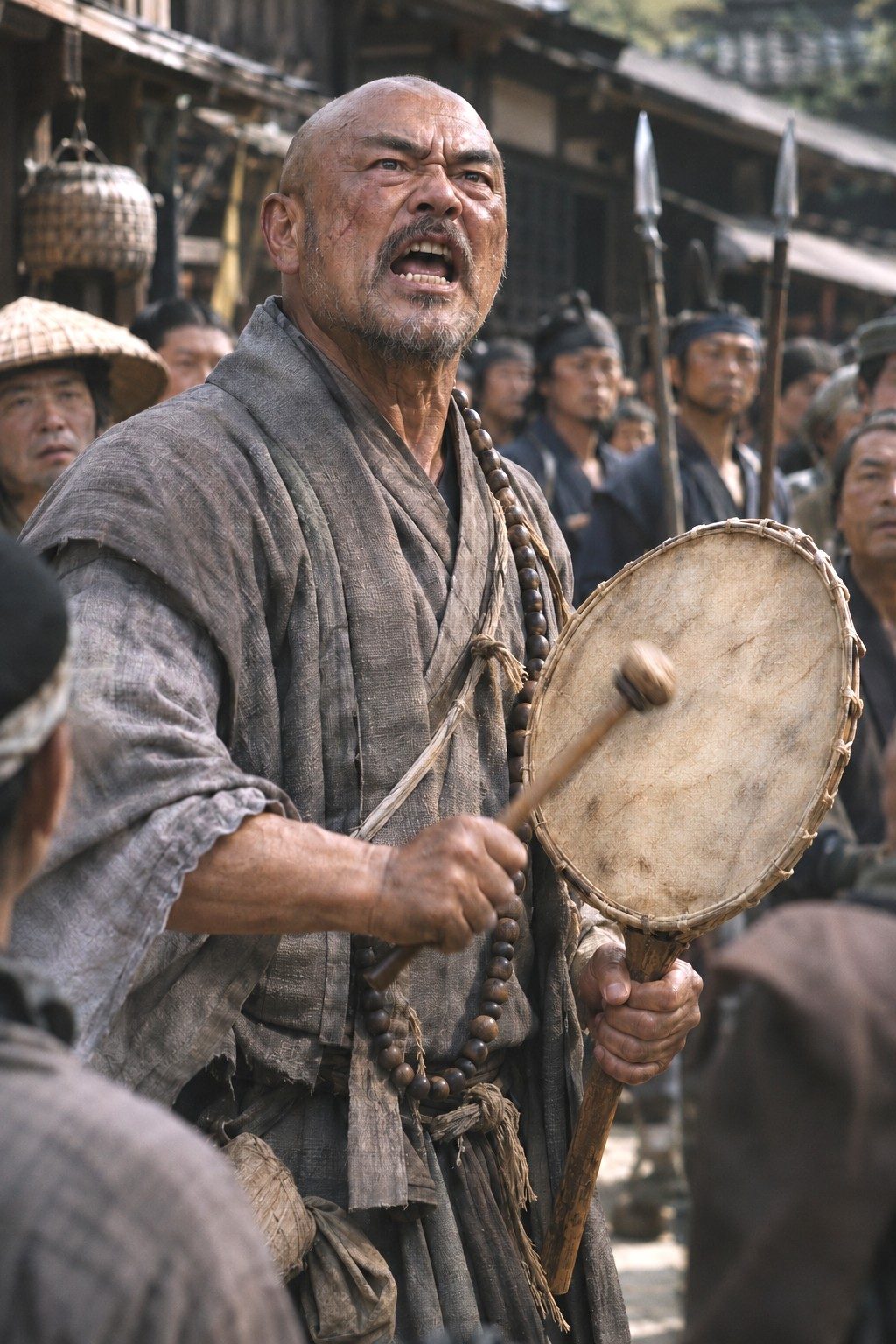
Who they are. The sect of the one true sutra. Lion's Roar teaches that a single sutra holds the whole truth, that chanting its title saves, and that every other sect leads the realm to ruin. Its preachers beat fan-shaped drums on street corners and shout down monks of other sects in the market. Its faithful are townsfolk: artisans, shopkeepers, fishmongers, and the merchants of the Inland Sea, who like a faith that tells them plainly what is true. In Kanagura and the harbors of Yūnagi, the townsmen have formed armed brotherhoods that guard their wards against robbers, fires, and Western Light leagues alike.
Who leads.
- Sonzan, head abbot of Shōkai-ji, the sect's head temple, which stands at the heart of Kanagura's Lion's Roar quarter (Chapter 8). He is a fishmonger's son in his fifties, with a voice that carries across a harbor. He has been exiled twice and beaten more often, and none of it has ever made him quieter.
Strength. No land worth the name. About 2,000 armed townsmen in Kanagura's brotherhoods and as many in Yūnagi's harbors (count them as soldiers, Chapter 8), and the money of a hundred merchant houses. The brotherhoods can fill a street in the time it takes to beat a drum.
What they want. For the rulers of the realm to honor the one true sutra and outlaw every false sect. Sonzan has sent the Shikken a memorial warning that the realm's floods, blights, and walking spirits are punishments for heresy, and that if the rulers don't repent, an enemy will come from across the sea.
What they fear. Thunder Peak, which has burned their temples before, and a Shikken who decides they are more trouble than they are worth.
What they offer heroes. The brotherhoods' protection in any harbor town on the Inland Sea, a bed in any Lion's Roar household, and street-level news from every ward in Kanagura.
What they ask. Protect a preacher whom Thunder Peak has marked. Find who is selling the brotherhoods' secrets to the Western Light. Or hunt down the converts of the Black Book, whom Sonzan calls the worst heresy of all.
Secrets. The brotherhoods have quietly bought 200 matchlocks in Umikado's back streets, without a single license. Sonzan is right that the floods and spirits are no accident, and right that an enemy may come from across the sea (Chapter 7). He is wrong about why.
Friends and foes. Friends: the Shikken (for now, Part 1), the Council of Ten Houses, the Kanezaki of Yūnagi. Foes: Thunder Peak, the Western Light, the Black Book, and, in Sonzan's sermons, everyone else.
Attitude. Uncooperative, unless the hero chants the sutra's title. Then Friendly, and loud about it.
Smaller Houses of the Law#
- The old sects of Furumiya. The great scholarly temples of the first capital (Chapter 8) are wealthy, learned, and mostly harmless. They keep giant bronze statues, sacred deer, and treasures older than Seikyō. In a locked sutra hall they also keep the Tatara Record, which perhaps three of their scholars can read (Chapter 7). The Shikken pays them well, which is why Tatsumi is red.
- The circuit of Ōgiri. The 48 temples of the pilgrim circuit (Chapter 8) belong to several sects and answer to none of them. They keep about 500 warrior monks between them, mostly to guard pilgrims.
- The Tamaeda convent. The nuns of the convent on the Ōgiri circuit have taught the glaive for three centuries (Chapter 3). They take no side in the war, and give sanctuary to women fleeing it.
- Convents across the realm give sanctuary to wives fleeing their husbands, and to widows who take vows to escape a second marriage. Part 4 explains the law of it.
The Mountain Way#
Who they are. The mountain ascetics (yamabushi) of the Mountain Way (Shugendō), who mix the kami and the Buddha's Law and seek power in the high places (Chapter 6). They belong to no one sect, though most are tied to Thunder Peak. Every ascetic in the realm has trained at least once on the ridge paths of the Tamagami mountains south of Furumiya, and their great lodge there is the closest thing the Way has to a head temple.
Who leads. Zenshun, the great guide (daisendatsu) of the Tamagami lodge, a wiry old ascetic who has walked the full ridge path, shrine to shrine, more than forty times. He speaks softly, laughs often, and has been seen arguing with a tengu.
Strength. No army. Several thousand ascetics who walk every mountain road in the realm, carry messages for anyone who pays, and are never stopped at a barrier, because no guard wants a mountain ascetic's curse. That makes them the best couriers and the best spies in the isles. Every side uses them, and every side knows it.
What they want. The mountain paths open, the mountain kami honored, and the high shrines kept.
What they fear. The Whetstone, though they don't know its name: for twenty years, ascetics have found old mountain shrines robbed, and lately a few of their own have gone missing on the high ridges.
What they offer heroes. Guides for any mountain road, safe passage through barriers in an ascetic's robes (a common disguise, and a dangerous one to be caught in), and training for a hero with Arcane Background (Yamabushi) (Chapter 6).
What they ask. Escort an ascetic to a shrine that hasn't been visited in a hundred years (Chapter 8). Find the ascetics who vanished on the high ridges.
Secrets. The lodge keeps an old route-book, The Way of the Eight Old Shrines, that describes a forgotten pilgrimage to the eight oldest shrines of the realm, one in each region. The ascetics think it is a curiosity. It is a map of the eight shard stones (below), and the Whetstone stole a copy of it twenty-one years ago, through a young Thunder Peak monk who came to the lodge to study: Kūzan. A tengu on the Tamagami ridge really is teaching a young samurai the sword (Chapter 8), and Zenshun knows which one.
Friends and foes. Friends: Thunder Peak, the mountain kami, the tengu who keep their bargains. Foes: none openly.
Attitude. Neutral. Friendly to genja and to anyone who has stood under a winter waterfall.
The Great Shrines#
The shrines aren't one faction. Each great shrine serves its own kami, keeps its own priestly family, and has quarreled with its neighbors for a thousand years. What they share is a world that is getting harder to keep pure, and a few old priests who are starting to understand why. These are the great shrines a campaign is most likely to visit.
The Great Shrine of Kagaribi (Kagaribi, Chapter 8). The oldest shrine in the realm, where the kami of the isles gather each Tenth Month. Its high priest, Shirakado Yasutsugu, is the head of a family older than the Imperial line, and he says so. He is austere, proud, and very tired. He knows what the shrine guards: the great rock that seals the road to Yomi, cracked a hand's width since the Spoiled Tasting of 1256 (Chapter 7). He knows the hakobore is widening. He has told no one outside his shrine, because no one outside his shrine would believe him, and he has begun to look for someone who would. Offers: shelter, purification, and the truth, to heroes who prove they can carry it. Asks: find the kami who failed to arrive at the gathering (Chapter 8). Attitude: Neutral.
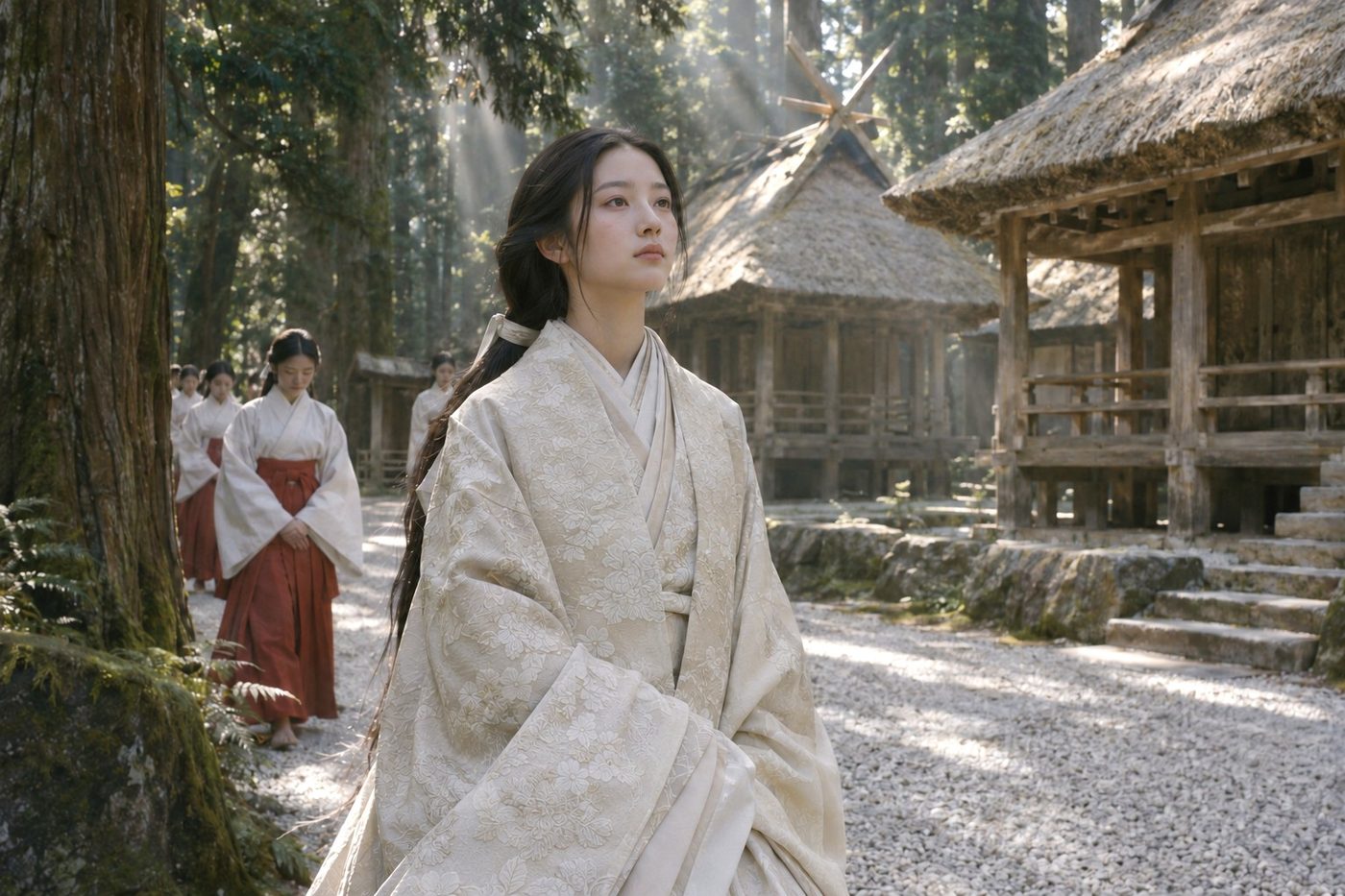
The Great Shrine of the Forging Gods (Tatsumi). The shrine of the gods the Emperor descends from, in the cedar forests south of Furumiya, a morning's walk from the Empress's tomb. Its plain halls are torn down and rebuilt in fresh cypress every twenty years, exactly as before, so that they are always new and always ancient. Each Ninth Month the Imperial envoy brings the first rice here (Chapter 8). The chief priest is Akisato Nobukiyo, a careful court ritualist who has never seen the shrine's sacred object, because no one has seen it in eight centuries. The shrine is served by an Imperial Votaress (itsuki-no-miya), an unmarried princess of the Imperial house who lives in purity beside the shrine. The present Votaress, Princess Shizu, is the Emperor's younger sister, seventeen, and a true kannagi, though only the shrine maidens know it. Offers: the court's favor, and purification of the gravest kind. Asks: guard the Ninth Month envoy on the road, because the roads are no longer safe even for gods' rice. Attitude: Neutral, and formal.
The shrines of Mount Hōrai (Kasumi). A string of small shrines up the holy mountain's slopes, each kept by a family that has lived on the mountain for centuries. They belong to the Eight Kami of the Mountain, and they insist the gods' council meets here, not at Kagaribi. A few of the keepers leave food out at night for "the old man" with the lantern, and don't ask who he is (Chapter 7). Meng Ruiyuan pays some of them for news (Chapter 7). Attitude: Uncooperative to strangers who ask about the lights.
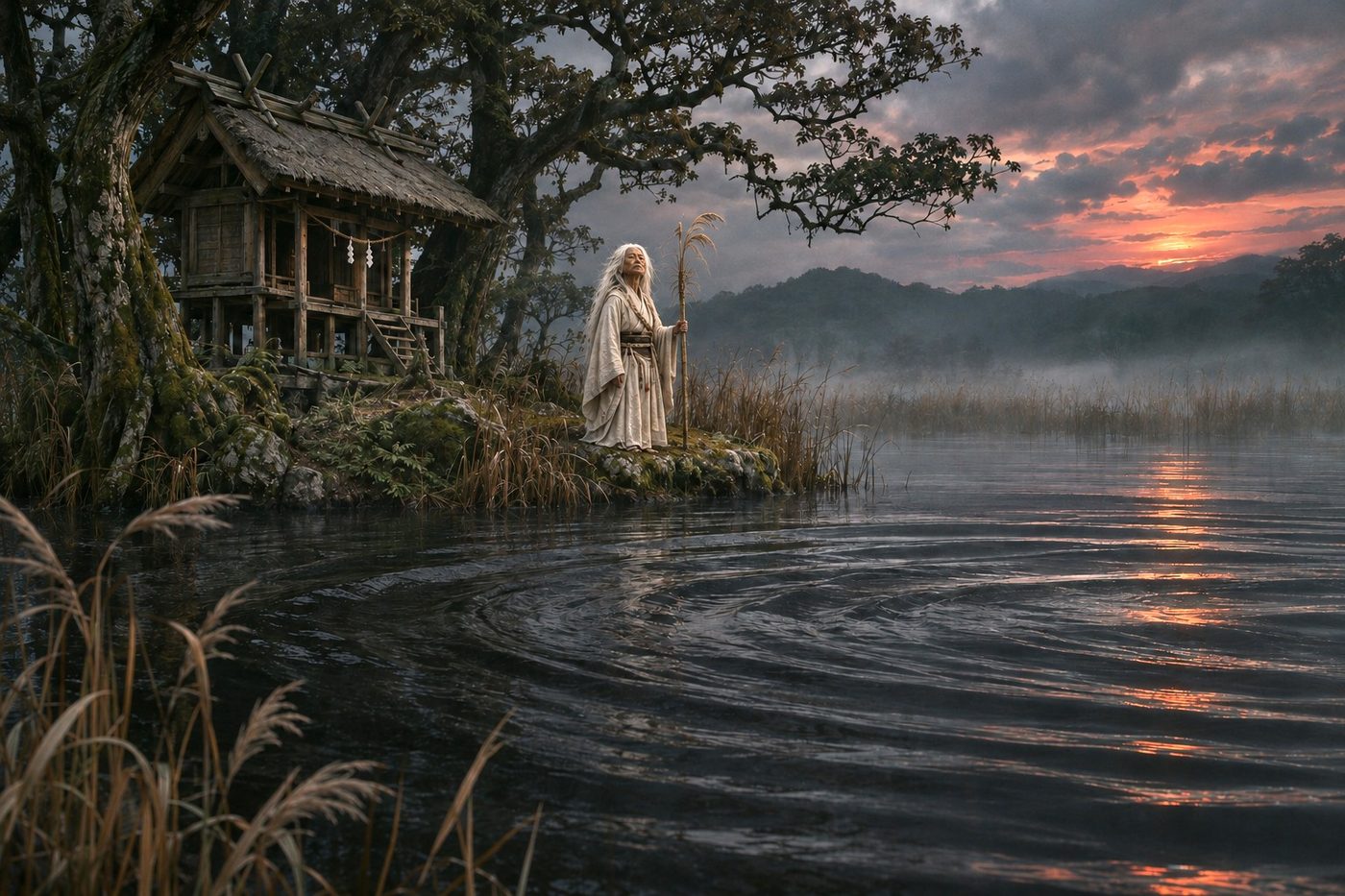
The dragon's pool of Mizuchi (Mizuchi, Chapter 8). The island shrine of the water dragon, served by priestesses whom the marsh folk obey before their lord. The high priestess, called only the Dragon's Bride (her own name was given to the dragon when she took the office), is ancient, sharp-tongued, and absolutely certain. Thunder Peak calls her cult heathen; Thunder Peak's monks went into the marshes and haven't come back. She keeps the riddle of where the Tide Jewels lie (Chapter 6), and the dragon keeps something else at the bottom of its pool (below). Offers: the dragon's protection on any river in the west. Asks: keep Thunder Peak out of the marshes. Attitude: Hostile to monks of Thunder Peak, Neutral to everyone else.
Hiraishi Shrine (Kurogane, Chapter 8). The first shrine of Kurogane, at the summit of the pass, kept by the Hiraishi family for 600 years. Hiraishi Sanetoki, the chief priest, is old and dying, and knows his flat stone is a shard of the Great Sword. His granddaughter Suzu speaks for the kami in trance. It is the shrine the heroes are most likely to protect, and the one the Whetstone is watching (Part 1).
The Eight Shard-Stone Shrines#
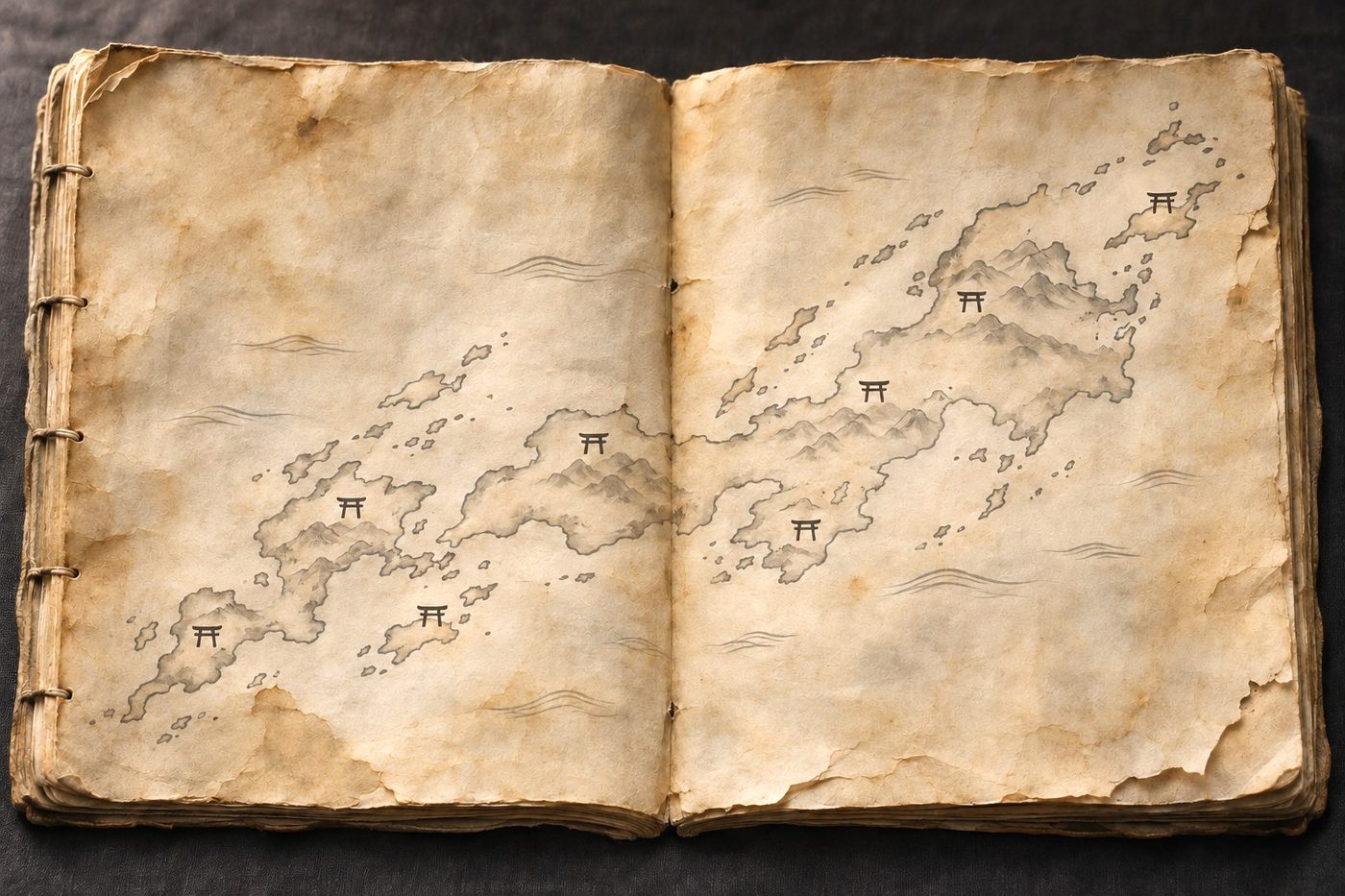
When the Great Sword shattered and the isles were made, eight true fragments survived as stones. Each is kept at one of the realm's eight oldest shrines, one in each region (Chapter 7). Most of their priests think their stone is simply holy. Only three of the eight chief priests know what it really is. The Whetstone knows all eight, and it holds one already.
| Region | Shrine | Province | The stone and its keepers | Who knows | Its state |
|---|---|---|---|---|---|
| Kissaki-jima | Akaishi ("Red Stone") | Hinoe | A rust-red slab in a lava cave on the volcano's flank, warm to the touch. The Tokumoto pray here before every war. Its young priest, Akaishi Toshinari, inherited the shrine last year. | No one | Safe for now. The volcano rumbles whenever the hakobore rises. |
| Tsuba-jima | Kiriyama ("Fog Mountain") | Ōgiri | A black stone in a small shrine inside the gates of a circuit temple, beside the fog valley. Pilgrims touch it for luck, and their hands have worn it smooth. | No one | In danger when the hakobore reaches 3 and a lost god walks the fog valley (Chapter 7). |
| Nishiji | The dragon's pool | Mizuchi | At the bottom of the pool, where no diver has ever reached it. The dragon lies coiled around it. | The Dragon's Bride | The safest of the eight. The Whetstone's agent tried and drowned. |
| Uchikuni | The Great Shrine of the Forging Gods | Tatsumi | The shrine's hidden sacred object, which no one has seen in eight centuries. The priests believe it is a mirror. | No one living | Guarded by the court, the shrine's holiness, and the Whetstone's fear of being seen. Kūzan means to take it last. |
| Yamaji | Hiraishi ("Flat Stone") | Kurogane | The flat stone beside the pass road, under a sacred rope, guarded by two stone foxes. | Hiraishi Sanetoki | It bled last month. Watched by the Whetstone. If the heroes do nothing, it is lost in the spring of 1262 (Part 1). |
| Higashiji | Kuroishi ("Black Stone") | Kazahaya | Gone. The shrine burned in the private wars ten years ago, and its family died with it, all but a daughter who became a nun. | The Whetstone | Held by the Whetstone. The nun, now in a convent in Hagane, is the only living person who could identify the stone on sight. |
| Kitaji | Shiraishi ("White Stone") | Shimoyuki | A pale stone on an island in a mountain lake, reached on foot only when the lake freezes. Kept by an old priestess and her two grandsons. | The old priestess | In danger. The Kuzuhara war is creeping toward the lake (Part 1). |
| Tsuka-jima | Ishikura ("Stone Storehouse") | Hate-no-Kuni | A stone in the ruins of a shrine deep in the northern forest. No one has kept it for a hundred years. | No one | Unguarded. The old kami of the north have never touched it, and the Whetstone hasn't dared to go and see why (Chapter 7). |
The Whetstone gains a stone every year or so if no one stops it (Chapter 7). Whichever stone the GM's story puts at risk next, a shrine burned "in passing soldiers' fires" or a keeper found dead in the snow is the first sign.
The Teaching of the Black Book#
Who they are. Ten years ago, the great black ships of the far westerners began to put in at Umikado, and with their guns, glass, and clocks came preachers of a single god (Chapter 2). Islanders call their faith the Teaching of the Black Book (Kokusho-kyō), for the small black book every believer carries. A few thousand islanders in Akashio and its outer islands have taken it: fishermen, merchants, the poor, and a lord's daughter. The temples call it a plague. The Shikken taxes it and keeps a register of its converts. Most islanders have never seen a foreigner.
The Black Book's people are neither saviors nor villains. Their preachers are brave, learned, and sincere, and some of them are also arrogant, and all of them depend on a trade that does terrible things. Their converts are islanders who found something in the book they couldn't find elsewhere. The GM should play them as people, the way the sects are played: with real faith, real courage, real blind spots, and real enemies.
How It Came#
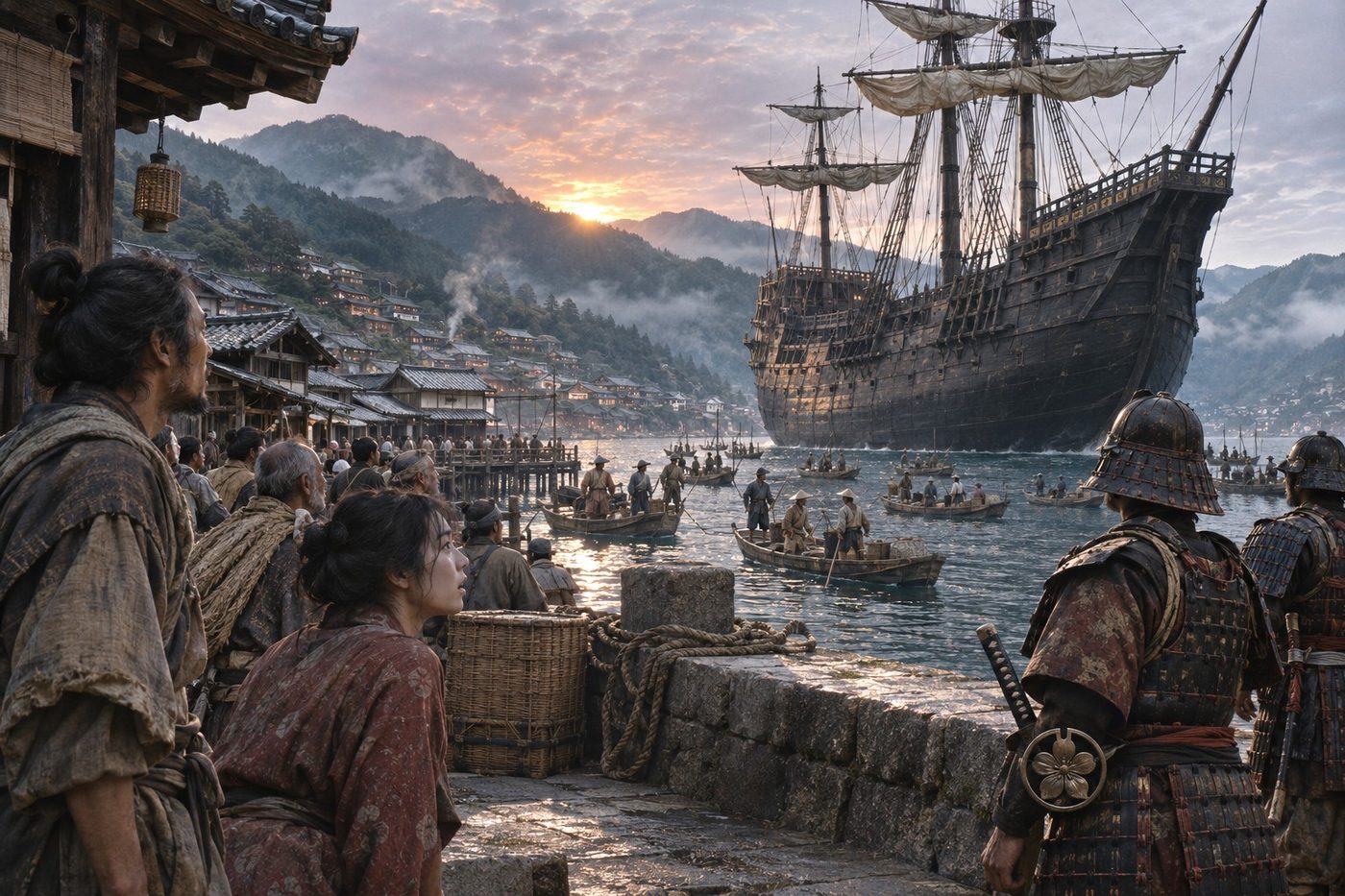
The Great Ship. The far westerners' trade turns on one voyage a year: the Great Ship, a huge black-hulled carrack that comes on the summer winds with Daqian silk bought in mainland ports, sells it in Umikado for silver, and sails home on the winter winds. Everything else follows the Great Ship: the guns, the clocks, the preachers, and the money that pays for the preachers. The elder of the Black Book takes a share of the silk cargo every year to keep his mission alive, and the Port Commissioner, who taxes every bale, knows exactly how much.
The great mistake. When the first preacher came ashore, he hired a fisherman's son to put his god's name into the island tongue. The young man, a Thunder Peak faithful, chose the grandest name he knew: the title of the sun-like buddha at the heart of Thunder Peak's secret rites. For a year the preacher stood in Umikado's markets and urged people to worship that buddha, and the Thunder Peak monks welcomed him as a new teacher of their own faith, from the Buddha's own country far to the west. When the preacher learned what the name meant, he was horrified, and began to use his own tongue's word for his god instead. To island ears the word sounds like ō-uso, "the great lie," and the temples have never let anyone forget it.
The temples' first mistake. Islanders who see a Black Book service for the first time often think it is a new sect of the Buddha's Law, and it is easy to see why: altars, candles, incense, rosaries, chanting, vows of celibacy, shaven heads among some of the preachers, and a holy book. Thunder Peak, Still Mind, and Lion's Roar learned better within a year. The fishermen of the outer islands still argue about it.
The Elder and the Black Robes#
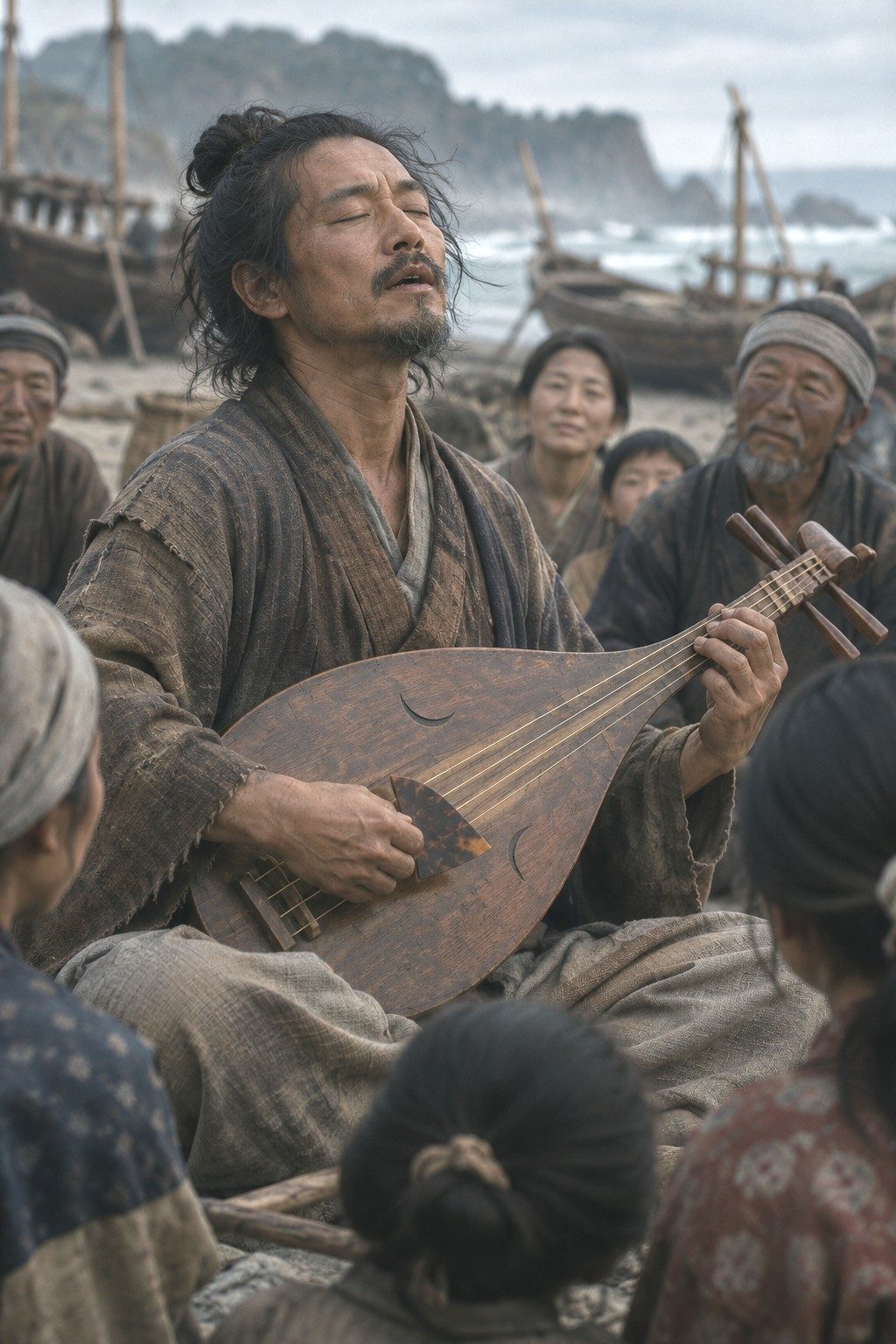
The preachers wear long black robes and call themselves by a word that means "fathers." Islanders call their leader the elder of the Black Book (Kokusho-no-chōrō), and he is a man of fifty, tall, gray, and patient, who speaks the island tongue better than many islanders. He has decided that the faith will never win the isles while it looks poor. His preachers now dress in silk like Still Mind abbots, keep their houses spotless, learn the tea ceremony, and never eat meat in front of guests. The younger preachers think this is wrong; the first preacher, they remind him, walked into the eastern cities barefoot and in rags, and was stoned. The elder reminds them that he was stoned.
The preachers are few, perhaps a dozen in the isles. The real work is done by islanders:
- Lay catechists (dōjuku, "those who share the lodging") are islander converts who live with the preachers, teach the faith in the island tongue, and do most of the preaching. The best of them is Tōsaku, a blind lute-singer who once wandered the roads chanting war tales for coins, and now chants the Black Book's stories in the same voice. Crowds that would never listen to a foreigner listen to him. Thunder Peak's monks have tried to argue him down in public three times, and lost three times.
- Confraternities (kumi) of lay believers meet in each village and town ward to pray, bury their dead, care for widows, and keep the faith alive when no preacher can come. In the outer islands, a kumi is the village.
The House of Mercy#
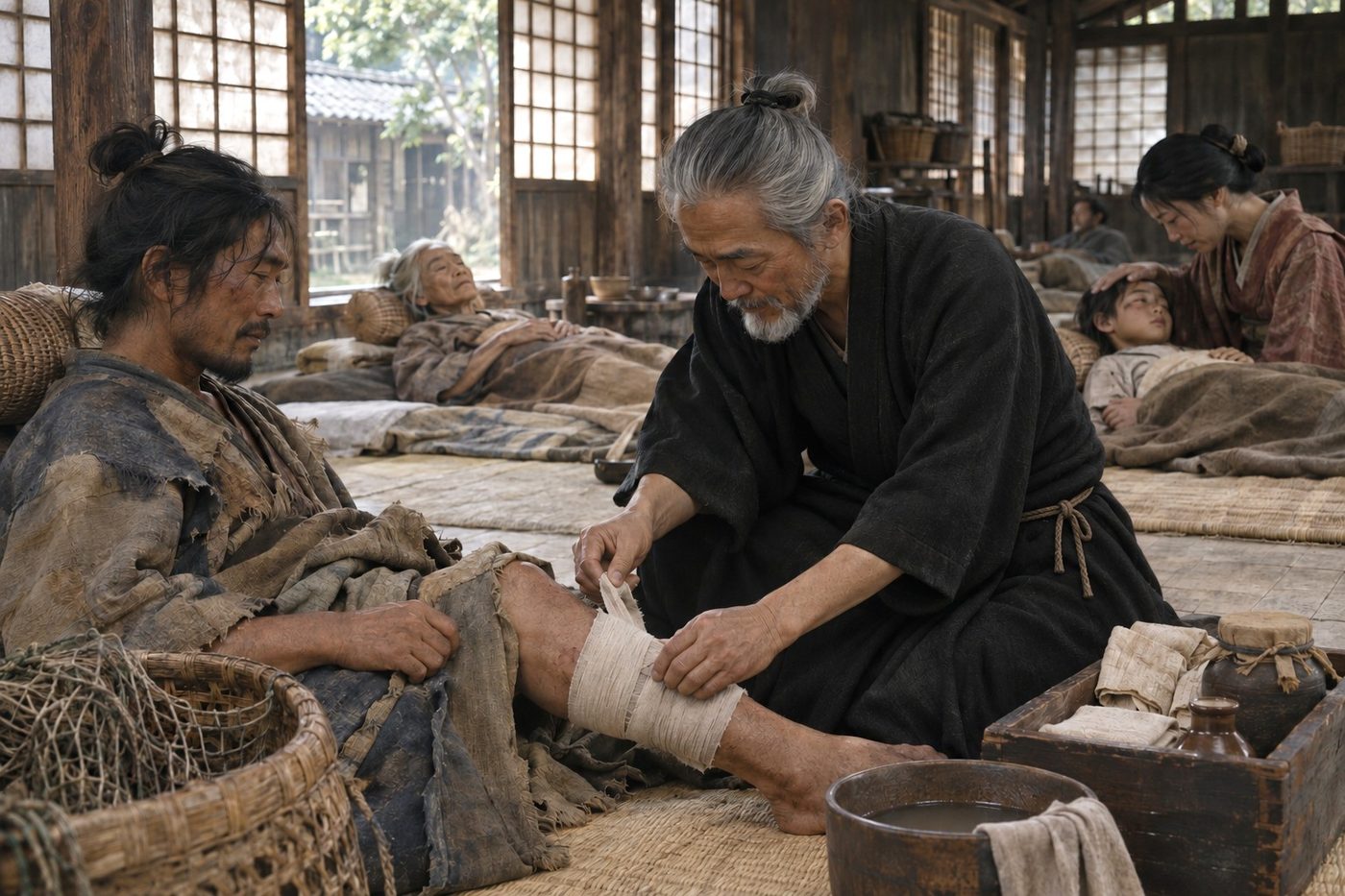
The faith's first converts didn't come from the market. They came from the house of mercy (jihi-no-ie), a hospital on the edge of Umikado where a former merchant of the black ships, now a lay brother of the faith, spent his whole fortune to nurse the sick, the poor, lepers, and children left at the temple gates. His patients were the first to be baptized, and the faith has carried their stamp ever since. Men of position stay away, because they won't share a faith with the lepers of the house of mercy. The fishermen and the poor come because nobody else ever nursed them.
Lord Takekuni and His Daughter#
Nishioka Takekuni, daimyo of Akashio (Part 1, Chapter 8), owns 300 foreign guns and has listened to the preachers with interest. Interest is all it is, so far. In other lands, the preachers tell him, a lord who took the faith gave the fathers a harbor of their own and destroyed the temples on his land, and the Great Ship came to his port every year. Takekuni can do that arithmetic. He has not yet decided whether the price is worth it, and the temples are watching him closely.
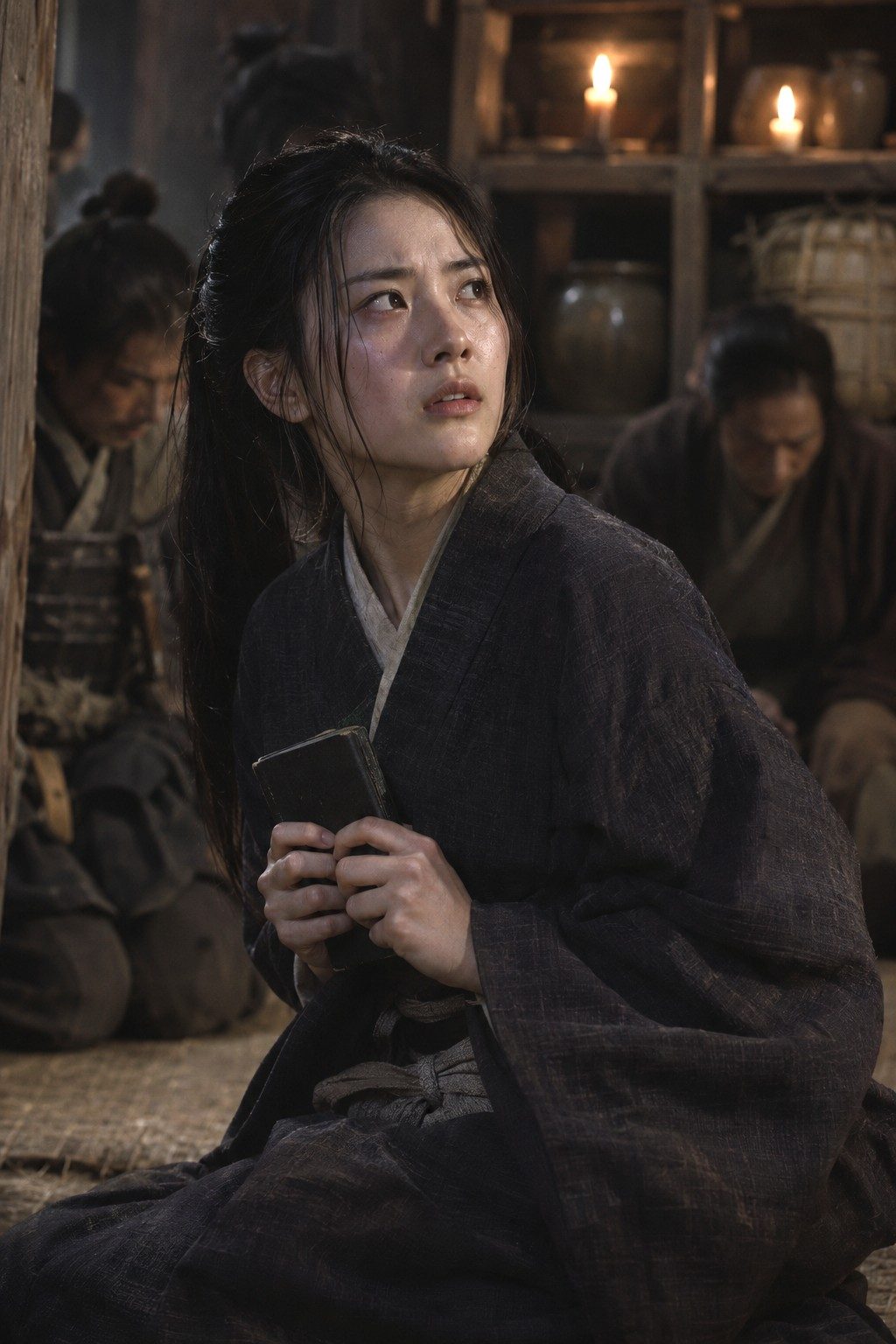
His daughter Nishioka Tamae, nineteen, has already decided. She took the faith in secret two years ago, from Tōsaku, and goes by night to the hidden chapel in the city, a merchant's storehouse behind the fish market where islander converts meet. She is clever, kind, and fearless in the way only the very young and the very certain are. She has begun to protect her friends among the converts with her father's name, and the Port Commissioner's register has her friends' names on it, if not yet hers.
The Captains' Trade#
The Great Ship and the smaller black ships carry more than silk. Their sailors and captains buy islanders taken in the wars, sold by lords who need silver and by raiders who need nothing else, and carry them off to be servants in ports across the sea. The trade is small, ugly, and growing. The elder has preached against it, and has threatened to cast out any believer who buys a captive, but the captains are not his to command, and the Great Ship's silver pays for his mission. The Port Commissioner is building a case. When it reaches Kanagura, it will touch the faith whether or not the faith had any part in it.
The Barefoot Brothers#
Last year's ships brought a second order of preachers: the barefoot brothers, a dozen men in patched brown robes who walk without sandals, beg for their food, preach in the streets, and refuse the silk and the tea. They think the elder has made the faith into a rich man's religion. The elder thinks they will get every believer in the isles killed. The quarrel is already public, and the temples are delighted.
The Faction#
Who leads. The elder of the Black Book; Tōsaku the catechist; Nishioka Tamae, who is becoming the converts' protector whether she means to or not. The black ships' captains, who need the faith less than the faith needs them.
Strength. A few thousand converts, most of them poor, concentrated in Umikado and the fishing villages of Akashio's outer islands. Two chapels, one open and one hidden. The house of mercy. The goodwill of the Great Ship, and through it, the foreign guns.
What they want. The preachers want souls, and the freedom to preach. The converts want to be left alone. Tamae wants her friends off the register.
What they fear. The register reaching Kanagura with a list of names. The temples persuading the Shikken to ban the faith. A lord taking the faith for the guns and making it a war.
What they offer heroes. Healing at the house of mercy, for anyone, without questions. News from the black ships, which have sailed the whole world. Through the captains, foreign goods: spectacles, clocks, sea charts, and guns, at prices that make the Umikado gun market look cheap.
What they ask. Tamae asks the heroes to get her converted friends out of Umikado before the register reaches Kanagura (Chapter 8). The elder asks the heroes to find the islanders a black-ship captain bought at the last sailing, and bring them home, quietly, because the elder can't be seen to defy the captains.
Secrets. Tamae has given the hidden chapel's location to no one but Tōsaku; the Port Commissioner already knows it, and is waiting to see who else comes. One of the barefoot brothers has been writing to the Shikken, offering to inform on the elder in exchange for the right to preach freely. The Black Book shows no proven miracles (Chapter 6). Whether a black book in a soldier's sleeve really stops bullets stays a rumor.
Friends and foes. Friends: the Nishioka (for now), the poor of Umikado, the Great Ship. Foes: the temples, above all the Lion's Roar; the Port Commissioner; the Daqian Town's merchants, who don't like the competition.
Attitude. Friendly to anyone in need. Neutral to samurai. Uncooperative to anyone with a temple's letter.
Playing the Black Book#
The faith works best in play when it asks the heroes a question rather than answering one. A Thunder Peak hero may be ordered to break up a convert's funeral. A samurai may find that the best men in his company carry black books. A shrine medium may meet a convert who smashed his village's fishing shrine, and a kami that wants him to pay for it, and a grieving village that doesn't know which side to take. None of these have right answers. The GM should give the converts faces and names, give the preachers both courage and pride, and let the heroes decide what they think.
| d6 | Rumor |
|---|---|
| 1 | "The black-robes are spies for a foreign king, who means to take the isles." (F) The preachers aren't. Some of the captains would sell anything to anyone. |
| 2 | "A black book in your sleeve stops bullets." (?) Nobody has proved it either way. |
| 3 | "Lord Takekuni will give the foreigners a harbor of their own." (?) He hasn't decided. |
| 4 | "The house of mercy cures leprosy." (F) It doesn't. It nurses lepers, which nobody else will. |
| 5 | "The black ships carry islanders away in chains." (T) A few, every year. The elder has condemned it. |
| 6 | "The foreigners eat beef and drink blood." (F) They eat beef. The blood is wine, and part of a rite. |
Notes#
- The warrior monks, the sacred palanquin, and the court's helplessness before it draw on F. Brinkley, A History of the Japanese People (1915).
- The Western Light leagues' hereditary head abbots and married priests draw on Brinkley (1915) and James Murdoch, A History of Japan (1903–1926).
- The Imperial Votaress follows the unmarried princesses who served the great shrine of the sun goddess, described in W. G. Aston, Shinto: The Way of the Gods (1905).
- The Mountain Way as couriers and spies, and ascetics' robes as a disguise, draw on Percival Lowell, Occult Japan (1894), and Brinkley (1915).
- The Teaching of the Black Book is grounded in the early Jesuit mission in Japan, as described in Murdoch (1903–1926), vol. 2, and Richard Hildreth, Japan as It Was and Is (1855):
- The Great Ship from Macao and the silk trade that funded the mission (Murdoch).
- The naming mistake, when Francis Xavier's first preaching used Dainichi, the Shingon title of the cosmic buddha, for God, and then switched to the Latin Deus, which Buddhist critics punned on as dai-uso, "great lie." This one comes from general histories of the mission; none of the folder's sources tells it. The island version names neither buddha nor god.
- The mission first being taken for a new Buddhist sect, because of the likeness of ritual (Murdoch).
- Accommodation: Xavier entering Yamaguchi barefoot and being stoned, then returning in fine clothes (Hildreth); later missionaries copying the bonzes' manners and dress (Murdoch).
- Lay catechists (dōjuku), and the half-blind wandering entertainer who became the mission's best preacher, the Japanese brother Murdoch calls Laurence (Murdoch). The confraternities (kumi) come from general histories of the mission.
- Luís de Almeida's hospital at Funai for lepers, the poor, and foundlings (Hildreth), and the converts of "low condition" that kept men of position away (Murdoch).
- Lords who ceded a port and destroyed temples (Ōmura Sumitada and Nagasaki) (Murdoch).
- The Portuguese slave trade in Japanese captives, and the bishop's excommunication of buyers in 1598 (Murdoch).
- The Franciscans' arrival and their quarrel with the Jesuits (Murdoch).
- The real terms bateren ("father"), iruman ("brother"), and kirishitan are left out on purpose, because each one names the real homeland and faith (Canon Guide).
Part 3: The Underworld#
Life Outside the Law#
A century of war has filled the roads with people who have nowhere else to go: ronin, deserters, runaways, debtors, widows, and the sons of burned villages. The lords can't feed them, the temples can't take them all, and the magistrates can't catch them. So they make their own families, swear their own oaths, and keep their own kind of order. In many post towns, the dice-house boss keeps the peace better than the lord's constables, and everyone knows it.
The underworld isn't one faction. It is four kinds of people who need each other and don't trust each other:
- Underworld families of gamblers, peddlers, and street champions, bound by the cup oath (Chapter 2).
- Shinobi leagues, the hidden mountain folk who sell spying, theft, fire, and death to any lord who can pay.
- Sea raiders, who rob the coasts and sell what they take in the back streets of every harbor.
- The people who serve them all: fences, forgers, smugglers, innkeepers, and the porters who know the paths around every barrier.
Underworld families and shinobi leagues keep their own accounts (Chapter 4). A hero's Honor carries no penalty among them, and their bosses promote by loyalty, not by war tales. What matters is whether a hero keeps faith with their own.
The Road Greeting and the Cup#
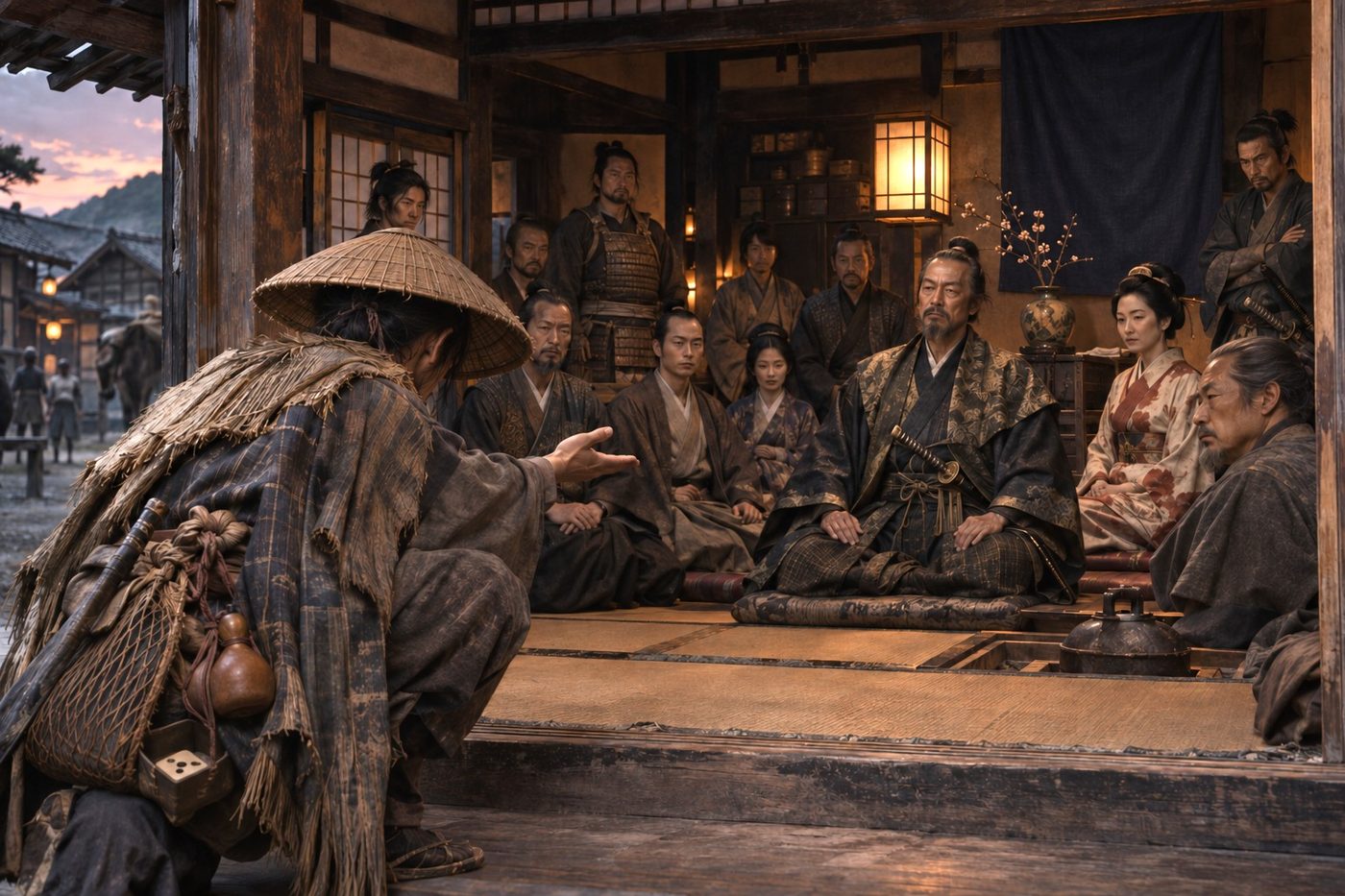
When a gambler of one family visits another family's town, they make the road greeting: they bow in the doorway of the boss's house, half crouching, one hand forward, and recite their name, their home, their boss, and their family in a set form. The house answers with its own. A hero who knows the greeting (anyone with the Gambler profession, Chapter 3) gets a meal, a bed for the night, and a place at the dice, and may ask a favor. A stranger who gets it wrong gets shown the road.
Breaking the cup oath is the one unforgivable crime. A member who betrays the family, or leaves without the boss's leave, is struck from its roll, and the boss sends a cast-out letter to every family on the road, with the traitor's name and face. From then on, no family takes them in. A hero who is cast out loses their Status in the family (Chapter 4) and gains the Enemy Hindrance (Minor) against it, or Major if they took the family's money or its secrets with them.
What the Underworld Sells#
Finding the right person in a strange town takes a Persuasion roll with the Streetwise Edge's bonus (SWADE p. 51), a Gambler hero's road greeting, or a day of asking around and a Notice roll. Prices below are in mon (Chapter 3).
| Service | Price | Notes |
|---|---|---|
| A forged travel pass | 200 | As Chapter 3. A raise on the forger's roll makes it good enough for a barrier captain's eye. |
| A guide around a barrier | 50 a head | By mountain paths. The bandits and yōkai on those paths are not included. |
| A night in a hideout | 10 | Above a dice house, behind a peddler's stall, or in a riverbank shack. No questions. |
| Selling stolen goods | A third of their worth | A fence pays half for coin or plain goods, and nothing for a famous blade, which no fence will touch. |
| A rumor | 10 to 100 | One true rumor from a Chapter 8 table, or one fact about a named person at the GM's call. |
| A hired blade for a day | 50 | An enforcer or ronin (Chapter 12). The boss answers for them, until the price is beaten. |
| Passage to Cheongun or Daqian | 2,000 | On a raider's ship. Getting there alive costs extra. |
| A shinobi league's contract | See The Shinobi Leagues | Through a go-between, never face to face. |
The Families#
These four families are models for underworld heroes and the patrons who hire them. A boss is a patron as Chapter 5 describes, and pays a share of the take. Each entry uses the format in Part 1.
The Senomura of Kayahara (Gamblers)#
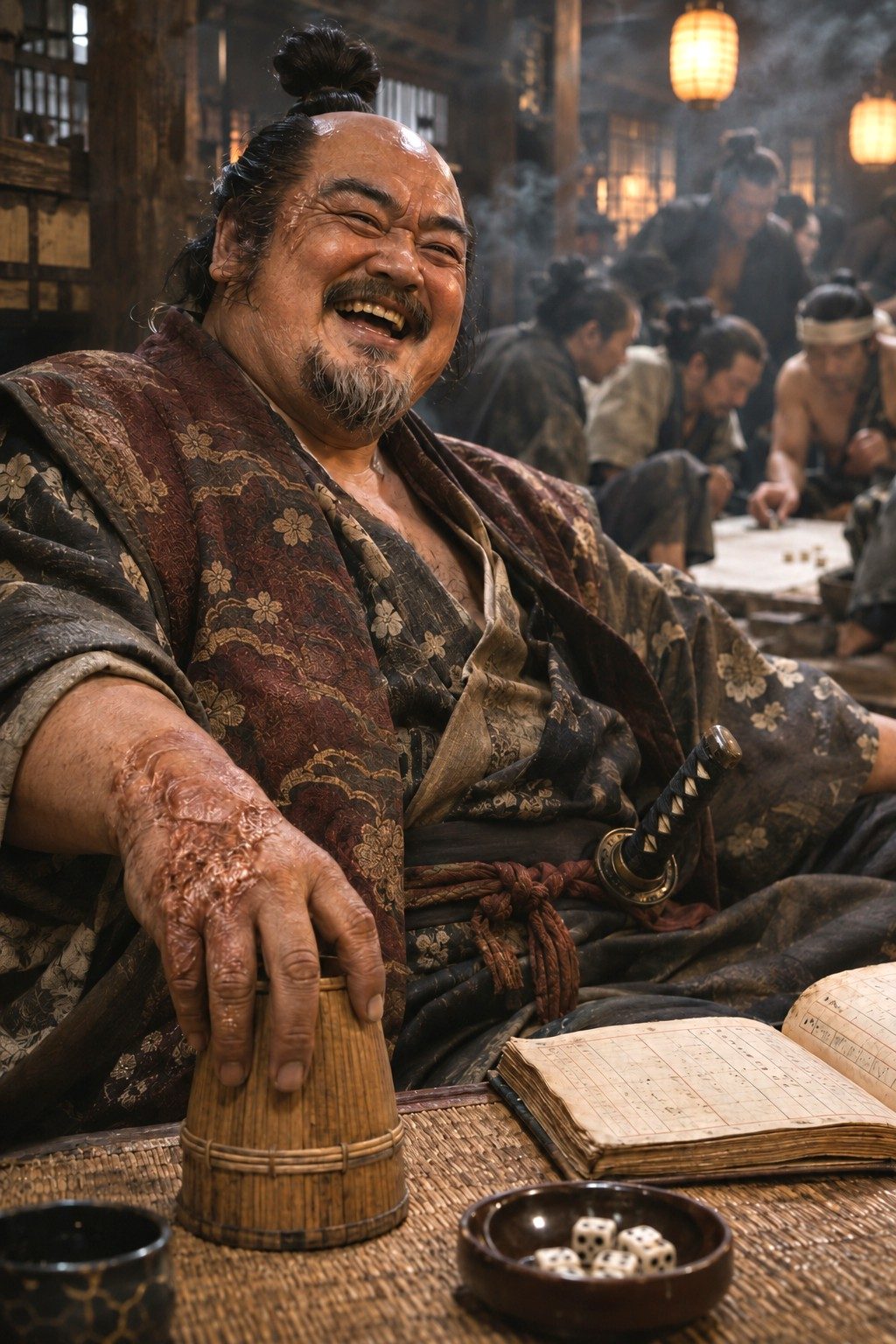
Who they are. The family that runs the dice houses of Kayahara, the post town at the foot of Kurogane Pass (Chapter 8). Travelers wait in Kayahara for the pass to clear, the barrier to open, or the rain to stop, and while they wait, they gamble. The Senomura take a cut of every game, every inn, and every porter's wage, and in return they keep the town quiet. A traveler who wins too much may find the road ahead suddenly dangerous.
Who leads.
- Gonzō, the boss, a heavy, cheerful man of fifty with a burned hand and a perfect memory for debts. He was a porter on the pass road until he won his first dice house in a single night, twenty years ago.
- Matajirō, his lieutenant (wakagashira), thirty, handsome, quick with a knife, and ambitious.
- Rokusuke, a hanger-on (sanshita) who stole the river kami's mirror from Mizunuma Marsh and is now wasting with its curse (Part 1).
Strength. About 40 sworn members and twice as many hangers-on, debtors, and lookouts. Four dice houses, a share of every inn in Kayahara, and the porters' guild of the pass road.
What they want. For Kayahara to stay a town where every side drinks and gambles, whichever blossom holds the pass.
What they fear. A battle for the pass, which would burn Kayahara to the ground. And Matajirō.
What they offer heroes. A place in the family, a bed, a share of the take, and the porters, who know every path around the barrier. Gonzō pays his debts, and he never forgets a favor.
What they ask. Find the stolen mirror before its curse brings the clans down on Kayahara (Chapter 8). Collect a debt from a samurai who thinks his rank excuses him. Watch the Teahouse at the Crossroads and report who meets whom.
Secrets. Gonzō doesn't yet know that the mirror thief was one of his own hangers-on. When he finds out, he must choose between handing Rokusuke to the Amanuma and protecting a member who shared the cup. Matajirō has been talking to the Kanehashi of Kanagura (below), who would like a dice house on the Yamaji Road, and he means to sell them Kayahara as soon as Gonzō is dead.
Friends and foes. Friends: the porters, the innkeepers, and anyone who pays. Foes: the castle's constables, Ōtaki Naomochi (who wants a cut of the dice houses, Part 1), and the Kanehashi, though Gonzō doesn't know it yet.
Attitude. Friendly to anyone who gambles. Neutral to everyone else.
The Kanehashi of Kanagura (the Pleasure Quarter)#
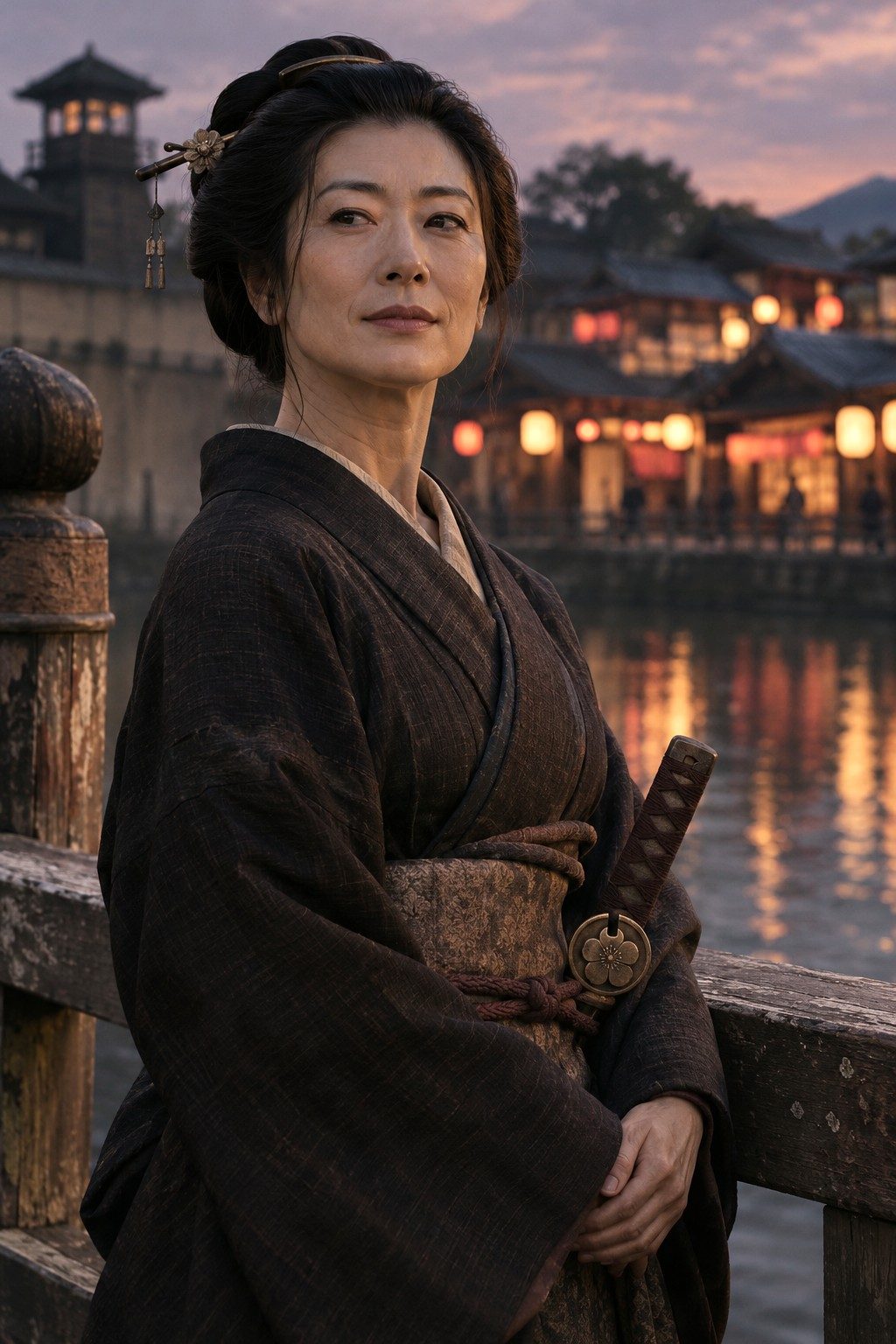
Who they are. The family that holds the walled pleasure quarter on its island in the river at Kanagura, reached by a single bridge (Chapter 8). The quarter's teahouses, theaters, and houses of courtesans are licensed by the Shikken. The Kanehashi ("Money Bridge") own the bridge, the gate, the night watch, and the dice rooms, and they take a share of every coin that crosses. Officials, merchants, and samurai meet in the quarter as equals and say things they would never say at court. The Kanehashi listen.
Who leads. Yae of the Bridge, called the Bridge Mother, about fifty, once the most famous courtesan in Kanagura, who bought her way out of her contract with what she had learned in it and took the family from the man who had owned her. She dresses plainly, speaks softly, and never raises her voice. She doesn't need to.
Strength. About 100 sworn members, the quarter's night watch, and the debts of half the officials in Kanagura. And the list: a ledger of every official in the city and what it costs to buy him, updated every month.
What they want. The quarter kept rich, licensed, and outside the war. Yae wants something more: to make sure no girl in her quarter is ever sold the way she was. She has quietly stopped buying contracts from the raiders who trade in war captives (Part 2).
What they fear. A new Shikken who doesn't renew the license. Fire, which has burned the quarter twice.
What they offer heroes. The list, a page at a time, at a price. A safe meeting place where no one draws a sword. Introductions to any official in Kanagura who can be bought.
What they ask. Find out who set the last fire in the quarter. Get a courtesan's younger sister out of a raider's hold before the next black ship sails. Carry the month's page of the list to a buyer who won't come to the quarter himself.
Secrets. Every season, the Shikken's steward Kuromura Jinzaemon buys a copy of the list (Part 1). Yae sells him one that is almost true. The one name on it marked "not for sale" is the Port Commissioner of Umikado, Asanaga Ujimoto (Part 2), and Yae has been trying to change that for three years.
Friends and foes. Friends: the Council of Ten Houses, every official in debt to them, and the Lion's Roar brotherhoods, who guard the bridge's far end. Foes: the raiders who sell captives, and Matajirō of the Senomura, once he stops being useful.
Attitude. Neutral, with a courtesan's courtesy. Friendly to anyone who brings something worth hearing.
The Peddlers of the Ground (Festival Peddlers)#
Who they are. The festival peddlers (tekiya) are the families who sell medicine, charms, toys, sweets, and roasted squid at every festival, shrine fair, and temple day in the realm. They travel the festival roads all year, and at each fair they divide the market ground (niwaba) among themselves by rules older than the clans. Anyone who sets up a stall without leave has it kicked over, and then gets kicked. The peddlers honor the Divine Farmer, the mainland god of medicine, whose painted scroll hangs in every peddler boss's house, and they say the first peddler of medicine was his servant.
The peddlers aren't one family but dozens, joined in a loose federation that meets once a year, at the great autumn fair in Seikyō, to settle its quarrels and divide the next year's fairs.
Who leads. Shinkichi, master of the ground (niwaba-oya) this year, a lean, sharp-tongued medicine seller of sixty who has walked every festival road in the isles. He holds the federation's ledger of grounds, which says which family sets up where at every fair in the realm.
Strength. Thousands of peddlers on every road, and their families. More useful than numbers: they go everywhere, they hear everything, and nobody notices them. Through the festival roads, news reaches the federation faster than it reaches most lords.
What they want. The festivals kept safe, the roads kept open, and the ground kept theirs.
What they fear. A war that closes the roads and cancels the festivals. Lately, the walking spirits: more and more fairs end with something at the edge of the lantern light (Chapter 7).
What they offer heroes. Cover. A hero traveling with the peddlers, carrying a pack of charms, passes every barrier and is noticed by no one. News from anywhere in the realm, within a season. Medicine of every kind, some of it real.
What they ask. Guard the ground at a great festival where two families are about to fight over it. Find the peddler who has been selling forged temple charms that don't work, before the temples blame the whole federation.
Secrets. About a tenth of the charms the peddlers sell are forged, and Shinkichi knows it. Some of the medicine sellers also sell poison, and their best customers are the Tomomura league (below). And the peddlers have noticed something no lord has: the walking spirits come more often to the fairs held near the old battlefields, and every year they come sooner (Chapter 7).
Friends and foes. Friends: the shrines and temples whose fairs they work, and the porters. Foes: anyone who sets up without leave.
Attitude. Friendly to customers. Neutral to everyone else, unless they're setting up a stall.
The Lantern Brotherhood of Seikyō (Street Champions)#
Who they are. A brotherhood of street champions (otokodate) in the townsmen's wards of Seikyō, below the Avenue of Willows and along the river. In a city where court nobles look down on everyone, the Deputy's soldiers bully everyone, and Thunder Peak's monks come down from the mountain to riot, the townsfolk need someone to stand up for them. The Lantern Brotherhood does. Its members are firemen, carpenters, porters, and drifters who wear bold clothes and carry paper lanterns painted with the brotherhood's sign. They are loud, vain, generous, and brave, and the townsfolk love them.
Who leads. Yohachi the Lantern, a former fireman in his thirties, tall, scarred, and dressed like a festival. He has thrown a Thunder Peak monk into the river and lived, and he once made a drunken samurai apologize to a fishmonger's wife on his knees. The ballad-singers have already made songs about him.
Strength. About 60 sworn brothers, and as many townsmen as they can call out with a drum. The fire brigades of four wards, which means that when the city burns, the brotherhood decides which houses are saved.
What they want. Respect for the townsfolk. The Deputy's soldiers out of their wards.
What they fear. The Deputy, Uchimori Shigetane, who has promised to hang Yohachi from the Southern Gate. Thunder Peak, which hasn't forgiven the river.
What they offer heroes. A place to hide in Seikyō, where the townsfolk shut their doors on the Deputy's men. A crowd when one is needed, and the fire brigades.
What they ask. Stand with the brotherhood against the Deputy's soldiers when they come to collect a new tax. Find out who has been taking children from the riverbank at night (Chapter 8's oni of the Southern Gate, Chapter 7).
Secrets. Yohachi is no commoner. He is the youngest son of a court noble of the Fifth Rank, who ran from his family at fifteen, and his father pretends he died. The Deputy has offered the brotherhood's second-in-command a pardon and 5 ryō of gold (Chapter 2) to deliver Yohachi, and the man is thinking about it.
Friends and foes. Friends: the townsfolk, the riverbank folk, and the ballad-singers. Foes: the Deputy, Thunder Peak's monks, and the court nobles who can't collect their rents.
Attitude. Friendly to commoners. Uncooperative to samurai and court nobles, until they prove themselves.
The Shinobi Leagues#
Everyone knows the great lords hire spies, thieves, and killers, and everyone has heard that they come from the hidden leagues of the mountains (Chapter 2). The leagues answer to no daimyo. They sell to all of them, through go-betweens, and their high masters are never seen. Three matter most in the present war. Each has its own style, and a GM can tell them apart by how they work.
The Shikken's Eyes, his household spies, are not a league. They are his own servants, paid from his own purse, and Part 1 describes them.
Hiring a League#
A lord or hero who wants a league's services leaves a message at its drop (a hollow tree, a shrine's offering box, a particular peddler) and waits. If the league accepts, a go-between brings a price. Payment is half before and half after. A league never sells a client's secret, unless the client betrays the league, and then it sells everything.
| Contract | Typical price | Notes |
|---|---|---|
| Watch a person or place for a season | 500 | Reports every month, through the drop |
| Steal a letter, a seal, or a small object | 1,000 to 3,000 | Higher from a castle or a temple |
| Set a fire | 2,000 | A storehouse, a granary, or a ward of a town |
| Kill a commoner | 2,000 | Most leagues prefer it to look like illness or accident |
| Kill a samurai | 10,000 | Twice that for a bannerman or an elder |
| Kill a lord | Not for sale, usually | The Kirikubo did it once (Part 1). It cost the price of a toll barrier. |
A hero shinobi is never paid these prices. The league pays its own agents in food, shelter, and the right to keep breathing (Chapter 5).
The Kirikubo (the Misty Hollows)#
Who they are. The league of the misty hollows above Kurogane Pass (Chapter 8), a maze of hanging valleys where fog lies most of the year and a few poor hamlets grow millet and burn charcoal. The hamlets are the league. The Kirikubo sell to anyone, keep every bargain, and are known for patience: they place sleepers in a household as cooks, grooms, or maids and leave them there for years, waiting. They prefer poison to blades, and an accident to either.
Who leads. Three high masters whom no outsider has seen. The face the world sees, if it sees any, is Kyūsaku, a middle master who lives as a charcoal burner by the shrine's back fence and empties the hollow tree each evening.
Strength. About 200 people in the hollows, of whom perhaps 50 are trained agents. Sleepers in Kurogane Castle, the Kitamori mines, and at least two other great households. Safe houses along the Yamaji Road.
What they want. To stay hidden, stay paid, and stay out of the war. Every side hires them, and none of them must ever win so completely that it no longer needs them.
What they fear. A lord who decides the hollows are worth burning. Sadatsugu's march on the pass, which would put his army in their valleys.
What they offer heroes. For a Kirikubo hero: shelter, safe houses, and a way out of any province (Chapter 3). For anyone else: contracts.
What they ask. Of their own: whatever the high masters say. Of outsiders: the price, and silence.
Secrets. The Kirikubo poisoned old Amanuma Nobuchika on the Shikken's commission, and the high masters keep the sealed commission as insurance (Part 1). Their sleeper in Kurogane Castle is still in the kitchens. If the heroes come looking for the commission, the high masters may sell it, but only if the Shikken has tried to silence them first, or if the heroes can make it worth more than the Shikken's goodwill.
Friends and foes. Friends: no one. Foes: no one, officially.
Attitude. Hostile to anyone who finds the way into the hollows uninvited.
The Tomomura (the River Road)#
Who they are. A league of medicine sellers from a village on the river road between Seikyō and Kanagura (Chapter 8). The Tomomura make and sell remedies all over the realm, and their peddlers, with boxes of pills on their backs, are welcome in every castle kitchen and every lady's quarters. They know every poison and every cure, they keep informers in every inn on the river road, and for twenty years they have sold most of their services to the Shikken. They work in the cities: theft, forgery, informing, and arson, which they can make look like the cooking fires of a crowded ward.
Who leads. The high masters are unseen. Their face is the widow Kiku, who keeps the Tomomura medicine house in Kanagura, a respectable shop with a blue curtain, where the Shikken's steward buys his stomach powders.
Strength. About 300 in the village and on the roads, with perhaps 80 trained agents. Informers in every inn on the river road and in Kanagura's merchant quarter.
What they want. The Shikken's money, and his protection, which keeps the magistrates out of their village.
What they fear. The Shikken's fall. If the white plum wins, the Tomomura will be the first league it hunts.
What they offer heroes. Medicine, poison, forged documents of the highest quality, and news from the river road.
What they ask. Of outsiders who want to hire them: a much higher price than the Shikken pays, and a promise never to use them against him.
Secrets. The Tomomura set the last fire in the Kanehashi pleasure quarter, on the Shikken's orders, as a warning when Yae raised her prices. They are also hedging: one of their high masters has sent a gift to Sadatsugu's camp.
Friends and foes. Friends: the Shikken, the Shikken's Eyes, and the medicine sellers among the festival peddlers. Foes: the Yamashiba, and Yae of the Bridge, once she learns who set her fire.
Attitude. Friendly to customers. Neutral to everyone else.
The Yamashiba (the North Mountains)#
Who they are. The league of the northern mountains between Takane and Kasumi, a people of hunters, charcoal burners, and mountain guides who have fought for whoever paid them since the Age of Kingdoms. Unlike the other leagues, the Yamashiba fight in the open as well as in the dark. They are scouts and raiders: they guide armies over mountain paths, raid supply trains, burn camps at night, and kill sentries. They scouted for Sadatsugu's army in Cheongun, and he has paid them ever since.
Who leads. Yamashiba Tsunamori, the head of the league and its war captain, a grizzled man of fifty-five with a hunter's eyes. Unlike other high masters, he is known by name and by face, because Sadatsugu has invited him to his council.
Strength. About 400 fighters, who count as Skirmishers in a mass battle (Chapter 5): +2 in forests, mountains, and at night. Their valleys are almost impossible to invade.
What they want. Sadatsugu to win, so that the Yamashiba hold their valleys by his charter instead of by their spears.
What they fear. The Kuzuhara's riders, who have twice tried to burn their valleys for the Shikken. And the Tomomura.
What they offer heroes. Guides over any mountain road in the north, and night-fighters for a raid. For a white plum hero, a scout in every company.
What they ask. Help to guard a mountain pass against the Kuzuhara. Find out who in Sadatsugu's camp is selling his plans to the Shikken.
Secrets. Someone in Sadatsugu's camp really is selling his plans. It is a young Yamashiba agent, who was bought by the Tomomura with a promise to free his sister, a Tomomura hostage. Tsunamori doesn't know, and when he finds out, he will kill the boy himself unless someone gives him another way.
Friends and foes. Friends: Sadatsugu, the Mizusawa, and the mountain kami. Foes: the Kuzuhara, the Tomomura, and the Shikken.
Attitude. Uncooperative to strangers in the mountains. Friendly to white plum heroes.
The Sea Raiders#
Crime that reaches across the sea belongs to the sea raiders (Chapter 8): crews of islanders, mainlanders, Cheongun exiles, ronin, and deserters who rob the coasts of three nations and sell the plunder in Umikado's back streets. Since the Treaty of the Strait sent thousands of unpaid veterans home, they have never had so many recruits. The sea lords of the Inland Sea, such as the Ashiura of Shiokaze, are a clan and appear in Part 1.
Zhuo Xianfeng and the Ghost-Light Fleet#
Who they are. The greatest of the raider kings: 50 ships and some 3,000 raiders, sailing from a hidden harbor among the ghost-lights of Shiranui, where no fleet dares to follow (Chapter 8). The crews are of every nation, and they swear to Zhuo, not to any flag.
Who leads.
- Zhuo Xianfeng, a Daqian merchant's son turned outlaw, about forty, elegant, cultivated, and pitiless. He writes poetry in two languages and has hanged men for spilling his tea.
- Tōhachi, his priest, a defrocked kannagi who was cast out of a shrine in Shiranui for drunkenness and now chants the monthly court rite for the drowned child-emperor on Zhuo's flagship (Chapter 7).
- A dozen captains, each with a ship and a crew of their own, who obey Zhuo because the dead obey him.
Strength. 50 ships, about 3,000 raiders (count them as veterans at sea and soldiers on land, Chapter 8), fire pots, a few cannon bought from a black ship, and the protection of the drowned dead.
What they want. Zhuo wants Shiogiri, the drowned Emperor's sword (Chapter 6), so that he can command the dead instead of paying them. After that, he wants a kingdom of the sea, with every harbor in three nations paying him tribute.
What they fear. The Daqian war fleet (Chapter 8), which is being built to burn every raider haven in the isles. The day the drowned dead decide Zhuo's offerings aren't enough.
What they offer heroes. Passage to Cheongun or Daqian, for a price. Goods no one else can get. A pardon from Zhuo, which means no raider will touch a hero's ship.
What they ask. Find an old palace servant in Seikyō who might know where Shiogiri lies. Carry a cargo past the Port Commissioner. Guide a raid on a coastal temple's treasury, and don't ask what happens to the monks.
Secrets. Zhuo pays the drowned dead with offerings stolen from the tribute ships that carry the western provinces' offerings to the capital (Chapter 7). Every ship he takes weakens the Emperor's rites and widens the hakobore. Several of Umikado's merchant houses finance his voyages and take a share of the plunder. The Tsuruzaki of Shiranui take his gold to look away. And some of his captains trade in war captives, selling them to black-ship sailors (Part 2); Zhuo takes his share and doesn't ask.
Friends and foes. Friends: the merchants who finance him, the Tsuruzaki, and the dead. Foes: the Port Commissioner, the Ashiura, the Daqian fleet, and the Shikken, who has put a price of 100 ryō of gold on his head.
Attitude. Neutral to anyone with money. Hostile to anyone who has seen the court rite.
Lesser Captains#
Dozens of smaller crews of one to five ships raid along every coast. The GM can roll on the table below for the captain of a crew the heroes meet.
| d6 | Captain | Crew |
|---|---|---|
| 1 | A Cheongun War veteran who sold his sword for back pay and kept selling | Strait Men who all know each other from the war |
| 2 | A mainland smuggler with forged Daqian trade licenses | Daqian sailors, honest by their own lights |
| 3 | A Cheongun exile, a former naval officer, who raids only island ships | Cheongun sailors with a grudge |
| 4 | A fisherman's widow whose village was burned by sea lords | Her late husband's kin, and anyone who'll follow her |
| 5 | A disgraced samurai who still flies his family's crest | Ronin, all of them claiming to be noble |
| 6 | A Black Book convert from the outer islands who raids only temple ships | Fishermen of his village, who pray before every raid |
Notes#
- The cup oath, the road greeting, and the cast-out letter draw on the gambling families of later centuries, as described in Brinkley (1915). The greeting is set earlier here, as the island custom.
- The festival peddlers and their god of medicine follow the tekiya's reverence for the Divine Farmer (Shinnō), the Chinese god of medicine and agriculture. This is folk tradition; none of the folder's sources describes it.
- The street champions follow the folk heroes (otokodate) of the townsmen's quarters, as described in Brinkley (1915) and A. B. Mitford, Tales of Old Japan (1871).
- The shinobi leagues as free mountain confederacies who sold services to every lord, and medicine sellers as cover, follow the Iga and Kōga leagues, as described in Murdoch (1903–1926).
- The Yamashiba draw on the Fūma band, who served the Hōjō as raiders and night-fighters. This is traditional history; none of the folder's sources describes it.
- The sea raiders (wakō) of mixed crews follow Murdoch (1903–1926).
Part 4: Magistrates and the Law#
The Law in a Broken Realm#
Chapter 2 gives what everyone knows: every daimyo is the law in his own domain, the Hagane Code stands above them all when anyone can enforce it, and rank decides everything. This part gives the GM what everyone doesn't know: how a case actually runs, what the punishments are, who the officials are, and how heroes can stand on the law's side of the barrier, or on the other.
The law of the isles is real, but it is thin. A magistrate in a castle town can try a thief, hang a robber, and settle a quarrel over a field boundary. He can't touch a lord's retainer without the lord's leave, a monk without his temple's, or a gambler whose boss pays the right people. Most crimes are never reported, because a village that reports a crime shares the punishment for it. Most criminals are never caught, because the next domain's magistrates don't care what happened in this one. And in a war, the law is whatever the nearest army says it is.
That makes the law an opportunity for heroes. A magistrate who wants justice has few honest hands. A boss who wants to stay outside the law needs people who know how it works.
Crime and Punishment#
The same crime earns a fine for one person and death for another (Chapter 2). The table below shows the usual sentence by the culprit's rank. A magistrate may lighten it for a good reason, a powerful friend, or a large gift, and may make it heavier to make an example. Monks, nuns, and priests are handed to their temple or shrine for judgment, unless their crime is treason or murder, and temples protect their own. Court nobles are judged by the court, which almost never punishes anyone worse than exile.
| Crime | A samurai | A commoner | Notes |
|---|---|---|---|
| Disrespect to a superior | Reprimand, or house arrest for a month | A beating, or the cutting right (Chapter 2) | A samurai may cut down a commoner who insults him, but the magistrate asks for witnesses. |
| Brawling | House arrest | Fine and a beating | If a sword is drawn inside a castle, death for the one who drew it, whoever started it. |
| Gambling | Loss of a year's stipend | Fine | Rarely enforced. The magistrates' own men gamble. |
| Petty theft | Dismissal, and the samurai becomes a ronin | A beating and banishment from the town | |
| Great theft (more than 2,000 mon) | Ordered to take his own life | Death | Stealing from a lord is always great theft. |
| Forging a travel pass or crossing a barrier without one | Exile | Death | The barriers are the realm's spine. Passing one by a mountain path is treated as breaking it. |
| An unlicensed gun | Loss of the gun, and a heavy fine | Death | Enforced where the Shikken's officials are, which is mostly Kanagura and Umikado. |
| Arson | Ordered to take his own life | Death | Arson in a town is the crime magistrates fear most. |
| Murder | Ordered to take his own life, or death if he flees | Death | A registered vendetta isn't murder (Chapter 4). |
| Killing one's lord, master, or parent | Death, and his house abolished | Death in the cruelest form the domain allows | The gravest crime there is. |
| Sacrilege (robbing a shrine or temple, or polluting one) | Exile | Death | The temples often judge it themselves first. |
| Curses (the Hour of the Ox, Chapter 6) | Ordered to take his own life | Death | Hard to prove, and only proved against those without protectors. |
| Treason | Ordered to take his own life, and his house abolished | Death, and his family enslaved or executed | Whatever the lord who wins says it is. |
Who shares the punishment. For grave crimes, a samurai's family may lose its stipend and its name, and a commoner's five-household group and village pay fines or worse (Chapter 2). A hero who commits a crime may bring ruin on people who had no part in it, and the law expects them to know that.
Exile. The Shogunate sends its exiles to Hate-no-Kuni (Chapter 8), and a domain sends its own to the poorest hamlet on its borders. Court exiles go to small islands where a noble can be forgotten in comfort.
Being sought. A hero whom the law is hunting has the Otazunemono Hindrance (Chapter 3): Minor if one domain's magistrates seek them for a lesser crime, Major if they are sought across the realm or for a crime that carries death. Their face is posted at every barrier where the magistrates who want them have influence.
Running a Case#
A case moves through four steps. The GM can play any of them as a scene, or skip it in a sentence.
1. The crime and the clues. Investigating a crime uses the core rules' tools: Notice to spot what doesn't fit at the scene, Research for registers, tax rolls, and letters, Common Knowledge for what any local would know, and Healing to read a body (the cause of death, and roughly when). The Investigator Edge (SWADE p. 48) adds its bonus to Research and to Notice for clues, and the Thief-Taker Edge (Chapter 3) gives its reroll to recognize a wanted face.
2. Witnesses and talk. Asking around a town is Networking (SWADE p. 133): a Persuasion roll for friendly questions, or Intimidation for the other kind. A boss, a headman, or an innkeeper who knows something but doesn't want to say it is a Social Conflict (SWADE p. 143), and a magistrate's own questioning of a suspect is one too.
3. The chase and the arrest. A suspect who runs is a Chase (SWADE p. 113). An arrest is a fight, but the law wants the suspect alive: constables carry the truncheon, the catch pole, and the sleeve-tangler, and thief-takers bind with cord (Chapter 3). A race to catch a killer before he strikes again, or to clear an innocent before the execution, is a Dramatic Task (SWADE p. 122).
4. The magistrate's court. The accused kneel on a bed of white gravel in the magistrate's courtyard, below the raised floor where he sits. Commoners kneel on the gravel. Samurai sit on a mat at its edge. There is no lawyer and no jury. The magistrate hears the accusers, the witnesses, and the accused, and then he wants a confession. A magistrate doesn't sentence without one if he can help it, and the law allows him to get it by force from commoners: beatings, the stones, the rope. A confession taken that way gives the magistrate an answer, true or not. A hero who brings him a better answer, with proof, can save an innocent from the gravel, and makes an enemy of whoever the magistrate was going to hang instead.
Sanctuary#
Some places the law can't follow:
- The great temples, such as Raihō-ji and Ryōun-ji (Part 2). A fugitive who reaches the gate is under the temple's protection, as long as they stay inside and the temple wants them. The temple may hand them over, or charge a price, or make them a monk.
- Convents. A wife fleeing her husband who reaches a convent, such as Matsunoki in Kurogane or the Tamaeda convent in Ōgiri (Chapter 8), can't be taken back by force. If she serves the convent for two years, her marriage is dissolved, and her husband can do nothing.
- The quarters outside the law. The magistrates' men don't enter the Strait Ward in Hagane, the Lantern Brotherhood's wards in Seikyō, or the sakaibito hamlets without a good reason and a lot of soldiers. These aren't sanctuaries by law, only by custom and fear.
Revenge#
A samurai may avenge a murdered lord or kinsman, but only after registering the vendetta. Chapter 4 gives the rules: who may avenge whom, the license, and what it allows. A registered avenger can kill the murderer openly. An unregistered one is a murderer, and appears in the table above.
Heroes of the Law#
A party can serve a magistrate as easily as a lord. It is a natural fit for Kurogane's castle town (Chapter 8), and for any campaign that wants mysteries, chases, and underworld intrigue without a war. It costs no new rules:
- The magistrate is the patron (Chapter 5). He pays a stipend to his samurai and a small wage to his thief-takers, and he answers for them.
- Constables (dōshin) are samurai of the lowest rank, who carry the iron truncheon and walk the streets. A buke hero can be one.
- Thief-takers (okappiki) are commoners, often reformed criminals, who know the back alleys. They take the Thief-Taker Edge (Chapter 3). A gambler or a shinobi who has changed sides makes a fine thief-taker, and a dangerous one.
- Assistant magistrates (yoriki) are mounted samurai who lead the constables. A seasoned buke hero may rise to the rank.
A magistrate's office is a group with its own Status ladder (Chapter 4):
| Rung | Title | Who they are |
|---|---|---|
| Head | Magistrate (bugyō) | Hears cases and passes sentence, in the lord's name |
| Seniors | Assistant magistrates (yoriki) | Mounted samurai who lead the constables and judge small cases |
| Trusted | Senior constables | Constables trusted with the hard cases and the dangerous districts |
| Members | Constables (dōshin) and thief-takers (okappiki) | The ones who walk the streets |
| Newcomers | Runners (shitappiki) | A thief-taker's own helpers: informers, lookouts, and errand boys |
Being on the law's side has a price. Underworld families see a thief-taker as a traitor. Lords' retainers resent being questioned by a constable of no rank. And the law's heroes learn sooner or later that their own magistrate takes gifts, or that the real criminal is a lord's son they can't touch. What they do then is the campaign.
Cases for Heroes of the Law#
| d6 | Case |
|---|---|
| 1 | A rice broker is found dead in his locked storehouse, and the rice in it has turned to black ash overnight. |
| 2 | Someone is setting fires in the castle town, one a week, each at a house where a Western Light preacher spoke. |
| 3 | A peddler has confessed to a murder he couldn't have done. The magistrate is satisfied. The hero isn't. |
| 4 | A samurai cut down a commoner and claims the cutting right. The commoner's neighbors say there was no insult, and they are afraid to say it twice. |
| 5 | Forged travel passes good enough to fool a barrier captain are turning up all along the road. Somebody inside the barrier is helping. |
| 6 | A string of thefts from shrines, and the thief takes only one thing from each: its sacred rope. |
Officials of the Realm#
These are the officials heroes are most likely to meet, beyond the ones already in Chapter 8. Their statistics are in Part 5.
Hatamori Yoshichika (Hagane). Head of the Samurai-dokoro, the Shogunate's board of retainers, which judges samurai crimes under the Hagane Code and commands the Shogun's guard. An old soldier, outwardly red, and tired of it (Chapter 8).
Tamaoka Kiyotada (Hagane). The magistrate of Hagane, and the most famous judge in the realm. Ballad-singers tell his judgments in every post town: the case of the borrowed umbrella, the farmer who sued a fox, the two widows and the one grave. He is a small, dry, patient man of sixty who takes no gifts, keeps no favorites, and has never sentenced anyone without proof. He serves under the Samurai-dokoro and despises the Shikken's officials. Everyone trusts him, which makes him very dangerous to the Shikken. Secret: he has begun a quiet inquiry into the Shogun's illness, and it is leading toward the disused tea room where Ishimura Sayo works (Chapter 7). He doesn't yet know what he will find, or what it will cost him.
Uchimori Shigetane (Seikyō). The Shogun's Deputy at Seikyō, red plum, who keeps order in the capital with a few hundred soldiers, watches the court, and arrests troublemakers (Chapter 8). He has promised to hang Yohachi the Lantern from the Southern Gate (Part 3), and he sells exemptions from his own new taxes.
Ōtaki Yorinao (Kanagura). The Shikken's chief magistrate of Kanagura, a nephew like so many of the Shikken's officials, but not a fool. He is hard, efficient, and incurious about anything his uncle doesn't want known. Kanagura is the best-policed city in the realm, and its jails are full of people whose crime was being inconvenient. Secret: his uncle's toll-station nephews (Part 1) have offered him a share of the river road's tolls to look away from their smuggling, and he took it.
Sakichi the Crow (Kanagura). Yorinao's most famous thief-taker, a former burglar who climbed walls like a crow and now catches those who do. He knows every thief, fence, and dice house in Kanagura, and he takes a cut from all of them to leave them alone. He is clever, greedy, and quite brave. Secret: Sakichi sells news to Yae of the Bridge (Part 3), and keeps a list of his own, with the names of the officials who pay him to bury cases.
Asanaga Ujimoto (Umikado). The Shikken's Port Commissioner, incorruptible, efficient, and hated, who taxes every cargo, licenses every gun, and keeps the register of Black Book converts (Chapter 8, Part 2). He is building a case against the captive trade, and against Zhuo Xianfeng's merchant backers.
Hirata Mochisuke (Kurogane). The magistrate of Kurogane's castle town, an honest, overworked retainer of the Amanuma who runs the constable's post with six constables, a dozen thief-takers, and no money. He answers to Lord Nobutane, but Ōtaki Naomochi interferes in every case that touches the toll. He would welcome capable heroes, and can't pay them much. Secret: he suspects the old lord was poisoned (Part 1), because the cook who served the lord's last meals disappeared a month after the funeral and came back a year later under another name. He has told no one, because he can't think of anyone it would be safe to tell.
Notes#
- The magistrates, constables, thief-takers, the white gravel court, and confession follow F. Brinkley, A History of the Japanese People (1915), and A. B. Mitford, Tales of Old Japan (1871). The constables and thief-takers belong properly to a later age, and are set earlier here.
- Crime by rank, the barrier laws, and the five-household groups follow Brinkley (1915) and Murdoch (1903–1926).
- Convent sanctuary and the dissolved marriage follow the "divorce temples" of later centuries, set earlier here.
- Tamaoka Kiyotada's judgments are original, in the tradition of the famous judge stories (ōoka seidan), and copy none of them.
Part 5: Notable Characters#
How to Use These Characters#
Every person named in Chapters 7, 8, and 9 has statistics here, in two kinds of entry:
- Full blocks for the people heroes are most likely to fight, duel, chase, or deal with closely.
- Short blocks for everyone else: one of the ten templates below, plus a line of changes. A great lord the heroes will only ever bow to doesn't need two inches of skills.
Reading a short block. The changes replace the template's values. A short block that names Hindrances replaces the template's Hindrances with that list. When a change raises Fighting, recompute Parry (2 + half Fighting, plus any shield or Edge); when it changes Vigor or armor, recompute Toughness. Skills are listed in alphabetical order once the changes are made.
Wild Cards are marked with a small tsuba (sword-guard) ring before their names. Everyone else is an Extra, though the GM can make anyone a Wild Card when the story needs it.
Each entry ends with three setting lines:
- Honor on the scale from –10 to +10 (Chapter 4). Underworld folk and shinobi keep their own accounts, so their Honor is what the respectable world thinks of them.
- Status: their rung and their group (Chapter 4).
- Secrets: a short reminder for the GM, pointing to where the full secret is told.
Power levels. Kurogane's people are built as challenges for Novice and Seasoned heroes. The great lords lean on social skills and command, because heroes meet them across a tea tray or a battlefield, not a sword's length. The leaders of the great threats (Chapter 7) are Veteran to Legendary, and heroes should not expect to beat them in a single fight.
Children. Botanmaru (age 10) and Kikuchiyo (age 2) have no combat statistics. They are people to protect, rescue, or win over, not opponents.
Index#
| Name | Who they are | Where |
|---|---|---|
| Abbess Shōun | The dead lord's widow, abbess of Matsunoki Convent | Kurogane |
| Akaishi Toshinari | Young priest of the Akaishi shard stone | The provinces |
| Akebana Tsunemaro | The Regent | Seikyō |
| Akisato Nobukiyo | Chief priest of the Forging Gods' great shrine | The provinces |
| Ameyama Tadamune | Lord of Takane | The provinces |
| Amanuma Nobutane | Lord of Kurogane Castle | Kurogane |
| Arasawa Kyūsuke | Headman of Arasawa | Kurogane |
| Asaoka Hirotada | Sadatsugu's chief retainer | The provinces |
| Asanaga Ujimoto | The Port Commissioner | Umikado |
| Ashiura Kagenobu | Sea lord of Shiokaze | The provinces |
| The captain of the great black ship | Commander of the Great Ship | Umikado |
| The Cloistered Emperor | The Emperor's father | Seikyō |
| The Dragon's Bride | High priestess of the dragon's pool | The provinces |
| Eichi | Keeper of the eternal lamp | Seikyō |
| Eisō | Master of Thunder Peak's warrior monks | Seikyō |
| The elder of the Black Book | Leader of the foreign preachers | Umikado |
| The Emperor | The realm's high priest | Seikyō |
| Fujinaga Kagemori | Lord of Momiji | The provinces |
| Gao Hongde | Elder of the Daqian Town | Umikado |
| Genzan | Abbot of Tamayama-ji | Kurogane |
| Gonzō | Boss of the Senomura | Kurogane |
| Habaki | The Whetstone's go-between | The hidden ones |
| Hatakura Michitaka | Lord of Tatsumi | The provinces |
| Hatamori Yoshichika | Head of the Samurai-dokoro | Hagane |
| Hiraishi Sanetoki | Chief priest of Hiraishi Shrine | Kurogane |
| Hiraishi Suzu | His granddaughter, the shrine maiden | Kurogane |
| Hirakubo Matazaemon | League banner captain | Kurogane |
| Hirasato Tatsuoki | Warden of the March | The provinces |
| Hirata Mochisuke | Magistrate of Kurogane's castle town | Kurogane |
| Ichizō | Leader of the Strait Men | The provinces |
| Ishimura Sayo | The curse-worker in Hagane | The hidden ones |
| Jinbei of Toyonaga | Chief of the Council of Ten Houses | Kanagura |
| Kagamino Sadatane | Sadatsugu's eldest son | The provinces |
| Kagamino Sadatsugu | Leader of the white plum | The provinces |
| Kagamino Tomoharu | The Shogun | Hagane |
| Kagamino Tomokiyo | The Shogun's uncle | Seikyō |
| Kaishin | Priest of the Sekitani Midō | Kurogane |
| Kanezaki Takeuji | Lord of Yūnagi | The provinces |
| Kayamori Harutsuna | Lord of Asagiri | The provinces |
| Kayanuma Moritsune | Lord of Ōgiri | The provinces |
| Kiku, the widow | Face of the Tomomura league | Kanagura |
| Kiritani Hisamura | Headmaster of the Kiritani School | Kurogane |
| Kissaki | The Whetstone's blade | The hidden ones |
| Kitamori Kaede | Head of the Kitamori | Kurogane |
| Kitamori Kagetsuna | Her son, captain of the mine guards | Kurogane |
| Kurobishi Hidesada | Lord of Tetsugawa | The provinces |
| Kuroe Sanemitsu | Captain of the pass barrier | Kurogane |
| Kuromura Jinzaemon | The Shikken's steward and spymaster | Kanagura |
| Kūzan | Master of the Whetstone | The hidden ones |
| Kuzuhara Akitada | Lord of Tsukikage | The provinces |
| Kyūsaku | The Kirikubo's face | Kurogane |
| Lady Chigusa | Sadatsugu's wife | The provinces |
| Lady Hyoseon | The Shogun's wife | Hagane |
| Lu Xian | The undying man of Hōrai | The hidden ones |
| Masuhiro, Master | The great swordsmith of Tetsugawa | The provinces |
| Matajirō | Gonzō's lieutenant | Kurogane |
| Meng Ruiyuan | The Daqian seeker | The hidden ones |
| Mitsuhara Akimaro | Steward of the Cloister | Seikyō |
| Mizunaga Sanekuni | Lord of the red half of Inazuma | The provinces |
| Mizusawa Kagehisa | Lord of Shimoyuki | The provinces |
| Nishioka Takekuni | Lord of Akashio | Umikado |
| Nishioka Tamae | His daughter, a Black Book convert | Umikado |
| Nobuyama Hidetsura | Lord of the white half of Inazuma | The provinces |
| Ōsato Tsugumasa | Lord of Kagaribi | The provinces |
| Ōtaki Kiyoaki | The Shikken | Kanagura |
| Ōtaki Korenaga, Ōtaki Sumikage | The Shikken's nephews | Kanagura |
| Ōtaki Munetane | The Shikken's heir | Kanagura |
| Ōtaki Naomochi | The Shikken's toll collector at the pass | Kurogane |
| Ōtaki Yorinao | Chief magistrate of Kanagura | Kanagura |
| Princess Shizu | The Imperial Votaress | The provinces |
| Rokusuke | The mirror thief | Kurogane |
| Rokuzaemon | Headman of Ukishima | Kurogane |
| Ryōchi | Abbot of Genten-ji | Kanagura |
| Ryōken | Head abbot of the Western Light | The provinces |
| Sainami Takemaro | A court noble in exile | Kurogane |
| Sakichi the Crow | Kanagura's famous thief-taker | Kanagura |
| Seian | Abbot of Zenkai-ji | Hagane |
| Shen Weining | Admiral of the Daqian war fleet | Beyond the isles |
| Shimanaga Kageyuki | The Shogun's admiral | Hagane |
| Shinkichi | Master of the ground | On the roads |
| Shirakado Yasutsugu | High priest of Kagaribi | The provinces |
| Sonzan | Head abbot of the Lion's Roar | Kanagura |
| Tachieda Masunari | Master of ceremonies | Seikyō |
| Tachieda Michimaro | The exiled ritualist | The hidden ones |
| Taishun | The Prince-Abbot | Seikyō |
| Takanaga Morinobu | Warden of the Strait | The provinces |
| Tamaoka Kiyotada | Magistrate of Hagane | Hagane |
| Tōhachi | Zhuo's defrocked priest | Beyond the isles |
| Tokumoto Katsutane | Lord of Hinoe | The provinces |
| Tora of the Spears | Banner captain of the Sekitani League | Kurogane |
| Tōsaku | The blind catechist | Umikado |
| Tsuruzaki Haruchika | Lord of Shiranui | The provinces |
| Uchimori Shigetane | The Shogun's Deputy at Seikyō | Seikyō |
| Ukinami Nobuhira | Lord of Mizuchi | The provinces |
| Watanaga Narimaro | Head of the Bureau of Yin and Yang | Seikyō |
| Yae of the Bridge | Boss of the Kanehashi | Kanagura |
| Yamashiba Tsunamori | Head of the Yamashiba league | The provinces |
| Yeom Taejin | Lady Hyoseon's chief envoy | Hagane |
| Yoemon of Kanemi | Head of the Iron Guild | Kurogane |
| Yohachi the Lantern | Head of the Lantern Brotherhood | Seikyō |
| Zenshun | Great guide of the Tamagami lodge | The provinces |
| Zhuo Xianfeng | The raider king | Beyond the isles |
Templates#
These ten templates are the base for every short block below. The Bestiary's common human Extras (soldiers, bandits, monks, and the rest) are built on the same foundations, so the two chapters agree. Each template lists its usual gear; a short block that says nothing about gear uses it.
Lord#
A daimyo, a great retainer, or the head of a clan.
Attributes: Agility d6, Smarts d8, Spirit d8, Strength d6, Vigor d6
Skills: Athletics d4, Battle d8, Common Knowledge d8, Fighting d6, Intimidation d8, Notice d6, Persuasion d8, Riding d6, Shooting d4
Pace: 6; Parry: 5; Toughness: 5, or 8 (3) in armor
Hindrances: Code of Honor (Major), and one that defines them
Edges: Command, Connections, Rich
Gear: Long sword (Str+d6, or Str+d6+1 two-handed), short sword (Str+d6), heavy armor (+3) for war.
Captain#
A bannerman, a veteran officer, or a famous warrior.
Attributes: Agility d8, Smarts d6, Spirit d8, Strength d8, Vigor d8
Skills: Athletics d6, Battle d6, Common Knowledge d4, Fighting d8, Intimidation d8, Notice d6, Persuasion d4, Riding d6, Shooting d6
Pace: 6; Parry: 6; Toughness: 9 (3)
Hindrances: Code of Honor (Major), Loyal (Minor)
Edges: Brave, Command
Gear: Long sword (Str+d6, or Str+d6+1 two-handed), short sword (Str+d6), great bow (15/30/60, 2d6, AP 1), heavy armor (+3).
Courtier#
A court noble, a lord's chamberlain, or a lady of a great house.
Attributes: Agility d6, Smarts d8, Spirit d8, Strength d4, Vigor d6
Skills: Academics d6, Athletics d4, Common Knowledge d8, Fighting d4, Notice d8, Performance d8, Persuasion d8, Stealth d4, Taunt d6
Pace: 6; Parry: 4; Toughness: 5
Hindrances: Arrogant (Major) or Cautious (Minor)
Edges: Connections, Court Poet
Gear: Formal court robes, fan, writing case.
Abbot or Priest#
The head of a temple or shrine, without true power unless the block says so.
Attributes: Agility d6, Smarts d8, Spirit d8, Strength d6, Vigor d6
Skills: Academics d8, Athletics d4, Common Knowledge d6, Fighting d4, Notice d6, Occult d6, Performance d6, Persuasion d8
Pace: 6; Parry: 4; Toughness: 5
Hindrances: Vow (Major: the precepts or the shrine's purity)
Edges: Connections (the temple or shrine)
Gear: Robes, prayer beads or a purification wand, the temple's or shrine's seal.
Genja#
A walker of one of the Five Paths (Chapter 6). The block names the path and swaps in that path's powers.
Attributes: Agility d6, Smarts d6, Spirit d8, Strength d6, Vigor d6
Skills: Athletics d6, Common Knowledge d4, Faith d8 (or Spellcasting d8 for an onmyōji), Fighting d6, Notice d6, Occult d8, Persuasion d6, Stealth d4
Pace: 6; Parry: 5; Toughness: 5
Hindrances: As the Arcane Background (Chapter 6)
Edges: Arcane Background (as the path)
Powers: As the path's starting powers (Chapter 6). 15 Power Points.
Gear: The path's tools: a purification wand, a ringed staff, a glaive, or a writing case of paper and seals.
Merchant#
The master of a house, a guild elder, or a moneylender.
Attributes: Agility d6, Smarts d8, Spirit d6, Strength d4, Vigor d6
Skills: Athletics d4, Common Knowledge d8, Fighting d4, Notice d8, Persuasion d8, Research d6, Stealth d4
Pace: 6; Parry: 4; Toughness: 5
Hindrances: Greedy (Minor) or Cautious (Minor)
Edges: Merchant's Eye, Rich
Gear: Fine clothes, abacus and ledgers, a guarded storehouse, a bodyguard or two (ronin).
Boss#
The head of an underworld family, a dice house, or a band of street champions.
Attributes: Agility d6, Smarts d8, Spirit d8, Strength d6, Vigor d8
Skills: Athletics d6, Common Knowledge d6, Fighting d6, Gambling d8, Intimidation d8, Notice d8, Persuasion d6, Stealth d4
Pace: 6; Parry: 5; Toughness: 6
Hindrances: Greedy (Minor), Obligation (Major: the family)
Edges: Command, Streetwise
Gear: Common blade (Str+d6), dice cup, a dozen enforcers within call (Chapter 12).
Magistrate#
A magistrate, assistant magistrate, or official of the law.
Attributes: Agility d6, Smarts d8, Spirit d8, Strength d6, Vigor d6
Skills: Academics d6, Athletics d4, Common Knowledge d8, Fighting d6, Intimidation d8, Notice d8, Persuasion d6, Research d8, Riding d4
Pace: 6; Parry: 5; Toughness: 5
Hindrances: Code of Honor (Major), Obligation (Major: the lord)
Edges: Command, Investigator
Gear: Long sword (Str+d6, or Str+d6+1 two-handed), short sword (Str+d6), official's robes, the lord's warrant, constables within call (Chapter 12).
Ronin#
A masterless warrior, a hired blade, or a bodyguard.
Attributes: Agility d8, Smarts d6, Spirit d6, Strength d8, Vigor d8
Skills: Athletics d6, Common Knowledge d4, Fighting d8, Gambling d4, Intimidation d6, Notice d6, Stealth d6, Survival d4
Pace: 6; Parry: 6; Toughness: 8 (2)
Hindrances: Masterless (Minor), Poverty (Minor)
Edges: Brave
Gear: Long sword (Str+d6, or Str+d6+1 two-handed), short sword (Str+d6), partial light samurai armor (+2), straw rain hat.
Spy#
A shinobi agent, an informer, or a household spy.
Attributes: Agility d8, Smarts d8, Spirit d6, Strength d6, Vigor d6
Skills: Athletics d8, Common Knowledge d6, Fighting d6, Notice d8, Performance d8, Persuasion d6, Stealth d8, Thievery d6
Pace: 6; Parry: 5; Toughness: 5
Hindrances: Secret (Major), Obligation (Major: the league or the master)
Edges: Shinobi, Thief
Gear: Shinobi sword or common blade (Str+d6), 6 throwing blades (3/6/12, Str+d4), hooked cord, the kit of the cover profession.
Kurogane#
★ Amanuma Nobutane#
Lord of Kurogane Castle, guardian of a nephew he keeps far away.
Attributes: Agility d6, Smarts d8, Spirit d6, Strength d6, Vigor d6
Skills: Athletics d4, Battle d8, Common Knowledge d8, Fighting d8, Intimidation d6, Notice d8, Persuasion d8, Riding d6, Shooting d6
Pace: 6; Parry: 6; Toughness: 8 (3)
Hindrances: Cautious (Minor), Code of Honor (Major), Hostage (Major: his nephew Botanmaru, in Kanagura), Secret (Minor: he profited from his brother's death)
Edges: Command, The Iron Gate (Chapter 3), Tactician
Gear: Long sword (Str+d6, or Str+d6+1 two-handed), short sword (Str+d6), heavy armor (+3), matchlock (10/20/40, 2d8, AP 2) in his hall.
Honor: +3 · Status: Head (the Amanuma) · Secrets: Suspects the Shikken poisoned his brother, and has never dared ask (Part 1).
★ Kitamori Kaede#
Head of the Kitamori, mistress of the mines.
Attributes: Agility d6, Smarts d10, Spirit d8, Strength d6, Vigor d6
Skills: Athletics d4, Battle d6, Common Knowledge d8, Fighting d6, Intimidation d8, Notice d8, Persuasion d8, Repair d6, Research d6, Riding d6, Shooting d6
Pace: 6; Parry: 5; Toughness: 5
Hindrances: Driven (Major: her son as lord of all Kurogane), Stubborn (Minor), Vengeful (Minor: the Amanuma)
Edges: Command, The Deep Galleries (Chapter 3), Merchant's Eye, Rich
Gear: Short sword (Str+d6), half bow (12/24/48, 2d6), the ledgers of the Ishikubo mines.
Honor: +2 · Status: Head (the Kitamori) · Secrets: The demon in the Fourth Gallery has offered her all the iron she wants (Chapter 8). In the darker Kurogane, she poisoned the old lord (Part 1, Other Truths).
★ Kitamori Kagetsuna#
Her son, captain of the mine guards, a Kiritani student in love with an Amanuma retainer.
Attributes: Agility d8, Smarts d6, Spirit d6, Strength d8, Vigor d8
Skills: Athletics d8, Battle d4, Common Knowledge d4, Fighting d8, Intimidation d6, Notice d6, Persuasion d6, Riding d6, Shooting d6, Stealth d4
Pace: 6; Parry: 6; Toughness: 9 (3)
Hindrances: Code of Honor (Major), Impulsive (Minor), Torn Heart (Major: an Amanuma retainer)
Edges: Kiritani Style, Quick
Gear: Long sword (Str+d6, or Str+d6+1 two-handed), short sword (Str+d6), heavy armor (+3), iron headband.
Honor: +3 · Status: Trusted (the Kitamori) · Secrets: His lover carries letters between the two clans without either lord knowing.
★ Kaishin#
Priest of the Sekitani Midō, who preaches mercy without lords. Abbot or Priest, with Spirit d10, Persuasion d10, Faith d6 (a skill only: no Arcane Background, so no powers), and Hindrances Pacifist (Minor) and Vow (Major). Edges: Command, Western Light Secret: Calling the Name (Chapter 3), Inspire. Honor: +4 · Status: Head (the Sekitani League council) · Secrets: Knows nothing of the mirror theft (Part 1). Sincere, and without true power (Chapter 8).
★ Tora of the Spears#
Banner captain of the Sekitani League, hero of Akahara.
Attributes: Agility d8, Smarts d6, Spirit d10, Strength d8, Vigor d8
Skills: Athletics d8, Battle d8, Common Knowledge d6, Fighting d10, Intimidation d8, Notice d6, Persuasion d6, Riding d4, Survival d6
Pace: 6; Parry: 8; Toughness: 8 (2)
Hindrances: Partisan (Major: the third power), Stubborn (Minor), Vengeful (Minor: the Amanuma, for her husband)
Edges: Command, Hold the Line!, Sekigawa Style, Sweep
Gear: Spear (Str+d6, Reach 1, Parry +1 two-handed), short sword (Str+d6), partial light foot soldier's armor (+2), the League's banner.
Special Abilities:
- The banner. Arrows aimed at anyone within a Medium Blast Template of Tora's banner subtract 1 from Shooting rolls. No one knows why. (The kami of the upper basin are fond of her.)
Honor: +3 · Status: Senior (the Sekitani League) · Secrets: Gave the quiet word that led to the mirror theft (Part 1).
★ Abbot Genzan#
Abbot of Tamayama-ji, scholar of the secret rites and old soldier. Genja (Gakushō), with Fighting d8, Battle d6, Faith d10, and Thunder Peak Secret: Wheel of Flame (Chapter 3). Powers: Driving Out (exorcism), Spirit Sight and Veil (detect/conceal arcana), Unbinding (dispel), Castle (barrier), Mending (healing). 20 Power Points. Gear: glaive (Str+d8, Reach 1). Honor: +3 · Status: Senior (Thunder Peak) · Secrets: Takes orders from Raihō-ji alone; would help any lord who promised to burn the Sekitani Midō (Chapter 8).
★ Hiraishi Suzu#
The shrine maiden of Hiraishi Shrine, who speaks for the angry kami of the pass.
Attributes: Agility d6, Smarts d6, Spirit d10, Strength d4, Vigor d6
Skills: Athletics d6, Common Knowledge d6, Faith d8, Fighting d4, Notice d8, Occult d6, Performance d6, Persuasion d6, Stealth d4
Pace: 6; Parry: 4; Toughness: 5
Hindrances: Haunted (Minor: the kami won't stop talking), Vow (Major: the shrine's purity, from the Arcane Background), Young (Minor)
Edges: Arcane Background (Kannagi), Kami's Favor
Nature: Mountain and Forest (the kami of the pass, whose messengers are foxes).
Powers: Purification (harai), Mending (healing), Trance (divination), Call the Beasts (summon animal, foxes), Spirit Sight and Veil (detect/conceal arcana). 10 Power Points.
Gear: Purification wand (ōnusa), bells, white and red robes.
Honor: +2 · Status: Member (Hiraishi Shrine) · Secrets: Doesn't know her grandfather's stone is a shard of the Great Sword. Her oracles are true (Chapter 7).
★ Kiritani Hisamura#
Headmaster of the Kiritani School of the draw-cut, trying to keep his yard neutral.
Attributes: Agility d10, Smarts d8, Spirit d10, Strength d6, Vigor d8
Skills: Athletics d8, Common Knowledge d6, Fighting d12, Intimidation d8, Notice d10, Performance d6, Persuasion d6, Riding d4
Pace: 6; Parry: 8; Toughness: 6
Hindrances: Code of Honor (Major), Loyal (Minor: his students), Stubborn (Minor)
Edges: First Strike, Kiritani Secret: Before the Thought, Kiritani Style, Level Headed, Quick, Trademark Weapon (long sword)
Gear: Masterwork long sword (Str+d6, or Str+d6+1 two-handed; Chapter 3), short sword (Str+d6), plain dark clothes.
Honor: +5 · Status: Head (the Kiritani School) · Secrets: Both clans have offered him a fief to declare for them. He has taken neither, and one of his senior students has taken both.
★ Gonzō#
Boss of the Senomura family in Kayahara. Boss, with Smarts d10, Spirit d10, Gambling d10, and Edges Gambler, Rich, and Streetwise. Hindrance: Greedy (Minor), Obligation (Major: the family), Loyal (Minor). Honor: –2 · Status: Head (the Senomura) · Secrets: Doesn't know the mirror thief is his own hanger-on, or that Matajirō means to sell him out (Part 3).
Kurogane in Short#
- Abbess Shōun. Courtier, with Spirit d10, Notice d10, and Vow (Major: the convent's rule). Honor +4 · Status Head (Matsunoki Convent) · Secrets: Believes Nobutane poisoned her husband (Part 1).
- Arasawa Kyūsuke. Merchant, as a gentry headman, with Survival d6 and Edge Connections (the Sekitani League) in place of Merchant's Eye. Honor 0 · Status Head (Arasawa village) · Secrets: Pays both the Amanuma and the League (Chapter 8).
- Hiraishi Sanetoki. Abbot or Priest, with Spirit d10, Occult d10, and Elderly. A kannagi in his youth, too old and frail now for any power. Honor +5 · Status Head (Hiraishi Shrine) · Secrets: Knows the flat stone is a shard, and is dying with no one to tell (Chapter 7).
- Hirakubo Matazaemon. Captain, as a League banner captain, with Partisan (Major: the third power) in place of Code of Honor and light armor (+2). Honor +1 · Status Trusted (the Sekitani League) · Secrets: Paid Rokusuke to steal the mirror (Part 1).
- Hirata Mochisuke. Magistrate, with Notice d10 and Hindrances Cautious (Minor), Code of Honor (Major), and Obligation (Major: the lord). Honor +3 · Status Head (Kurogane's castle-town magistrate's office) · Secrets: Suspects the old lord was poisoned (Part 4).
- Kuroe Sanemitsu. ★ Captain, with Fighting d10 and Edge Hold the Line!. Honor +4 · Status Trusted (the Amanuma) · Secrets: Hates Naomochi's thefts at his barrier, and keeps a written record of them.
- Kyūsaku. ★ Spy, as a Kirikubo middle master, with Smarts d10, Stealth d10, Survival d6, and Edge Assassin. Honor 0 (as a charcoal burner) · Status Senior (the Kirikubo) · Secrets: Carries the high masters' answers through the hollow tree (Part 3).
- Matajirō. Boss, as a lieutenant, with Agility d8, Fighting d8, and Hindrance Greedy (Major). Honor –3 · Status Senior (the Senomura) · Secrets: Means to sell Kayahara to the Kanehashi (Part 3).
- Ōtaki Naomochi. Courtier, as a toll official, with Greedy (Major) and Edge Rich. Honor –2 · Status Member (the Ōtaki) · Secrets: Hired the Kirikubo to poison the old lord (Part 1).
- Rokusuke. Spy, as a hanger-on, with no Edges, Thievery d8, and the mirror's curse: one level of Fatigue that can't be recovered until the mirror is returned. Honor –4 · Status Newcomer (the Senomura) · Secrets: Stole the mirror (Part 1).
- Rokuzaemon. Merchant, as a sakaibito headman, with Repair d8 and Edge Connections (the armorers of both clans) in place of Merchant's Eye. Honor +1 · Status Head (Ukishima) · Secrets: Quietly supports the League (Chapter 8).
- Sainami Takemaro. Courtier, with Poverty (Minor). Honor 0 · Status Member (the court, Fifth Rank) · Secrets: Sells the Amanuma's table talk to the Bamboo Teahouse's foxes for sake.
- Yoemon of Kanemi. Merchant, with Smarts d10 and Edge Filthy Rich. Honor +1 · Status Head (the Iron Guild) · Secrets: Sells Kitamori iron to the Amanuma through a third house.
- Botanmaru. No combat statistics. Status Member (the Amanuma), and the clan's heir, a hostage in Kanagura.
The Seats of Power#
Seikyō#
★ Watanaga Narimaro#
Head of the Bureau of Yin and Yang.
Attributes: Agility d6, Smarts d10, Spirit d8, Strength d4, Vigor d6
Skills: Academics d10, Athletics d4, Common Knowledge d8, Notice d8, Occult d10, Performance d6, Persuasion d8, Research d10, Spellcasting d10, Stealth d4
Pace: 6; Parry: 2; Toughness: 5
Hindrances: Arrogant (Minor), Cautious (Minor), Taboo (Minor: never travels in an unlucky direction), Armor Interference (Major) and Material Components (from the Arcane Background)
Edges: Arcane Background (Onmyōji), Court Poet, Power Points, Scholar (Occult), Shikigami
Phase: Earth (stone, dust, and the slow weight of mountains).
Powers: Spirit Sight and Veil (detect/conceal arcana), Unbinding (dispel), Spirit Servant (summon ally, a shikigami), Seal and Open (lock/unlock), Binding Seal (planar binding), Trance (divination), Body Ward (protection), Through the Earth (burrow). 20 Power Points.
Gear: Compass board, almanac, writing case, court robes of the Fourth Rank.
Honor: +2 · Status: Trusted (the court) · Secrets: Has read the stars over the Spoiled Tasting and knows something went wrong; doesn't know what (Chapter 7).
★ Yohachi the Lantern#
Head of the Lantern Brotherhood of Seikyō.
Attributes: Agility d8, Smarts d6, Spirit d10, Strength d8, Vigor d8
Skills: Athletics d8, Common Knowledge d6, Fighting d8, Gambling d6, Intimidation d8, Notice d6, Performance d6, Persuasion d8, Stealth d4, Taunt d8
Pace: 6; Parry: 6; Toughness: 6
Hindrances: Heroic (Major), Overconfident (Minor), Secret (Minor: his noble birth)
Edges: Charismatic, Command, Street Champion
Gear: Fireman's hook (Str+d6, as an axe), iron pipe (Str+d4), a painted paper lantern, a festival robe no one could miss.
Honor: +1 (–2 to court nobles; +6 to the townsfolk) · Status: Head (the Lantern Brotherhood) · Secrets: A court noble's runaway son; his second-in-command is thinking about selling him (Part 3).
★ Eisō#
Master of Thunder Peak's warrior monks.
Attributes: Agility d8, Smarts d6, Spirit d8, Strength d12, Vigor d10
Skills: Athletics d8, Battle d8, Common Knowledge d4, Faith d8, Fighting d12, Intimidation d10, Notice d6, Persuasion d4, Survival d6
Pace: 6; Parry: 8; Toughness: 11 (3)
Hindrances: Overconfident (Minor), Partisan (Major: Thunder Peak), Vow (Minor: the temple's rule, from the Arcane Background)
Edges: Arcane Background (Sōhei), Brawny, Frenzy, Niō's Wrath (Chapter 6), Sweep, Tamaeda Style
Powers: Burning Steel (smite), Body Ward (protection), Thunderclap (stun), Dread (fear). 15 Power Points.
Gear: Great axe (Str+d10, AP 2, Parry –1) or glaive (Str+d8, Reach 1), head-cowl and robes over heavy armor (+3).
Honor: +2 · Status: Senior (Thunder Peak) · Secrets: Doesn't know what lies under the binding hall; would march every monk to the capital if Taishun let him (Part 2).
Seikyō in Short#
- The Emperor. Courtier, with Spirit d10, Faith d8, and Arcane Background (Kannagi): Purification (harai), Blessing of the Fields (blessing), Shelter (sanctuary), Trance (divination). 15 Power Points. No one has seen him fight, and no one will. Honor +10 · Status the throne · Secrets: Suspects the Spoiled Tasting (Chapter 7).
- Akebana Tsunemaro. ★ Courtier, with Smarts d10, Persuasion d10, and Edges Filthy Rich, Humiliate, and The Regent's Precedent (Chapter 3). Honor –1 (+4 in the court's own eyes) · Status Head (the court) · Secrets: Spoiled the Tasting of 1256 (Chapter 7).
- The Cloistered Emperor. ★ Courtier, with Smarts d10, Persuasion d10, and Edge Command. Honor +6 · Status Senior (the court), and master of Thunder Peak through his brother · Secrets: Has never been told about the Lord of the Demon Gate (Chapter 7).
- Eichi. Genja (Gakushō), with Spirit d12, Faith d10, Elderly, and Hindrance Vow (Major: never to leave the binding hall). Powers add Castle (barrier) and Binding (entangle). Honor +6 · Status Senior (Thunder Peak) · Secrets: Keeps the eternal lamp (Part 2).
- Kagamino Tomokiyo. Courtier, as a warrior turned poet, with Fighting d6 and Hindrance Vengeful (Minor: the Shikken). Honor +3 · Status Senior (the Kagamino of Hagane) · Secrets: Listens to every noble who hates the Shikken (Part 1).
- Mitsuhara Akimaro. Courtier, with Smarts d10 and Edge Calculating. Honor +2 · Status Senior (the Cloister) · Secrets: Wants the Regent's office for his own house.
- Tachieda Masunari. Abbot or Priest, as the court's master of ceremonies, with Academics d10, Elderly, and Arcane Background (Kannagi): Purification (harai), Straw Rope (consecrate ground), Sending Away (banish). 10 Power Points. Honor +3 · Status Trusted (the court) · Secrets: Knows the Tasting was spoiled, and kept silent (Chapter 7).
- Taishun, the Prince-Abbot. ★ Genja (Gakushō), with Smarts d10, Faith d10, Academics d10, and Edges Command and Thunder Peak Secret: Wheel of Flame. Powers add Driving Out (exorcism) and Castle (barrier); 20 Power Points. Honor +4 · Status Head (Thunder Peak) · Secrets: Knows what lies beneath Raihō-ji (Part 2).
- Uchimori Shigetane. Magistrate, as the Shogun's Deputy, with Battle d6, Greedy (Minor), and Edge Rich. Honor 0 · Status Senior (the Shogunate) · Secrets: Sells exemptions from his own taxes (Part 4).
- Shinkichi (on the roads). Merchant, as master of the ground, with Persuasion d10, Edge Streetwise in place of Rich, and Hindrance Obligation (Major: the federation). Honor 0 · Status Head (the Peddlers of the Ground, this year) · Secrets: Knows a tenth of the federation's charms are forged (Part 3).
Hagane#
★ Kagamino Tomoharu, the Shogun#
The fifteenth Shogun, gentle and pious, and not mad.
Attributes: Agility d6, Smarts d8, Spirit d10, Strength d4, Vigor d4
Skills: Academics d8, Athletics d4, Battle d4, Common Knowledge d8, Faith d4, Fighting d4, Notice d10, Occult d4, Performance d8, Persuasion d6, Riding d6
Pace: 6; Parry: 4; Toughness: 4
Hindrances: Anemic (Minor, from the curse), Haunted (Major: the voices), Mild Mannered (Minor), Night Terrors (Minor, from the curse)
Edges: Arcane Background (Kannagi), Artist, Spirit Sight
Powers: None trained. 20 Power Points that he doesn't know he has.
Gear: The Shogun's robes, a rosary, and the long sword of the first Shogun, which he has never drawn.
Special Abilities:
- Untrained Sight. Tomoharu always sees and hears spirits within sight and earshot, as Spirit Sight and Veil (detect arcana) and Calling the Dead (séance), and can't stop. He can't tell the living from the dead without a Notice roll at –2. In a scene with a ghost, a kami, or a yōkai, he is Distracted until it leaves.
- The curse. Ishimura Sayo's curse (Chapter 7) gives him one level of Fatigue that can't be recovered and the Anemic and Night Terrors Hindrances. Each night she renews it, and every month it worsens: the GM may add a second level of Fatigue after three more months, and Incapacitation after six. If the curse is broken, the Fatigue, Anemic, and Night Terrors vanish. Tomoharu still sees the dead, but he can learn to use his gift: with a teacher, he gains Purification (harai), Trance (divination), and Calling the Dead (séance) as trained powers, and the first Shogun's spirit can speak through him (Kami Riding, kamigakari).
Honor: +5 · Status: Head (the Shogunate) · Secrets: An untrained kannagi of great power, cursed by the Shikken's curse-worker (Chapter 7, Part 1).
★ Lady Hyoseon#
The Shogun's wife, a princess of Cheongun, and the will behind the throne.
Attributes: Agility d6, Smarts d10, Spirit d10, Strength d4, Vigor d6
Skills: Academics d8, Athletics d4, Common Knowledge d8, Fighting d6, Intimidation d8, Notice d10, Performance d6, Persuasion d10, Research d8, Riding d6, Shooting d6
Pace: 6; Parry: 5; Toughness: 5
Hindrances: Loyal (Minor: her husband and son), Outsider (Minor: a foreign princess), Stubborn (Minor)
Edges: Calculating, Connections (Cheongun), Iron Will, Rich, Strong Willed
Gear: Fine robes in the Cheongun fashion, a short knife in her sleeve (Str+d4), a half bow she shoots well (12/24/48, 2d6), her dowry silver.
Honor: +5 · Status: Senior (the Kagamino of Hagane) · Secrets: Knows about the first Shogun's hidden shrine, and suspects her husband isn't mad (Chapter 7).
★ Tamaoka Kiyotada#
Magistrate of Hagane, the most famous judge in the realm. Magistrate, with Smarts d12, Spirit d10, Notice d12, Research d10, Persuasion d8, and Edges Alertness, Investigator, Level Headed, and Strong Willed. Hindrances: Code of Honor (Major), Elderly, Stubborn (Minor). Honor: +7 · Status: Senior (the Samurai-dokoro) · Secrets: His quiet inquiry into the Shogun's illness is leading him toward Ishimura Sayo (Part 4).
Hagane in Short#
- Hatamori Yoshichika. ★ Captain, as head of the Samurai-dokoro, with Battle d10, Smarts d8, Elderly, and Edges Command, Hold the Line!, and Sekigawa Style. Honor +4 · Status Senior (the Shogunate) · Secrets: Outwardly red; would follow Sadatsugu if the Shogun were moved to Kanagura.
- Kikuchiyo. No combat statistics. Status Heir (the Kagamino of Hagane).
- Seian. Abbot or Priest, with Performance d10 (painting), Edges Seated Meditation and Still Mind Secret: No-Mind. Honor +5 · Status Head (Zenkai-ji) · Secrets: His well-meant advice opens the Shogun wider to the voices (Part 2).
- Shimanaga Kageyuki. ★ Captain, as the admiral, with Boating d10, Battle d8, and Edge Tactician. Honor +2 · Status Senior (the Shogunate) · Secrets: Will take half the fleet to whoever pays his sailors first (Part 1).
- Yeom Taejin. Courtier, as a Cheongun scholar-envoy, with Academics d10, Research d8, and Outsider (Minor). Honor +3 (by Cheongun's measure) · Status Senior (Lady Hyoseon's court) · Secrets: Sends a copy of every letter home by every ship (Chapter 8).
Kanagura#
★ Ōtaki Kiyoaki, the Shikken#
The military regent: greedy, clever, and hated.
Attributes: Agility d6, Smarts d12, Spirit d10, Strength d6, Vigor d6
Skills: Academics d8, Athletics d4, Battle d8, Common Knowledge d10, Fighting d6, Intimidation d10, Notice d10, Persuasion d10, Research d10, Riding d6
Pace: 6; Parry: 5; Toughness: 7 (2)
Hindrances: Doubting Thomas (Minor), Greedy (Major), Mean (Minor), Ruthless (Major)
Edges: Calculating, Command, Filthy Rich, Iron Will, The Ledger (Chapter 3), Tactician
Gear: Long sword (Str+d6, or Str+d6+1 two-handed), short sword (Str+d6), hidden mail under his robes (+2), the ledgers of the realm.
Honor: –3 · Status: Head (the Ōtaki), and the realm's regent · Secrets: Paid for the curse on the Shogun and the poisoning of Kurogane's old lord, and has forgotten the second (Part 1).
★ Ōtaki Munetane#
The Shikken's heir, master of Kanagura Castle's guard.
Attributes: Agility d8, Smarts d6, Spirit d8, Strength d8, Vigor d8
Skills: Athletics d8, Battle d8, Common Knowledge d6, Fighting d10, Intimidation d8, Notice d8, Persuasion d4, Riding d8, Shooting d8
Pace: 6; Parry: 7; Toughness: 9 (3)
Hindrances: Code of Honor (Major), Loyal (Major: his father), Clueless (Minor: court intrigue)
Edges: Command, Gunner, Hold the Line!, Kanemori Style
Gear: Long sword (Str+d6, or Str+d6+1 two-handed), short sword (Str+d6), matchlock (10/20/40, 2d8, AP 2), superior heavy armor (+3).
Honor: +4 · Status: Senior (the Ōtaki) · Secrets: Doesn't know his cousins started the rumor that he plots against his father (Part 1).
★ Kuromura Jinzaemon#
Steward of the Shikken's household and master of his spies.
Attributes: Agility d6, Smarts d12, Spirit d8, Strength d4, Vigor d6
Skills: Academics d8, Athletics d4, Common Knowledge d10, Fighting d4, Notice d10, Persuasion d8, Research d12, Stealth d6, Thievery d6
Pace: 6; Parry: 4; Toughness: 5
Hindrances: Cautious (Minor), Loyal (Major: the Shikken), Mild Mannered (Minor)
Edges: Calculating, Connections (the Shikken's Eyes), Investigator, Scholar (Research)
Gear: Writing case, keys to every ledger room, a guardless knife he has never used (Str+d4), the Eyes within call (Spy).
Honor: +1 · Status: Trusted (the Ōtaki) · Secrets: Carries the payments to Ishimura Sayo (Part 1); buys Yae of the Bridge's list every season, and doesn't know it is almost true (Part 3).
★ Yae of the Bridge#
Boss of the Kanehashi, the Bridge Mother of Kanagura's pleasure quarter. Boss, with Smarts d10, Spirit d10, Persuasion d10, Performance d8, Fighting d4, and Edges Charismatic, Connections (half the officials of Kanagura), Filthy Rich, and Streetwise. Hindrances: Obligation (Major: the quarter), Secret (Major: the list), Vengeful (Minor: whoever burned her quarter). Honor: –1 · Status: Head (the Kanehashi) · Secrets: Sells the Shikken an almost-true list; one name on it can't be bought (Part 3).
★ Sakichi the Crow#
Kanagura's famous thief-taker.
Attributes: Agility d10, Smarts d8, Spirit d6, Strength d6, Vigor d6
Skills: Athletics d10, Common Knowledge d8, Fighting d8, Intimidation d6, Notice d10, Persuasion d6, Stealth d8, Thievery d10
Pace: 6; Parry: 7; Toughness: 5
Hindrances: Greedy (Minor), Overconfident (Minor), Secret (Minor: his own list)
Edges: Acrobat, Streetwise, Thief, Thief-Taker
Gear: Truncheon (Str+d4, Parry +1), binding cord, climbing claws (Str+d4), a thief-taker's lantern.
Honor: –1 · Status: Member (Kanagura's magistrate's office) · Secrets: Sells news to Yae, and keeps a list of officials who pay him to bury cases (Part 4).
Kanagura in Short#
- Jinbei of Toyonaga. Merchant, with Smarts d10, Persuasion d10, and Edge Filthy Rich. Honor +1 · Status Head (the Council of Ten Houses) · Secrets: The Shikken owes him more than he can repay.
- Kiku, the widow. Spy, as the Tomomura's face, with Healing d8, Smarts d10, and Edges Healer and Shinobi; she poisons rather than fights. Honor +1 (as an apothecary) · Status Senior (the Tomomura) · Secrets: Her league set the fire in the pleasure quarter (Part 3).
- Ōtaki Korenaga and Ōtaki Sumikage. Courtiers, with Greedy (Major) and Edge Rich. Honor –2 · Status Members (the Ōtaki) · Secrets: Started the rumor against Munetane, and pay Yorinao to look away from their smuggling (Part 1, Part 4).
- Ōtaki Yorinao. Magistrate, with Intimidation d10 and Hindrance Ruthless (Minor). Honor +1 · Status Head (Kanagura's magistrate's office) · Secrets: Takes a share of the toll smuggling (Part 4).
- Ryōchi. Abbot or Priest, with Persuasion d10 and Edge Tea Master. Honor +3 · Status Head (Genten-ji) · Secrets: Writes to Sadatsugu; keeps notes on every lord's son he taught (Part 2).
- Sonzan. ★ Abbot or Priest, with Spirit d10, Persuasion d10, Intimidation d8, and Edges Fervor and Lion's Roar Secret: Drum and Sutra. Hindrances: Stubborn (Major), Vow (Major). Honor +2 · Status Head (the Lion's Roar) · Secrets: His brotherhoods hold 200 unlicensed guns (Part 2).
Umikado#
- Asanaga Ujimoto. ★ Magistrate, as the Port Commissioner, with Research d10, Strong Willed, and Hindrance Code of Honor (Major). He can't be bribed. Honor +4 · Status Senior (the Shikken's officials) · Secrets: Building a case against the captive trade and Zhuo's backers (Part 4).
- The captain of the great black ship. ★ Captain, as a far-western sea captain, with Boating d10, Shooting d8, and a foreign matchlock pistol (5/10/20, 2d6, AP 1). Hindrances: Greedy (Minor), Outsider (Major). Honor — (outside the isles' reckoning) · Status Head (the Great Ship) · Secrets: His sailors carry war captives, and he takes his share (Part 2).
- The elder of the Black Book. Abbot or Priest, as a foreign preacher, with Spirit d10, Persuasion d10, and Outsider (Minor). Edges: Strong Willed, Tea Master. No powers. Honor — (outside the isles' reckoning; +3 among converts) · Status Head (the Black Book's preachers) · Secrets: Funds his mission from the silk cargo (Part 2).
- Gao Hongde. ★ Merchant, with Smarts d10, Edges Connections (Daqian) and Filthy Rich, and speaks four languages. Honor 0 · Status Head (the Daqian Town) · Secrets: Spies for the Daqian court, the Shikken, and himself (Chapter 8).
- Nishioka Takekuni. Lord, with Shooting d8 and Edges Foreign Guns (Chapter 3) and Gunner. Honor +2 · Status Head (the Nishioka) · Secrets: Weighing a harbor for the black ships against the temples' wrath (Part 2).
- Nishioka Tamae. Courtier, with Spirit d10 and Hindrances Heroic (Minor), Secret (Major: her faith), and Young (Minor). Honor +3 · Status Member (the Nishioka) · Secrets: Goes to the hidden chapel at night; the Port Commissioner knows where it is (Part 2).
- Tōsaku. Abbot or Priest, as a blind catechist, with Performance d10 (lute and chanting), Persuasion d10, and Hindrance Blind (Major). Honor +2 (–2 to the temples) · Status Trusted (the Black Book's converts) · Secrets: Has beaten Thunder Peak's monks in public debate three times (Part 2).
The Provinces and Beyond the Isles#
From southwest to northeast, as in Chapter 8.
★ Tokumoto Katsutane#
Lord of Hinoe, a scarred veteran of Cheongun who has never lost a battle.
Attributes: Agility d8, Smarts d8, Spirit d10, Strength d8, Vigor d10
Skills: Athletics d6, Battle d10, Common Knowledge d6, Fighting d10, Intimidation d10, Notice d8, Persuasion d6, Riding d8, Shooting d6
Pace: 6; Parry: 7; Toughness: 10 (3)
Hindrances: Code of Honor (Major), One Eye (Minor), Vengeful (Major: the Shikken, for the Treaty of the Strait)
Edges: Command, Fervor, Hold the Line!, Never Retreat (Chapter 3), Tactician
Gear: Slung sword (Str+d8, or Str+d8+1 two-handed), short sword (Str+d6), complete armor (+3), a war fan.
Honor: +5 · Status: Head (the Tokumoto) · Secrets: His guard has never retreated; one of his sons secretly wants to.
★ Master Masuhiro#
The greatest swordsmith of Tetsugawa.
Attributes: Agility d6, Smarts d10, Spirit d8, Strength d10, Vigor d8
Skills: Academics d6, Athletics d6, Common Knowledge d6, Faith d6, Fighting d6, Notice d10, Occult d6, Persuasion d6, Repair d12
Pace: 6; Parry: 5; Toughness: 7
Hindrances: Arrogant (Minor), Driven (Major: the perfect blade), Stubborn (Minor)
Edges: Brawny, Professional (Repair), Swordsmith
Gear: Hammer and tongs (Str+d6), a masterwork long sword of his own making, his forge and its shrine.
Honor: +3 · Status: Head (the Masuhiro forge) · Secrets: His new blade, Ryōdan, holds the dead; it is the Whetstone's experiment, and he doesn't know it (Chapter 6, Chapter 7).
★ The Dragon's Bride#
High priestess of the dragon's pool of Mizuchi.
Attributes: Agility d6, Smarts d8, Spirit d12, Strength d4, Vigor d6
Skills: Athletics d6, Boating d8, Common Knowledge d6, Faith d12, Fighting d4, Intimidation d10, Notice d10, Occult d10, Persuasion d8, Survival d6
Pace: 6; Parry: 4; Toughness: 5
Hindrances: Elderly, Stubborn (Major), Vow (Major: the dragon)
Edges: Arcane Background (Kannagi), Kami's Favor, Power Points, Strong Willed
Nature: Sea and River (the water dragon).
Powers: Purification (harai), Mending (healing), Storm (havoc), Waterfall Body (environmental protection), Trance (divination), Kami Riding (kamigakari), Sending Away (banish). 20 Power Points.
Gear: White robes, a mirror, a staff of river reed.
Special Abilities:
- The dragon's bride. In the marshes of Mizuchi, the dragon answers her. Once per session, she may call it to the surface, and anything it sees as an enemy faces the dragon of Mizuchi (Chapter 12).
Honor: +4 · Status: Head (the dragon's priestesses) · Secrets: Knows the stone in the pool is a shard; keeps the Tide Jewels' riddle (Part 2).
★ Zenshun#
Great guide of the Tamagami lodge. Genja (Yamabushi), with Agility d8, Spirit d10, Faith d10, Athletics d10, Survival d10, and Edges Conch of the Mountain, Hermit's Secret, and Power Points. Powers: Spirit Ward (arcane protection), Soothing (relief), Purification (harai), Strengthen and Doom (boost/lower Trait), Burning Steel (smite), Shrinking the Earth (teleport), Cliff Walker (wall walker). 20 Power Points. Gear: ringed staff (Str+d4, Parry +1, Reach 1), conch trumpet. Honor: +4 · Status: Head (the Tamagami lodge) · Secrets: Knows which samurai the tengu is teaching; doesn't know the lodge's route-book is a map of the shard stones (Part 2).
★ Kagamino Sadatsugu#
Lord of Kasumi, leader of the white plum, the hero of the Cheongun War.
Attributes: Agility d8, Smarts d8, Spirit d10, Strength d8, Vigor d10
Skills: Athletics d8, Battle d12, Common Knowledge d8, Fighting d10, Intimidation d10, Notice d8, Persuasion d6, Riding d10, Shooting d8
Pace: 6; Parry: 7; Toughness: 10 (3)
Hindrances: Code of Honor (Major), Driven (Major: to take the Shogunate), Stubborn (Minor)
Edges: Cheongun Discipline (Chapter 3), Command, Command Presence, Hold the Line!, Inspire, Master Tactician, Tactician
Gear: Slung sword (Str+d8, or Str+d8+1 two-handed), short sword (Str+d6), great bow (15/30/60, 2d6, AP 1), complete armor (+3), the old Kagamino banner.
Honor: +6 · Status: Head (the Kagamino of Kasumi) · Secrets: Has received friendly letters from the Cloister and from Ryōchi, both promising nothing; his camp holds a Yamashiba traitor (Part 3).
★ Kagamino Sadatane#
Sadatsugu's eldest son, who wants a battle before the war is over.
Attributes: Agility d10, Smarts d6, Spirit d8, Strength d8, Vigor d8
Skills: Athletics d8, Battle d4, Common Knowledge d4, Fighting d8, Intimidation d6, Notice d8, Persuasion d6, Riding d10, Shooting d10
Pace: 6; Parry: 6; Toughness: 9 (3)
Hindrances: Code of Honor (Major), Impulsive (Minor), Overconfident (Major)
Edges: Asaoka Style, Marksman, Steady Hands
Gear: Great bow (15/30/60, 2d6, AP 1) and 30 arrows, long sword (Str+d6, or Str+d6+1 two-handed), heavy armor (+3), a fine war horse.
Honor: +4 · Status: Trusted (the Kagamino of Kasumi) · Secrets: Has promised to marry a wavering lord's daughter to win her father, without asking his own.
★ Asaoka Hirotada#
Sadatsugu's chief retainer, head of the Asaoka School of the mounted bow. Captain, with Agility d10, Riding d12, Shooting d12, Battle d8, and Edges Asaoka Secret: Rider's Eye, Asaoka Style, Command, Marksman, and Steady Hands. Honor: +6 · Status: Senior (the Kagamino of Kasumi), Head (the Asaoka) · Secrets: Would die for Sadatsugu, and fears that Sadatsugu's war will kill them both for nothing.
★ Ichizō#
Leader of the Strait Men, who wants to burn the Shikken's tax registers.
Attributes: Agility d8, Smarts d6, Spirit d10, Strength d8, Vigor d10
Skills: Athletics d8, Battle d8, Common Knowledge d6, Fighting d10, Intimidation d10, Notice d6, Persuasion d8, Shooting d6, Survival d6
Pace: 6; Parry: 8; Toughness: 9 (2)
Hindrances: Driven (Major: justice for the veterans), Partisan (Major: the third power), Vengeful (Major: the Shikken)
Edges: Command, Fervor, Rabble-Rouser, Sekigawa Style
Gear: Spear (Str+d6, Reach 1, Parry +1 two-handed), common blade (Str+d6), partial light foot soldier's armor (+2), his old war badge.
Honor: +1 (+5 to the Strait Men) · Status: Senior (the Western Light leagues) · Secrets: Has met a white plum officer who promised back pay if the veterans rise at the right moment (Part 2).
★ Yamashiba Tsunamori#
Head and war captain of the Yamashiba league. Spy, as a mountain war captain, with Spirit d10, Survival d10, Stealth d10, Battle d8, Fighting d8, Shooting d8, and Edges Command, Shinobi, and Woodsman. Gear adds a half bow (12/24/48, 2d6) and light armor (+2). Honor: +1 (+3 in Sadatsugu's camp) · Status: Head (the Yamashiba) · Secrets: Doesn't know the traitor in Sadatsugu's camp is one of his own (Part 3).
★ Kuzuhara Akitada#
Lord of Tsukikage, the most powerful lord in the realm after the Shikken.
Attributes: Agility d6, Smarts d10, Spirit d10, Strength d8, Vigor d8
Skills: Athletics d6, Battle d10, Common Knowledge d8, Fighting d8, Intimidation d10, Notice d8, Persuasion d10, Riding d10, Shooting d6
Pace: 6; Parry: 6; Toughness: 9 (3)
Hindrances: Driven (Major: to be Shogun), Ruthless (Minor), Secret (Minor: his ambition, which everyone knows)
Edges: Calculating, Command, Filthy Rich, Northern Riders (Chapter 3), Tactician
Gear: Long sword (Str+d6, or Str+d6+1 two-handed), short sword (Str+d6), heavy armor (+3) under northern furs.
Honor: +1 · Status: Head (the Kuzuhara) · Secrets: Bought the same court title as Sadatsugu in the same month (Part 1).
The Provinces in Short#
- Akaishi Toshinari (Hinoe). Abbot or Priest, with Young (Minor). Honor +2 · Status Head (Akaishi Shrine) · Secrets: Doesn't know his stone is a shard (Part 2).
- Akisato Nobukiyo (Tatsumi). Abbot or Priest, with Academics d10 and Edge Court Poet. Honor +4 · Status Head (the Forging Gods' great shrine) · Secrets: Has never seen the sacred object, a shard (Part 2).
- Ameyama Tadamune (Takane). Lord, with Survival d6 and Hindrance Poverty (Minor). Honor +4 · Status Head (the Ameyama) · Secrets: Owes Sadatsugu everything, and resents it.
- Ashiura Kagenobu (Shiokaze). ★ Captain, as a sea lord, with Boating d10, Battle d8, and Edge Command. Honor +1 · Status Head (the Ashiura) · Secrets: Would sink Zhuo's fleet for a Shogun's pardon (Chapter 8).
- Fujinaga Kagemori (Momiji). Lord, with Performance d8 (poetry). Honor +4 · Status Head (the Fujinaga).
- Hatakura Michitaka (Tatsumi). Lord, with Academics d8 and Edge Furumiya Learning (Chapter 3). Honor +3 · Status Head (the Hatakura).
- Hirasato Tatsuoki (Hate-no-Kuni). ★ Captain, as the Warden of the March, with Survival d8 and Hindrance Grim (Minor). Honor +1 · Status Trusted (the Shogunate) · Secrets: Rules only what he can see from his walls (Chapter 8).
- Kanezaki Takeuji (Yūnagi). Lord, with Persuasion d10, Edges The Salt Road (Chapter 3) and Merchant's Eye. Honor +1 · Status Head (the Kanezaki).
- Kayamori Harutsuna (Asagiri). Lord, with Cautious (Minor) and Edge Lake Barges (Chapter 3). Honor +2 · Status Head (the Kayamori) · Secrets: A third of his levies are Western Light faithful (Chapter 8).
- Kayanuma Moritsune (Ōgiri). Lord, with Faith d4 (no powers) and Poverty (Minor). Honor +4 · Status Head (the Kayanuma).
- Kurobishi Hidesada (Tetsugawa). Lord, with Repair d6 and Edge Swordsmith. Honor +3 · Status Head (the Kurobishi) · Secrets: Some of his smiths have vanished on the road (Chapter 7).
- Lady Chigusa (Kasumi). Courtier, with Battle d6 and Edge Command. Honor +5 · Status Senior (the Kagamino of Kasumi).
- Mizunaga Sanekuni and Nobuyama Hidetsura (Inazuma). Lords, red and white, each with Hindrance Vengeful (Major: the other). Honor +2 each · Status Heads (the Mizunaga, the Nobuyama).
- Mizusawa Kagehisa (Shimoyuki). ★ Lord, with Fighting d8, Riding d8, and Edges Snow Riders (Chapter 3) and Uchinami Style. Hindrance: Stubborn (Minor). Honor +4 · Status Head (the Mizusawa).
- Ōsato Tsugumasa (Kagaribi). Lord, with Persuasion d10 and Hindrance Cautious (Minor). Honor +1 · Status Head (the Ōsato) · Secrets: Has promised Kagaribi to both blossoms (Chapter 8).
- Princess Shizu (Tatsumi). Courtier, with Spirit d10, Faith d8, and Arcane Background (Kannagi), Nature Sun: Purification (harai), Mending (healing), Shelter (sanctuary), Trance (divination), Spirit Sight and Veil (detect/conceal arcana). 10 Power Points. Honor +6 · Status Member (the Imperial house) · Secrets: A true kannagi, known only to the shrine maidens (Part 2).
- Ryōken (Hotaru). Abbot or Priest, with Persuasion d10 and Edge Western Light Secret: Calling the Name. Honor +3 · Status Head (the Western Light) · Secrets: Has written secretly to the Shikken (Part 2).
- Shirakado Yasutsugu (Kagaribi). ★ Genja (Kannagi), with Spirit d10, Faith d10, Occult d10, Elderly, Nature Ancestors and the Dead. Powers add Straw Rope (consecrate ground) and Sending Away (banish); 20 Power Points. Honor +5 · Status Head (the Great Shrine of Kagaribi) · Secrets: Knows the rock that seals Yomi is cracked (Part 2).
- Takanaga Morinobu (Sakimori). ★ Captain, as Warden of the Strait, with Battle d8, Boating d6, and Edge Hold the Line!. Honor +3 · Status Senior (the Shogunate).
- Tsuruzaki Haruchika (Shiranui). Lord, with Greedy (Minor). Honor –1 · Status Head (the Tsuruzaki) · Secrets: Takes Zhuo's gold to look away (Part 3).
- Ukinami Nobuhira (Mizuchi). Lord, with Boating d6 and Hindrance Cautious (Minor). Honor +2 · Status Head (the Ukinami) · Secrets: Asks the priestesses before he does anything (Chapter 8).
Beyond the Isles#
★ Zhuo Xianfeng#
The raider king of the ghost-lights.
Attributes: Agility d10, Smarts d10, Spirit d8, Strength d6, Vigor d8
Skills: Academics d6, Athletics d8, Battle d10, Boating d12, Common Knowledge d8, Fighting d10, Intimidation d10, Notice d8, Performance d6, Persuasion d8, Shooting d8, Stealth d6
Pace: 6; Parry: 7; Toughness: 8 (2)
Hindrances: Arrogant (Major), Greedy (Major), Mean (Minor)
Edges: Command, Command Presence, Elan, Filthy Rich, Quick, Tactician
Gear: Daqian straight sword (as a long sword, Str+d6), dagger (Str+d4), hidden mail (+2), a foreign matchlock pistol (5/10/20, 2d6, AP 1), poetry brushes.
Special Abilities:
- The drowned dead's patron. At sea within sight of the ghost-lights, Zhuo may call 2d6 ship ghosts (funa-yūrei, Bestiary) once per night, as long as the month's court rite was kept. If a rite is missed, the ghosts come for him instead.
Honor: — (outside the isles' reckoning; –5 to every islander he has robbed) · Status: Head (the Ghost-Light Fleet) · Secrets: Steals the tribute ships' offerings to keep the dead's favor, and wants Shiogiri (Chapter 7, Part 3).
Beyond the Isles in Short#
- Shen Weining. ★ Captain, as the Daqian admiral, with Battle d10, Boating d10, and Edges Master Tactician and Tactician. Honor — (outside the isles' reckoning) · Status Senior (the Daqian court) · Secrets: Wants leave to burn every raider haven, whosever islands they are (Chapter 8).
- Tōhachi. Genja (Kannagi), as Zhuo's defrocked priest, with Habit (Major: drink) and Nature Ancestors and the Dead. Powers: Calling the Dead (séance), Trance (divination), Purification (harai), Sending Away (banish). Honor –5 · Status Trusted (the Ghost-Light Fleet) · Secrets: Chants the monthly court rite for the drowned child-emperor (Chapter 7).
The Hidden Ones#
The leaders of the great threats of Chapter 7, and the people who know too much. Heroes should meet them first as rumors, then as shadows, and only last as enemies they can fight.
★ Kūzan#
Master of the Whetstone, a tengu-taught sorcerer.
Attributes: Agility d8, Smarts d12+1, Spirit d12, Strength d6, Vigor d8
Skills: Academics d12, Athletics d8, Common Knowledge d8, Fighting d8, Intimidation d10, Notice d10, Occult d12+1, Persuasion d10, Research d12, Spellcasting d12+1, Stealth d8
Pace: 6; Parry: 7; Toughness: 6
Hindrances: Arrogant (Major, from the Arcane Background), Driven (Major: reforge the Great Sword), Secret (Major: the Whetstone)
Edges: Arcane Background (Tengu-Taught Sorcerer, Chapter 7), Improved Arcane Resistance, Channeling, Concentration, Iron Will, Level Headed, Power Points (×3), Rapid Recharge, Scholar (Occult), Wizard
Powers: Arrows (bolt), Borrowed Face (disguise), Call the Oni (summon demon), Dread (fear), Mist (illusion), Return Blow (spite), Ride the Wind (fly), Spirit Sight and Veil (detect/conceal arcana), Storm (havoc), Unbinding (dispel). 40 Power Points.
Gear: Staff (Str+d4, Parry +1, Reach 1), a worn gray monk's robe, a plain gray mask, a single black feather in his sash.
Special Abilities:
- The black feather. Once per session, when Kūzan would be Shaken or Wounded, he crumbles into a whirl of black feathers and reappears anywhere within 12" next turn, unharmed. If the feather is taken from him, he loses this ability until his tengu master gives him another, and the master asks a price.
- The master's claim. As the Arcane Background (Chapter 7).
- Polluted. Kūzan is Polluted (Chapter 4) and doesn't care.
Honor: — (he has cast it away; –8 to anyone who learns what he is) · Status: Head (the Whetstone) · Secrets: Holds one shard stone and seeks the rest; stole the Tamagami lodge's route-book (Chapter 7, Part 2).
★ Habaki#
The Whetstone's go-between, a pawnbroker in Tetsugawa. Merchant, with Smarts d10, Notice d10, Persuasion d10, Stealth d6, Edges Connections (the smiths of Tetsugawa) and Streetwise, and Hindrance Secret (Major: the Whetstone). Gear adds a cane sword (Str+d6). In a pinch, he burns a paper charm Kūzan gave him: Mist (illusion) once, with no roll. Honor: +1 (as a pawnbroker) · Status: Senior (the Whetstone) · Secrets: Steered Masuhiro to his iron sand, and arranges the kidnapping of smiths (Chapter 7).
★ Kissaki#
The Whetstone's blade, a renegade onmyōji who does its killing.
Attributes: Agility d10, Smarts d10, Spirit d8, Strength d6, Vigor d8
Skills: Academics d6, Athletics d10, Common Knowledge d6, Fighting d10, Notice d10, Occult d8, Persuasion d4, Spellcasting d10, Stealth d10, Thievery d6
Pace: 6; Parry: 7; Toughness: 8 (2)
Hindrances: Bloodthirsty (Major), Material Components (from the Arcane Background), Secret (Major: the Whetstone)
Edges: Arcane Background (Onmyōji), Assassin, Extraction, First Strike, Quick, Shikigami
Phase: Metal (blades, cold, and cutting wind).
Powers: Spirit Sight and Veil (detect/conceal arcana), Unbinding (dispel), Spirit Servant (summon ally, a paper hound), Arrows (bolt, flying paper blades), Hidden Form (invisibility), Heavy Eyes (slumber). 20 Power Points.
Gear: Two short swords (Str+d6), hidden mail (+2), writing case of paper, cinnabar, and seals, a plain gray mask.
Special Abilities:
- Ignores Armor Interference. Kissaki learned to cast in hidden mail. He keeps Material Components.
Honor: –6 · Status: Senior (the Whetstone) · Secrets: Was expelled from the Bureau of Yin and Yang for a killing; Watanaga Narimaro signed the order (Chapter 7).
★ Ishimura Sayo#
The curse-worker in the Shogun's household, a lady-in-waiting placed from Kanagura.
Attributes: Agility d8, Smarts d8, Spirit d10, Strength d4, Vigor d6
Skills: Athletics d6, Common Knowledge d8, Faith d4, Fighting d4, Notice d8, Occult d10, Performance d8, Persuasion d8, Spellcasting d10, Stealth d10
Pace: 6; Parry: 4; Toughness: 5
Hindrances: Greedy (Minor), Jealous (Major: the Shogun's love for Hyoseon), Secret (Major: the curse)
Edges: Arcane Background (Curse-Worker, Chapter 7), Hour of the Ox (Chapter 7), Power Points
Powers: Hour of the Ox (curse), Bad Dreams (nightmares), Heavy Eyes (slumber), Borrowed Face (disguise). 15 Power Points.
Gear: Court robes, a guardless knife (Str+d4), and, under the floor of a disused tea room, the straw effigy of the Shogun, an iron crown of candles, and a mallet.
Special Abilities:
- The seven nights. As the Arcane Background (Chapter 7). If anyone sees her at the rite, the curse turns back on her.
- Polluted. Sayo is Polluted (Chapter 4).
Honor: –5 · Status: Member (the Shogun's household) · Secrets: Paid by the Shikken through Kuromura Jinzaemon; Tamaoka Kiyotada is closing in (Part 1, Part 4).
★ Meng Ruiyuan#
The Daqian court's sorcerer and elixir-maker, seeking Lu Xian on Mount Hōrai.
Attributes: Agility d6, Smarts d12, Spirit d10, Strength d6, Vigor d8
Skills: Academics d12, Athletics d8, Common Knowledge d6, Fighting d6, Healing d10, Notice d10, Occult d12, Persuasion d8, Research d10, Spellcasting d12, Survival d8
Pace: 6; Parry: 5; Toughness: 6
Hindrances: Driven (Major: the emperor's elixir), Obligation (Major: the Daqian court), Outsider (Minor)
Edges: Arcane Background (Magic, SWADE p. 37), Healer, Power Points (×2), Scholar (Academics)
Powers: Bid the Elements (elemental manipulation), Body Ward (protection), Distant Eye (farsight), Mending (healing), Road and Mire (sloth/speed), Spirit Sight and Veil (detect/conceal arcana), Waterfall Body (environmental protection), Unbinding (dispel). 30 Power Points.
Gear: A bronze geomancer's compass, a chest of elixirs (several potions of Waterfall Body and Mending), a scholar's traveling robe, a forged merchant's pass.
Special Abilities:
- Daqian elixirs. Meng brews potions as the Alchemy Edge (Fantasy Companion). It is a Daqian art, and no hero can learn it.
Honor: — (outside the isles' reckoning) · Status: Trusted (the Daqian court) · Secrets: Close to finding Lu Xian; Gao Hongde reports on him to the Shikken (Chapter 7).
★ Lu Xian#
The undying man of Mount Hōrai, with his lantern.
Attributes: Agility d6, Smarts d12, Spirit d12+2, Strength d6, Vigor d12
Skills: Academics d12, Athletics d8, Common Knowledge d6, Faith d12, Fighting d8, Healing d10, Notice d12, Occult d12+2, Persuasion d8, Stealth d10, Survival d12
Pace: 6; Parry: 7; Toughness: 8
Hindrances: Elderly (in appearance only: he takes none of its penalties), Grim (Major), Outsider (Minor: from a dynasty a thousand years gone)
Edges: Arcane Background (Miracles), Iron Will, Power Points (×2), Scholar (Occult), Woodsman
Powers: Lantern and Smoke (light/darkness), Mending (healing), Hidden Form (invisibility), Shrinking the Earth (teleport), Soothing (relief), Trance (divination), Waterfall Body (environmental protection). 30 Power Points.
Gear: Faded mainland robes, a paper lantern that never burns out, a staff (Str+d4, Parry +1, Reach 1).
Special Abilities:
- Undying. Lu Xian can't die. If he is Incapacitated or killed, he rises at the next dusk wherever he fell, unchanged, until Tokoyo returns to Hōrai (Chapter 7).
- Bound to the mountain. He can't leave the slopes of Mount Hōrai. If carried off them, he is Incapacitated at the border and wakes back on the mountain at dusk.
- Doesn't age. Poison, disease, and hunger don't harm him. Cold does, and he has felt every winter for a thousand years.
Honor: — (beyond it) · Status: none · Secrets: Stole the Eight Kami's fruit and closed Tokoyo; his one letter home said "eternal life is a cage with no door" (Chapter 7).
★ Tachieda Michimaro#
The exiled ritualist, who wrote everything down. Courtier, with Academics d10, Research d10, Survival d6, Faith d6, and Arcane Background (Kannagi): Purification (harai), Straw Rope (consecrate ground), Trance (divination). 10 Power Points. Hindrances: Heroic (Minor), Poverty (Minor), Otazunemono (Minor: the Regent wants him silent). Gear: a lacquered box of notes he never lets out of his sight. Honor: +5 · Status: Newcomer (the court, Sixth Rank, in disgrace) · Secrets: His notes prove the Spoiled Tasting (Chapter 7).
Notes#
- Templates are built so that the Bestiary's common human Extras (Chapter 12) can share them.