Gamemaster's Section · GM only · Chapter 12
Bestiary
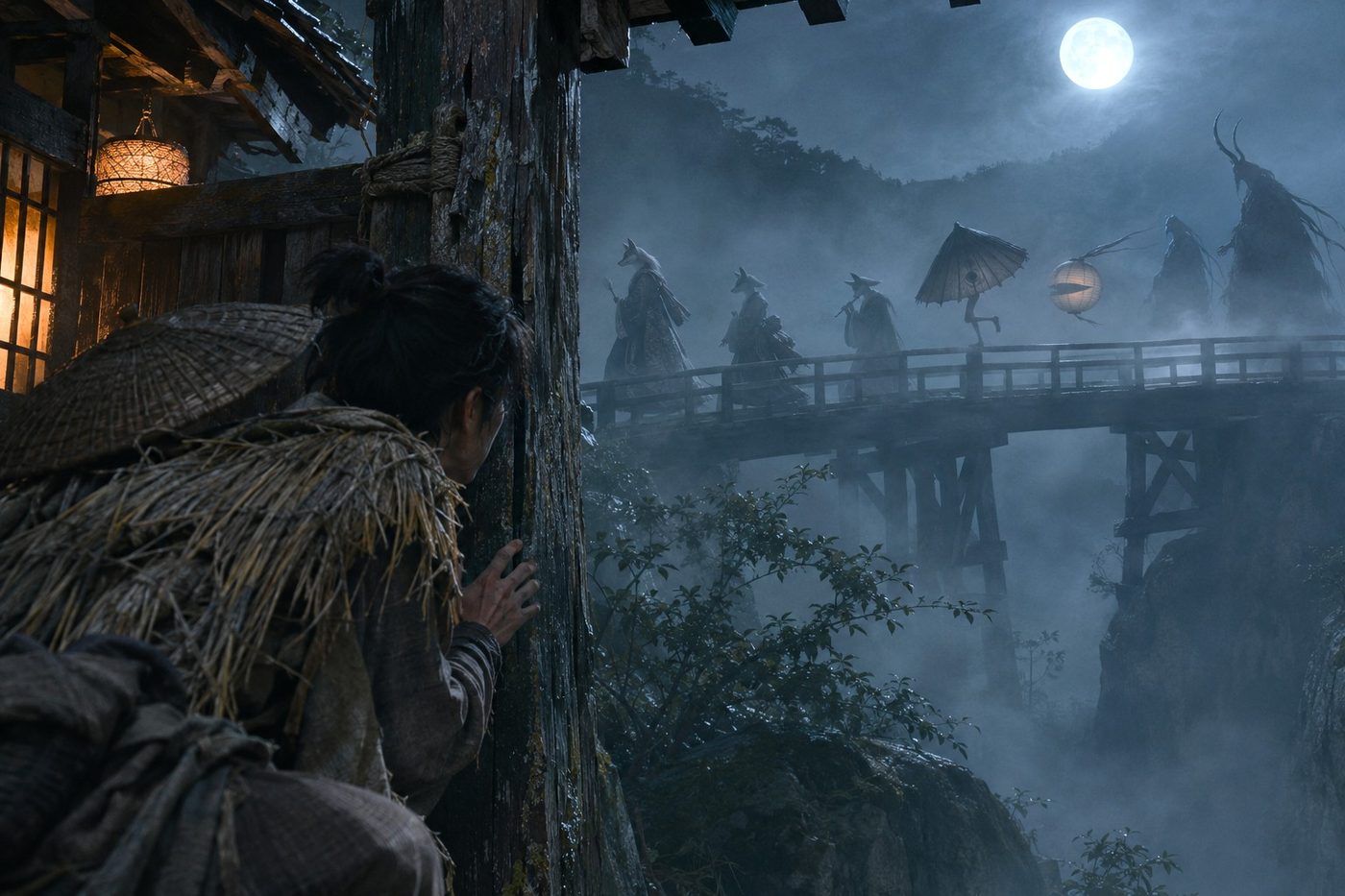
Part 1: Using the Bestiary#
The isles are crowded. A farmer shares his field with its kami, his river with a kappa, his hill with a fox, and his grandfather's grave with whatever his grandfather became. Most of these neighbors want something simple: an offering, a bow, a little respect, or to be left alone. A few want much worse.
This chapter gives the truth behind the stories of Chapter 2, and statistics for everything heroes might bargain with, flee from, or fight: the strange folk called yōkai, the oni and demons, the restless dead, the kami and their servants, the beasts of the wild and of legend, and the ordinary people with swords who are more dangerous than all of them.
Reading an Entry#
Every creature follows the same pattern:
- Name and tag. Every entry is headed the same way: the English name, then the Japanese name and its kanji, as in Ghost (Yūrei, 幽霊). Where the Japanese word is itself the creature's name in English (oni, tengu, kappa), it appears once, as in Oni (鬼). A unique creature takes "The" (The Dragon of Mizuchi); a kind of creature doesn't. Stat blocks and variants under an entry use the English name alone, unless the variant has a Japanese name of its own. Below the heading comes a tag giving the creature's kind (below) and the Rank of heroes it suits.
- The story is what people say about it, the half-truth heroes hear at a teahouse or from a grandmother.
- The truth is what it really is and what it wants. This is for the GM.
- Signs tell heroes it's near before they see it.
- Banes and courtesies give what wards it off and the old rule it keeps. Nearly every yōkai can be dealt with by someone who knows its rule, without a sword ever leaving its scabbard.
- Statistics follow SWADE's format, with skills in alphabetical order.
- Tale seed is a one-line adventure idea for Chapter 11 or for the GM's own use.
Wild Cards are marked with a small tsuba ring before their names. Everyone else is an Extra, though the GM can make any creature a Wild Card when the story needs it.
Threat Ranks (Novice to Legendary) are a guide, not a rule. A Novice threat is a fair fight for a party of four Novice heroes. Most of the old stories end with a clever trick, not a long battle, and a party that learns a creature's rule can beat things far above its Rank.
The Four Kinds of Spirit#
Every supernatural creature in this chapter belongs to one of four kinds. The kind tells the GM which spirit-banes ward it off, which powers touch it, and what a seal can hold (Chapter 6).
| Kind | Who they are | Warded by | Powers that touch them |
|---|---|---|---|
| Kami | Gods of places and things, and their sacred messengers | Nothing. Kami aren't evil, and banes don't drive them off. They're calmed with offerings and courtesy. | Calling Down the Kami (kami-oroshi) calls and bargains with them. Sending Away (banish) works, but driving a kami from its own ground offends it (as an unpaid price, Chapter 6). Harai doesn't drive them back. |
| Yōkai | The strange folk: foxes, badgers, kappa, tengu, and the rest | A bronze mirror against shapeshifters; whatever bane the entry names | True Form (suppress transformation) forces a shapeshifter into its own shape. Harai's Drive Back and Calling the Guardians work only on yōkai the entry calls Wicked. |
| Oni | Demons, most of them climbed up from Yomi | Peach wood, demon-breaking arrows, a twanged bowstring, sacred spring water | Harai, Calling the Guardians, and Sending Away. Not segaki. |
| Restless dead | Ghosts and worse: those who died wronged, unburied, or unfed | Salt, bells, sutras, a sacred rope | Segaki, harai, Calling the Guardians, Sending Away, and Sutra Skin (grave shroud). |
Seals hold all four kinds (Chapter 6), unless the GM decides a being is too great. Sealing a kami is a terrible offense, and most kannagi won't do it.
Beasts are animals, ordinary or enormous. No bane wards them and no rite moves them, though a kannagi's Beast Kin (beast friend) and Call the Beasts (summon animal) work as written.
Special Abilities of Spirits#
Entries use SWADE's Special Abilities by name (SWADE p. 175): Ethereal (p. 176), Fear (p. 176), Hardy (p. 177), Invulnerability (p. 177), Size (p. 178), Undead (p. 178), Weakness (p. 178), and the rest. The Horror Companion's new abilities (HC p. 101) appear the same way. Six abilities belong to the isles and are defined here once:
- Bane (name): The creature is warded by the named spirit-bane, using the Wards rules (HC p. 48, Chapter 6): it makes a Spirit roll at –4 to attack someone holding the bane, or to cross a threshold protected by it. Many entries add a Weakness to the same bane, so the thing that wards it off also hurts it.
- Courtesy: The old rule the creature keeps, and must keep. A kappa bows back. A fox keeps a bargain to the letter. A courtesy isn't a weakness the creature chooses to have; it's part of what it is. A hero who invokes it gets the effect the entry describes, without a roll unless the entry says otherwise.
- Hidden Road: The creature can step between the Middle Land and the Hidden World (Chapter 7) at a thin place during its time, as an action. It vanishes from one world and appears in the other. Kami can do so anywhere on their own ground, at any hour.
- Polluting: A hero Shaken or Wounded by this creature gains one step of pollution (Chapter 4), at most once per scene.
- Spirit Powers: The creature uses the listed powers by nature, as if it had an Arcane Background. It rolls Spirit as its arcane skill and has the Power Points listed, which it recovers as heroes do. The powers use their island names (Chapter 6), and their trappings are the creature's own: a fox's powers look like fox fire and falling leaves.
- Spirit: The creature has no body of flesh as people do. It adds +2 when recovering from being Shaken, is immune to poison and disease, and doesn't need to eat, drink, or breathe (unless the entry says it does, as foxes do).
Knowing the Truth#
Everyone in the isles knows stories, and the stories are half right. When heroes meet a creature, any of them may roll to remember what they know:
- Common Knowledge recalls the folk story: what people say it is, and the usual way to deal with it. The GM tells the story as people tell it, including the parts that are wrong.
- Occult recalls the truth. Success gives what the creature really is and one bane. A raise also gives its courtesy, or a second bane.
A hero may roll each skill once per kind of creature. The Wards rules let anyone with Occult recall a common creature's ward, and this replaces that roll. The difference matters. Everyone knows a kappa bows back. Only an Occult roll tells a hero that the kappa of Mizunuma, sick with the marsh's pollution, has forgotten how.
Fighting Spirits#
Pollution. Chapter 4 gives a hero one step of pollution for a bloody fight. A fight with oni or the restless dead always counts as a bloody fight, even when no blood is spilled, because the touch of Yomi pollutes by itself. Creatures with the Polluting ability are worse still. Chapter 4 (Becoming Polluted, How sources stack) shows how these add up, and the scene cap of two steps that holds them.
Fear. The Horror Companion's Fear rules are in play (Chapter 4). Creatures that cause Fear say so, and the hakobore makes those checks harder (below).
Talking first. Most yōkai and kami are people of a kind, and they answer courtesy, bargains, and offerings. Social Conflict and Persuasion work on any creature with a Smarts of d4 or more that isn't marked (A) for animal. Starting attitudes (SWADE p. 33) follow the creature's nature: a kami starts Neutral to a respectful visitor, a fox starts Uncooperative, a hungry ghost starts Hostile.
Spirits and the Hakobore#
As the hakobore widens (Chapter 7), the boundaries thin and the spirits grow bolder. The Hakobore track in Chapter 7 already sets the Fear penalties. This table adds what changes for the creatures themselves.
| Step | What changes for spirits |
|---|---|
| 0–1, Quiet and Stirring | Spirits keep to their places and their old rules. Most entries in this chapter are rumors. |
| 2, Waking (the present) | As written in each entry. Yōkai and the dead walk at their thin places and times. |
| 3, Restless | Yōkai and the restless dead walk every night, anywhere. They subtract only 2 (not 4) when testing a ward. |
| 4, Torn | Every named spirit is a Wild Card. Oni walk by day. A creature that tests a ward and gets a raise breaks it: the salt line scatters, the rope snaps, or the talisman burns. |
| 5, Broken | Chapter 7's endings begin. Wards still work, but they're all that does. |
When the heroes mend the cut, the spirits fall back with it.
Spirits as Allies#
Humans are the only heroes in this book (Chapter 3), but a hero can still have a spirit at their side. A spirit ally works like any other ally (Chapter 10, Allies and Retainers): the player runs it, and it advances as allies do.
A spirit ally is never bought. It's won in play, through a bargain or a debt:
- The bargain. A kappa beaten fairly at wrestling swears service. A fox whose jewel is returned stays grateful for life. A tengu sends a crow to a student it likes.
- The debt. The hero owes the spirit a Major on (Chapter 4), or the spirit owes the hero one, and both know it.
- The rule. Every spirit ally keeps its courtesy and expects the hero to respect it. A hero who breaks it (who lies to a fox, insults a kappa, or boasts before a tengu) loses the ally at once, and usually gains an Enemy in its place.
A spirit ally isn't a weapon to be spent. It has its own wants, it leaves when it chooses, and it doesn't fight to the death for anyone. No Edge is needed.
Creatures of the Core Rules and the Companions#
Many creatures in SWADE and the Companions live in the isles too. Use them as written, or with the change listed. New creatures appear in full in Parts 2 to 7.
| Creature (source) | In the isles |
|---|---|
| Ama-No-Jaku (HC p. 102) | Changed: the contrary imp (Part 2). |
| Bear (SWADE p. 180) | Unchanged: the brown bear of the north. The black bear of the south uses the same profile with Size 0 and Toughness 8 (Part 6). |
| Bird of Prey (FC p. 178) | Unchanged: hawks and eagles, the falconer's birds. |
| Boar (FC p. 178) | Unchanged: the "mountain whale" of the hunters. |
| Bull (SWADE p. 180) | Unchanged: the plow ox, rarely angry. |
| Cat, Large (FC p. 179) | Unchanged: the tigers and leopards of the mainland, never seen in the isles except caged as a gift. |
| Dog/Wolf (SWADE p. 181) | Unchanged: village dogs, war dogs, and the wolves of the mountains (Part 6). |
| Ghost (SWADE p. 183) | Changed: the base for the yūrei (Part 4). |
| Giant Centipede (FC p. 206) | Changed: the great centipede (Part 6). |
| Giant Crab (FC p. 206) | Unchanged: the great crabs of the southern beaches. |
| Giant Octopus (FC p. 207) | Unchanged: the great octopus of the Inland Sea. |
| Giant Snake (FC p. 208) | Changed: the base for the great serpent (Part 6). |
| Horse and Horse, War (SWADE pp. 184–185) | Unchanged: the small, tough horses of the isles. |
| Mule (SWADE p. 186) | Unchanged: pack horses and mules on the mountain roads. |
| Noppera-Bo (HC p. 151) | Changed: the faceless trick of the badger (Part 2). |
| Rokurokubi (HC p. 153) | Changed: the head that leaves its body (Part 2). |
| Shark and Shark, Great White (SWADE p. 187) | Unchanged: the sharks of the open sea. |
| Snake (SWADE p. 188) | Unchanged: the venomous mamushi of the fields uses the venomous snake profile. |
| Spider, Giant (SWADE p. 188) | Changed: the base for the earth spider (Part 2). |
| Swarm (SWADE p. 189) | Unchanged: hornets, rats, and crabs. Changed swarms appear in Part 4. |
| Whale (FC p. 246) | Unchanged: the whales of the Eastern Sea, mistaken for dragons. |
| Zombie (SWADE p. 191) and Skeleton (SWADE p. 187) | Unchanged, but only as the work of a necromancer's Walking Corpse and Raise the Restless (Chapter 7). The isles' own dead walk as ghosts, not as corpses. |
| Summon ally profiles (FC p. 139) | Unchanged: shikigami and the guardians' attendants (Part 5). |
Not in the Isles#
The isles have no vampires, werewolves, orcs, goblins, elves, dwarves, trolls, or dragons that hoard gold. Where a GM borrows an adventure that uses them, these fill the same roles:
| Instead of | Use |
|---|---|
| Goblins or orcs | Little oni (Part 3), or bandits (Part 7) |
| Ogres or trolls | Oni (Part 3) |
| Vampires | The cat that walks, the corpse-eater, or the wandering head (Parts 2 and 4) |
| Werewolves and shapeshifters | Foxes and badgers (Part 2) |
| Hags and witches | The mountain hag (Part 2), or a curse-worker (Part 7) |
| Elves and fey | Tengu, foxes, and the kami of places (Parts 2 and 5) |
| Dragons | The dragon of Mizuchi (Part 5), a kami, not a beast |
| Zombies | Ghost warriors and hungry ghosts (Part 4) |
Two creatures in the Horror Companion that are sometimes called Japanese don't appear: the Kuchisake-Onna (HC p. 143) and the giant skeleton some modern books call a gashadokuro. Both are modern inventions, not the folklore of the age this book draws on.
Creatures by Rank#
This index covers the whole chapter.
| Rank | Creatures |
|---|---|
| Novice | Young fox, raccoon-dog, kappa, crow tengu, small tool spirits, little oni, hungry ghost, Kamaeda crabs and demon-fires, sacred messengers, wolf, monkey troop, bandit, foot soldier, and most human Extras |
| Seasoned | Three-tailed fox, the fox sisters, the polluted kappa, wandering head, the faceless, contrary imp, empty armor, willow spirit, lost-way god, common oni, forest oni, ghost, ship ghosts, ghost warriors, corpse-eater, stone guardians, shark-man, great centipede and the centipede of the Fourth Gallery, night beast, dream-eater |
| Veteran | Nine-tailed fox, great tengu, snow woman, mountain hag, earth spider, the cat that walks, great oni, the hags of Yomi, demon of sickness, the jealous demon, vengeful ghost, old warrior ghost, living ghost, kami of a village or river, the messenger of the Dragon Palace, great serpent, sea-crocodile |
| Heroic | The One-Armed of the Southern Gate, the dragon of Mizuchi |
| Legendary | The Lord of the Demon Gate, the kami of a mountain or province |
| No statistics | The Elder of the Forest, the drowned child-emperor, the Forging Gods and the Eight Kami |
Notes#
- The four kinds of spirit follow the distinction between kami, the strange beings of folk belief, demons, and the dead in W. G. Aston, Shinto: The Way of the Gods (1905), and Lafcadio Hearn, Glimpses of Unfamiliar Japan (1894).
- Courtesies, the rules each yōkai keeps (the kappa's bow, the fox's bargain), follow the tales in F. Hadland Davis, Myths and Legends of Japan (1912).
Part 2: Yōkai#
The yōkai are the strange folk of the isles: neither gods nor ghosts nor animals, though many look like animals and some were people once. Country people use a plainer word for anything that changes its shape: bakemono, "a thing that changes." Most yōkai live at the edges, in rivers, on mountains, at crossroads, and in old houses, and most of them keep rules older than any lord's law. A hero who knows those rules can walk past a kappa, drink tea with a fox, and lose a bout to a tengu with honor. A hero who doesn't is the next story.
Fox (Kitsune, 狐)#
Yōkai, shapeshifters. Novice to Veteran.
The story. Foxes are the messengers of the rice kami, and they are also the cleverest tricksters in the isles. A fox lives long, and as it ages it grows another tail, until at a thousand years it has nine and its fur turns silver or gold. Foxes take the shape of beautiful women, old monks, and dignified samurai. They lead travelers in circles, turn leaves into coins and horse dung into rice cakes, and possess people, who then crave fried bean curd and speak in a voice like a yelp. When the sun shines through falling rain, a fox wedding is passing, and anyone who watches is cursed.
The truth. All of it is true, though not of every fox. Foxes come in two sorts, and they hate each other. Messenger foxes serve the kami of the rice and wear the shrine's favor: they guard fields, punish thieves, and carry the kami's word. Field foxes serve no one. They play, steal, bargain, and feed on the life of people they bewitch, and an old field fox can be very dangerous indeed. Every old fox keeps its soul in a pearl, the fox's jewel (Chapter 6), and whoever holds it holds the fox.
Signs. Pale fire bobbing in a line across a field at night (kitsunebi, fox fire). A road that loops back on itself. A stranger who won't stand near a dog or a mirror. A shadow on a paper screen with a tail. Sun through rain.
Banes and courtesies.
- Bane (bronze mirror). A fox in human shape shows its true form in a bronze mirror, and makes the Spirit roll to come near one held toward it.
- Dogs. Dogs see through any fox's disguise and bark at it. A fox in human shape won't willingly come within a few yards of a dog, and a dog that bites it forces it back into fox shape.
- Drink and fright. A fox who drinks too much, or is badly startled, lets its tail slip: a Notice roll at –2 spots it.
- Courtesy: the bargain. A fox keeps its word to the letter, and expects others to keep theirs. It repays kindness, and it never forgets cruelty. A fox who has promised something can't break the promise, though it can twist the meaning.
Fox possession (kitsunetsuki). Foxes possess people using Possession (puppet, FC p. 134), a power only the GM's creatures use (Chapter 6). A short possession is the power as written. A long one is a story: the fox moves into the victim and stays, eating through them and speaking with their mouth. The victim gains a level of Fatigue every week that can't be recovered while the fox remains. Driving it out takes Driving Out (exorcism, HC p. 76), Sending Away (banish), or a bargain with the fox, which usually wants something specific: an apology, a shrine, a feast of red rice and bean curd, or revenge.
Young Fox (Kogitsune, 子狐)#
A fox of a hundred years or so, with one tail, a quick tongue, and a single human shape it wears like a borrowed coat. The pipe fox a fox-keeper carries (Chapter 7) is a young fox the size of a mouse (Size –3, Toughness 2), and a freed pipe fox grows into one of these in a year.
Attributes: Agility d8, Smarts d8, Spirit d8, Strength d4, Vigor d6
Skills: Athletics d8, Fighting d6, Notice d8, Performance d8, Persuasion d8, Stealth d10, Taunt d6
Pace: 8; Parry: 5; Toughness: 4
Edges: Fleet-Footed
Special Abilities:
- Bane (bronze mirror), and the fox's weaknesses above.
- Bite: Str+d4.
- Low Light Vision: Ignores penalties for Dim and Dark Illumination.
- Shapeshift: As an action, the fox takes one human shape, always the same, or returns to fox shape. A fox that is Shaken or worse in human shape makes a Spirit roll or returns to fox shape.
- Size –1: A fox is a small animal.
- Spirit Powers: Bewilder (confusion) and Lantern and Smoke (light/darkness). 10 Power Points.
★ Three-Tailed Fox (Sanbi-no-kitsune, 三尾の狐)#
A fox of three or four hundred years, with a household's worth of human shapes and a real taste for mischief.
Attributes: Agility d10, Smarts d10, Spirit d10, Strength d4, Vigor d8
Skills: Athletics d8, Fighting d6, Notice d10, Occult d8, Performance d10, Persuasion d10, Stealth d10, Taunt d8
Pace: 8; Parry: 5; Toughness: 5
Edges: Charismatic, Dodge, Fleet-Footed
Special Abilities:
- As the young fox, except that it may take any human shape it has seen.
- Fox's jewel: Its soul is in its jewel (Chapter 6).
- Hidden Road.
- Spirit Powers: Bewilder (confusion), Borrowed Face (disguise), Heavy Eyes (slumber), Lantern and Smoke (light/darkness), Mist (illusion), and Possession (puppet, GM only). 20 Power Points.
★ Nine-Tailed Fox (Kyūbi-no-kitsune, 九尾の狐)#
A fox of a thousand years, silver or golden, as old as a great shrine and as clever as a court. A messenger fox of this age sits at the right hand of a rice kami. A field fox of this age has ruined dynasties.
Attributes: Agility d10, Smarts d12, Spirit d12+1, Strength d6, Vigor d10
Skills: Athletics d10, Fighting d8, Intimidation d10, Notice d12, Occult d12, Performance d12, Persuasion d12+1, Stealth d12, Taunt d10
Pace: 8; Parry: 6; Toughness: 7
Edges: Charismatic, Improved Dodge, Fleet-Footed, Level Headed, Power Points (×2)
Special Abilities:
- As the three-tailed fox.
- Fear: A nine-tailed fox who shows its true shape causes a Fear check.
- Spirit Powers: As the three-tailed fox, adding Arrows (bolt, fox fire), Dread (fear), River of Forgetting (mind wipe), and Spirit Thief (drain Power Points). 40 Power Points.
Tale seed. A young lord's new bride never stands near the house dogs, and the lord has had them all sent away.
The Fox Sisters of the Bamboo Teahouse (Takechaya-no-Kitsune, 竹茶屋の狐)#
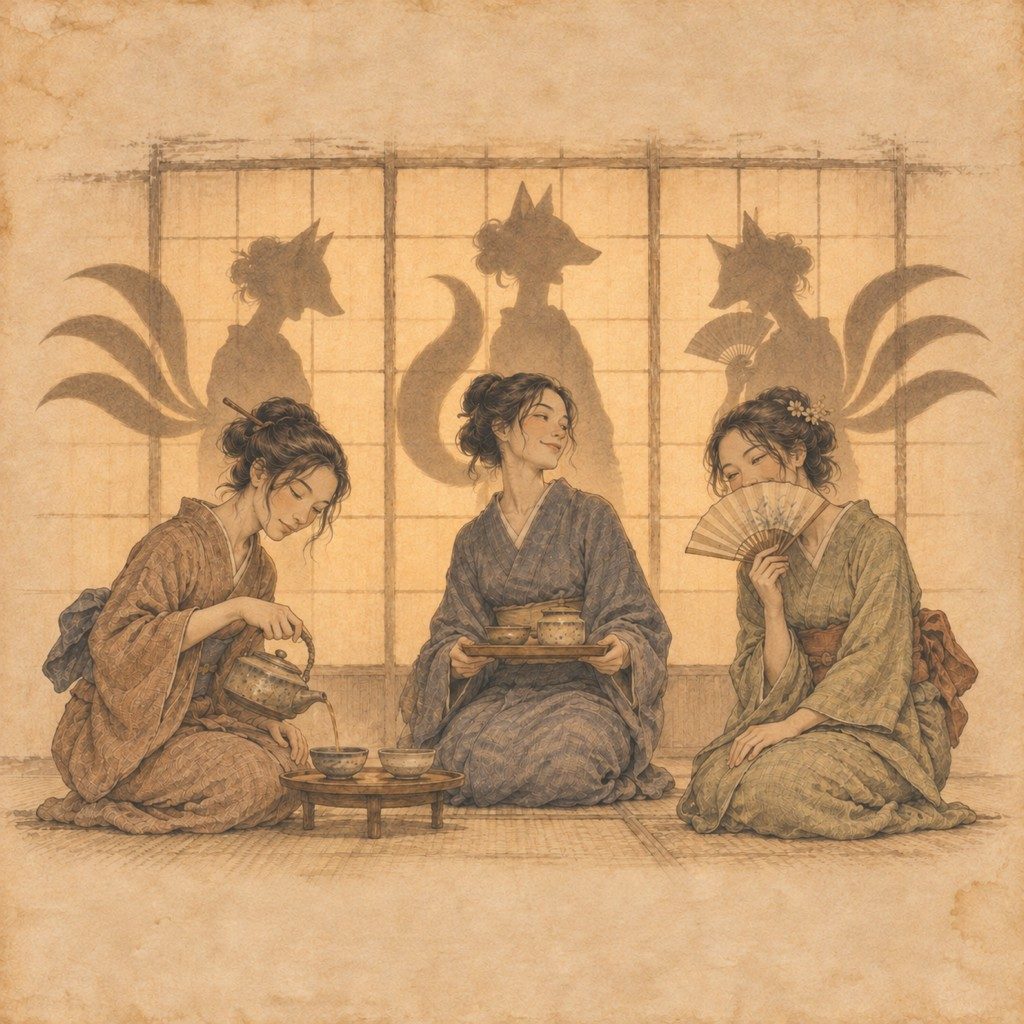
Yōkai, shapeshifters. Seasoned.
Three field foxes keep the Bamboo Teahouse on the border road in Kurogane (Chapter 8), in the shape of three beautiful sisters who serve the finest tea in the province. Officers of every side stop there, and every side's secrets leak out over the cups. The sisters sell what they hear for fine sake and fresh talismans, and amuse themselves by leading proud samurai astray in illusions. They aren't murderers, and they've never needed to be.
- ★ Akane, the eldest, is a three-tailed fox who runs the house and does all the bargaining. She is gracious, patient, and greedy for news. She knows Kurogane's secrets better than the Kirikubo, and sells them more cheaply.
- ★ Tsuyu, the middle sister, is a three-tailed fox who lost her jewel to a traveling monk thirty years ago (Chapter 6). She is the gentlest of the three, and the most desperate. She would do almost anything for whoever brings it back, and the monk's temple still has it, in a box nobody has opened.
- Hagi, the youngest, is a young fox, proud of her first human face and too quick to show off. She leads the illusions. When a guest sees through her, she sulks for a month.
What they want. News, sake, talismans to sell, and Tsuyu's jewel. They don't care which plum blossom wins, but they would hate to lose the teahouse, and a battle on the border road would end it.
Tale seed. Hagi led an Amanuma captain in circles for a night, and he swears he'll burn the grove down. The sisters hire the heroes to stop him, and pay in a secret one of the heroes would rather not have known.
Raccoon-Dog and Badger (Tanuki, 狸, and Mujina, 貉)#
Yōkai, shapeshifters. Novice to Seasoned.
The story. The raccoon-dog is a fat, cheerful trickster who drums on his belly on moonlit nights. He turns himself into a tea kettle to be sold and walks away when it's put on the fire. He pays for his sake with leaves that turn back from coins at dawn. The badger is his older, colder cousin, and the badger's trick is the worst in the isles: a face with nothing on it.
The truth. Raccoon-dogs are mostly harmless pranksters, and they repay kindness generously. An old badger is another matter. Its illusions are strong, it likes fear the way a fox likes news, and it plays its trick twice: a victim who flees the faceless woman by the moat runs straight to a noodle seller's lantern, gasps out the story, and the noodle seller asks, "Was it like this?"
Signs. Drumming in the hills at night. Coins in the till that turn to leaves. A lone figure crouched by a moat or a dark road, weeping, face hidden in its sleeves.
Banes and courtesies.
- Bane (bronze mirror), as foxes. Dogs see through them too.
- Courtesy: repayment. A raccoon-dog repays a kindness, often in a way that causes trouble (the old tale's raccoon-dog turned himself into gold coins and let himself be spent). A badger repays an insult.
Raccoon-Dog#
Attributes: Agility d6, Smarts d6, Spirit d8, Strength d6, Vigor d8
Skills: Athletics d6, Fighting d6, Notice d6, Performance d8, Persuasion d6, Stealth d8, Taunt d8
Pace: 6; Parry: 5; Toughness: 5
Edges: —
Special Abilities:
- Bane (bronze mirror) and dogs, as above.
- Bite: Str+d4.
- Leaf money: A raccoon-dog can make leaves look like coins, up to 100 mon a day. They turn back at dawn.
- Shapeshift: As an action, it takes the shape of a person or of an object about its own size (a kettle, a stone, a jizō statue). Shaken in another shape, it makes a Spirit roll or returns to its own.
- Size –1.
- Spirit Powers: Bewilder (confusion, the belly drum). 10 Power Points.
Faceless (Noppera-bō, のっぺらぼう)#
Noppera-Bo (HC p. 151), with these changes:
- What it is: an old badger's illusion, not a creature of its own. It's a yōkai and a shapeshifter: a bronze mirror shows the badger behind the face, True Form (suppress transformation) forces it back into a badger's shape (use the raccoon-dog's profile with Smarts d8 and Spirit d10), and dogs bark at it.
- Twice shown: a hero who fails a Fear check against the faceless and flees meets it again within the hour, in a new shape (a noodle seller, a watchman, a friend). The second Fear check is at –2.
- No weapons: the faceless never fights if it can frighten. Hurt, it drops the illusion and runs.
Tale seed. Travelers on the Kayahara road have started arriving at the post town white and speechless, and the last one swears the innkeeper has no face.
Kappa (河童)#
Yōkai. Novice.
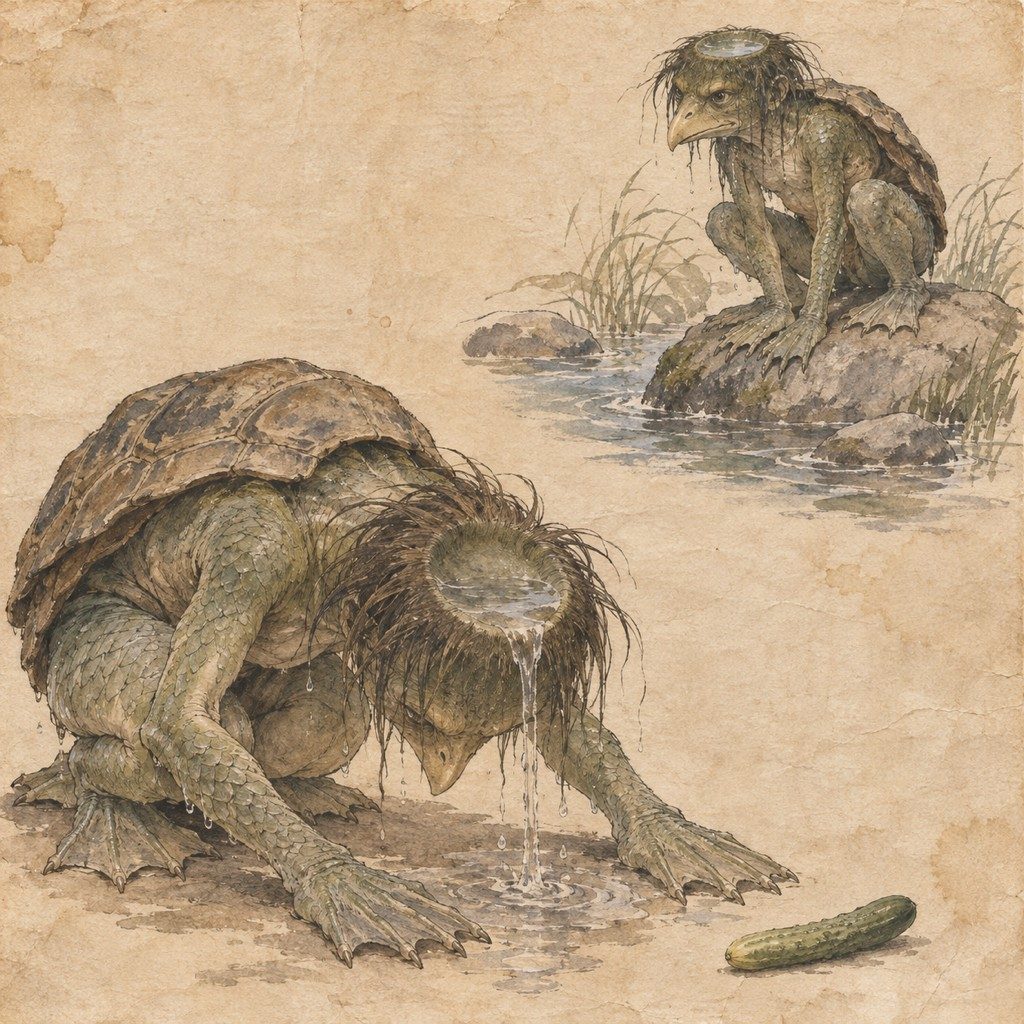
The story. The kappa is a river goblin the size of a child, with a turtle's shell, a beak, webbed hands, and a dish-shaped hollow on top of its head full of water. It drags horses and swimmers under and drinks their life, and those who escape it waste away. It challenges travelers to wrestle, and can't be refused. But it is fiercely polite: bow to a kappa, and it bows back, spills the water from its head, and loses its strength.
The truth. Exactly so. A kappa is a lord in its own small stretch of water, as quarrelsome as a drunk ronin and as proud of its manners as a court noble. Villagers along the rivers throw it cucumbers with their families' names carved in the skin, and the kappa leaves those families alone. A kappa that is beaten fairly, or bound and spared, can be made to swear an oath, and it seals the oath with the print of its webbed hand. Kappa keep those oaths for centuries, and some temples still keep the paper. A grateful kappa sometimes teaches the art of setting bones.
Signs. Wet footprints leading out of a river and back in. A horse that won't drink at a certain pool. A child's voice calling a challenge from the reeds.
Banes and courtesies.
- Courtesy: the bow. A hero who bows deeply to a kappa forces it to bow back, unless it makes a Spirit roll at –4. If it bows, it spills its water (below).
- Courtesy: the challenge. A kappa's challenge to wrestle can't be refused without dishonor among the river folk; a hero who refuses can't cross that water safely again.
- Courtesy: the oath. A kappa that swears an oath by handprint keeps it forever.
- Cucumbers. A cucumber carved with a family's name and thrown into the water keeps the kappa from that family for a year.
Kappa#
Attributes: Agility d8, Smarts d6, Spirit d6, Strength d10, Vigor d8
Skills: Athletics d10, Fighting d8, Notice d6, Persuasion d4, Stealth d8
Pace: 6; Parry: 6; Toughness: 8 (2)
Edges: Brawny
Special Abilities:
- Aquatic: Pace 10 in water.
- Armor +2: Its shell.
- Claws: Str+d4.
- Drowning grip: A kappa that grapples a target in water (Grappling, SWADE p. 101) drags it under on its next turn. The victim starts to drown (SWADE p. 126) until they break free.
- Life-drinker: A hero Wounded by a kappa in the water, or who loses a wrestling match with one, gains a level of Fatigue that recovers only after a night at a shrine or a priest's harai.
- Size –1.
- The dish: A kappa whose water is spilled (by its own bow, or by a Called Shot to the head at –4 that knocks it down or Shakes it) falls to Strength d4 and flees to the nearest water to refill it.
The Kappa of Mizunuma (Mizunuma-no-Kappa, 水沼の河童)#
The marsh's kappa used to be polite and easily bowed to (Chapter 8). Since the dead of Akahara were thrown into the water, the pollution has soaked into them, and they've forgotten their manners. Use the kappa, with these changes:
- No courtesy: they don't bow back, they don't keep the challenge, and cucumbers mean nothing to them.
- Polluting.
- Strength d12, and Toughness 9 (2) from swollen bodies. (Variant adjustment: +1 Toughness over the ordinary kappa's 8 (2). Keep it when recounting.)
- Wicked: while polluted, they count as wicked yōkai for harai and Calling the Guardians.
The cure. When Akahara is cleansed (Chapter 6) and the mirror is returned to its shrine (Chapter 9), the kappa come back to themselves in a season. The oldest of them, a grey-shelled kappa as big as a man, still half remembers, and a hero who bows to it gets a long, slow, pained bow back, and a chance to talk.
Tale seed. A Sekitani farmer's son was dragged into the marsh at dusk, and the boy's mother says she saw the kappa bow to her before it went under, as if it were sorry.
Tengu (天狗)#
Yōkai. Novice to Veteran.
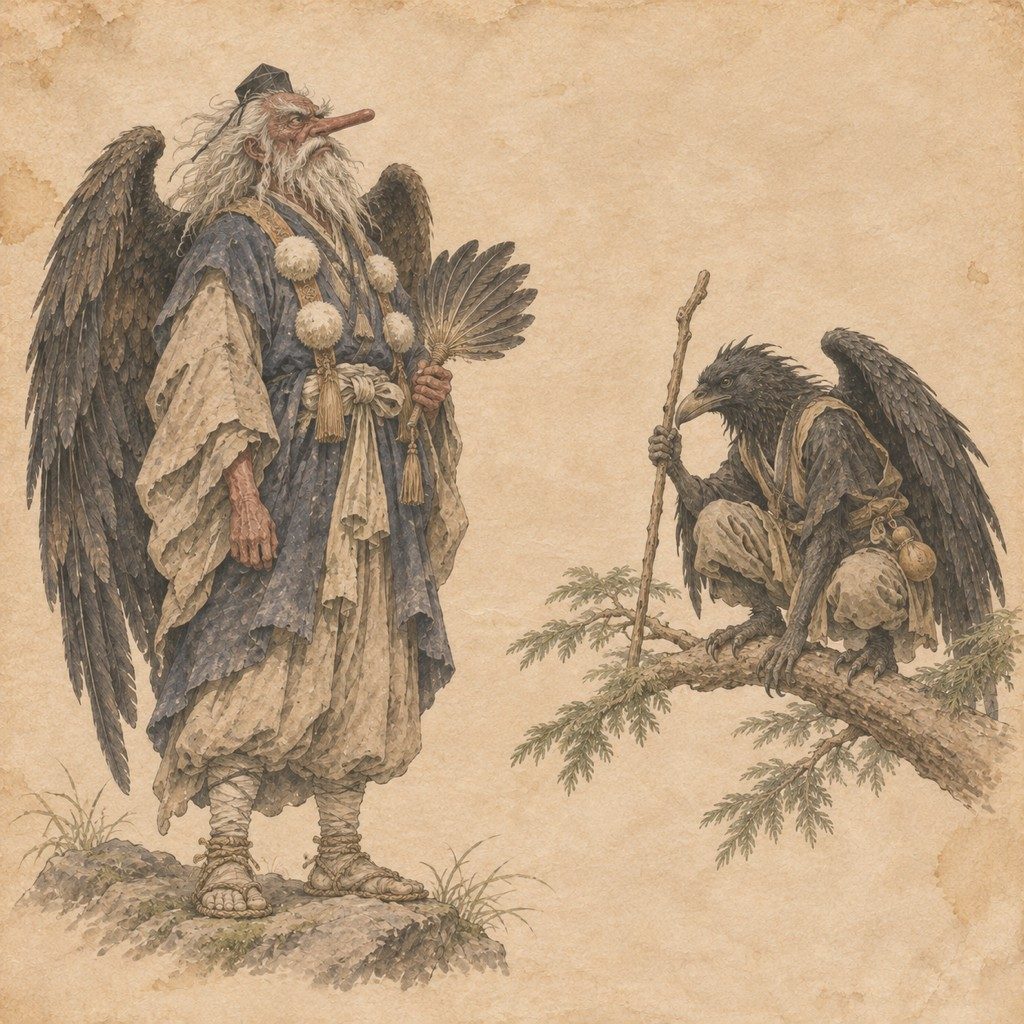
The story. Tengu are the goblins of the high mountains. The lesser ones have the faces of crows; the great ones have long red noses and the robes of mountain ascetics, and they carry feather fans that raise a gale. They kidnap the proud, mislead travelers, mock priests who think too well of themselves, and every so often take a young warrior to a mountaintop and teach him the sword.
The truth. Tengu love skill and hate pride, except their own, which is bottomless. A crow tengu is a mountain bully. A great tengu is a master of the sword and of strange arts, and a law to itself. Some great tengu, like the Grey Abbot of Tachiyama (Chapter 10), teach for the joy of it. Others teach sorcery for the pleasure of watching their students fall, and one of those taught Kūzan of the Whetstone (Chapter 7).
Signs. Laughter on an empty ridge. Stones falling from a clear sky. A traveler found on a temple roof miles away with no memory of the climb (spirited away, Chapter 7). A crow that stares too long.
Banes and courtesies.
- Courtesy: skill and pride. A tengu answers a boast made in its mountains with a challenge, and it respects skill shown honestly, even in defeat. A hero who loses a tengu's bout with grace or style earns its respect; a hero who wins and gloats makes an enemy for life.
- Bane: none. Tengu are proud of that.
Crow Tengu (Karasu-tengu, 烏天狗)#
Attributes: Agility d10, Smarts d6, Spirit d8, Strength d6, Vigor d6
Skills: Athletics d10, Fighting d8, Notice d8, Stealth d8, Taunt d8
Pace: 6; Parry: 6; Toughness: 5
Edges: Acrobat, Extraction
Gear: Long sword (Str+d6) or staff (Str+d4, Parry +1, Reach 1).
Special Abilities:
- Beak and claws: Str+d4.
- Flight: Pace 12.
- Hidden Road.
- Spirit Powers: Bewilder (confusion, the trick of turning a road around). 5 Power Points.
★ Great Tengu (Daitengu, 大天狗)#
Use this block for the tengu who teaches sorcery, or for any great tengu that must fight. The Grey Abbot is a person, not a stat block (Chapter 10).
Attributes: Agility d12, Smarts d10, Spirit d10, Strength d10, Vigor d10
Skills: Athletics d12, Fighting d12, Intimidation d10, Notice d10, Occult d10, Persuasion d8, Stealth d10, Taunt d10
Pace: 6; Parry: 9; Toughness: 7
Edges: Block, Improved Counterattack, First Strike, Improved Frenzy, Level Headed
Gear: Long sword of a master smith (Str+d8, AP 2), feather fan (Chapter 6).
Special Abilities:
- Flight: Pace 12.
- Hidden Road.
- Spirited away: A great tengu can carry off a sleeping or helpless person to any mountain it knows, as an action, using Shrinking the Earth (teleport) with the Additional Recipient modifier at no cost.
- Spirit Powers: Bewilder (confusion), Borrowed Face (disguise), Ride the Wind (fly), Shrinking the Earth (teleport), and Storm (havoc, with the fan). 30 Power Points.
Tale seed. A tengu has kidnapped a young lord of Takane who boasted he was the best swordsman in the province (Chapter 8), and sends word that he'll return him when someone better comes to fetch him.
Wandering Head (Rokurokubi, 轆轤首)#
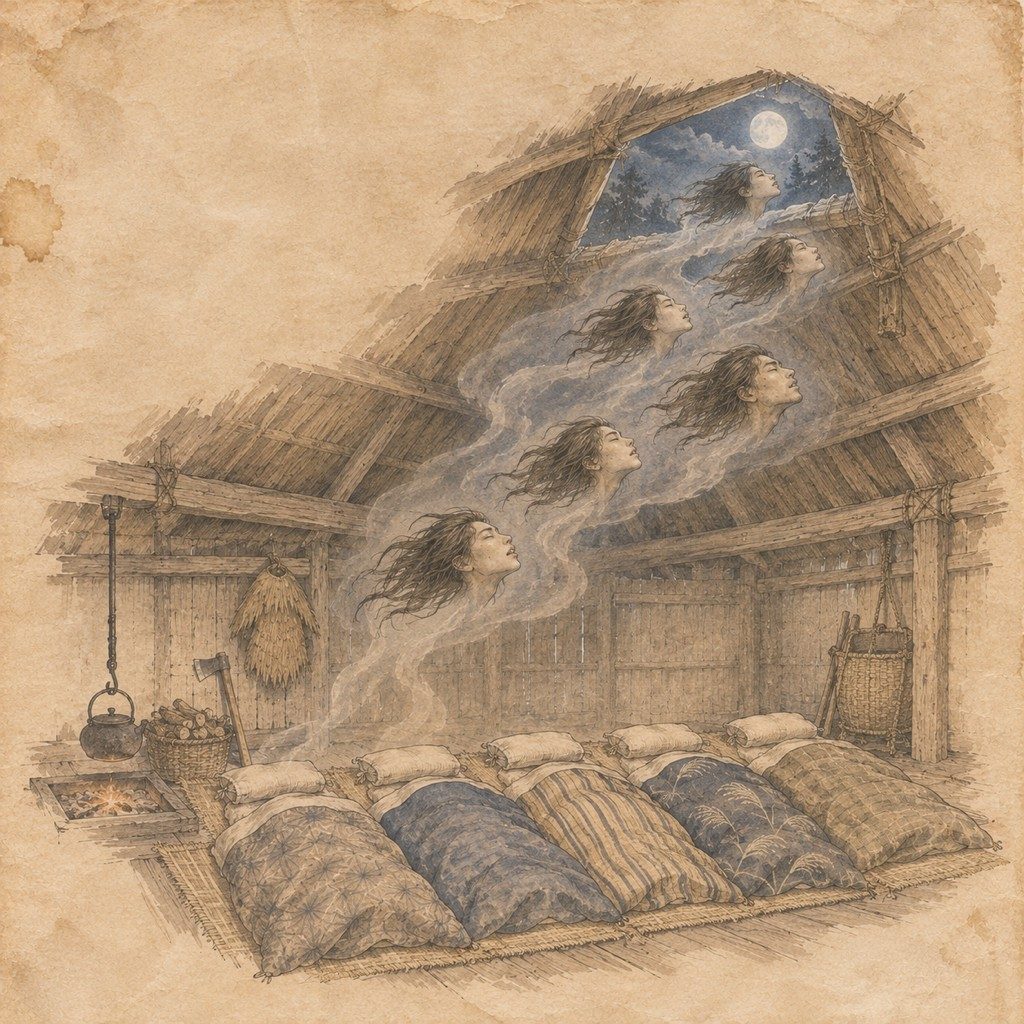
Yōkai, wicked. Seasoned.
Rokurokubi (HC p. 153), with these changes:
- What it is: a family of yōkai who live as ordinary people, often woodcutters or innkeepers in a lonely place. By night their heads leave their bodies and fly out to hunt. Hearn's tale is the model: a whole household in a hut in the hills, and a traveling priest who found their headless bodies sleeping and moved one.
- Kind: yōkai, wicked. Harai and Calling the Guardians work on the flying heads.
- The body: keep the Companion's weakness. In the isles, a head that can't rejoin its body by dawn beats itself against the ground in rage and grief, and dies at sunrise. It doesn't seek another body.
- The cruel trick: a head that bites and holds a victim's sleeve or hair never lets go, even dead, until a priest cuts it free.
Tale seed. A wandering monk arrives at a castle town with a dead head clamped to the sleeve of his robe, and says the woodcutters who gave him lodging are still out there.
Snow Woman (Yuki-onna, 雪女)#
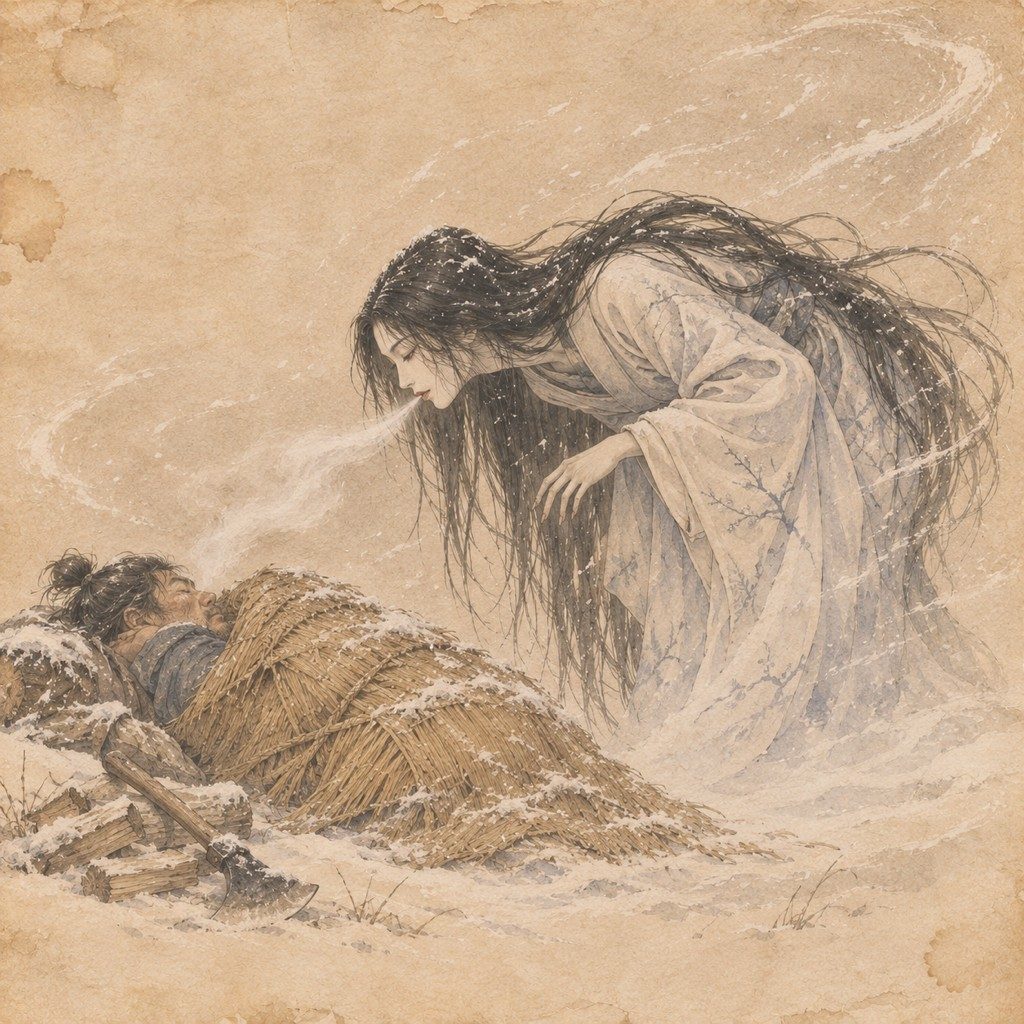
Yōkai. Veteran.
The story. In the worst blizzards of the north, a woman in white comes into the huts of travelers and woodcutters and breathes on them as they sleep, and they never wake. Once, the story goes, she spared a young man because he was beautiful, and made him promise never to tell anyone what he had seen. Years later he married a pale, lovely wife, and one winter night he told her the story. She was the snow woman, and she left him and their children forever.
The truth. She is the cold itself, given a woman's shape and a woman's heart, and she means everything the story says: the killing and the mercy and the love. There are several snow women in the north, and all of them keep the promise.
Signs. A sudden silence in the storm. A door blown open with no wind behind it. A woman's footprints that stop in the middle of a snowfield.
Banes and courtesies.
- Courtesy: the promise. A snow woman sometimes spares someone, always on the promise that they will never tell. One who breaks the promise sees her again, and whether she kills them or only leaves them is up to her.
- Fire. She won't enter a room with a well-tended fire unless invited.
★ Snow Woman#
Attributes: Agility d8, Smarts d8, Spirit d10, Strength d6, Vigor d10
Skills: Athletics d8, Fighting d6, Intimidation d10, Notice d8, Persuasion d10, Stealth d12
Pace: 6; Parry: 5; Toughness: 7
Edges: Very Attractive, Level Headed
Special Abilities:
- Breath of winter: As an action, she breathes over a Cone Template. Everyone in it makes a Vigor roll at –2 (–4 if asleep) or gains a level of Fatigue from cold (SWADE p. 125), which can lead to Incapacitation and death as usual.
- Fear: When she shows her true face, everyone who sees it makes a Fear check.
- Hidden Road (any snowfield is a thin place for her).
- Immunity (cold).
- Snow-born: In falling snow she can vanish as a free action, as Hidden Form (invisibility) with a raise, until she next attacks.
- Spirit.
- Weakness (fire): She takes +4 damage from fire.
Tale seed. A hunter of Hate-no-Kuni comes south in midwinter, asking the heroes to find his wife of ten years, who walked out into a blizzard the night he told her a story.
Mountain Hag (Yamauba, 山姥)#
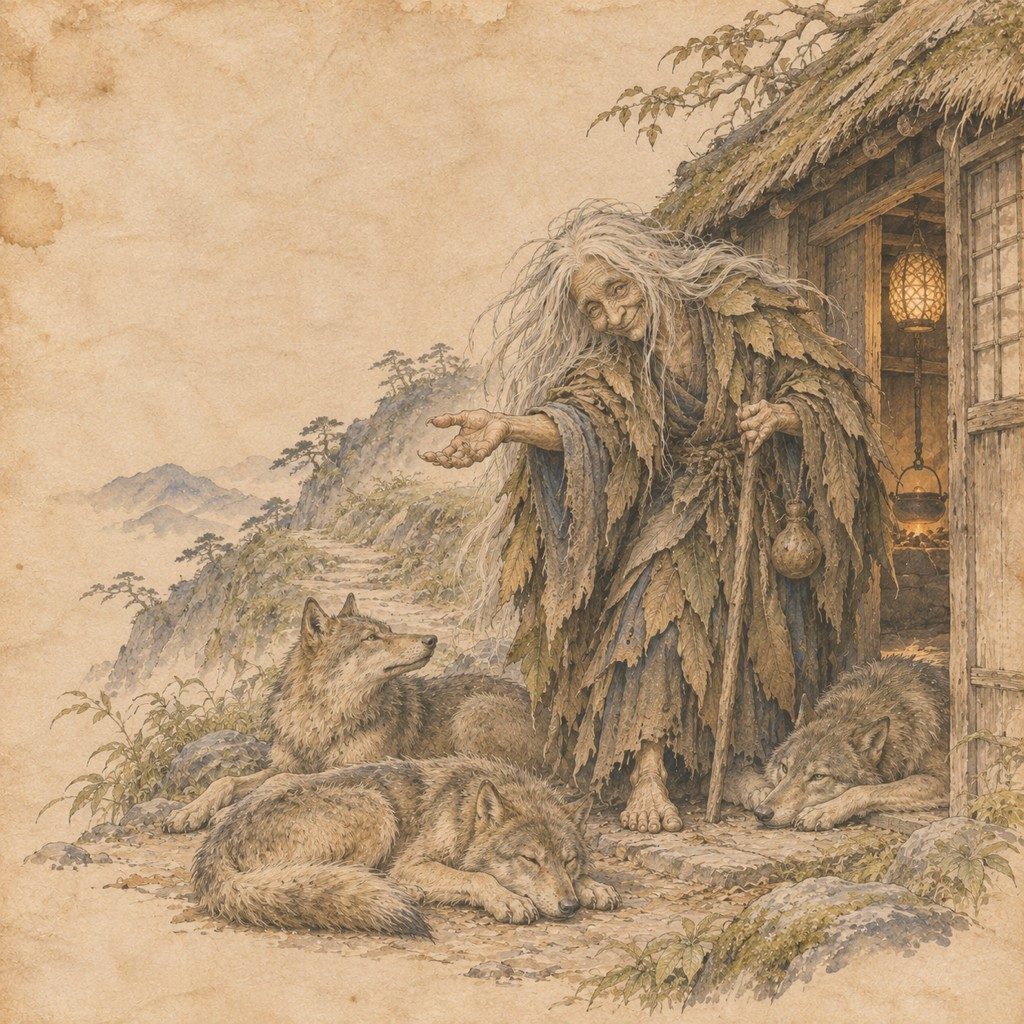
Yōkai. Veteran.
The story. Deep in the mountains lives an old woman with long white hair, a wide mouth, and a hut that's always lit. In some villages she's a cannibal who offers travelers lodging and eats them in the night. In others she's a mountain mother who raised a wild boy among the bears and monkeys until he grew strong enough to carry a tree, and sent him down to serve a great warrior.
The truth. Both stories are true, because she is both. A mountain hag is the mountain's own hunger and its own care. She shelters the lost, feeds the hungry, and raises abandoned children as fiercely as a she-bear, and she eats the rude, the cruel, and the greedy. She keeps the old law of the guest.
Signs. A lit hut where no hut should be. Beasts that walk calmly past travelers on the path, as if sent. A child's laughter far up the slope.
Banes and courtesies.
- Courtesy: the guest. A traveler who accepts her hospitality, eats what she offers, and keeps her house's rules is safe under her roof, whatever she is. One who refuses her food, steals, lies, or pries is fair game. Her rules are always strange: don't look in the back room, don't put out the fire, don't speak after dark.
- Children. She won't harm a child, and anyone who harms one in her mountains is hers.
★ Mountain Hag#
Attributes: Agility d8, Smarts d8, Spirit d10, Strength d12, Vigor d10
Skills: Athletics d10, Fighting d10, Intimidation d10, Notice d10, Occult d8, Persuasion d6, Stealth d10, Survival d12
Pace: 8; Parry: 7; Toughness: 8
Edges: Brawny, Woodsman
Special Abilities:
- Claws and teeth: Str+d6.
- Hardy.
- Hidden Road.
- Mountain mother: The bears, wolves, and monkeys of her mountain obey her. Once per scene she can call 1d6 wolves or a bear (SWADE pp. 180–181), who arrive at the start of the next round.
- Spirit Powers: Beast Kin (beast friend), Borrowed Face (disguise, a kindly old woman), Heavy Eyes (slumber), and Shrinking the Earth (teleport, on her own mountain only). 20 Power Points.
Tale seed. A mountain village lost a baby to wolves last winter, and now a hunter swears he saw the child alive, carried on the shoulders of an old woman with white hair.
Earth Spider (Tsuchigumo, 土蜘蛛)#
Yōkai, wicked. Veteran.
Giant Spider (SWADE p. 188), with these changes:
- What it is: an old spider grown huge in a cave or the ruins of a temple, which hunts people. It's the "goblin spider" of the old warrior tales: it visits a great man in the shape of a priest, and he falls sick with a fever no physician can cure.
- Size 2 (as big as a horse), Strength d12+2, Vigor d10, Toughness 11 (2) with a hard shell, Smarts d8 (no longer an animal).
- Kind: yōkai, wicked. Fear.
- Web: as an action, it throws a sticky thread at a target within 6": a Shooting roll, and on a hit the target is Entangled (Bound with a raise).
- Shapeshift: an old priest, a young page, or a beautiful woman. A bronze mirror shows the spider.
- Wasting fever: a person the spider visits in human shape falls sick with a fever. They gain a level of Fatigue each night until the spider dies; the Fatigue can't be recovered until then. Killing the spider breaks the fever at once.
- Courtesy: none. Follow the blood trail from the wound it took in the sickroom to its lair.
Tale seed. A lord lies dying of a fever in Kanagura, and his page says a priest no one knows visits him at the Hour of the Ox.
Cat That Walks (Bakeneko, 化け猫)#
Yōkai, wicked, shapeshifter. Veteran.
The story. A cat that lives too long grows large and learns to walk on its hind legs, and some say to dance with a towel on its head. The worst kind kills a woman, buries her under the veranda, and takes her shape, and every night it comes to her husband or her lord and drinks his life while his guards fall asleep at their posts.
The truth. This is the old tale of the great house whose lord wasted away while his favorite lay beside him, until a low-ranking retainer stayed awake by stabbing his own thigh and saw what she was. Cats that walk are rare, old, and patient, and they choose great houses.
Signs. A lord who sickens each night and recovers by day. Guards who sleep through every watch, ashamed and unable to say why. A beloved wife or concubine who has lately grown cold to the house's dogs. A smell of fish in a lady's chamber.
Banes and courtesies.
- Bane (bronze mirror), and dogs see through it, as foxes.
- Pain wakes. A hero who takes a Wound or a level of Fatigue on purpose (cutting their own hand, kneeling on a blade) ignores the cat's Heavy Eyes for the rest of the night.
★ Cat That Walks#
Attributes: Agility d10, Smarts d8, Spirit d10, Strength d8, Vigor d8
Skills: Athletics d10, Fighting d8, Notice d10, Performance d8, Persuasion d8, Stealth d12
Pace: 8; Parry: 6; Toughness: 6
Edges: Acrobat, Dodge
Special Abilities:
- Claws and bite: Str+d6.
- Drinks the life: Each night the cat spends beside a sleeping victim, the victim gains a level of Fatigue that can't be recovered until the cat dies or leaves them. A victim who reaches Incapacitated this way dies within a week.
- Low Light Vision.
- Shapeshift: It takes only the shape of someone it has killed, and keeps their memories well enough to fool all but their closest kin. Shaken in human shape, it makes a Spirit roll or returns to its own shape: a cat as big as a dog, walking upright.
- Spirit Powers: Heavy Eyes (slumber, always with the Area Effect modifier, at no extra cost). 15 Power Points.
- Wall Walker.
Tale seed. The heir of a great house is wasting away in Hagane, and his mother, who doesn't trust the physicians, wants guards who won't fall asleep.
Tool Spirit (Tsukumogami, 付喪神)#
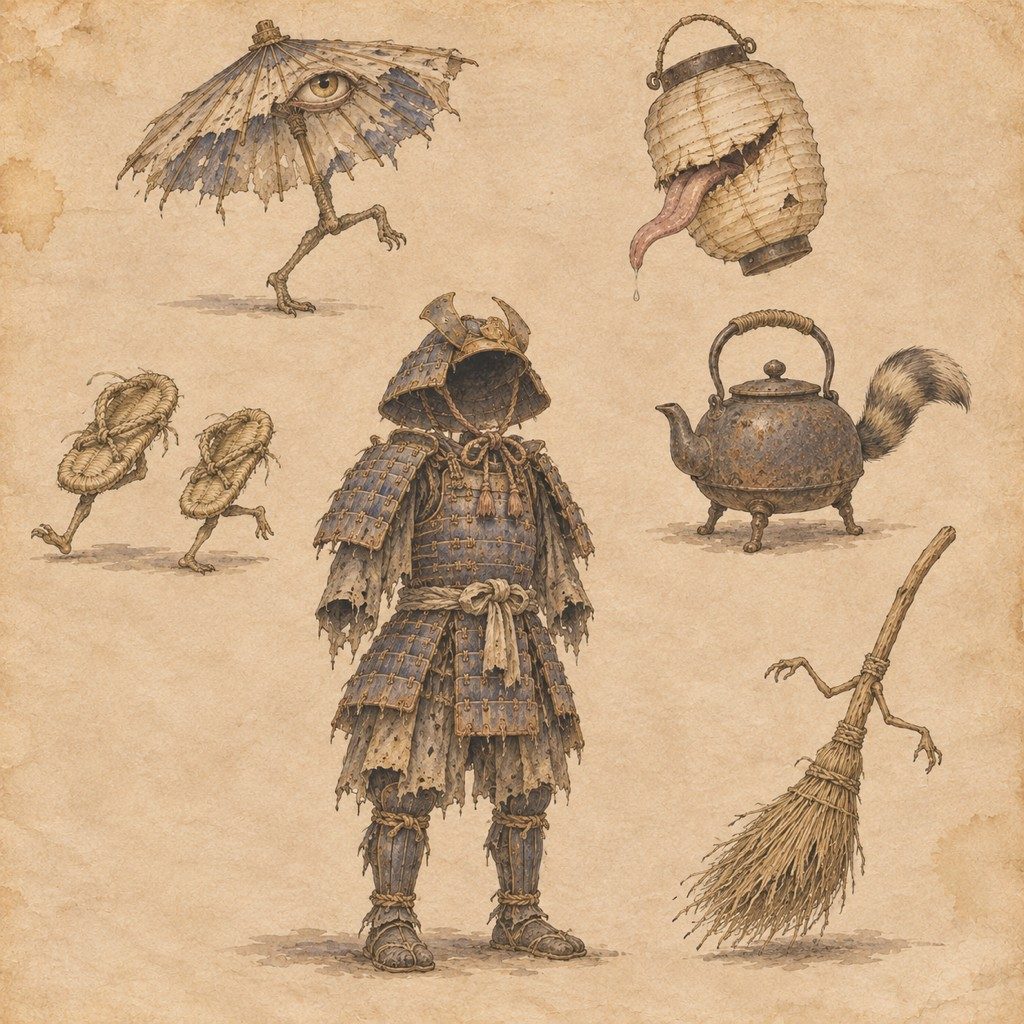
Yōkai. Novice to Seasoned.
The story. A thing that has served a household for a hundred years gains a spirit (Chapter 6). If it's cared for, it becomes a lucky heirloom. If it's thrown away, it wakes angry. On certain nights the discarded things of a town (umbrellas, lanterns, sandals, pots, a broken lute, an old suit of armor) rise and march through the streets in a procession, and anyone who sees it falls sick.
The truth. Angry tsukumogami want two things: revenge on the careless, and to be thanked. Most are pranksters who hop, lick, and frighten. A few, like an old suit of armor left to rot in a storehouse, are dangerous.
Signs. Things moving in a storehouse. A paper lantern with a split in it like a mouth. Wet footprints of one bare foot. A procession of lights and clatter in the street on a night of no festival.
Banes and courtesies.
- Courtesy: thanks. A memorial service for old things (kuyō), held by a priest with offerings and thanks, calms any tsukumogami in the house. It goes back to being a thing, and might wake again someday as a lucky heirloom (Chapter 6).
- The procession. Anyone who sees the night procession makes a Fear check at –2, and those who fail fall sick for a week (a level of Fatigue). A sutra carried or recited protects against both.
Small Tool Spirit#
The paper lantern, the one-eyed umbrella that hops on its single leg, the worn straw sandal, the cracked pot.
Attributes: Agility d8, Smarts d4, Spirit d6, Strength d4, Vigor d6
Skills: Athletics d6, Fighting d4, Intimidation d6, Notice d6, Stealth d8, Taunt d6
Pace: 6; Parry: 4; Toughness: 3
Edges: —
Special Abilities:
- Construct: SWADE p. 176.
- Long tongue: Str+d4, Reach 1. The tongue does no real harm; a hero it licks makes a Fear check.
- Mimicry: While motionless, it's an ordinary object.
- Size –2.
- The lantern breathes fire once per scene (Cone Template, 2d6, Fire, Chapter 4), and has Weakness (water).
Empty Armor (Yoroi Tsukumogami, 鎧付喪神)#
An old suit of armor, abandoned in a storehouse by the heirs of a warrior who died in it.
Attributes: Agility d6, Smarts d4, Spirit d8, Strength d10, Vigor d10
Skills: Athletics d6, Fighting d8, Intimidation d8, Notice d6
Pace: 5; Parry: 7; Toughness: 11 (4)
Edges: Sweep
Gear: Long sword (Str+d6, or Str+d6+1 two-handed), or a glaive (Str+d8, Parry +1, Reach 1).
Special Abilities:
- Armor +4: It's made of armor.
- Construct.
- Fear.
- Fearless.
- Hollow: Called Shots do no extra damage. There's nothing inside.
- Its owner's name: A hero who learns the name of the warrior who wore it and speaks it aloud, with a bow, makes it stop and listen for a round. Holding a kuyō for both armor and warrior ends it.
Tale seed. A pawnshop in Kanagura bought an old storehouse's contents at auction, and its owner wants to know why the clerk keeps finding the sandals back in the shop every morning, facing the door.
Contrary Imp (Amanojaku, 天邪鬼)#
Yōkai, wicked. Seasoned.
Ama-No-Jaku (HC p. 102), with these changes:
- What it is: a small, ugly, spiteful yōkai who does the opposite of whatever it's told and leads people into ruin by pretending to help. The temples carve it under the feet of their gate guardians, crushed and furious.
- Kind: yōkai, wicked.
- No skins: in the isles it disguises itself in stolen clothes, a child's straw hat, or a shadow, and imitates voices, often the voice of someone the victim loves. Its knife is an ordinary knife (Str+d4), not an infected one.
- Courtesy: contrary. It must do the opposite of a direct order. A hero who knows this tells it the opposite of what they want ("Stay here and keep hurting us"), with a Smarts roll at –2 to word it right.
- Contradiction: it can't let a statement pass unchallenged. Taunt rolls against it get +2.
Tale seed. A lady's maid has started giving the household every message wrong, and she weeps that she never said any of it.
Willow Spirit (Kodama, 木霊)#
Yōkai. Seasoned.
The story. Very old trees have souls. A woodcutter who fells one without asking hears it cry out, and is cursed. And sometimes the spirit of a willow or a plum walks out in the shape of a slender, gentle woman, falls in love, and marries; and when the tree is cut down, she dies in her husband's arms.
The truth. A tree spirit is a small kami that has grown a heart. It can't go far from its tree, and it lives as long as its tree does. Most never leave the shade of their branches. A few have walked into the world.
Signs. A tree hung with a sacred rope that no shrine keeps. A voice that answers when someone calls in the forest (the echo is the tree spirit answering). A young woman nobody in the village can place, who is always near the old willow at the ford.
Banes and courtesies.
- Courtesy: asking. A woodcutter who makes an offering and asks the tree's leave before felling it, as the old custom says, is never cursed.
- Bound to the tree. Fire or an axe set to her tree harms her as if she were struck, with Wounds she can't heal except by the tree's healing.
★ Willow Spirit#
Attributes: Agility d8, Smarts d8, Spirit d10, Strength d4, Vigor d6
Skills: Athletics d6, Notice d8, Performance d10, Persuasion d8, Stealth d10
Pace: 6; Parry: 2; Toughness: 5
Edges: Attractive
Special Abilities:
- Bound to the tree: As above. She can't go more than a mile from it. If the tree dies, she dies.
- Hidden Road (into her tree, as an action).
- Spirit.
- Spirit Powers: Binding (entangle, roots and branches), Heavy Eyes (slumber), Mending (healing), and Soothing (relief). 15 Power Points.
Tale seed. A lord has ordered the great willow at the ford felled for a beam in his new keep, and a young retainer has just asked the heroes, quietly, to stop it without telling anyone why.
Lost-Way God (Mayoigami, 迷い神)#
Yōkai, wicked. Seasoned.
The story. Travelers who lose their way in fog and mountains say a god led them astray: the mayoigami, the god of losing the way.
The truth. A mayoigami is one of the hungry spirits of the Hidden World (Chapter 7), and it feeds on those who stray. It wears the shape of someone the traveler trusts. In Ōgiri's fog valley, it walks with lone pilgrims in the Founder's shape, and leads them off the path into the hidden side of the valley, where the fog never lifts (Chapter 7).
Signs. Chapter 7 gives the three signs in Ōgiri: the mayoigami walks on the left, its footprints face backward, and sooner or later it asks to see the pilgrim's stamp book. Elsewhere, it's always a companion who knows a shortcut.
Banes and courtesies.
- Its name. Naming the mayoigami for what it is, aloud, drives it off for the rest of the day (Chapter 7).
- Bells. It won't walk within earshot of a pilgrim's bell rung steadily.
★ Lost-Way God#
Attributes: Agility d8, Smarts d10, Spirit d10, Strength d6, Vigor d8
Skills: Athletics d6, Fighting d4, Notice d10, Occult d8, Performance d10, Persuasion d10, Stealth d12
Pace: 6; Parry: 4; Toughness: 6
Edges: Charismatic
Special Abilities:
- Borrowed trust: It takes the shape of someone its victim trusts. A hero who spots one of its signs (Chapter 7) sees through it.
- Hidden Road.
- The lost road: A traveler who follows its advice for an hour crosses into the Hidden World without knowing it, and can't find the way out again without a guide, a genja, or a thin place at its time (Chapter 7). Each day lost there costs a level of Fatigue as the mayoigami feeds.
- Spirit.
- Spirit Powers: Bewilder (confusion) and Mist (illusion). 15 Power Points.
- Weakness (its name): As above.
Tale seed. A pilgrim band reaches the fourteenth temple of Ōgiri with one more pilgrim than it started with, and no one can say which.
Notes#
- Foxes, their tails, fox fire, fox weddings, fox possession, and the fox's jewel follow Lafcadio Hearn, "Kitsune," in Glimpses of Unfamiliar Japan (1894); M. W. de Visser, "The Fox and the Badger in Japanese Folklore," Transactions of the Asiatic Society of Japan (1908); and F. Hadland Davis, Myths and Legends of Japan (1912).
- The badger's faceless trick, played twice, follows Lafcadio Hearn, "Mujina," in Kwaidan (1904). The raccoon-dog who turns into a tea kettle follows William Elliot Griffis, Japanese Fairy World (1880), and the badger who repays a kindness as gold coins follows A. B. Mitford, "The Badger's Money," in Tales of Old Japan (1871).
- The kappa, its bow, its wrestling challenge, the wasting of its victims, and its handprint oath follow Davis, Myths and Legends of Japan.
- Tengu follow Davis, Myths and Legends of Japan, and Griffis, Japanese Fairy World.
- The rokurokubi household follows Lafcadio Hearn, "Rokuro-Kubi," in Kwaidan (1904).
- The snow woman follows Lafcadio Hearn, "Yuki-Onna," in Kwaidan (1904).
- The mountain mother who raises a wild boy follows Griffis, "Kintaro, the Wild Baby," in Japanese Fairy World.
- The goblin spider that visits a sick warrior as a priest follows Davis, Myths and Legends of Japan, and Griffis, Japanese Fairy World.
- The cat that walks follows A. B. Mitford, "The Vampire Cat of Nabéshima," in Tales of Old Japan (1871).
- The willow spirit follows Lafcadio Hearn, "The Story of Aoyagi," in Kwaidan (1904).
Part 3: Oni and Demons#
The oni are the demons of the isles: horned, huge, red or blue or black, with iron clubs and tiger-skin loincloths and appetites for human flesh. Most of them come from Yomi, the land of the dead under the earth (Chapter 7), climbing up through cracks where the cut runs thin. In the age of the Kagamino peace they were stories. Now they're seen again, in the capital's southern gate and in the forests of the north.
Every oni in this part is of the oni kind (Part 1) except the forest oni, who are something else. All true oni share three things:
- Bane (peach wood, demon-breaking arrows, a twanged bowstring, sacred spring water). Every true oni is warded by all of these (Chapter 6).
- Weakness (peach wood): A true oni takes +4 damage from a peach-wood weapon (Chapter 6) or a demon-breaking arrow.
- Yomi's touch: A fight with an oni counts as a bloody fight for pollution (Part 1).
Little Oni (Ko-oni, 小鬼)#
Oni. Novice.
The story. In the temple paintings of the hells, little demons with horns and potbellies drive the damned with clubs and pitchforks. In the night-procession scrolls, they march at the heels of the great ones, carrying their banners.
The truth. Little oni are the troops and servants of the great. They're the size of a child, cowardly alone and vicious in a crowd, and they come up from Yomi in the wake of bigger oni like rats behind a cart. They do the oni's errands: carrying off victims, spying, starting fires, and stealing the things their masters can't touch.
Signs. Small horned footprints in ash. Food missing from offerings. Giggling under a temple floor. Where there are little oni, a bigger one isn't far off.
Little Oni#
Attributes: Agility d8, Smarts d4, Spirit d6, Strength d6, Vigor d6
Skills: Athletics d8, Fighting d6, Intimidation d6, Notice d6, Stealth d8, Thievery d6
Pace: 6; Parry: 5; Toughness: 4
Edges: —
Gear: Club (Str+d4) or rusty spear (Str+d6, Reach 1).
Special Abilities:
- Bane and Weakness (peach wood), as all oni.
- Claws: Str+d4.
- Cowardly: A little oni without a bigger oni in sight is Shaken on a failed Fear check against anything, and flees if it's alone.
- Low Light Vision.
- Size –1.
Tale seed. A rice merchant's storehouse loses a little rice every night, and the boy sent to watch it says the thieves had horns and sang.
Oni (鬼)#
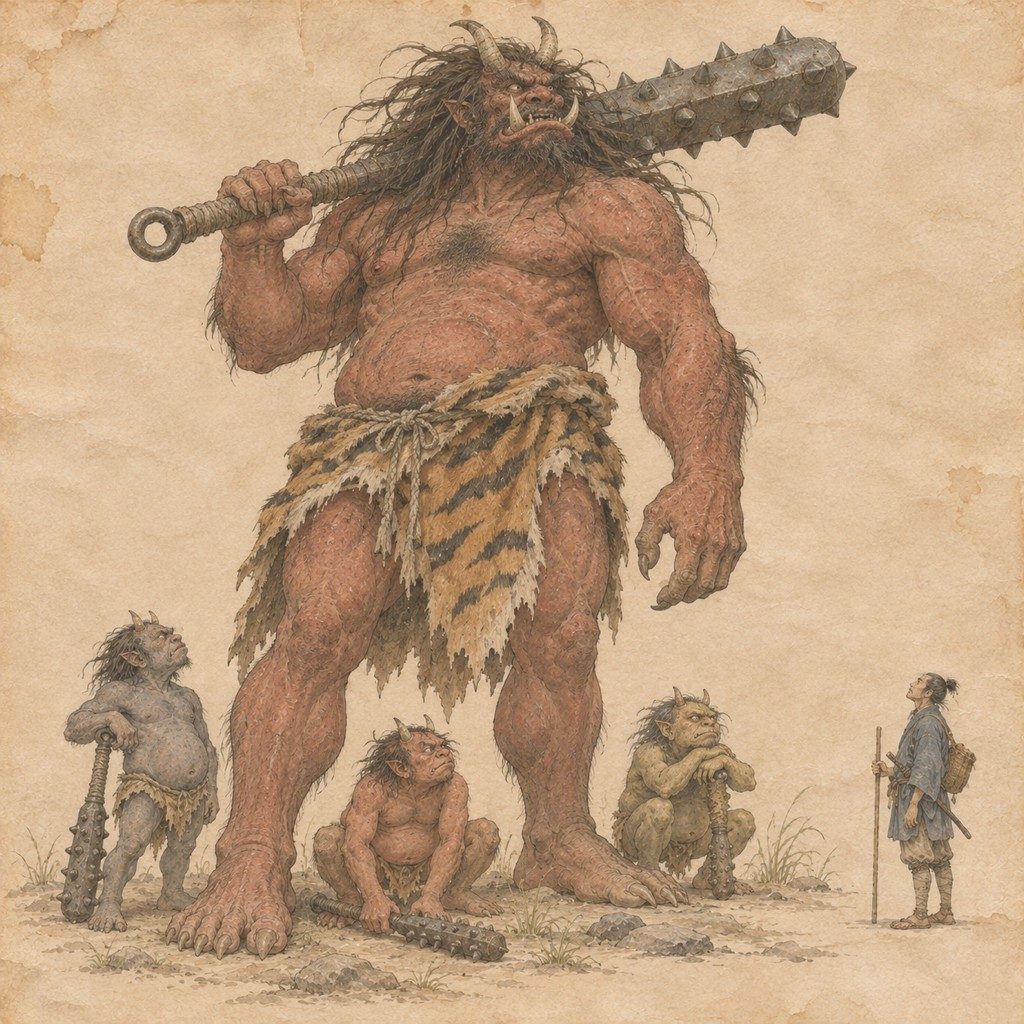
Oni. Seasoned.
The story. Oni are giants with horns, tusks, and wild hair, red or blue or black, wearing tiger skins and swinging iron clubs studded with spikes. They live in mountain fortresses, steal maidens and treasure, and eat people. A hero once got into an oni lord's mountain hall disguised as a mountain ascetic, made the oni drunk on poisoned sake, and cut off its head while it slept.
The truth. All that, and they're clever too. An oni can speak and bargain, take human shape for a night, and plan a raid like a warlord. They love sake, music, and cruelty, in that order. They're always hungry.
Signs. Heavy footsteps that shake the ground at night. A smell of sulfur and iron. Livestock torn apart and left half eaten. Villagers who go missing in threes and fours.
Banes and courtesies.
- Bane and Weakness (peach wood), as all oni.
- Sake. An oni offered strong sake drinks it, and keeps drinking. Every cup after the first gives it –1 to Agility and Smarts rolls for the scene (to –3). Poisoned sake works on an oni, and the old story says so.
- Beans. At the New Year, families scatter roasted beans and shout "Out with the oni!" An oni hit with a handful of roasted beans thrown by a hero with no pollution (Clean on the kegare track, Chapter 4) is Shaken (no roll); it can only happen once per scene.
Oni#
Attributes: Agility d6, Smarts d6, Spirit d8, Strength d12+2, Vigor d12
Skills: Athletics d8, Fighting d10, Intimidation d10, Notice d6, Stealth d4
Pace: 7; Parry: 7; Toughness: 12 (2)
Edges: Sweep
Gear: Iron club studded with spikes (kanabō, Str+d10, AP 2), tiger skin.
Special Abilities:
- Armor +2: Hide like leather.
- Bane and Weakness (peach wood), as all oni.
- Borrowed Face: Once per night, an oni can take a human shape until dawn, as Borrowed Face (disguise) with no roll. A bronze mirror shows the horns.
- Fear.
- Low Light Vision.
- Size 2: Oni stand about 10 feet tall.
Tale seed. A village on the edge of Hōzuki has paid an oni a cask of sake every month for three years. This month the brewer is dead, and there's no sake.
★ Great Oni (Ō-oni, 大鬼)#
The lord of an oni band, with a mountain fortress, a hall of captives, and a court of lesser oni. Use the oni with these changes:
- Wild Card, Smarts d8, Spirit d10, Strength d12+4, Fighting d12, Intimidation d12, Persuasion d8, Battle d8.
- Size 4 (Large), Toughness 15 (2). It takes one extra Wound.
- Edges: Command, Improved Sweep, Hard to Kill.
- Court: A great oni is never alone. 2d6 little oni and 1d4 oni serve it.
- Spirit Powers: Arrows (bolt, a breath of fire), Dread (fear), and Storm (havoc). 15 Power Points.
Tale seed. A great oni has taken a court lady to its fortress in the mountains northeast of Seikyō, and the Regent wants her back without anyone learning she was gone.
★ The One-Armed of the Southern Gate (Minamimon-no-Kataude-Oni, 南門の片腕鬼)#
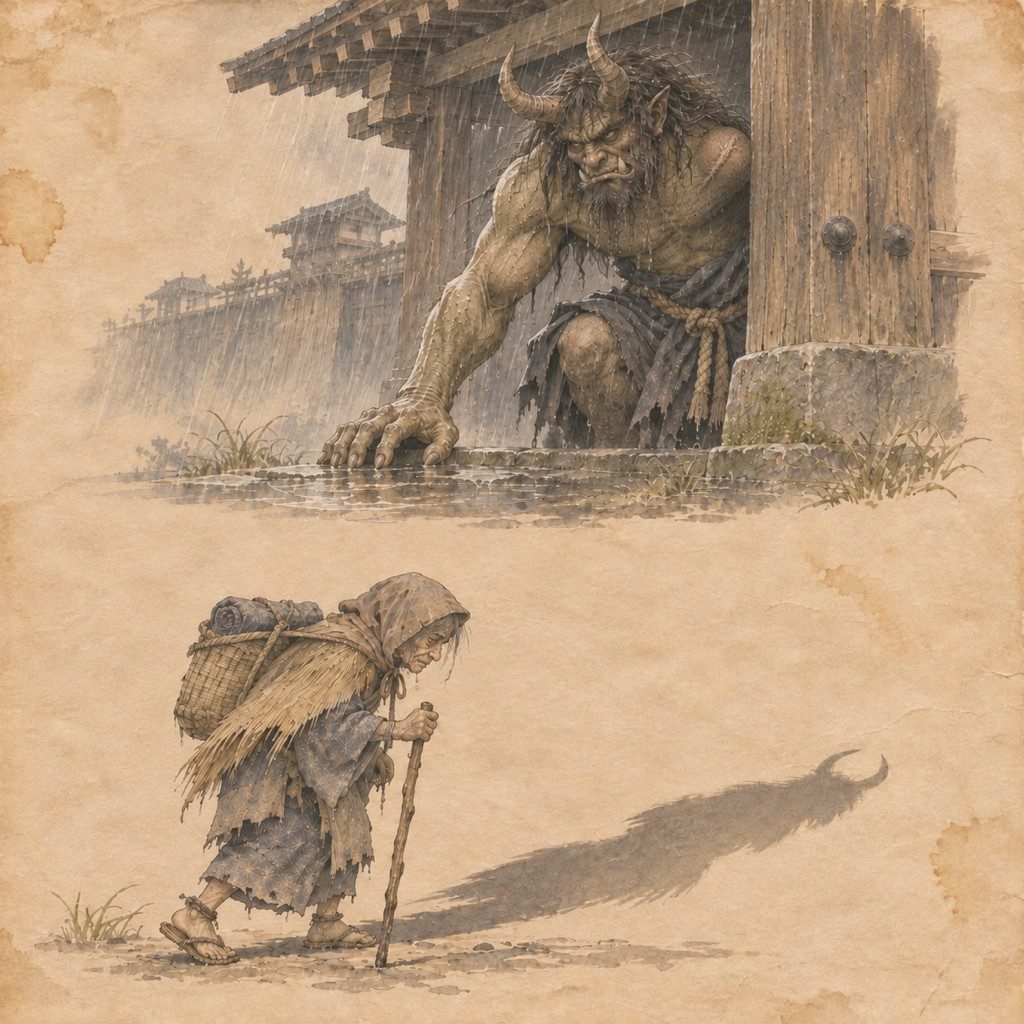
Oni. Heroic.
The story. Twenty years ago, an oni haunted the great Southern Gate of Seikyō, snatching people who passed it at night. A warrior of the capital guard waited for it there, and when it seized him by the helmet, he cut off its arm. He carried the arm home, locked it in a stone chest, and kept watch over it. On the seventh night his old aunt came to visit, weeping, and begged to see the famous arm. He opened the chest for her. "This is my arm!" she cried, became the oni, snatched it, and fled through the smoke hole in the roof. That's the story everyone in Seikyō knows.
The truth. The story is true, but its ending is wrong. The warrior was no fool: what the "aunt" snatched was a decoy, a carved arm of wood. The real arm still lies in a stone chest, sealed with paper talismans, in the storehouse of a small temple in Seikyō's lower city, where the warrior's widow keeps it and pays the monks to pray over it. The oni has spent twenty years looking for it.
The oni is the Lord of the Demon Gate's scout (Chapter 7). It's learning the city's defenses, gate by gate, temple by temple, and it's grown bolder as the hakobore widens. Last month it took a court noble's son (Chapter 8). It needs its arm back, because a one-armed oni can't climb back down to Yomi, and because with both arms it would be strong enough to tear open the shrines that guard the northeast.
Signs. A cold wind under the Southern Gate on a still night. Clawed handprints, always the left hand, on the gate's pillars. An old woman, a beggar, or a weeping child who asks people the way to temples in the lower city.
Banes and courtesies. As all oni. It won't pass under a sacred rope (shimenawa) at all.
Statistics. Use the great oni, Wild Card, with these changes:
- Smarts d10, Notice d10, Persuasion d10, Stealth d8, Performance d8. It's patient, cunning, and a good actor.
- One arm: It can't use two-handed weapons. It fights with one claw (Str+d8) and its club in the same hand. If it regains its arm, it gains Improved Frenzy, a second claw, and the Hardy ability.
- Many faces: It can take any human shape, as often as it likes, for as long as it likes, but always with its left arm hidden in a sleeve.
- Hidden Road: Every gate in Seikyō is a thin place for it.
- No court: It works alone.
Tale seed. The warrior's widow, now old, is dying, and the temple's new abbot doesn't believe in oni. He wants to sell the "ancient relic" in the stone chest to a collector from Kanagura.
Forest Oni (Yama-oni, 山鬼)#
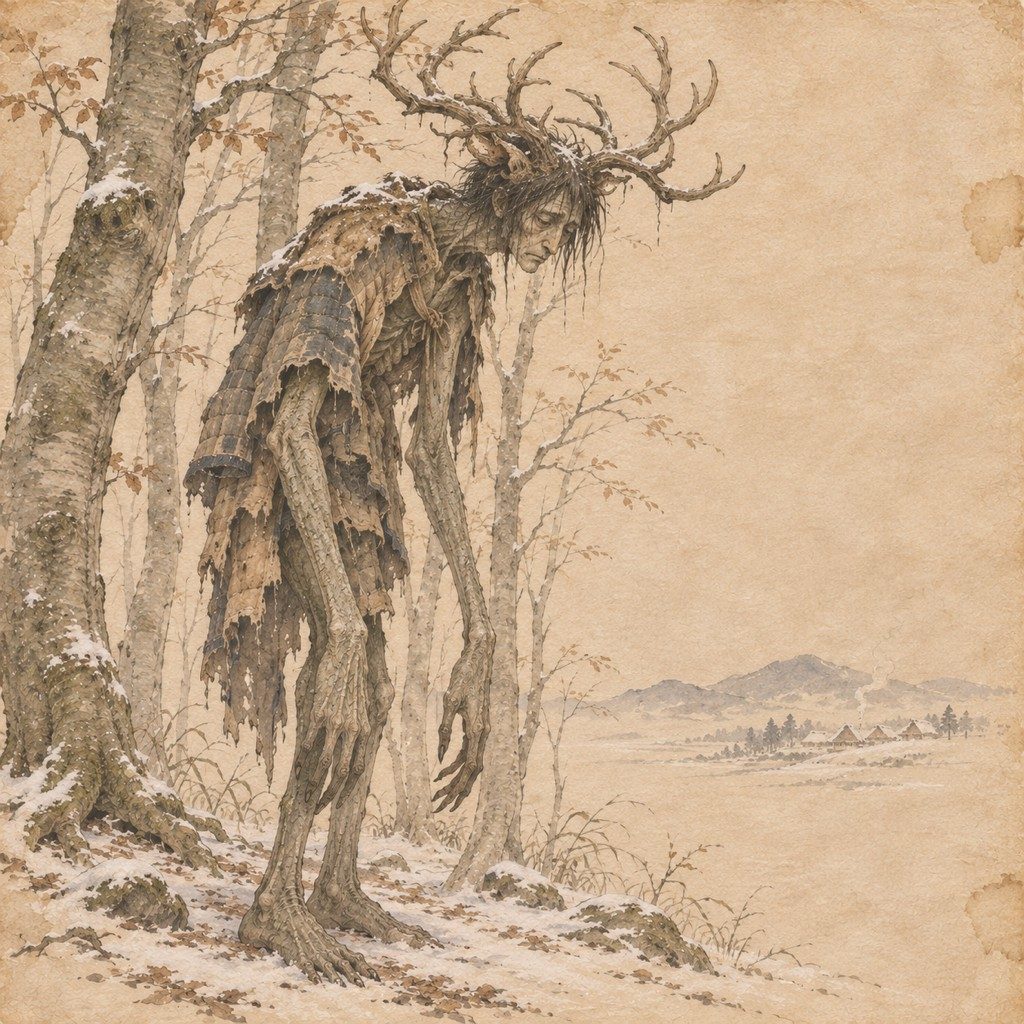
Not true oni (see below). Seasoned.
The story. Hunters in the northern forests of Tsukikage and Hate-no-Kuni have seen oni again: tall, horned, silent figures standing among the beech trees at dusk, watching the villages. Some say they carry off children. Some say they're only bears seen badly.
The truth. They were people. The exiles in the valleys of Hate-no-Kuni, the hunters who go too deep, and the lonely and grieving of the northern villages sometimes hear the old kami of the north (Chapter 7) calling them to "the quiet." Those who answer walk into the forest, and the forest takes them back. Over a season their bodies grow, their skin roughens like bark, antlers or horns of root and bone rise from their brows, and they forget their names. They don't eat people. They don't do anything a person would understand. They stand at the edge of the forest and watch, and sometimes they take a child by the hand and lead it into the trees.
A forest oni isn't a creature of Yomi, so the demon-banes don't touch it. It's a person who has stopped being separate, which is what the old kami want for everyone.
Signs. A figure standing among the trees where no figure should be, and gone when the eye returns. Footprints that start as a man's and end as a stag's. A family that whispers about the uncle who "went to the quiet."
Banes and courtesies.
- No demon-banes. Peach wood, demon-breaking arrows, and spring water do nothing. Harai's Drive Back doesn't work.
- Their names. A forest oni who hears its human name spoken by someone who knew it in life stops, and makes a Spirit roll at –2. If it fails, it stands still and remembers for the rest of the scene, and doesn't attack or flee. A hero who learns a forest oni's name has a way to reach it.
- Calling them back. A forest oni who has been in the forest less than a year can be brought back to itself: someone who loved it speaks its name, and a kannagi uses Calling Down the Kami (kami-oroshi) at the forest's edge to ask the Elder of the Forest (Part 5) to let it go. The Elder's price is always strange. As the hakobore falls to 1 or lower, every forest oni slowly remembers, and walks home.
Forest Oni#
Attributes: Agility d6, Smarts d6, Spirit d10, Strength d12, Vigor d12
Skills: Athletics d10, Fighting d8, Notice d10, Stealth d10, Survival d12
Pace: 7; Parry: 6; Toughness: 12 (2)
Edges: Woodsman
Special Abilities:
- Armor +2: Bark-like skin.
- Claws and antlers: Str+d6.
- Fear.
- Forest walk: In forest, it moves without sound and leaves no trail it doesn't choose to leave. It gets the Drop on anyone who hasn't seen it.
- Hardy.
- Size 2.
- The quiet: Once per scene, a forest oni can stand still and let the forest speak through it. Everyone within 6" who can hear it makes a Spirit roll. Those who fail are Distracted and walk one move toward the forest on their next turn, as if called.
Other Truths: The Oni of Yomi. A GM who wants plain oni in the north can make them so: a plague pit or an unpurified battlefield deep in the forest has cracked down to Yomi, and true oni are climbing out, using the old kami's forest as cover. Use the oni block, and keep the old kami as a separate, slower threat.
Tale seed. A Tsukikage hunter's wife begs the heroes to find her husband, who walked into the forest at midsummer. She has seen a horned figure at the edge of the trees, every night, wearing the remains of his coat.
Hag of Yomi (Yomotsu-shikome, 黄泉醜女)#
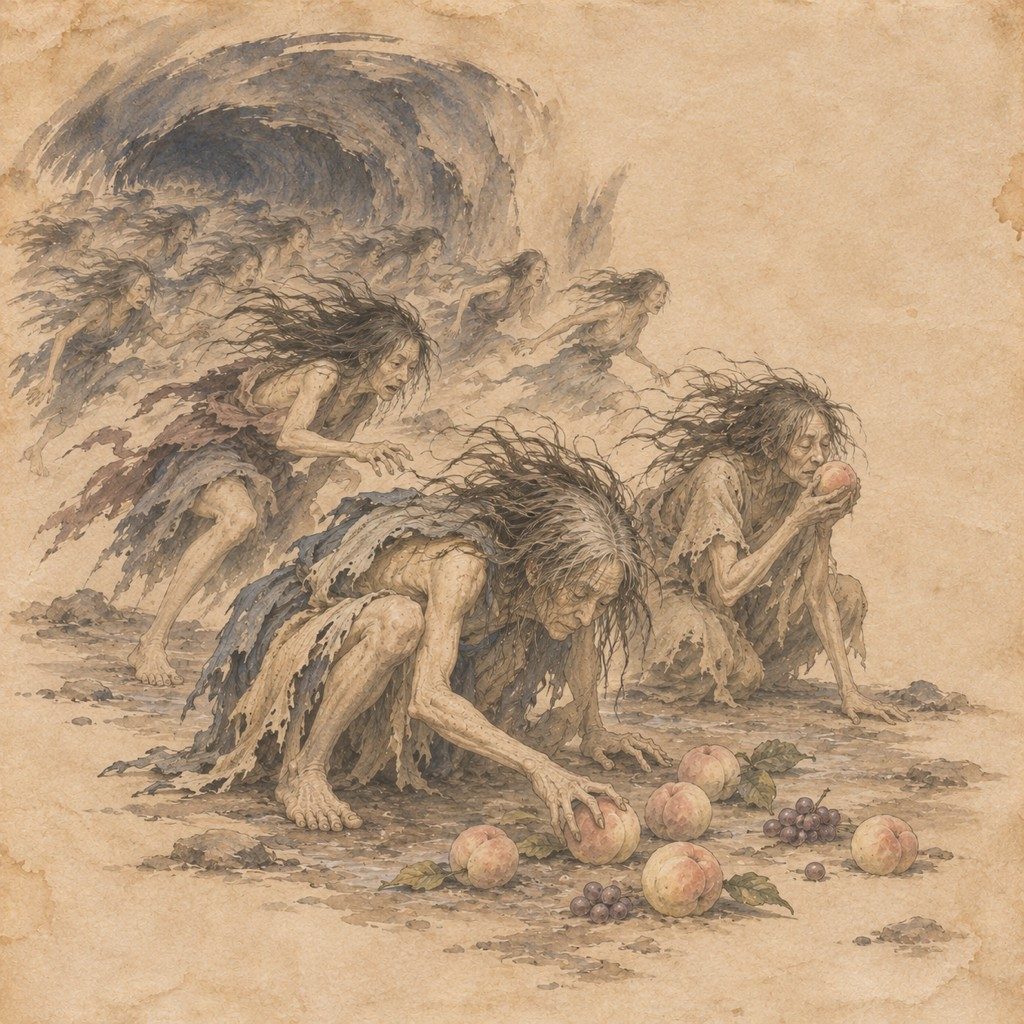
Oni. Veteran, as a host.
The story. In the oldest tale, when the first god fled the land of the dead, his dead wife sent the Ugly Females of Yomi after him, a shrieking host of hags who ran faster than any living thing. He escaped only by throwing down his headdress and his comb, which turned into grapes and bamboo shoots, and the hags stopped to eat them. Then he threw peaches, and they fled.
The truth. The hags are the oldest and hungriest of Yomi's dead, become something worse than ghosts. They're Yomi's hunters. When the dead of Yomi climb up, or a living hero goes down (Chapter 7), the hags come, always in a host.
Signs. A sound like many women weeping, coming closer very fast. A stench of rot and wet earth. Torches that burn green.
Banes and courtesies.
- Bane and Weakness (peach wood), as all oni. A thrown peach makes every hag within a Medium Blast Template where it lands make a Spirit roll or flee for the round.
- Hunger. Food thrown behind a fleeing hero stops the hags: each time a hero throws down food during a chase (Chases, SWADE p. 111), the hags lose their next action as they fall on it. Yomi's dead are always starving.
Hag of Yomi#
Attributes: Agility d10, Smarts d4, Spirit d8, Strength d8, Vigor d10
Skills: Athletics d12, Fighting d8, Intimidation d10, Notice d8
Pace: 10; Parry: 6; Toughness: 7
Edges: Fleet-Footed
Special Abilities:
- Bane and Weakness (peach wood), as all oni.
- Claws: Str+d6.
- Fear (–2).
- Hardy.
- Polluting.
- Undead: SWADE p. 178.
Tale seed. A grave-robber in Kagaribi broke into an old mound and fell through the floor into darkness. He climbed out, but his friends hear weeping in the hills every night now, getting closer.
Demon of Sickness (Ekiki, 疫鬼)#
Oni. Veteran.
The story. Plagues are demons. Smallpox, measles, and the summer fever walk the roads in human shape, or in no shape at all, and stop at houses that haven't hung charms at their doors. That's why villages set straw figures at their boundaries to turn the demons back, why palace guards twang their bowstrings at night, and why shrines sell demon-breaking arrows at the New Year.
The truth. The demon of sickness is an oni of Yomi that feeds on fever. It's invisible, and it travels with the wounded, the hungry, and the unburied: armies, refugees, and fields of the dead. Where the war goes, it follows.
Signs. Red paper images of a fierce warrior pasted on doors (folk charms against it). Sickness starting in one house and spreading along a street. A traveler seen at every house that fell sick, whom no one can describe afterward.
Banes and courtesies.
- Bane (peach wood, demon-breaking arrows, a twanged bowstring, sacred spring water), as all oni, and the boundary figures and red charms of the villages (as a hasty seal, Chapter 6).
- It can't cross running water except by a bridge, and the boundary rites at the edges of villages turn it back.
★ Demon of Sickness#
Attributes: Agility d8, Smarts d8, Spirit d10, Strength d6, Vigor d10
Skills: Athletics d8, Fighting d8, Notice d8, Persuasion d6, Stealth d12
Pace: 6; Parry: 6; Toughness: 7
Edges: —
Special Abilities:
- Bane and Weakness (peach wood), as all oni.
- Ethereal: It's invisible and immaterial unless it chooses otherwise.
- Fever touch: A hero touched by it (a Fighting roll, ignoring armor) makes a Vigor roll at –2 or catches its fever (Disease, SWADE p. 127, as a Chronic Disease that also costs a level of Fatigue). A raise on the touch gives –4.
- Hidden Road.
- Plague walker: Each night it spends in a town, 1d6 households fall sick.
- Spirit Powers: Borrowed Face (disguise, a traveler, a peddler, or a monk) and Strengthen and Doom (boost/lower Trait, lowering Vigor only). 15 Power Points.
Tale seed. A fever is following the white plum army north, camp by camp, and Sadatsugu's physicians say it's ordinary. His shrine priest says it isn't, and wants the heroes to prove it.
★ Jealous Demon (Kijo, 鬼女)#
Oni. Veteran.
The story. A woman wronged, betrayed, or abandoned can hate so much that she becomes an oni while she still lives. Her face grows horns and fangs, and she hunts the one who wronged her, and anyone who stands between them. The nō theater's horned mask shows her, half grief and half rage.
The truth. Most stories tell of women; the isles know men who've done it too. A kijo begins as a person with a great grief and nowhere to put it. Some turn to a curse-worker (Part 7), or a tengu who teaches sorcery (Chapter 7). A few walk the seven nights of the Hour of the Ox themselves (Chapter 7), and on the seventh night something answers. By day the kijo is still themselves, haggard and burning. By night they are the oni.
Signs. Nails driven into the old cedar behind a shrine, with straw dolls. A woman in white walking at the Hour of the Ox with candles on an iron crown. A lover, a rival, or a faithless husband who wakes every night choking.
Banes and courtesies.
- Bane and Weakness (peach wood), as all oni.
- The grief. A kijo isn't evil from the start, and can be turned back. If the one who wronged them truly repents, publicly and at a cost, or if a gakushō (Chapter 6) can make them speak their grief aloud (a Social Conflict, with Persuasion against their Spirit), they become themselves again: Defiled, exhausted, and human. Killing the one who wronged them doesn't end it. It only frees the oni.
★ Jealous Demon#
Attributes: Agility d10, Smarts d8, Spirit d12, Strength d10, Vigor d10
Skills: Athletics d10, Fighting d10, Intimidation d12, Notice d10, Occult d8, Stealth d10, Taunt d8
Pace: 8; Parry: 7; Toughness: 8 (1)
Edges: Frenzy, Iron Will
Special Abilities:
- Armor +1: Her skin hardens at night.
- Bane and Weakness (peach wood), as all oni.
- Claws: Str+d6.
- Day and night: By day the kijo is human: use the curse-worker (Part 7) or a suitable Chapter 9 template. At dusk, she becomes the oni.
- Fear (–2).
- Hunter: She always knows the direction of the one who wronged her, and adds +2 to Fighting and Intimidation rolls against them.
- Spirit Powers: Bad Dreams (nightmares), Hour of the Ox (curse), and Return Blow (spite). 20 Power Points.
Tale seed. A rich merchant of Umikado married a Black Book convert and put aside his first wife, who lives alone across the harbor now. Every night his new wife wakes screaming, and every morning there's a new nail in the cedar behind the shrine.
★ The Lord of the Demon Gate (Kimon-no-Ō, 鬼門の王)#
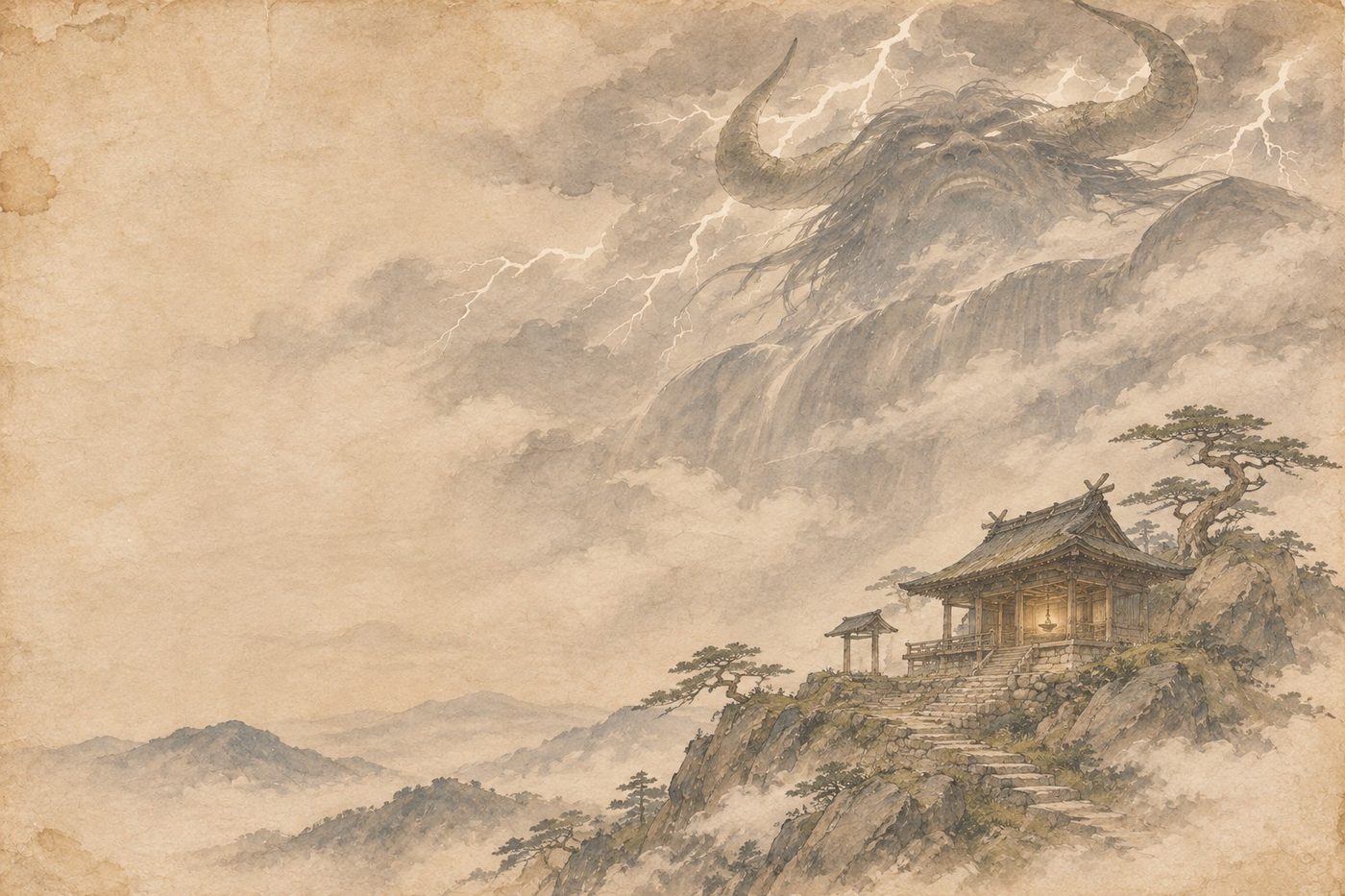
Oni. Legendary.
Chapter 7 tells what this oni is, what binds it under Raihō-ji, and what frees it: the hakobore reaching Broken (5), or the eternal lamp going out. Bound, it can't act except through dreams. Free, it walks straight for Seikyō. A Legendary party can fight it, but can't destroy it with weapons alone. It has to be fought and bound at once.
Signs. As Chapter 7: the guttering lamp, the shared dream of a burning city, lightning on a clear peak, oni in the capital.
Banes and courtesies. As all oni. Only a spirit-bane against demons can Wound it (below).
★ The Lord of the Demon Gate#
Attributes: Agility d8, Smarts d12, Spirit d12+2, Strength d12+10, Vigor d12+4
Skills: Athletics d10, Battle d12, Fighting d12+2, Intimidation d12+4, Notice d12, Occult d12, Persuasion d10
Pace: 10; Parry: 9; Toughness: 22 (4)
Edges: Command, Fervor, Improved Frenzy, Improved Sweep, Iron Will, Level Headed
Gear: An iron club like a gatepost (Str+d12, AP 4).
Special Abilities:
- Armor +4: Hide like bronze.
- Bane and Weakness (peach wood), as all oni.
- Dream sender: Bound or free, it sends Bad Dreams (nightmares) to anyone who sleeps within a mile of it, or anyone Polluted or worse who sleeps within sight of its mountain, at no cost.
- Fear (–4).
- Hardy.
- Invulnerability: It can be Shaken but not Wounded except by peach wood, the Thunder Peak Glaive (Chapter 6), a demon-breaking arrow from a blessed bow, or a power with a spirit-bane trapping cast by a Clean genja.
- Lord of oni: Every oni within a mile obeys it, and every round it can call 1d6 little oni or one oni up through the earth, as a free action.
- Polluting. Its presence makes the ground around it Profane Ground for 100 yards (HC p. 41).
- Size 8 (Gargantuan): It stands as tall as a gate tower. It takes three extra Wounds and has the Stomp and Swat abilities (SWADE pp. 177–178).
- Spirit Powers: Arrows (bolt, black fire), Dread (fear), Sphere (blast, black fire), and Storm (havoc). 50 Power Points.
Binding it again. Chapter 7 says that driving it back into the mountain takes a battle and a rite at once. Run the rite as a Dramatic Task (SWADE p. 122) led by a gakushō or sōhei at the binding hall, with the Thunder Peak Glaive before the altar: five rounds, with Complications on Clubs. While the rite runs, the heroes fight the Lord to keep it from the altar. Each round, if the Lord has been Shaken or Wounded since the last roll, the rite's leader adds +2. If the rite succeeds, the Lord is dragged down into the mountain, the lamp relights, and the hakobore falls one step. If it fails, Seikyō burns.
Tale seed. Every monk of Raihō-ji is ordered to carry the sacred palanquin to the capital, all at once, and only the heroes know what will happen when the last of them walks out the gate.
Notes#
- Oni, their iron clubs, and the oni lord made drunk on poisoned sake in his mountain hall follow "Raiko and the Oni" in William Elliot Griffis, Japanese Fairy World (1880), and "The Goblin of Oyeyama" in F. Hadland Davis, Myths and Legends of Japan (1912).
- The oni's arm cut off at a gate, and the oni who came back disguised as an old aunt to take it follow Griffis, Japanese Fairy World, and the warrior who fought a demon at a ruined city gate in Helen C. Gunsaulus, Japanese Sword-Mounts (1923).
- Roasted beans thrown to drive out oni at the New Year follow W. G. Aston, Shinto: The Way of the Gods (1905).
- The Ugly Females of Yomi, stopped by grapes and bamboo shoots and driven off with peaches, follow W. G. Aston, trans., Nihongi (1896), and Aston, Shinto.
- The demons of disease and pestilence, and the boundary rites against them, follow Aston, Shinto.
- The jealous woman taught sorcery by a tengu follows Davis, Myths and Legends of Japan, and the curse at the Hour of the Ox follows Lafcadio Hearn, Kwaidan (1904).
- The demon bound in the northeast follows the demon-gate beliefs in Aston, Shinto.
Part 4: The Restless Dead#
The dead are supposed to leave. A family washes the body, the temple chants, the kannagi purifies the house, and on the forty-ninth day the soul goes on to its next life or its place among the ancestors (Chapter 4). Most of the dead go. Some don't. In the isles, there are three reasons:
- They died wronged. Murdered, betrayed, or shamed, and the wrong was never put right. These are the angriest dead.
- They were never purified. Soldiers left on a battlefield, a court drowned at sea, a beggar buried without rites. Pollution holds them like mud.
- They go unfed. The dead need offerings, and those with no living family to give them starve. Hunger keeps them here, and hunger makes them cruel.
The war has made all three common. Every battlefield of the last thirty years has its fog, and the hakobore (Chapter 7) lets the dead walk farther from their graves each year.
Every creature in this part is of the restless dead kind (Part 1) except the living ghost, who is something stranger. All of the restless dead share three things:
- Bane (salt, bells, sutras, a sacred rope). All of the dead are warded by these (Chapter 6).
- Yomi's touch: A fight with the dead counts as a bloody fight for pollution (Part 1).
- Laying them to rest: Feeding the Hungry Ghosts (segaki, Chapter 6) quiets them for a scene, and its Release modifier sends an Extra on for good. A Wild Card of the dead goes on only when what holds it here is put right: its wrong avenged or forgiven, its body purified, or its name spoken by someone who owes it. Destroying one of the dead in a fight only scatters it until the next night, unless the entry says otherwise.
Harming the bodiless. Many of the dead are Ethereal (SWADE p. 176), and only magical attacks harm them. In the isles, that means powers, relics (Chapter 6), and weapons blessed in a rite. A spirit-bane used as a weapon (a handful of salt thrown, a bell struck in a ghost's face, a sutra pressed on it) counts as a magical attack that does no damage but Shakes the target on a hit. Throwing salt uses Athletics.
Ghost (Yūrei, 幽霊)#
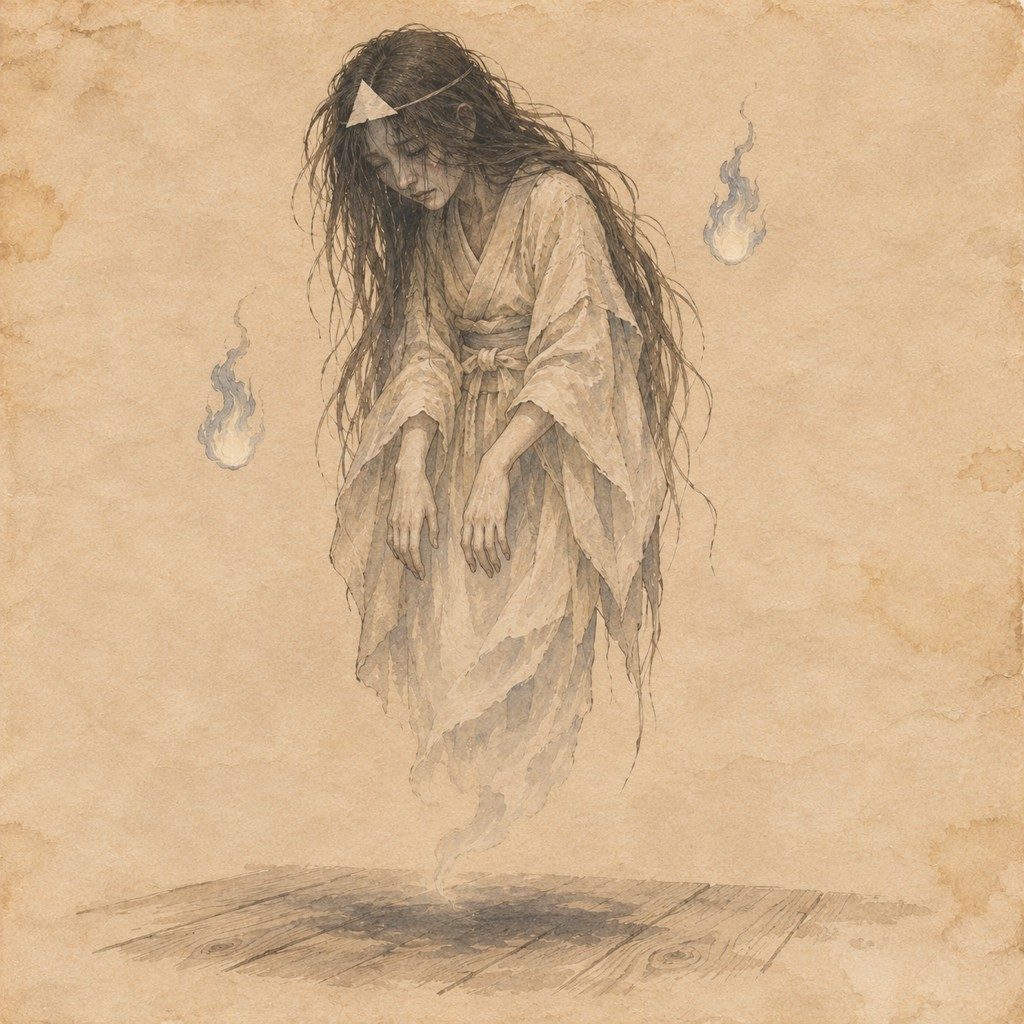
Restless dead. Seasoned.
The story. A ghost wears the white robe the dead are buried in, with a triangle of white paper on its brow. Its long black hair hangs loose over its face. It has no feet, and it drifts a little above the ground with its hands hanging limp at the wrists. It comes at the Hour of the Ox, the dead of night, with pale fires floating beside it, and it wants something.
The truth. The story is right. Every ghost wants one thing: a wrong revealed, a child cared for, a message carried, a letter burned, a body moved to the family grave. Most ghosts aren't evil, only stuck, and a hero who learns what holds one can send it on without a blow.
Signs. A cold room in summer. Lamps that burn blue. A woman's voice counting at the bottom of a well. A servant who won't go into one wing of the house after dark.
Ghost (SWADE p. 183), with these changes:
- Kind: restless dead. Add Bane (salt, bells, sutras, a sacred rope) and Spirit (Part 1).
- Bound: A ghost is tied to a place, a person, or a thing, and can't go farther than a stone's throw from it. Moving the thing moves the ghost.
- Cold hands: Replace the thrown objects with a touch of grave-cold (Str+d4). A ghost in a haunted house may still throw things.
- The one thing: Each ghost wants one thing, chosen by the GM. Giving it what it wants is a Release (above), with no roll.
Tale seed. The new wife of a castle steward hears the first wife counting plates in the old well every night. She stops at nine, and the tenth plate is still somewhere in the castle.
★ Vengeful Ghost (Onryō, 怨霊)#
Restless dead. Veteran.
The story. When a man is executed unjustly, he may swear, with his last breath, to come back and take revenge. A woman murdered by a faithless husband may return to haunt his house until every member of it is dead. The old capital once built a shrine to a slandered minister because lightning kept striking the palace after his death in exile.
The truth. A vengeful ghost is a ghost made of nothing but its wrong. It's far stronger than a common ghost, it can curse a whole household, and it doesn't stop at the guilty. Some can be calmed by honors: a shrine built, a rank given back, an apology made before witnesses. A few can't, and the only cure is to do what they want.
Signs. A run of deaths in one family. A house where every mirror cracks. Dreams of the same face, shared by everyone in a household. Sudden storms over a grave.
Banes and courtesies.
- Bane (salt, bells, sutras, a sacred rope), as all the dead.
- Courtesy: the grudge must be heard. A vengeful ghost always answers someone who asks, by its name, what was done to it. It stops attacking while it tells the story, and it tells the truth.
- Honors. A wrong admitted in public by the guilty, or a shrine built to the ghost by a lord, lets a Wild Card vengeful ghost go on (Release, above).
★ Vengeful Ghost#
Attributes: Agility d8, Smarts d8, Spirit d12, Strength d6, Vigor d8
Skills: Athletics d6, Fighting d8, Intimidation d12, Notice d10, Persuasion d6, Stealth d12, Taunt d10
Pace: 6; Parry: 6; Toughness: 6
Edges: Level Headed
Special Abilities:
- Bane (salt, bells, sutras, a sacred rope).
- Cold hands: Str+d6.
- Ethereal.
- Fear (–2): When it lets itself be seen.
- Polluting.
- Spirit.
- Spirit Powers: Bad Dreams (nightmares), Dread (fear), Hour of the Ox (curse), and Storm (havoc). 20 Power Points.
- Undying grudge: A vengeful ghost reduced to Incapacitated returns the next night at its grave or the place of its death, unless its wrong was put right.
Tale seed. Ten years ago a lord had his chief retainer executed on a forged letter. Now the lord's sons die one by one, each on the anniversary, and the forger is still at court.
Ghost Warrior (Bōrei-musha, 亡霊武者)#
Restless dead. Seasoned.
The story. On the old battlefields, the soldiers who fell fight on. On autumn nights, fishermen near the old sea battles hear war drums under the water, and travelers who camp in the wrong valley wake to the sound of horses.
The truth. Ghost warriors are the unpurified dead of a battle, bound to the field by pollution and by their last oaths. They keep their sides. They attack anyone who wears an enemy's colors, and many of them attack anyone at all. They're the dead of Akahara in Kurogane, standing in two lines in the fog (Chapter 8), and the thousand dead of the Minazuki Return in the hills of Momiji, who refight their battle every autumn night (Chapter 6).
Signs. Fog that lies on an empty field at noon. Rusted arrowheads in the furrows, newly bloodied. Footprints of straw sandals that start and end in the middle of the field. At Akahara, matchlock shots in the fog with no gunners (Chapter 8).
Ghost Warrior#
Attributes: Agility d6, Smarts d4, Spirit d8, Strength d8, Vigor d6
Skills: Athletics d6, Fighting d8, Intimidation d8, Notice d6, Shooting d6
Pace: 6; Parry: 6; Toughness: 9 (2)
Edges: —
Gear: Rusted armor (+2), spear (Str+d6, Reach 1) or common blade (Str+d6), or a great bow (15/30/60, 2d6, AP 1).
Special Abilities:
- Bane (salt, bells, sutras, a sacred rope).
- Bound to the field: Ghost warriors can't leave their battlefield, and they fade at dawn.
- Fear: When the dead first rise.
- Undead: +2 Toughness, and the rest of SWADE's Undead ability (p. 178). A ghost warrior has a body of fog and memory, and it falls apart when Incapacitated, to rise again the next night.
Ghost gunner. At Akahara, some of the dead carry the matchlocks lost in the fog (Chapter 8). Use the ghost warrior with Shooting d8 and a phantom matchlock (10/20/40, 2d8, AP 2) that never needs reloading. The guns themselves are real, and finding them in the fog ends the shooting.
★ Ghost captain. Each side's dead have a leader. Use the ghost warrior as a Wild Card with Smarts d6, Fighting d10, Battle d8, and Intimidation d10, the Command and Hold the Line! Edges, a long sword (Str+d6, +1 two-handed), and a ghost horse (War Horse, SWADE p. 185, with Undead). The captain remembers its name, if no one else does, and a hero who speaks it gets its attention.
In a mass battle. Ghost warriors bound by the Service rite (Chapter 6) give the army that holds their oath 2 Force Tokens, and the enemy subtracts 1 from its Morale rolls. Ghost warriors who rise against both sides, as they do at Akahara, count as a third army with 2 Force Tokens that fights everyone and never checks Morale.
Tale seed. A Sekitani League patrol and an Amanuma patrol both take shelter from a storm at the same empty farmhouse on the edge of Akahara, and at midnight the fog comes in.
★ Old Warrior Ghost (Furu-musha-no-rei, 古武者の霊)#
Restless dead. Veteran.
The story. A blind singer of war tales was once called out by night to a great house, where a lord and his ladies asked him to sing the story of their last battle. He sang, and they wept. In the morning, his friends found him in the graveyard, singing to the tombs of the drowned.
The truth. Some of the dead of the old wars are not lost and wild, but whole: warriors who keep their names, their courtesy, and their skill, held here by a duty left undone, a lord unavenged, or a gate unguarded. They hold court in ruined halls, they test the living, and a few of them teach. The ghost of Sogama Okihide at Furumiya's ruined south gate is one, and a person, not a stat block (Chapter 10). This profile is for others of his kind.
Signs. A ruined gate or hall that's lit at night. A challenge called from the dark in the old court speech. Fresh offerings that someone else left at a forgotten grave.
Banes and courtesies.
- Bane (salt, bells, sutras, a sacred rope), as all the dead.
- Courtesy: the formal challenge. An old warrior answers any challenge given properly, with names, lineage, and a bow, and fights it as a duel (Chapter 4). It never strikes first at someone who has bowed to it.
- Prayers for the lord. A hero who kneels and prays for the old warrior's fallen lord makes it Friendly for the night (SWADE p. 33).
★ Old Warrior Ghost#
Attributes: Agility d10, Smarts d8, Spirit d10, Strength d8, Vigor d8
Skills: Athletics d8, Battle d6, Fighting d12, Intimidation d10, Notice d8, Performance d6, Persuasion d6, Riding d8
Pace: 6; Parry: 8; Toughness: 8 (2)
Edges: Block, Counterattack, Frenzy, Level Headed
Gear: Old armor (+2), long sword (Str+d6, +1 two-handed), glaive (Str+d8, Reach 1).
Special Abilities:
- Bane (salt, bells, sutras, a sacred rope).
- Bound: It can't leave the place of its duty.
- Ethereal: At will. Its sword is real enough when it strikes.
- Fear: When it shows its wounds.
- Spirit.
Tale seed. A young blind biwa singer has been missing from her temple every night for a week, and she comes back each dawn with her robes damp with sea spray and her fingers bleeding.
Ship Ghost (Funa-yūrei, 船幽霊)#
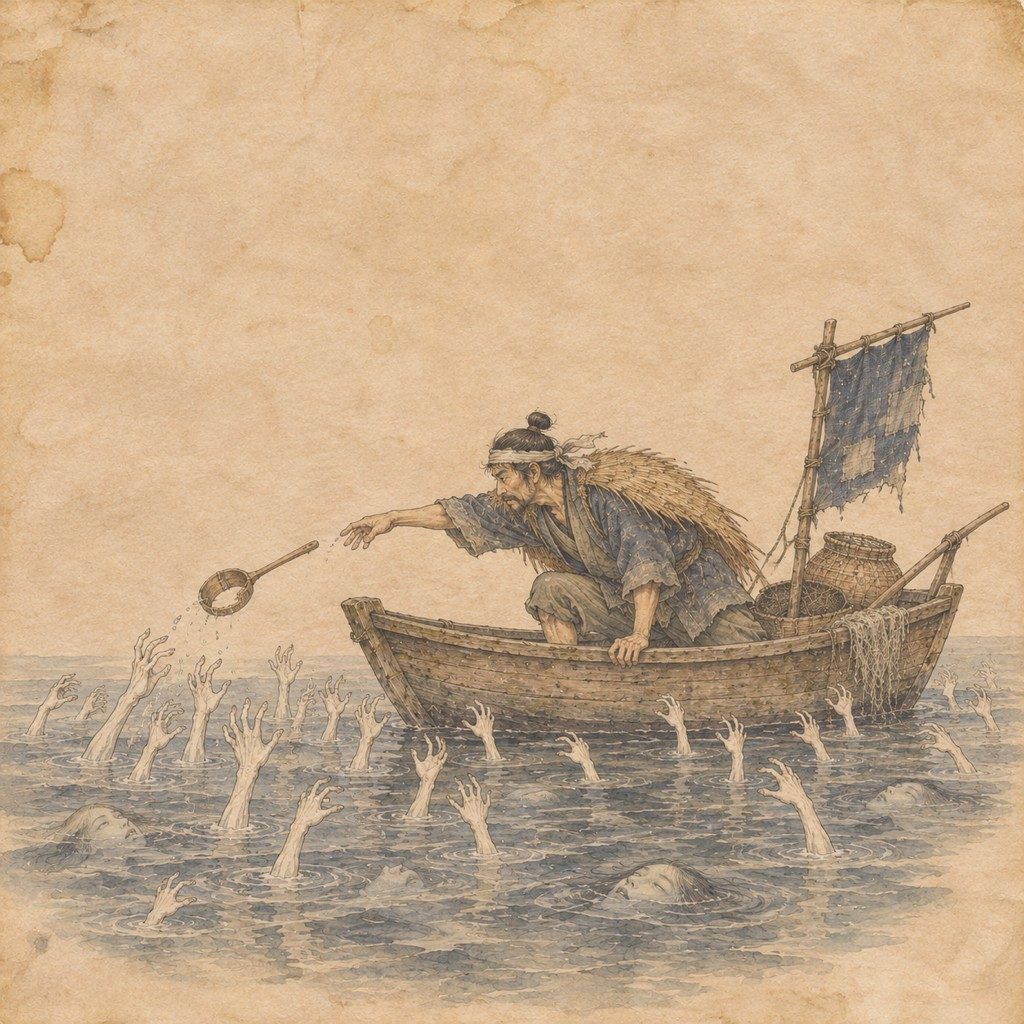
Restless dead. Seasoned.
The story. On the anniversary of a wreck, or on any night when the sea is strange, the drowned rise beside a boat in their dozens, white hands reaching up out of the water. "Give us a ladle!" they cry. "Give us a ladle!" A sailor who hands them a ladle sees them use it to fill the boat with seawater until it sinks. Every fisherman of Shiranui carries a ladle with its bottom knocked out, to throw to them.
The truth. The story is exactly right. Ship ghosts are the drowned who were never purified, and they want company. The bottomless ladle works because they must use what they're given.
Signs. A calm sea that glows faintly green. The smell of wet straw and rot. A sudden silence of the gulls. Off Shiranui, the ghost-lights of the drowned court (below).
Banes and courtesies.
- Bane (salt, bells, sutras, a sacred rope), as all the dead.
- Courtesy: the ladle. Ship ghosts must use any ladle or bucket thrown to them. Give them a whole one and they swamp the boat. Give them a bottomless one and they bail in vain until dawn.
Ship Ghost#
Attributes: Agility d6, Smarts d4, Spirit d8, Strength d8, Vigor d6
Skills: Athletics d8, Fighting d6, Intimidation d8, Notice d6
Pace: 2; Parry: 5; Toughness: 5
Edges: —
Special Abilities:
- Aquatic: Pace 8 in the water.
- Bane (salt, bells, sutras, a sacred rope).
- Drag down: A ship ghost that grapples someone (SWADE p. 101) at the rail pulls them into the sea on its next turn, where they begin to drown (SWADE p. 126).
- Spirit.
- Swamping: Each round, the ship ghosts fill the boat. A small boat sinks after 5 rounds, a coastal ship after 10, and a war fleet's ship after 20. Each ghost with a whole ladle takes one round off that count, and each one destroyed or given a bottomless ladle stops filling.
Tale seed. A tribute ship bound for Seikyō went down off Shiranui last month, and its captain, who swam ashore alone, swears someone threw the ship ghosts a good ladle on purpose.
Demon-Fire and Kamaeda Crab (Onibi, 鬼火, and Kamaeda-gani, 鎌枝蟹)#
Restless dead. Novice.
The story. Where the Kamaeda fleet went down at Shiranui (Chapter 8), pale fires drift over the water on summer nights, and the crabs of that shore carry the scowling faces of warriors on their shells. Fishermen throw the crabs back. No one eats them.
The truth. Both are the lesser dead of the drowned court. The fires (onibi, "demon-fires") are souls too small or too lost to keep a shape, and they gather around anything living that comes near the court's waters. The crabs are the common soldiers of the fleet, and on the night of the battle's anniversary they come ashore in thousands.
Demon-Fire#
Attributes: Agility d8, Smarts d4, Spirit d6, Strength d4, Vigor d6
Skills: Athletics d8, Fighting d6, Notice d6
Pace: —; Parry: 5; Toughness: 3
Edges: —
Special Abilities:
- Bane (salt, bells, sutras, a sacred rope).
- Burning touch: 2d4 damage from cold fire. It sets paper, straw, and sails alight.
- Ethereal.
- Flight: Pace 8.
- Size –2.
- Spirit.
Kamaeda crabs. Use the Swarm (SWADE p. 189), with Bane (salt, bells, sutras, a sacred rope) and Spirit. A Medium Blast of segaki disperses a whole swarm for the night. A hero who eats a Kamaeda crab gains one step of pollution and dreams of drowning.
Tale seed. A Daqian merchant in Umikado pays well for Kamaeda crabs, dried and in a sealed jar, and won't say who his buyer is.
The Drowned Child-Emperor (Umi-no-Mikado, 海の帝)#
Restless dead. No statistics.
Who he is. The last Kamaeda Emperor was a boy of eight when his court fled the Minazuki Return by sea and drowned at Shiranui in Kenreki 885 (Chapter 7). He had performed his Great Tasting, so in the eyes of the gods he is still a sovereign, and his court still serves him under the water. The ghost-lights of Shiranui are his procession.
How he appears. As a small boy in court robes too big for him, sitting very straight on a lacquered seat that floats on black water, with ladies in drowned silks kneeling around him. He speaks in the old court language, gravely, the way children who are taught to be emperors speak. He isn't angry. He's lonely, and he wants to go home.
Why no statistics. He's a child and an Emperor, and no hero should be fighting him. If a fight breaks out in his presence, his court fights for him (use ghost warriors, ship ghosts, demon-fires, and a ghost captain or two for his guards), and he watches. Anyone who strikes at him is struck by the gods: their Honor drops to –10 at once and the hakobore widens one step (Chapter 7).
What he does. He answers courtesy and the forms of the court. A hero who addresses him as Emperor, with the right words (a Common Knowledge roll at –2 for a samurai or a courtier, –4 for anyone else) can ask him one thing, and he answers it truthfully. Ways to send him on, and to stop the pirate who flatters him, are in Chapter 7: Shiogiri's rite, or the funeral rites of an Emperor sent from Seikyō.
Tale seed. On the night of the new moon, a fishing girl of Shiranui rows out among the ghost-lights to beg the boy to give back her drowned brother, and the heroes are the only ones who'll go with her.
Hungry Ghost (Gaki, 餓鬼)#
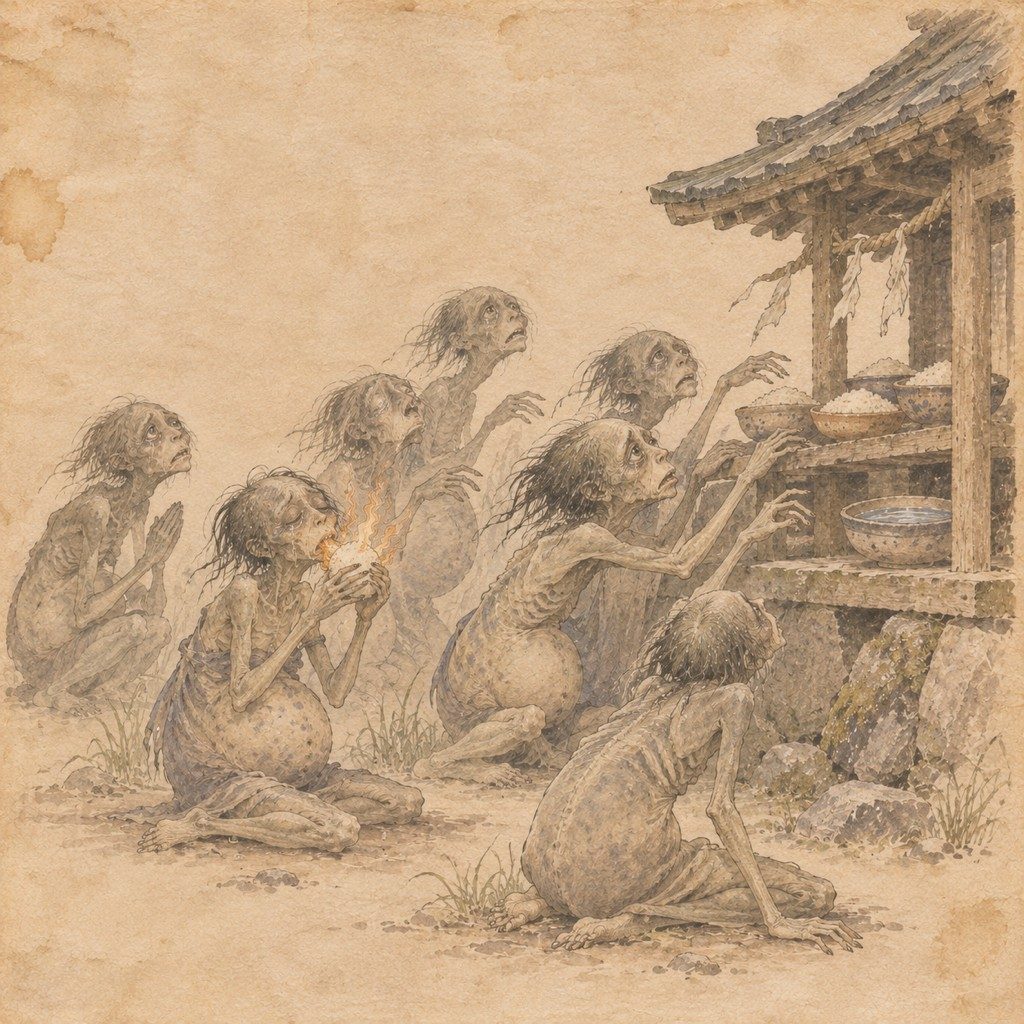
Restless dead. Novice.
The story. The greedy are reborn as hungry ghosts, with swollen bellies and throats as thin as needles, so they can never eat enough. Food turns to fire in their mouths. Water vanishes before their eyes. At the summer festival of the dead, temples hold the Feeding of the Hungry Ghosts, setting out rice and water on a shelf for the dead no one else feeds.
The truth. In the isles, the hungry ghosts are mostly the war's dead: the unburied, the forgotten, the families wiped out with no one left to make the offerings. They crowd around villages at night, stealing food they can't swallow, souring wells, and making children sick. They're pitiful, and they're dangerous in numbers.
Signs. Rice that turns black in the pot overnight. Offerings on the household altar gnawed but not eaten. Thin gray shapes at the edge of firelight. Babies who cry at nothing.
Hungry Ghost#
Attributes: Agility d6, Smarts d4, Spirit d6, Strength d6, Vigor d6
Skills: Athletics d6, Fighting d6, Notice d8, Stealth d8
Pace: 6; Parry: 5; Toughness: 5
Edges: —
Special Abilities:
- Bane (salt, bells, sutras, a sacred rope).
- Claws: Str+d4.
- Ethereal, except when it eats (below).
- Hunger: A hungry ghost within reach of food or drink grabs for it as a free action, and is solid until its next turn. Throwing food to them is a good way to fight them.
- Polluting.
- Spirit.
Tale seed. A village that lost every man in the Cheongun war has stopped making offerings, because it can't feed the living, and now something takes the rice from the storehouse every night.
Corpse-Eater (Jikininki, 食人鬼)#
Restless dead. Seasoned.
The story. A traveling priest stopped at a mountain village on the night of a death. The villagers left him alone with the body, as their custom was, and went to sleep in the next village. In the night a shapeless thing came in and ate the corpse, offerings and all. In the morning, the old hermit-priest who lived above the village confessed: he was the thing. In life he had served as a priest only for the fees, and now he was a corpse-eater. He begged the traveler for the Feeding of the Hungry Ghosts, and then he and his hut vanished.
The truth. Corpse-eaters are greedy priests, monks, and funeral-sellers who profited from the dead. By day they keep a human shape, often the shape they had in life. By night they eat the dead. Most of them hate what they are, and many beg for release, but the hunger is stronger than the shame.
Signs. A village with a strange custom of leaving its dead alone overnight. Graves that sink. Funeral offerings that vanish with the body. A holy man who never eats in front of anyone.
Banes and courtesies.
- Bane (salt, bells, sutras, a sacred rope), as all the dead.
- Courtesy: confession. Asked directly what it is, by someone who has seen it feed, a corpse-eater confesses and begs for help.
- Segaki is especially strong against it (Chapter 6), and segaki with Release, cast on the corpse-eater when it confesses, sends it on for good.
Corpse-Eater#
Attributes: Agility d6, Smarts d6, Spirit d8, Strength d10, Vigor d10
Skills: Academics d6, Athletics d6, Faith d6, Fighting d8, Intimidation d8, Notice d8, Persuasion d6, Stealth d10
Pace: 6; Parry: 6; Toughness: 8
Edges: —
Special Abilities:
- Bane (salt, bells, sutras, a sacred rope).
- Claws and teeth: Str+d6.
- Fear (–2): In its true shape.
- Polluting.
- Size 1: In its true shape, a swollen, formless thing.
- Spirit.
- Spirit Powers: Borrowed Face (disguise, its old human shape, by day) and Heavy Eyes (slumber, cast over a whole village before it feeds). 10 Power Points.
Tale seed. A village headman asks the heroes to sit up with his father's body tonight, as custom demands, because the priest who usually does it has fallen sick.
★ Living Ghost (Ikiryō, 生霊)#
A living spirit. Veteran.
The story. The people of the isles know two kinds of ghosts: the spirits of the dead, and the spirits of the living. A person consumed by jealousy, hatred, or longing can send their soul out of their body in sleep without knowing it, to haunt the one they hate or love. In the old court tales, a great lady's spirit went out in her dreams and killed her lover's wives one by one, and she woke each morning with the smell of temple incense in her hair and no idea why.
The truth. The story is right, and that's the horror of it: the living person usually doesn't know. A living ghost is as strong as the feeling behind it. It can't be fed or laid, because its owner isn't dead. It can only be stopped by the owner, or at a cost.
Signs. A sick person who cries out a rival's name in fever. A woman in the corridor who looks just like someone who lives across the city. The owner, somewhere else, sleeping strangely late and waking exhausted.
Banes and courtesies.
- Bane (salt, bells, sutras, a sacred rope). These ward it as they ward the dead.
- Not dead. Segaki doesn't work on it. Harai, Sending Away (banish), and Calling the Guardians do.
- The owner. A living ghost vanishes for good when its owner faces the feeling behind it and lets it go (a Social Conflict with the owner, Chapter 4, or a sincere apology from the person they hate). A rite at the owner's bedside while they sleep (Driving Out, exorcism, HC p. 76) stops it for a month.
- The cost. Each Wound the living ghost suffers gives its owner a level of Fatigue. If it's killed, its owner dies in their sleep. A hero who kills one has killed a living person, and they lose 4 or more Honor, as for murder (Chapter 4).
★ Living Ghost#
Attributes: Agility d8, Smarts d8, Spirit d12, Strength d4, Vigor d6
Skills: Fighting d6, Intimidation d10, Notice d8, Stealth d12, Taunt d8
Pace: 6; Parry: 5; Toughness: 5
Edges: —
Special Abilities:
- Bane (salt, bells, sutras, a sacred rope).
- Cold hands: Str+d6.
- Ethereal.
- Fear: When it shows its owner's face.
- Spirit.
- Spirit Powers: Bad Dreams (nightmares), Doom (lower Trait), and Hour of the Ox (curse). 15 Power Points.
Tale seed. A lord's new bride is wasting away, and the shrine diviner says a living spirit is to blame. Everyone suspects the lord's first wife. It's actually his sister, who loved the bride first.
Notes#
- The ghost in a white burial robe, with loose hair and no feet, follows Lafcadio Hearn, "Of Ghosts and Goblins," in Glimpses of Unfamiliar Japan (1894). The ghost counting plates in a well follows the well-known Banchō Sarayashiki folk tale.
- The two kinds of ghosts, the dead (shiryō) and the living (ikiryō), and the hungry ghosts (gaki) and the Feeding of the Hungry Ghosts follow Hearn, In Ghostly Japan (1899).
- The vengeful ghost of an executed man follows "Diplomacy" in Hearn, Kwaidan (1904). The slandered minister calmed by a shrine follows the Sugawara no Michizane legend as told in W. G. Aston, Shinto: The Way of the Gods (1905). No real person is named in the text.
- The blind singer called out by the drowned court, the demon-fires over the sea, and the crabs with warriors' faces follow "The Story of Mimi-Nashi-Hoïchi" in Hearn, Kwaidan.
- The corpse-eater follows "Jikininki" in Hearn, Kwaidan.
- Ship ghosts and the bottomless ladle follow Hearn, "By the Japanese Sea," in Glimpses of Unfamiliar Japan.
- The living spirit of a jealous lady follows the court-tale tradition of The Tale of Genji, as summarized in Hearn, In Ghostly Japan.
- Statistics. The ghost is the SWADE Ghost (p. 183), changed. The Kamaeda crabs are the SWADE Swarm (p. 189), changed. All other blocks are new.
Part 5: Kami, Messengers, and Spirit Servants#
The kami are not monsters. They're the gods of the isles: the spirit in a waterfall, an old camphor tree, a crossroads, a mountain, a rice field, a clan's founder. They aren't good or evil, any more than weather is. Treat them well, and they bless a village for a thousand years. Pollute their ground, forget their festival, or cut their tree, and they show the other side of their nature.
Heroes meet kami far more often than they fight them, and this part is written for meeting. Most kami arrive through Calling Down the Kami (kami-oroshi, Chapter 6), and the rules for bargaining with them are there. The statistics here are for the rare night when a kami's anger must be faced, or when one walks among people for its own reasons.
All kami share four things:
- Kami kind. No spirit-bane wards a kami (Part 1). They're calmed with offerings, purification, and courtesy.
- Two spirits. Every kami has a gentle spirit (nigimitama) and a rough spirit (aramitama). A kami starts Neutral to a respectful visitor (SWADE p. 33). When it's offended (its ground polluted, its festival skipped, its price unpaid, or blood spilled before its shrine), its rough spirit wakes. A kami with its rough spirit awake is Hostile, adds +2 to its Fighting rolls and Spirit Powers rolls, and stays that way until it's purified (harai, or the Rite of Cleansing a Place, Chapter 6) and given an offering.
- Purity. A kami won't come to, speak with, or help a Polluted or Defiled hero. A Touched hero subtracts 2 from Persuasion rolls with it (Chapter 4).
- Its own ground. On its own ground, a kami has the Hidden Road ability (Part 1) at any hour, and knows everything that happens there.
Kami of Place (Tochigami, 土地神)#
Kami. Seasoned, Veteran, or Legendary.
The story. Every place with a power to it has a god: a spring, a grove, a great rock, a crossroads, a well, a village, a river, a mountain. Its home is marked with a sacred rope, a little shrine, or a gate, and its body (shintai) is something in that place: the rock itself, a mirror, a sword, an old tree.
The truth. All of that is true. Most kami never take a shape anyone can see. When they do, it's a shape that suits them: an old man with moss in his beard, a woman in white by a waterfall, a child at a crossroads, a great white stag, a voice from a cloud. A kami that is fought isn't killed. Reduced to Incapacitated, it withdraws into its body, and its ground suffers for it: springs run dry, crops fail, and luck leaves the village until the kami is honored again.
Signs. A sacred rope around a rock or tree. Offerings, fresh or old. A clearing that's quieter than it should be. Animals that don't flee.
Building a kami. Pick the kami's size from the three below, and its nature from Chapter 6's kami natures (Sea and River, Rice and Harvest, Mountain and Forest, Thunder and Storm, Fire and Forge, and the rest). Its Spirit Powers come from that nature's power list, with the island names and trappings of the place.
Kami of a Spring, a Grove, or a Crossroads#
Seasoned. The small gods, known to one family or one hamlet. Answers Calling Down the Kami at Seasoned.
Attributes: Agility d8, Smarts d8, Spirit d10, Strength d6, Vigor d8
Skills: Athletics d6, Fighting d6, Intimidation d8, Notice d10, Occult d8, Persuasion d8, Stealth d10
Pace: 6; Parry: 5; Toughness: 6
Edges: —
Special Abilities:
- Hidden Road (on its own ground).
- Spirit.
- Spirit Powers: Two powers from its nature. 15 Power Points.
- Withdrawal: When Incapacitated, it withdraws into its body (above) instead of dying.
★ Kami of a Village or a River#
Veteran. The gods of a whole community, with a shrine, a festival, and a priest. Answers Calling Down the Kami at Seasoned. As the kami of a spring, with these changes:
- Wild Card, Smarts d10, Spirit d12, Strength d10, Vigor d10, Fighting d8, Intimidation d10, Notice d12, Occult d10.
- Fear: When it shows its true shape.
- Size 2: In its true shape (a great white stag, a giant carp, a robed figure taller than the shrine gate). Toughness 9.
- Spirit Powers: Four powers from its nature. 25 Power Points.
★ Kami of a Mountain or a Province#
Legendary. The great gods, whose shrines draw pilgrims from across the realm. Answers Calling Down the Kami at Veteran, and only at its own shrine, on its festival day, or where its power is strongest (Chapter 6). As the kami of a village, with these changes:
- Spirit d12+2, Strength d12+4, Vigor d12+2, Fighting d10, Intimidation d12+2.
- Fear (–2).
- Huge (Size 8): In its true shape (a mountain-tall figure in the clouds, a serpent around a peak, a storm with a face). Toughness 17. It takes two extra Wounds.
- Invulnerability: On its own ground, nothing harms it but a relic or a power cast by a genja it has accepted as its priest.
- Spirit Powers: Six powers from its nature, and Storm (havoc) on a scale that covers a whole valley. 40 Power Points.
- The land is its body. If a great kami is ever brought to Incapacitated, the hakobore widens one step (Chapter 7).
Tale seed. The village of the heroes' lord has forgotten which day its festival falls on since the old priest died, and the rice in the paddies is turning red.
Sacred Messenger (Tsukai, 使い)#
Kami. Novice.
The story. Each great kami has a beast that carries its word: foxes for the rice kami, crows for the gods who guide travelers, deer for the gods of the old capital's great shrines, white snakes for the goddess of water and music, and wolves for the mountain shrines that guard against fire and thieves. People bow to these animals, feed them, and never harm them.
The truth. Most foxes and crows are only foxes and crows. A few are messengers, and those few are kami of the smallest kind, sent by their masters to watch, warn, guide, and sometimes to punish. A messenger can speak, if it chooses to. A Calling Down the Kami at Novice brings one (Chapter 6).
Signs. An animal that meets a person's eyes and doesn't look away. A white animal where none should be. One crow that follows a traveler for a whole day's walk.
Messenger. Use the animal's ordinary profile, with these changes:
- Fox, crow, or white snake: Smarts d8, Spirit d8, and Notice d10. Use the young fox's statistics (Part 2) for a fox, Bird of Prey (FC p. 178) for a crow, and Snake (SWADE p. 188) for a white snake, with no poison unless its master is angry.
- Deer: Agility d8, Smarts d8, Spirit d8, Strength d8, Vigor d8; Athletics d8, Fighting d4, Notice d10; Pace 10; Parry 4; Toughness 7; antlers (Str+d6), Size 1.
- Wolf: Dog/Wolf (SWADE p. 181), with Smarts d8, Spirit d8, and Notice d10. Mountain shrines' wolves come in pairs.
- All messengers add Hidden Road (Part 1), Spirit, and Speech: it speaks any language its master's worshippers speak.
- Sacred: A hero who harms a messenger offends its kami, as an unpaid price (Chapter 6).
Tale seed. A white crow lands on the ridgepole of the heroes' inn and calls one of them by their childhood name.
Stone Guardian (Komainu, 狛犬)#
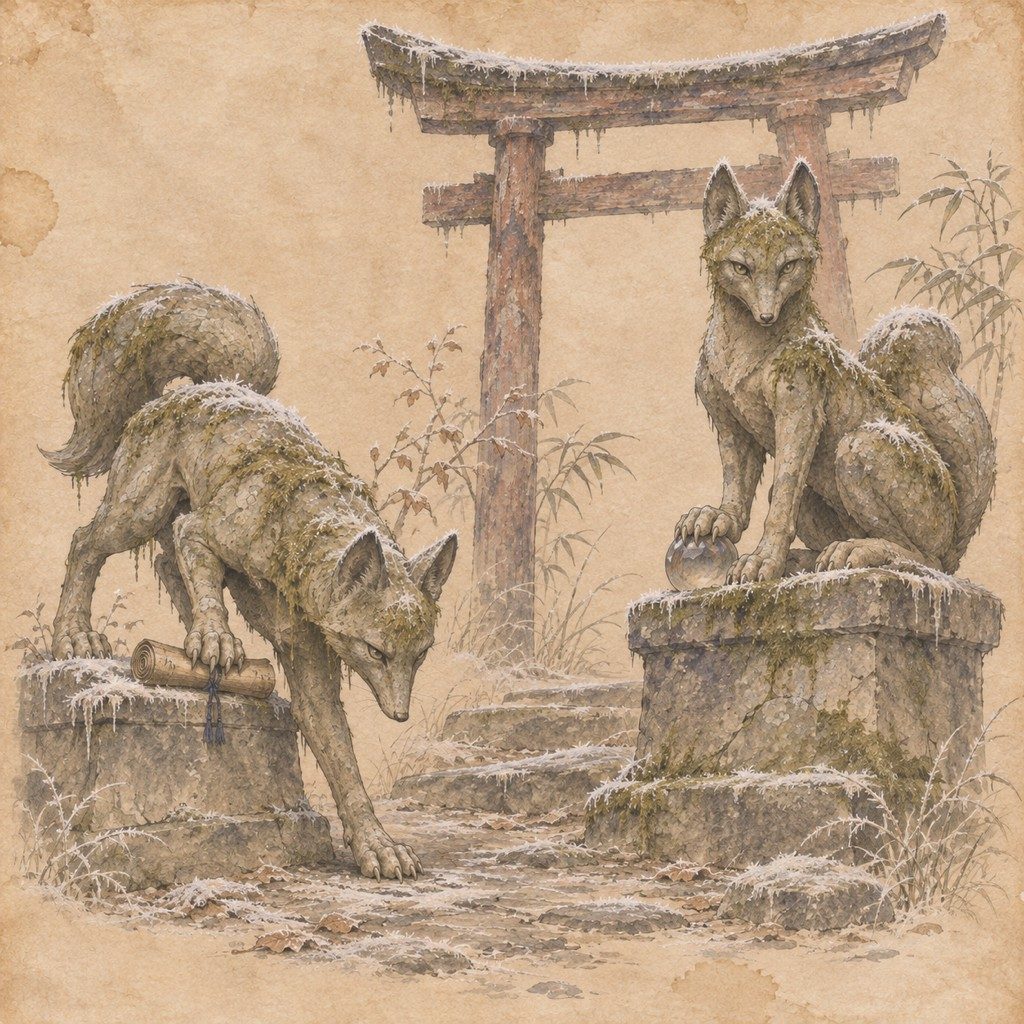
Kami. Seasoned.
The story. Two guardians flank the path to every great shrine: lion-dogs of stone (komainu), or foxes at the shrines of the rice kami. One has its mouth open and the other closed, for the first and last sound of all things. Children say the guardians wake at night, and pat their heads for luck.
The truth. At most shrines, the guardians are carvings, and their power is a prayer. At a few old shrines, the first priests asked a messenger of the shrine's kami to live in the stones, and the stones are alive. They wake when the shrine is attacked, when its priest calls them by their names, or when the hakobore stirs them (Part 1).
Signs. Fresh scratches on a stone pedestal. A guardian whose head is turned a different way in the morning. Moss scraped off a stone paw.
Stone Guardian#
Attributes: Agility d6, Smarts d6, Spirit d10, Strength d12, Vigor d10
Skills: Athletics d6, Fighting d10, Intimidation d10, Notice d10
Pace: 6; Parry: 7; Toughness: 12 (4)
Edges: —
Special Abilities:
- Armor +4: Stone.
- Bite or claws: Str+d8.
- Construct (SWADE p. 176).
- Fearless.
- Hardy.
- Paired: A pair of guardians always fights together. When one is beside the other, both add +1 to Fighting rolls.
- Size 1.
- Stone sleep: A stone guardian can't move more than a bowshot from its shrine, and it returns to its pedestal at dawn.
The Stone Foxes of Hiraishi (Hiraishi-no-Kitsune, 平石の狐)#
The two stone foxes at the gate of Hiraishi Shrine on Kurogane Pass (Chapter 8) are the messengers of the pass's kami, set in the stones six hundred years ago by the first Hiraishi priest to guard the flat stone, a shard of the Great Sword (Chapter 7). The priest promised them they could go home when the sword was whole again. They have waited for six hundred years, and through the shrine maiden Suzu, they've begun to say that they're tired of waiting.
What they want is a reason to keep guarding. Use the stone guardian, with these changes:
- Wild Cards, both of them, with Smarts d8 and Persuasion d6. They speak only through Suzu in trance, or to a hero who sleeps at the shrine.
- Fox fire: Each has Spirit Powers: Arrows (bolt, fox fire) and Mist (illusion). 10 Power Points each.
- Their choice. If the flat stone is threatened (the Whetstone's fire, Chapter 7), they fight for it. If no one has given them a reason to stay by the time the hakobore reaches Restless, they leave their stones and walk into the hills, and the shard stone has no guardians at all.
- A reason to stay. A hero who swears before the flat stone to see the cut mended (a Major Vow) gives them one. They watch that hero from then on, and a fox from the pass may appear when the hero is in need (as a sacred messenger, at the GM's call).
Tale seed. Opening the shrine at dawn, Suzu finds one of the two pedestals empty and fox prints in the frost leading down the road toward Hagane.
★ The Dragon of Mizuchi (Mizuchi-no-Ryū, 蛟の竜)#
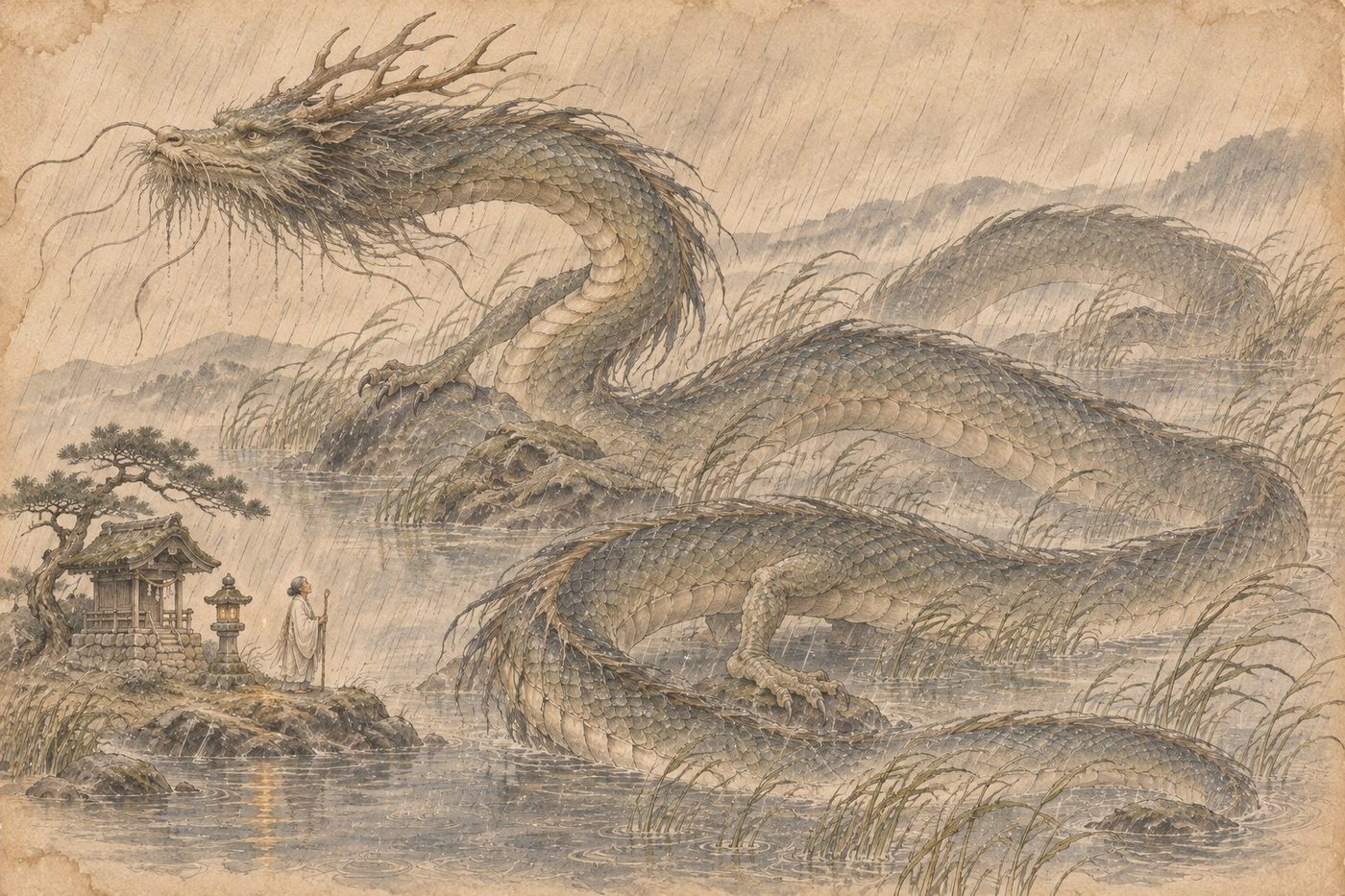
Kami. Heroic.
The story. In the dark lake at the heart of the Mizuchi marshes lives the water dragon, the great river kami of the province (Chapter 8): a serpent longer than a river barge, with a stag's antlers, a carp's scales, and a voice like thunder in the reeds. It brings the rains and the floods. Its priestesses live on an island in its pool, and the high priestess is called the Dragon's Bride (Chapter 9). In bad years, the rumors say, the offerings thrown into the pool are people.
The truth. The dragon is old, vast, and not unkind, as kami go. It guards the stone at the bottom of its pool, which is a shard of the Great Sword (Chapter 7), and it keeps the province's waters in their channels as long as it is honored. The rumors are old truth: in the hungriest years before the Kagamino peace, the priestesses gave it brides from the floating villages. The present Dragon's Bride ended that custom forty years ago, by going down into the pool herself and coming back up alive. No one knows what she promised it. The floods have been worse every year since.
Signs. Rain that falls only on the marsh. A wake in the dark water with no boat to make it. Reeds flattened in a path wider than a road. Thunder from a clear sky.
Banes and courtesies.
- Kami. No bane wards it.
- The centipede. Like all dragons, it fears the great centipede, its ancient enemy (Part 6). It won't come within a bowshot of one, and it owes a debt to anyone who kills one in its waters, as in the tale of the dragon's rice bale (Chapter 6).
- The Bride. The Dragon's Bride can call it once per session, in Mizuchi's waters (Chapter 9). It comes as her ally.
★ The Dragon of Mizuchi#
Attributes: Agility d8, Smarts d8, Spirit d12, Strength d12+6, Vigor d12+2
Skills: Athletics d10, Fighting d10, Intimidation d12, Notice d10, Occult d10, Persuasion d6
Pace: 8; Parry: 7; Toughness: 21 (4)
Edges: Improved Sweep, Level Headed
Special Abilities:
- Aquatic: Pace 12 in the water.
- Armor +4: Scales like bronze plates.
- Bite: Str+d8.
- Coils: A dragon that hits with a raise can wrap its target in its body (a grapple, SWADE p. 101) and crush it for Str+d6 each round after.
- Fear (–2).
- Flight: Pace 12. It rides on clouds and rain.
- Hardy.
- Huge (Size 8): Over 80 feet long. It takes two extra Wounds.
- Spirit.
- Spirit Powers: Arrows (bolt, lightning), Mist (illusion), Storm (havoc), and Waterfall Body (environmental protection). 30 Power Points.
- The river is its body. In Mizuchi's waters, the dragon recovers from being Shaken as a free action at the start of each turn.
Tale seed. The Thunder Peak monks marching on Mizuchi (Chapter 9) mean to drain the dragon's pool and break its shrine, and the Dragon's Bride sends for heroes to stand between the monks and something much worse than a flood.
★ The Messenger of the Dragon Palace (Ryūgū-no-Tsukai, 竜宮の使い)#
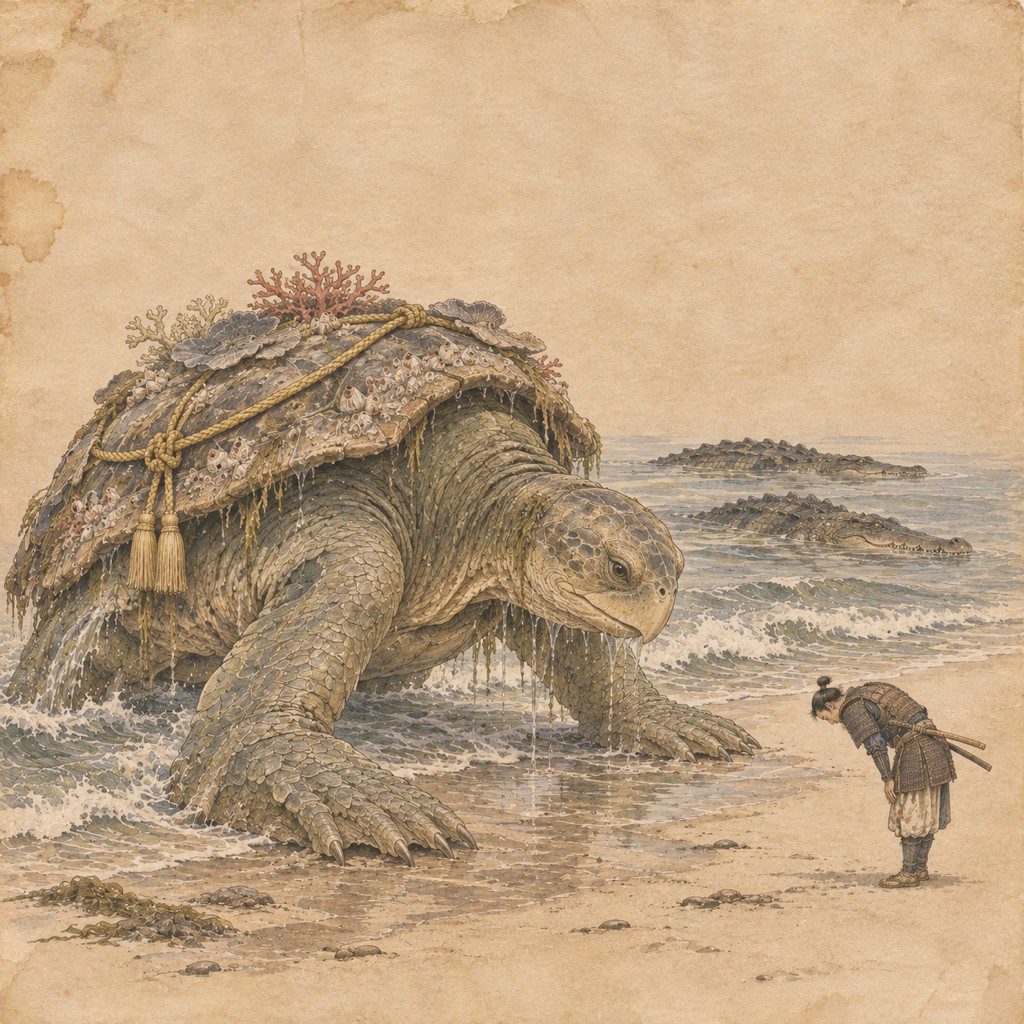
Kami. Veteran.
The story. Under the sea lies the palace of the dragon king, with walls of coral and roofs of pearl, where a fisherman once stayed for three days and came home to find three hundred years had passed. The dragon king lent his tide jewels to a hero of the oldest days. His messengers are sea creatures that speak.
The truth. The dragon king's patience is long, but it ends. Whoever wakes the Tide Jewels (Chapter 6) can expect his messenger: an enormous old sea turtle, its shell crusted with coral and hung with a golden cord, who walks out of the surf on the next full moon and asks, with perfect court manners, for the jewels back. It's escorted by sea-crocodiles (wani, Part 6), who wait in the shallows.
Signs. A full moon with a ring around it. Fish leaping onto the beach. Coral where no coral grows. A turtle's track up the beach that ends at a door.
Banes and courtesies.
- Kami. No bane wards it.
- Courtesy: the guest. The messenger is an envoy. It never strikes first, and it answers any question asked courteously about the sea or the dragon palace. To harm it is to declare war on the sea.
- Refusal. If the jewels aren't returned by the next full moon, storms close the coast to all shipping for a season, and the wani hunt the heroes in any water deeper than a man.
★ The Messenger of the Dragon Palace#
Attributes: Agility d4, Smarts d10, Spirit d12, Strength d12+2, Vigor d12
Skills: Athletics d6, Fighting d6, Intimidation d8, Notice d10, Occult d10, Persuasion d10
Pace: 3; Parry: 5; Toughness: 16 (6)
Edges: Strong Willed
Special Abilities:
- Aquatic: Pace 10 in the water.
- Armor +6: Its shell.
- Bite: Str+d6.
- Hidden Road: Any beach at full moon is a thin place for it.
- Size 3.
- Spirit.
- Spirit Powers: Shrinking the Earth (teleport, through any water), Storm (havoc), and Waterfall Body (environmental protection, which it can grant to those it carries under the sea). 20 Power Points.
Tale seed. A Shogunate admiral believes he's found the Tide Jewels. He asks the heroes to watch the beach at the next full moon for the dragon king's messenger. (The messenger comes only if the real jewels have been awakened; Chapter 6 keeps them lost at the start of play.)
Tale seed. A fisherwoman offers to dive into the Dragon Palace itself and take back a temple's stolen crystal from the sleeping dragons who guard it, if a lord will raise her infant son as a samurai. She needs heroes to hold the rope and to make the lord keep his word.
Shark-Man (Samebito, 鮫人)#
Kami. Seasoned.
The story. A young man crossing a long bridge found a strange creature sitting under it: a man's body, skin as black as ink, a dragon's face, and green eyes. He said he had served the dragon king, and had been banished from the palace for a small fault. The young man took him home and let him live in a pond in his garden. When the young man fell sick with love for a girl whose family asked an impossible bride-price of ten thousand jewels, the shark-man wept for him, and his tears fell as rubies. The young man married the girl, and the dragon king forgave his servant.
The truth. The dragon king's servants are sometimes cast out, and they wash up in the strangest places: under bridges, in temple ponds, in the nets of fishermen. A banished shark-man is gentle, lonely, and grateful for kindness. He can't go home until he is forgiven.
Signs. Salt water in a freshwater pond. Wet footprints on a bridge at night. A fisherman who suddenly has a ruby to sell.
Courtesy: kindness repaid. A shark-man owes a debt (a Major on, Chapter 4) to anyone who shelters him. When someone he loves grieves, he weeps, and his tears harden into rubies worth 2d6 × 100 mon. He can't weep on command, and he can't be made to.
Shark-Man#
Attributes: Agility d8, Smarts d8, Spirit d10, Strength d10, Vigor d8
Skills: Athletics d8, Fighting d8, Notice d8, Occult d6, Persuasion d6, Stealth d8
Pace: 6; Parry: 6; Toughness: 7
Edges: —
Special Abilities:
- Aquatic: Pace 10.
- Bite: Str+d6.
- Size 1.
- Spirit.
Tale seed. A Hagane moneylender is selling rubies no jeweler can place, and the heroes find the shark-man chained in his cellar, beaten every night to make him weep.
Spirit Servants (Shikigami, 式神, and Dōji, 童子)#
Onmyōji fold paper servants (shikigami, Chapter 6), and monks call the boy attendants (dōji) of the wrathful kings with Calling the Guardians at Novice. Both use the Fantasy Companion's ally profiles for summon ally (FC p. 138) unchanged: the Attendant, Bodyguard, Sentinel, and Mirror Self (FC p. 139). Only their looks change.
| Profile | A shikigami looks like | A guardian's attendant looks like |
|---|---|---|
| Attendant | A paper bird, a paper servant in court dress, a child with a paper face | A temple boy with his hair in loops, carrying a rope or a staff |
| Bodyguard | A paper warrior, a carved wooden doll with a sword | A small wrathful figure wreathed in flame, with a sword and a lasso |
| Sentinel | A paper giant folded from a hundred sheets, a straw-and-paper ox | A temple guardian in armor, taller than the gate |
| Mirror Self | A paper figure that unfolds into the onmyōji's own image | Not available. The guardians don't wear the caster's face. |
Their kind. A shikigami is a small spirit bound in paper. It counts as a yōkai for banes and powers, and Unbinding (dispel) frees it, after which it usually flies away. A guardian's attendant is none of the four kinds. No bane wards it, and it can't be made to harm the innocent.
The Elder of the Forest (Mori-no-Okina, 森の翁)#
Kami of the old kind. No statistics.
What it is. The greatest of the old kami of the north, who were here before the cut and still rule the forests of Hate-no-Kuni (Chapter 7). It has no name, because names are a way of cutting one thing from another. Hunters who have seen it describe it differently: a bear the size of a hill, a stag with a forest in its antlers, a mist that walks.
How it appears. Rarely, and never all at once. The forest goes silent. Every animal turns to look the same way. Snow begins to fall upward. Then something too large to see whole moves between the trees, and every hero who sees it makes a Fear check at –4. A hero who meets its eyes forgets their own name until dawn.
Why no statistics. The Elder can't be fought, any more than winter can (Chapter 7). Swords pass through mist, arrows lose themselves in the trees, and powers fall silent. It doesn't attack. If heroes threaten it, the forest itself closes around them: the paths vanish, the snow deepens, and the old kami's servants (great bears, wolves, and the forest oni, Part 3) see them out, or don't.
What it does. It listens to a genja who comes with offerings and asks permission, as the hunters do (Calling Down the Kami at Veteran, Chapter 7). It answers in images, dreams, and the movements of animals. Its prices make sense to a forest and rarely to a person.
Tale seed. A hunter's daughter who walked into the forest of Hate-no-Kuni three winters ago walks out again, unaged, carrying a message for the Shogun that no one can understand.
Notes#
- The kami of places, their bodies (shintai), and the gentle and rough spirits (nigimitama and aramitama) follow W. G. Aston, Shinto: The Way of the Gods (1905).
- The sacred messengers (the rice kami's fox, the guiding crow, the shrine deer, the white snake, and the mountain wolf) follow Aston, Shinto, and Lafcadio Hearn, "Kitsune," in Glimpses of Unfamiliar Japan (1894).
- The guardian lion-dogs with open and closed mouths follow Hearn, Glimpses of Unfamiliar Japan.
- The water dragon, its enemy the centipede, and the dragon's rice bale follow F. Hadland Davis, Myths and Legends of Japan (1912). Dragons as rain and river kami follow Aston, Shinto.
- The dragon palace under the sea, the fisherman who stayed three hundred years, the tide jewels, and the sea-crocodiles who serve the sea king follow Davis, Myths and Legends of Japan, and W. G. Aston, trans., Nihongi (1896).
- The banished shark-man who wept rubies follows "Totaro and Samebito" in Davis, Myths and Legends of Japan. The fisherwoman who dived into the sea king's palace for a stolen crystal follows "The Crystal of Buddha," also in Davis.
- The boy attendants of the wrathful kings follow Buddhist temple iconography as described in Davis, Myths and Legends of Japan.
- Statistics. Spirit servants use the Fantasy Companion's summon ally profiles (FC p. 139) unchanged. Messengers are ordinary animal profiles, changed. All other blocks are new.
Part 6: Beasts of Legend and the Wild#
Not every danger in the isles is a spirit. Bears take hunters in the northern forests, wild boar tear up the terraces, and sharks follow the fishing fleets. Above the ordinary animals are the great beasts of legend: centipedes as long as a temple hall, serpents that drink lakes, and the night-crying thing on the palace roof. Most of these are beasts (Part 1): no bane wards them and no rite moves them. A few have grown so old that they've become something more, and their entries say so.
Beasts of the Isles#
The ordinary animals of the isles use the profiles listed in Part 1, unchanged. These notes say where they live and what people think of them.
| Beast | Profile | In the isles |
|---|---|---|
| Black bear | Bear (SWADE p. 180), with Size 0 and Toughness 8 | The forests of the main islands. Shy, but dangerous in autumn, when it fattens on acorns and chestnuts. |
| Brown bear | Bear (SWADE p. 180) | Only in the north, in the forests of Hate-no-Kuni, where the hunters call it "the mountain's guest" and send its spirit home with a feast. Since the hakobore widened, they come down to the villages unafraid (Chapter 7). |
| Wild boar | Boar (FC p. 178) | Everywhere there are hills. Hunters call its meat "mountain whale," which lets the pious eat it. |
| Wolf | Dog/Wolf (SWADE p. 181) | The mountains. Wolves guard the fields from deer and boar, and farmers leave them offerings; the mountain shrines keep wolves as messengers (Part 5). |
| Dog | Dog/Wolf (SWADE p. 181) | Village dogs, hunting dogs, and the great fighting dogs that some lords keep. |
| Monkey | See below | Troops in every mountain range, bold, clever, and protected by the mountain kami. |
| Horse and war horse | Horse and War Horse (SWADE pp. 184–185) | Small, tough, and shaggy, bred on the grass of the eastern plains. A lord's war horse is worth a village. |
| Ox | Bull (SWADE p. 180) | The plow ox and the cart ox of the capital, rarely angry. |
| Hawk and eagle | Bird of Prey (FC p. 178) | Falconry is a lord's sport, and a fine hawk is a lord's gift. |
| Mamushi | Snake (SWADE p. 188), venomous | The small viper of the rice paddies and the stone walls. |
| Shark | Shark and Shark, Great White (SWADE p. 187) | The open sea. Fishermen call sharks wani, like the sea-crocodiles of the old chronicles (below). |
| Whale | Whale (FC p. 246) | The Eastern Sea. The whalers of the southern capes hunt them from open boats with harpoons and nets, and hold memorial services for the whales they kill. |
| Tiger, crocodile | Cat, Large (FC p. 179); Alligator/Crocodile (SWADE p. 180) | Only on the mainland. Daqian's envoys sometimes bring a caged tiger as a gift, and painters who've never seen one paint them anyway. |
Monkey Troop (Saru, 猿)#
Monkeys are clever thieves, and a whole troop is a real danger to a traveler with food. Use these statistics for one monkey, and the Swarm (SWADE p. 189) for a whole troop on the attack.
Attributes: Agility d8, Smarts d6 (A), Spirit d6, Strength d4, Vigor d6
Skills: Athletics d10, Fighting d6, Notice d8, Stealth d8, Thievery d6
Pace: 6; Parry: 5; Toughness: 3
Special Abilities:
- Bite: Str+d4.
- Climb: Monkeys climb at full Pace.
- Size –1.
Great Centipede (Ōmukade, 大百足)#
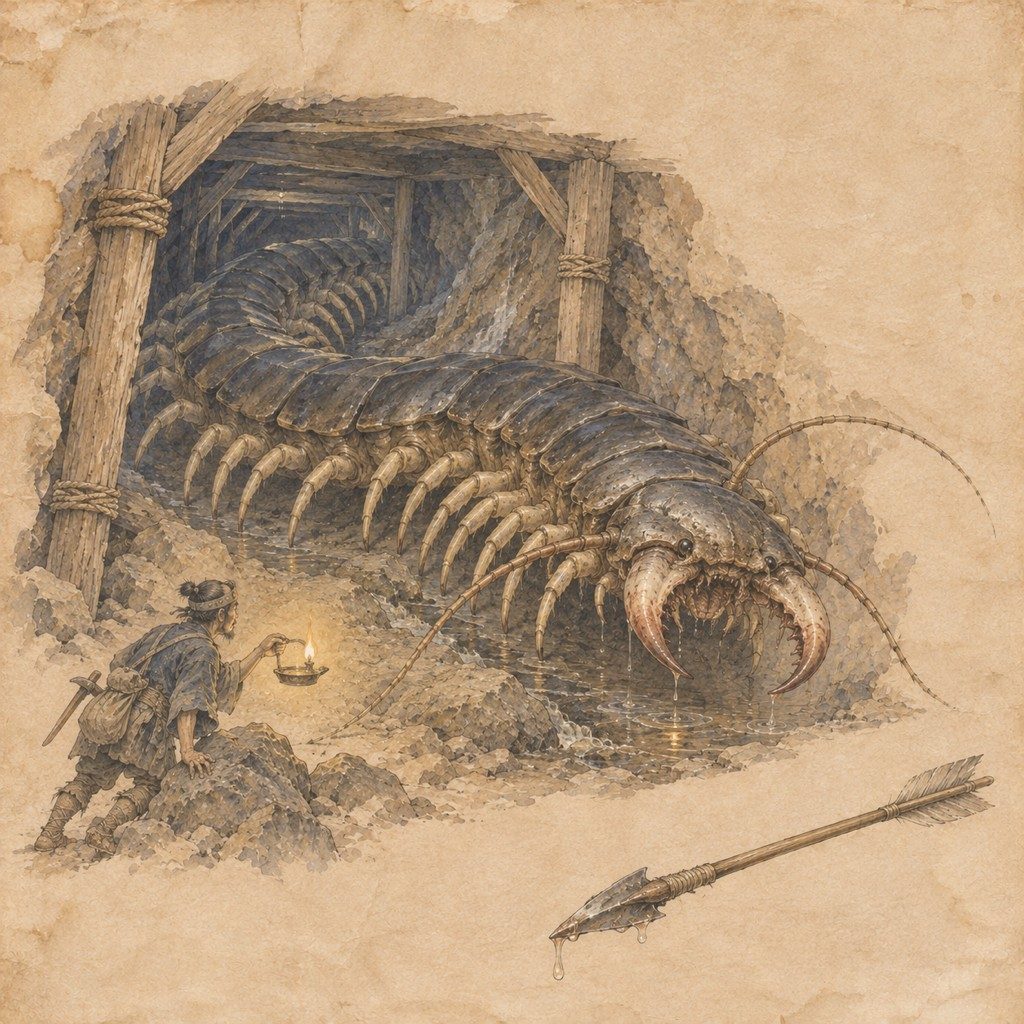
Beast. Seasoned.
The story. Long ago, on a great bridge, a dragon in the shape of a serpent lay across the road to test travelers' courage. A young warrior stepped over it without a pause. That night the dragon came to him in the shape of a man and begged for help: a centipede longer than the mountain was wide was eating its children. The warrior shot two arrows at the monster, and both bounced off its armor. Then he wet the third arrowhead with his own spit, remembering that human spittle is poison to centipedes, and shot it through the creature's brain. The dragon gave him a rice bale that never runs dry (Chapter 6).
The truth. Great centipedes live in caves, mines, and deep gorges, and they eat whatever comes into the dark. They're the ancient enemies of dragons, and dragons fear them. The old story's trick works.
Signs. Rasping in the dark like someone dragging a chain. Rock scored by many claws. A smell of rot and iron. Lights moving in pairs in the depths: its eyes.
Banes.
- Human spittle. A weapon or arrowhead wet with human spit ignores the centipede's armor and does +4 damage. Wetting a blade is part of an attack; wetting it again takes an action.
- Dragons' enemy. Any dragon or water kami that learns a hero killed a great centipede owes that hero a favor.
Giant Centipede (FC p. 206), with these changes:
- Kind: beast. Add Low Light Vision and Weakness (human spittle) (above).
- Wall Walker: It moves at full Pace on walls and ceilings.
- Enemy of dragons: The dragon of Mizuchi and every dragon kami fear it (Part 5).
★ The Centipede of the Fourth Gallery (Daiyon-Kō-no-Mukade, 第四坑の百足)#
Last spring, the deepest shaft of the Ishikubo mines in Kurogane (Chapter 8) broke into an old cavern, and the first crew sent in never came back. The Kitamori sealed the gallery. At night, something in it knocks. The knocking is a great centipede that has lived in the dark under Kurogane's iron hills for longer than the mines have been there, striking the stone with its jaws to call the miners it remembers. It's old enough to have become more than a beast: it has eaten men and learned their speech, and now it bargains.
The "demon's voice" that offers Kitamori Kaede all the iron she wants (Chapter 8) is the centipede. It knows where every vein of ore under Kurogane runs, and it will show her, for three miners a month. Use the great centipede with these changes:
- Wild Card, Smarts d8 (not an animal), Persuasion d6, Intimidation d8.
- Kind: yōkai, Wicked, because it has grown old and clever enough. Harai's Drive Back and Calling the Guardians work on it.
- Speech: It speaks in the voices of the miners it has eaten.
- Old and starving: It has eaten little for a hundred years. It starts each fight with one Wound, until it has fed on a whole crew.
- Its tunnels: In the narrow galleries it can strike from any wall or the ceiling, but it can't bring its full length to bear. It subtracts 2 from Fighting rolls in a passage less than 10 feet wide.
Tale seed. A miner's daughter goes into the sealed Fourth Gallery after her father, and the heroes find the seal broken from the inside.
Great Serpent (Daija, 大蛇)#
Beast, or kami. Veteran.
The story. The oldest chronicles tell of an eight-headed serpent whose body covered eight valleys, which ate a maiden every year until a storm kami made it drunk on eight vats of sake and cut it to pieces. Every mountain lake and every great river pool has its own serpent story: a lord of the lake (nushi) that grows bigger every century and demands a sacrifice in drought.
The truth. Great serpents are real, and most of them are what the stories say: enormous, old, and hungry. A very old serpent becomes the kami of its lake, and then it's a kami, with all of a kami's rights (Part 5), and killing it is a terrible offense. Telling which is which is a matter for an Occult roll and a shrine's records.
Signs. Fish gone from a lake. A trail through the reeds like a fallen tree dragged to the water. A shed skin longer than a house. Cattle missing from the lake shore.
Banes and courtesies.
- Sake. Like its ancestor, a great serpent can't resist strong sake. It drinks all it finds, and a serpent that drinks a whole vat (about 40 gallons) falls asleep for 1d6 hours.
- Lord of the lake. A serpent that has become a kami is warded by nothing, and answers Calling Down the Kami as the kami of a village or river.
Giant Snake (FC p. 208), with these changes:
- Kind: beast, or kami of its lake (above). A serpent kami adds Spirit and Spirit Powers: Mist (illusion) and Storm (havoc, rain only), with 20 Power Points.
- Aquatic: Pace 10 in the water.
- Constrict: All great serpents of the isles are constrictors.
- Fear: When it rises out of the water.
Tale seed. A drought has dried a mountain lake to a mud flat, and the village beside it has chosen a girl for the old serpent, as its grandparents did. The serpent's shrine priest insists the serpent never asked.
Tale seed. A sea serpent in a cave under a sacred islet has been cursing a lord with madness, and the only one willing to go down after it is a young pearl diver with a knife in her teeth, who wants the heroes to hold her rope.
Sea-Crocodile (Wani, 鰐)#
Beast. Veteran.
The story. A white hare once tricked the sea-crocodiles into lining up across the sea, from an island to the shore, so it could count them, and hopped across their backs. Just before the shore, it boasted of the trick, and the last crocodile tore off its fur. The oldest chronicles also say the dragon king of the sea has wani for servants, and that a sea princess turned into one to give birth.
The truth. Wani are great sea beasts, something between a crocodile, a shark, and a dragon, longer than a fishing boat. They serve the dragon king (Part 5), and they also hunt for themselves along the wilder coasts, especially where shipwrecks are common. They're cunning, and they can understand speech.
Signs. A fishing boat found empty and gnawed. A great shape under the surface with a long, toothed snout. Off the southern capes, a line of dark backs in calm water.
Sea-Crocodile#
Attributes: Agility d8, Smarts d6 (A), Spirit d8, Strength d12+3, Vigor d12
Skills: Athletics d10, Fighting d10, Intimidation d8, Notice d8, Stealth d10
Pace: 3; Parry: 7; Toughness: 15 (3)
Edges: —
Special Abilities:
- Aquatic: Pace 12.
- Armor +3: Scaled hide.
- Bite: Str+d8, AP 2.
- Death roll: A sea-crocodile that hits with a raise grapples its target (SWADE p. 101) and drags them under, where they begin to drown (SWADE p. 126).
- Size 4 (Large): About 25 feet long. It takes one extra Wound.
- Understands speech: A wani can understand any spoken language, though it can't speak. Persuasion works on it, at –2.
Tale seed. A pearl-diving village on the southern capes keeps losing divers, and an old woman there says the wani are looking for something someone took from the sea.
Giant Spider (Ōgumo, 大蜘蛛)#
Spiders the size of dogs nest in old temples, ruined castles, and the deep forest. Use the Giant Spider (SWADE p. 188), unchanged. The great earth spider of the old tales is in Part 2.
Tale seed. The roof beams of an abandoned temple on the Ōgiri pilgrimage road are draped in webs as thick as rope, and pilgrims who shelter there are found in the morning wrapped in silk, alive but unable to wake.
★ The Night Beast (Nue, 鵺)#
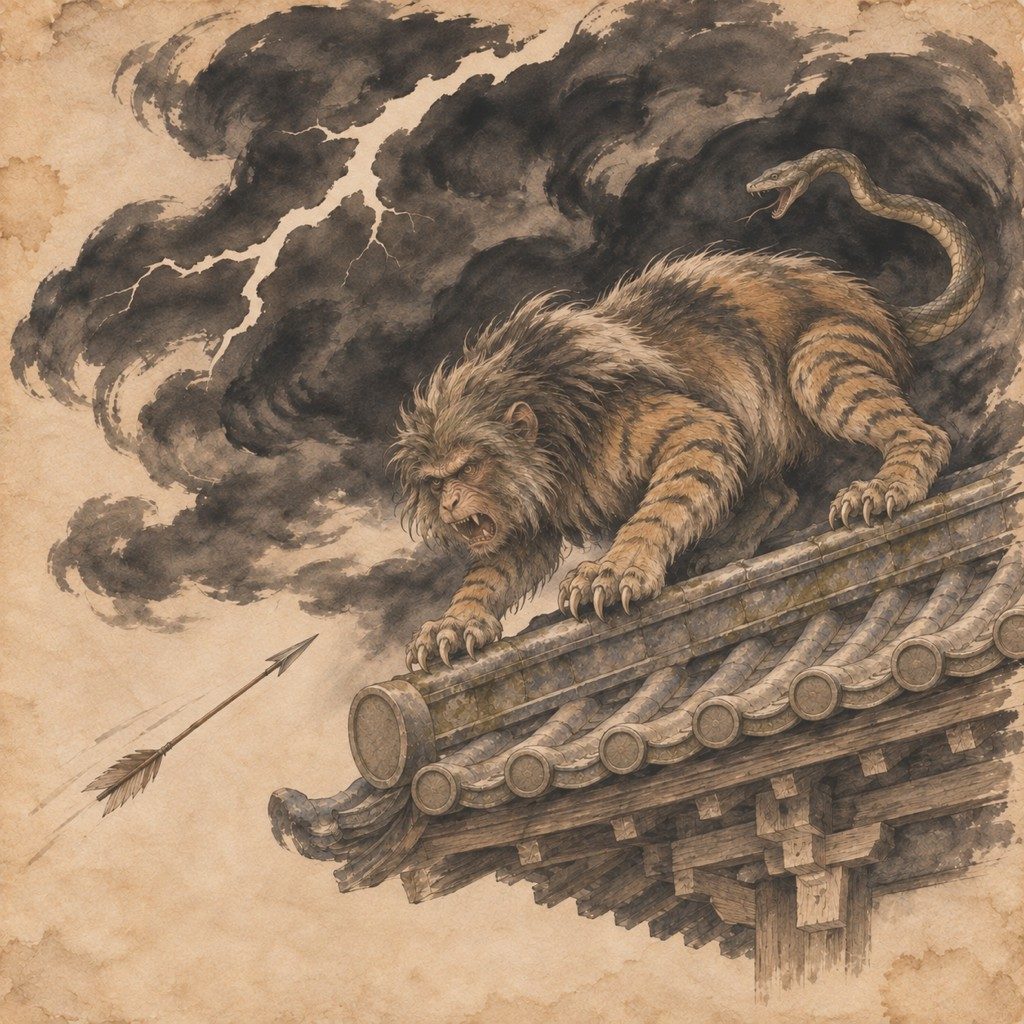
Yōkai, wicked. Seasoned.
The story. Long ago, the Emperor fell sick, and every night at the Hour of the Ox, a black cloud came out of the northeast and settled on the palace roof, and from inside it came a terrible cry. The court physicians and priests could do nothing. A famous archer was called to stand guard. In a flash of lightning, he saw two eyes glaring from the cloud above the Emperor's sleeping room, aimed a little to one side of them, and shot. Down fell a beast with the head of a monkey, the body of a raccoon-dog, the legs of a tiger, and a snake for a tail. The Emperor recovered at once.
The truth. The nue is a creature of the demon gate, born where the northeast's bad influence gathers. It brings sickness to the great by roosting over their sleep. With the Lord of the Demon Gate stirring (Chapter 7), the nue has come back, and the black cloud has been seen over Seikyō's palace and over the Shogun's fortress at Hagane.
Signs. A black cloud that moves against the wind at night. A cry like a thrush, but heavier and sadder. A great lord who sickens without cause. Tiger-clawed scratches on roof tiles.
Banes and courtesies.
- Bane (a twanged bowstring). The court's custom of twanging bowstrings at night to drive off evil is aimed at the nue first of all.
- The archer's aim. The cloud hides it. Attacks against the nue in its cloud suffer –4 (Dark illumination, SWADE p. 102) unless the attacker sees its eyes by lightning or torchlight. An archer who aims a little to one side of the eyes ignores the penalty.
★ The Night Beast#
Attributes: Agility d10, Smarts d6, Spirit d8, Strength d10, Vigor d8
Skills: Athletics d10, Fighting d8, Intimidation d8, Notice d8, Stealth d10
Pace: 8; Parry: 6; Toughness: 7
Edges: Frenzy
Special Abilities:
- Bane (a twanged bowstring).
- Bite and claws: Str+d6.
- Black cloud: It flies in a cloud that fills a Large Blast Template and gives Dark illumination inside (above).
- Fear: Its cry.
- Flight: Pace 10, in its cloud.
- Night sickness: Every night it roosts over a sleeper's roof, the sleeper makes a Vigor roll at –2 or gains a level of Fatigue that can't be recovered while the nue lives. It can lead to Incapacitation and death.
- Size 1.
- Snake tail: Str+d4, Mild Poison (SWADE p. 177). It can bite with its tail and its jaws in the same turn, at no penalty.
Tale seed. The Shikken's young heir is sick and growing weaker, and the castle physicians are blaming poison. The castle's oldest guard says he heard a thrush calling on the keep's roof at the Hour of the Ox, in winter.
Dream-Eater (Baku, 獏)#
Yōkai. Seasoned.
The story. The baku has the face of a lion, the body of a horse, the tail of an ox, and the feet of a tiger. It eats bad dreams. Someone who wakes from a nightmare cries, "Eat it, Baku! Eat my bad dream!", and the baku eats it and turns it into good fortune. People write its name on their pillows and hang its picture by their beds.
The truth. Baku are rare, shy, and kind. They feed on nightmares, and they gather where nightmares are worst: battlefields, haunted houses, and the bedsides of people cursed with Bad Dreams. Most people never see one. They only wake feeling better.
Signs. A nightmare that stops halfway through. A sleeper who wakes smiling after a terrible night. Tiger prints in the dust under a sleeper's window, and no other trace.
Courtesy: the call. A baku comes to anyone who calls it by name on waking from a true nightmare, with its name written on their pillow. It eats the dream.
Dream-Eater#
Attributes: Agility d8, Smarts d8, Spirit d10, Strength d8, Vigor d8
Skills: Athletics d8, Fighting d6, Notice d10, Occult d8, Stealth d12
Pace: 8; Parry: 5; Toughness: 7
Edges: —
Special Abilities:
- Dream walk: A baku can enter the dreams of anyone asleep within a stone's throw.
- Eat the dream: It ends any Bad Dreams (nightmares) on a sleeper, and the sleeper gets a Benny when they wake. Once per night, it can also eat the hold of a ghost or living ghost that troubles a sleeper's dreams, making that spirit Shaken and unable to enter dreams again for a week.
- Kick: Str+d6.
- Size 1.
- Spirit.
Tale seed. Every soldier in a castle under siege has had the same nightmare for a week, and the castle's priest says the baku that should be eating it has been caught in a cage by someone outside the walls.
Notes#
- The great centipede, the dragon of the bridge, and the arrow wet with spit follow "Hidesato and the Centipede" in F. Hadland Davis, Myths and Legends of Japan (1912). Centipedes as Bishamon's creature follow Helen C. Gunsaulus, Japanese Sword-Mounts (1923).
- The diver who killed a sea serpent in its undersea cave follows "Tokoyo and the Sea Serpent" in Davis, Myths and Legends of Japan.
- The eight-headed serpent made drunk on sake follows W. G. Aston, trans., Nihongi (1896), and W. G. Aston, Shinto: The Way of the Gods (1905).
- The white hare and the sea-crocodiles, and the wani as the sea king's servants, follow Davis, Myths and Legends of Japan, and Aston, Nihongi.
- The nue on the palace roof, shot by an archer in a flash of lightning, follows "Yorimasa, the Brave Archer" in William Elliot Griffis, Japanese Fairy World (1880). Twanging bowstrings against evil follows Aston, Shinto.
- The baku, its shape, and the cry "Devour, O Baku!" follow Davis, Myths and Legends of Japan.
- Statistics. Animals use the core and Companion profiles listed. The great centipede is the FC Giant Centipede (p. 206), changed, and the great serpent is the FC Giant Snake (p. 208), changed. The monkey, the sea-crocodile, the nue, and the baku are new.
Part 7: Human Foes and Allies#
In a land at war, the most dangerous thing on the road is a hungry man with a spear. This part gives the ordinary people heroes fight beside and against: soldiers, bandits, constables, monks, spies, and the rest. Every one is an Extra unless marked ★ , and every one is built on one of the ten templates in Chapter 9, so a GM can turn any of them into a named character by adding a Wild Card and a secret.
Each entry gives the template, the changes, and the finished Parry and Toughness. Gear comes from Chapter 3. Anyone here can be a man or a woman, and the notes say where women are common: the gunners and spears of the sect leagues, the dice-dealers, the thief-takers, the shrine maidens, and the shinobi agents who travel as performers.
Any of these can also be an ally. A hero who hires, saves, or befriends one can take them on as an ally (Chapter 10, Allies and Retainers), played and advanced by the player.
War#
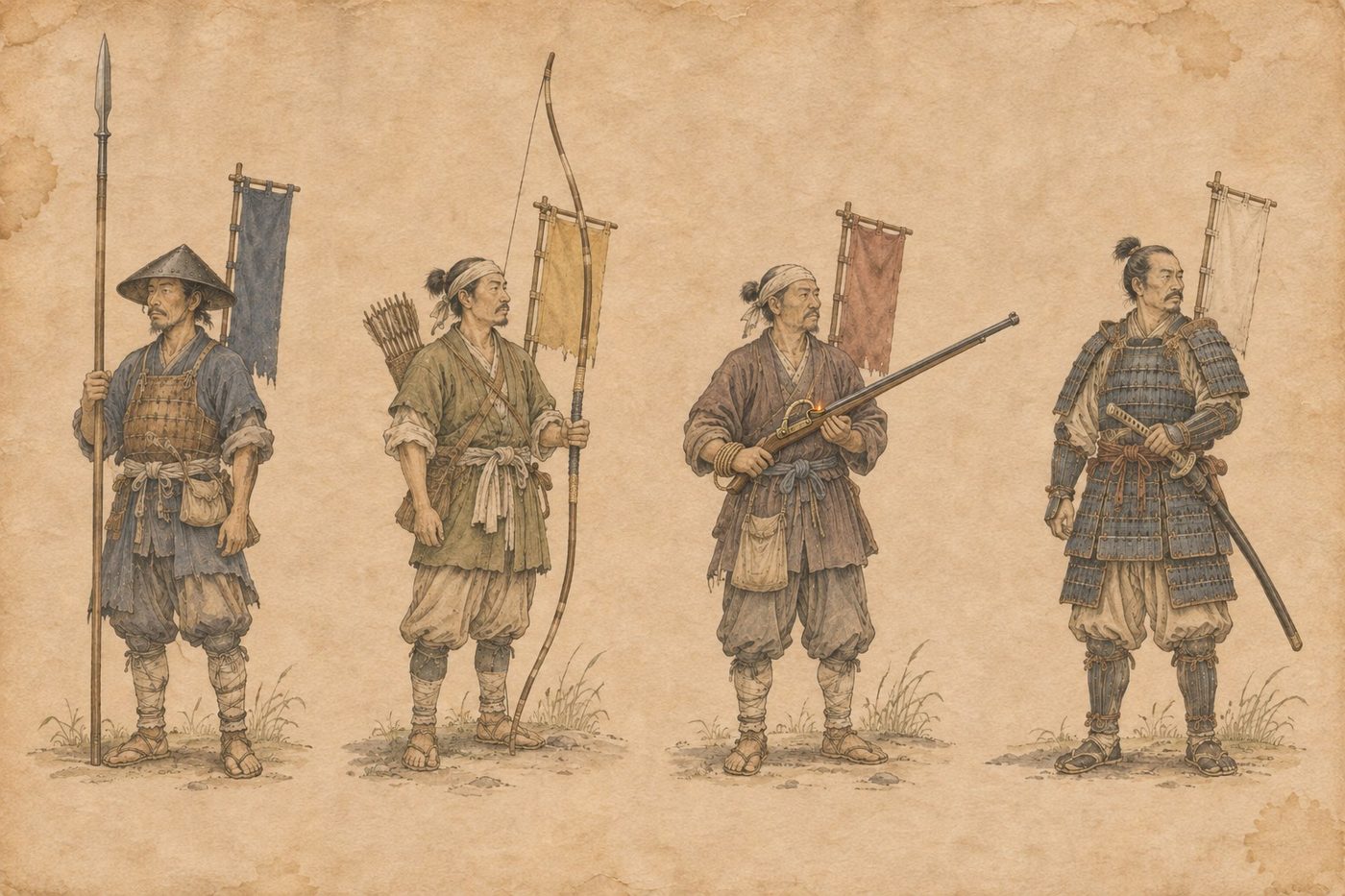
Foot Soldier: Spearman (Yari ashigaru, 槍足軽)#
Novice. Ronin template. The foot soldiers who win the wars: village boys and landless men, raised by the thousand, fighting in ranks behind a wall of long spears.
- Changes: Smarts d4, Spirit d6, Strength d8, Vigor d6; Fighting d6, Shooting d4; no Hindrances or Edges.
- Gear: Long spear (Str+d8, Reach 2), common blade (Str+d6), partial light foot soldier's armor (+2), iron headband (+2, head).
- Parry: 5; Toughness: 7 (2).
- Spear wall: Three or more spearmen standing together subtract 2 from the Fighting rolls of mounted foes attacking any of them.
Foot Soldier: Gunner (Teppō ashigaru, 鉄砲足軽)#
Novice. Ronin template. The new soldiers of the matchlock, drilled to fire in volleys. Among the sect leagues, gunners are often women.
- Changes: As the spearman, with Strength d6, Fighting d4, and Shooting d8.
- Gear: Matchlock (10/20/40, 2d8, AP 2), common blade (Str+d6), partial light foot soldier's armor (+2), iron headband (+2, head), powder flask and slow match.
- Parry: 4; Toughness: 7 (2).
- Volley: Five or more gunners who are Extras, on Hold under a leader, fire a volley by Chapter 4's Volley fire rule (Combat): one Shooting roll, a Medium Blast Template.
Foot Soldier: Archer (Yumi ashigaru, 弓足軽)#
Novice. Ronin template. Bowmen of the foot, cheaper than gunners and still more common.
- Changes: As the spearman, with Strength d6 and Shooting d8.
- Gear: Half bow (12/24/48, 2d6), common blade (Str+d6), partial light foot soldier's armor (+2), iron headband (+2, head).
- Parry: 5; Toughness: 7 (2).
Samurai Retainer (Kerai, 家来)#
Seasoned. Captain template. A lord's sworn man, born to the sword, who fights for his lord's name and his own.
- Changes: Spirit d6, Vigor d6; Battle d4, Intimidation d6; no Command Edge.
- Gear: Long sword (Str+d6, +1 two-handed), short sword (Str+d6), great bow (15/30/60, 2d6, AP 1), light armor (+2).
- Parry: 6; Toughness: 7 (2).
- Honor: A retainer won't run while his lord watches, and he doesn't attack a foe who is down unless ordered to.
Mounted Warrior (Kiba Musha, 騎馬武者)#
Seasoned. Captain template. The armored rider of the old wars, bow first and sword after, now often a lord's son.
- Changes: Riding d8, Shooting d8.
- Gear: Slung sword (Str+d8), short sword (Str+d6), great bow (15/30/60, 2d6, AP 1), heavy armor (+3), war horse (SWADE p. 185).
- Parry: 6; Toughness: 9 (3).
★ Banner Captain (Hatagashira, 旗頭)#
Veteran. Captain template. The officer who holds a company together, and the first target of any enemy archer.
- Changes: Wild Card. Add the Hold the Line! Edge.
- Gear: As the template, with a banner on a pole across the back.
- Parry: 6; Toughness: 9 (3).
The core Soldier (SWADE p. 188) can stand in for any foot soldier in a hurry.
The Road#
Bandit (Sanzoku, 山賊)#
Novice. Use the Bandit (FC p. 175), unchanged, with island gear: a spear (Str+d6, Reach 1) or common blade (Str+d6), a half bow (12/24/48, 2d6), and straw rain capes.
★ Bandit Chief (Sanzoku-no-kashira, 山賊の頭)#
Seasoned. Ronin template. A ronin who's given up on finding a lord, or a village headman who's given up on the lord he had.
- Changes: Wild Card. Intimidation d8, Fighting d10; add the Command Edge.
- Parry: 7; Toughness: 8 (2).
Deserter (Dassōhei, 脱走兵)#
Novice. Ronin template. Foot soldiers who ran from a lost battle and can't go home. They're desperate, and some of them are ashamed.
- Changes: Spirit d4, Vigor d6; Fighting d6, Survival d6; Hindrances Poverty (Minor) and Otazunemono (Minor, Chapter 3); no Edges (Spirit d4 is too low for Brave).
- Gear: Spear (Str+d6, Reach 1), common blade (Str+d6), partial light foot soldier's armor (+2), with the old lord's crest torn off.
- Parry: 5; Toughness: 7 (2).
Sea Raider (Kaizoku, 海賊)#
Novice. Ronin template. The crews of the island sea lords and the free raiders of the outer coasts, who take toll from ships or take the ships.
- Changes: Athletics d8, Boating d6, Fighting d6, Shooting d6; no Hindrances or Edges.
- Gear: Common blade (Str+d6), 2 javelins (3/6/12, Str+d6), a fire pot (3/6/12, 2d6) for every third raider, grappling hooks.
- Parry: 5; Toughness: 6.
★ Raider Captain (Kaizoku-no-kashira, 海賊の頭)#
Veteran. Ronin template. A sea lord's younger son, a Cheongun veteran, or a woman of a sea-lord house who knows the tides better than anyone alive.
- Changes: Wild Card. Smarts d8, Boating d10, Fighting d10, Intimidation d8, Battle d6; add the Command and Level Headed Edges.
- Gear: Long sword (Str+d6, +1 two-handed), short sword (Str+d6), partial light samurai armor (+2), a foreign pistol (5/10/20, 2d6, AP 1).
- Parry: 7; Toughness: 8 (2).
Law and the Underworld#
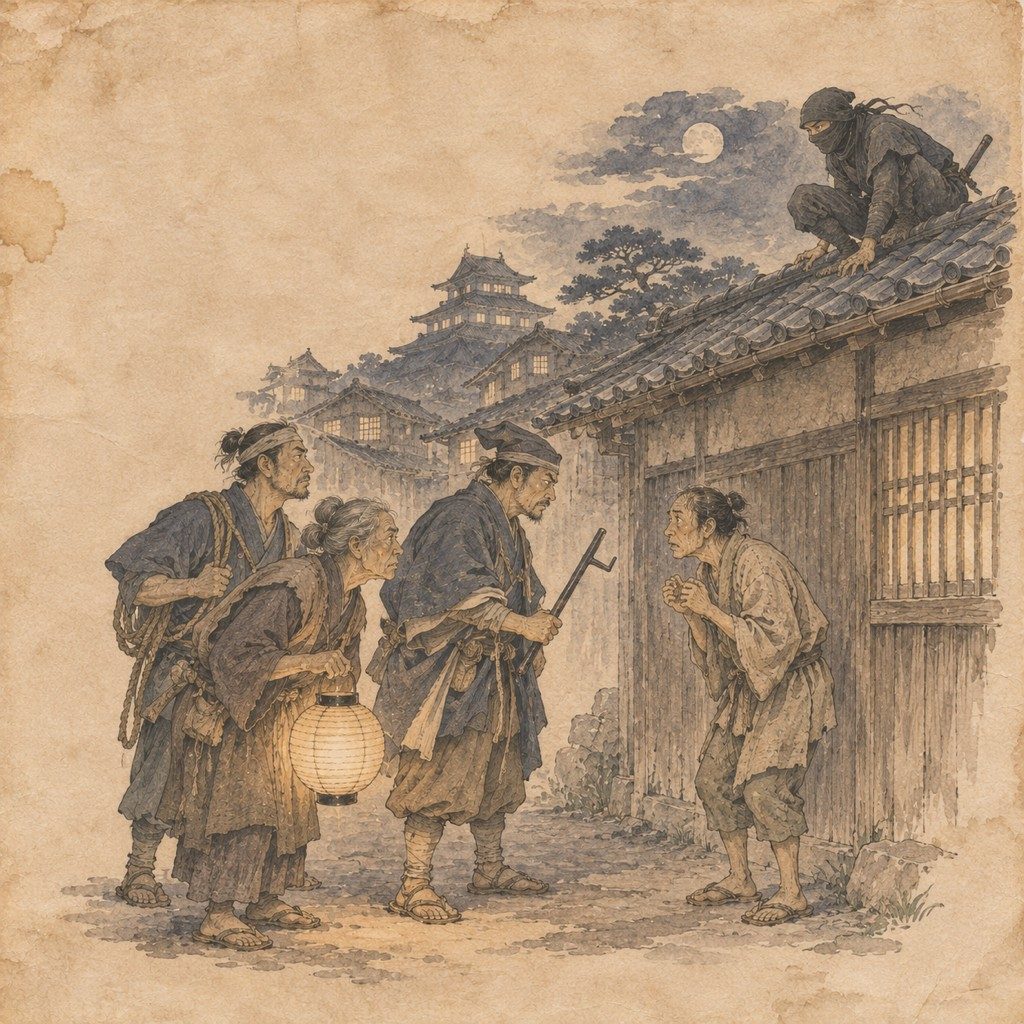
Constable (Dōshin, 同心)#
Novice. Magistrate template. The lowest-ranking samurai of the law, who walk the streets with an iron truncheon and a long sword (Chapter 9).
- Changes: Smarts d6, Spirit d6; Fighting d8, Intimidation d6, Research d4; no Command or Investigator Edge.
- Gear: Truncheon (jitte, Str+d4), long sword (Str+d6, +1 two-handed), short sword (Str+d6), hidden mail (+2, torso and arms) on a raid.
- Parry: 6; Toughness: 5, or 7 (2) in mail.
- Take them alive: Constables fight to subdue (Nonlethal Damage, SWADE p. 104) unless the magistrate says otherwise. Three constables with a catch pole (sasumata), a sleeve-tangler (sodegarami), and a truncheon add +2 to a grapple against one foe.
Thief-Taker (Okappiki, 岡っ引)#
Novice. Spy template. The commoners who do the law's real work: informers, reformed thieves, and widows who know every alley. They carry a truncheon by the magistrate's leave.
- Changes: Fighting d6, Notice d8, Persuasion d6; Edges Thief-Taker (Chapter 3), not Shinobi or Thief. Hindrances Obligation (Minor: the magistrate).
- Gear: Truncheon (jitte, Str+d4), a hooked cord, the magistrate's token.
- Parry: 5; Toughness: 5.
Enforcer (Kobun, 子分)#
Novice. Boss template. The muscle of an underworld family, sworn by the cup oath.
- Changes: Smarts d4, Spirit d6; Fighting d6, Gambling d4, Intimidation d6; no Command or Streetwise Edge.
- Gear: Common blade (Str+d6), dagger (Str+d4), a tattoo the family knows.
- Parry: 5; Toughness: 6.
Street Champion (Otokodate, 男伊達)#
Seasoned. Boss template. A protector of the townsmen's wards, half hero and half bully, beloved by the poor and hated by the samurai (Chapter 9).
- Changes: Fighting d8, Persuasion d8; Edges Street Champion (Chapter 3) and Brave, not Command.
- Gear: Cudgel (Str+d4) or common blade (Str+d6), a fireman's hook, a bold festival robe.
- Parry: 6; Toughness: 6.
Gambler (Bakuto, 博徒)#
Novice. Boss template. The dice-dealers and card sharps of the dice houses. The best dice-dealers are often women, who kneel by the cup with one shoulder bare to show they hide nothing up their sleeve.
- Changes: Fighting d4, Gambling d10; Edge Gambler (Chapter 3), not Command.
- Gear: Guardless knife (Str+d4, or thrown 3/6/12), dice cup.
- Parry: 4; Toughness: 6.
Faith#
Warrior Monk (Sōhei, 僧兵)#
Seasoned. Ronin template. The armed monks of the great temples, in hoods and armor over their robes, who march with the sacred palanquin when the temple has a grievance.
- Changes: Spirit d8; Faith d4 (no powers), Fighting d8; Hindrances Vow (Major: the precepts) and Loyal (Minor: the temple), not Masterless or Poverty.
- Gear: Glaive (Str+d8, Reach 1), short sword (Str+d6), partial heavy armor (+3), a white hood.
- Parry: 6; Toughness: 9 (3).
League Spear (Ikki-shū, 一揆衆)#
Novice. Ronin template. The farmers, gentry, and monks of a sect league, who fight for their temple and for the Buddha's mercy (Chapter 9). Women stand in the league's lines beside the men.
- Changes: Smarts d4, Spirit d8, Vigor d6; Fighting d6, Faith d4 (no powers); Hindrances Loyal (Minor: the league), not Masterless.
- Gear: Spear or bamboo spear (Str+d6, Reach 1), sickle (Str+d4), padded winter clothes (+1).
- Parry: 5; Toughness: 6 (1).
- Calling the Name: While the league's banner stands and they chant the Buddha's name together, League spears are Fearless.
Mountain Ascetic (Yamabushi, 山伏)#
Seasoned. Genja template, Yamabushi path. Guides of the mountain pilgrimages, healers, and wonder-workers, in checked robes with a conch at the hip (Chapter 6).
- Changes: Agility d8; Athletics d8, Survival d8. 10 Power Points.
- Gear: Ringed staff (Str+d4, Parry +1, Reach 1), conch trumpet.
- Parry: 6; Toughness: 5.
Shrine Maiden (Miko, 巫女)#
Novice. Abbot or Priest template. The young women who dance the sacred dances, sell amulets, and serve the kami at every shrine. Most have no power. One in a hundred hears the kami, and becomes a kannagi (use the Genja template).
- Changes: Academics d4, Performance d8, Persuasion d6, Occult d6; Hindrances Vow (Minor: the shrine's purity).
- Gear: White robe and red trousers, a cluster of bells (a spirit-bane, Chapter 6), a purification wand.
- Parry: 4; Toughness: 5.
The Hidden#
Shinobi Agent (Genin, 下忍)#
Seasoned. Spy template. The league's agents, who travel as peddlers, monks, actors, and servants. Women agents usually travel as performers or shrine maidens, and they use this same block.
- Changes: None. The Spy template is the agent.
- Parry: 5; Toughness: 5.
★ Shinobi Master (Chūnin, 中忍)#
Veteran. Spy template. The middle master who plans the missions and leads the agents in the field.
- Changes: Wild Card. Agility d10, Smarts d10; Fighting d8, Stealth d10, Battle d6; add the Command and Extraction Edges.
- Gear: As the template, with hidden mail (+2, torso and arms), a blowgun (3/6/12, d4–2, with poison), and fire pots.
- Parry: 6; Toughness: 7 (2).
Curse-Worker (Noroishi, 呪い師)#
Seasoned. Genja template, Curse-Worker path (Chapter 7). A jealous lover, a ruined rival, or someone who sells curses to them.
- Changes: Spellcasting d8 in place of Faith. Powers: Hour of the Ox (curse), Bad Dreams (nightmares), and Doom (lower Trait). 15 Power Points.
- Gear: Straw effigies, iron nails, a white robe, and an iron crown of candles.
- Parry: 5; Toughness: 5.
Fox-Keeper (Kitsune-mochi, 狐持ち)#
Seasoned. Genja template, Dog-Spirit Owner path (Chapter 7), with a fox in place of the dog. Families accused of keeping foxes (kitsune-mochi) are shunned in some villages, and as with the dog-spirit owners, the accusation is far more common than the thing (Chapter 7). A real fox-keeper has bargained with a fox, and it serves them for a price.
- Changes: Spellcasting d6 in place of Faith. Powers: Bad Dreams (nightmares) and Hour of the Ox (curse). 10 Power Points.
- The fox: A young fox (Part 2) serves the keeper. It can possess a victim (fox possession, Part 2) at the keeper's word.
- Parry: 5; Toughness: 5.
Necromancer (Shiryō-tsukai, 死霊使い)#
Seasoned. Genja template, Necromancer of the Hungry Dead path (Chapter 7). A fallen monk or a grave-robber who learned too much.
- Changes: Faith d8 (a fallen gakushō) or Spellcasting d8. Powers: Spirit Sight and Veil (detect/conceal arcana), Unbinding (dispel), Walking Corpse (zombie), and Raise the Restless (summon undead). 15 Power Points.
- Gear: A begging bowl of grave rice, a book of the dead with the names inked out.
- Parry: 5; Toughness: 5.
Ordinary Folk#
Villager (Hyakushō, 百姓)#
Novice. Use the Commoner (FC p. 182), unchanged, with a sickle (Str+d4), a bamboo spear (Str+d6, Reach 1), or a flail.
Pilgrim (Junreisha, 巡礼者)#
Novice. Use the Commoner (FC p. 182), with Faith d4 (no powers) and Survival d6, a pilgrim's staff (Str+d4, Parry +1, Reach 1), a white robe, and a stamp book of the temples visited.
Mine Guard (Kōzan-ban, 鉱山番)#
Novice. Ronin template. The hired guards of the mines and smelters, who watch the roads in iron headbands (Chapter 8).
- Changes: Smarts d4, Spirit d6, Vigor d6; Fighting d6, Notice d8; no Hindrances or Edges.
- Gear: Iron club (tetsubō, Str+d8, AP 1) or spear (Str+d6, Reach 1), iron headband (+2, head), padded winter clothes (+1).
- Parry: 5; Toughness: 6 (1).
Daqian Sailor (Daiken-no-suifu, 大乾の水夫)#
Novice. Use the Sailor (FC p. 235), unchanged, with a broad Daqian saber (use the slung sword, Str+d8) and a quilted coat (+1). Daqian marines on a war junk add a half bow.
Far-Western Musketeer (Ijin-no-teppō-mochi, 異人の鉄砲持ち)#
Seasoned. Ronin template. The soldiers of the great black ships (Chapter 8), strange, bearded, and very well armed. They are few, and they never forget it.
- Changes: Shooting d8; Edge Gunner (Chapter 3), not Brave; Hindrances Outsider (Major).
- Gear: Matchlock (10/20/40, 2d8, AP 2) or foreign pistol (5/10/20, 2d6, AP 1), a long thin sword (use the long sword, Str+d6), a steel breastplate and helmet (+3, torso and head).
- Parry: 6; Toughness: 9 (3).
Bands#
When heroes meet people on the road, they rarely meet one. These bands give a quick mix. Numbers can go up or down with the size of the hero party.
| Band | Who's in it |
|---|---|
| Patrol | 1 samurai retainer (leader), 4–6 spearmen, and 1–2 archers or gunners. A castle patrol adds 1 constable. |
| War party | 1 ★ banner captain, 1d4 mounted warriors, 2d4 samurai retainers, and 4d6 foot soldiers (half spearmen, a quarter archers, a quarter gunners). Anything larger is a Mass Battle (Chapter 5). |
| Merchant train | 1 merchant or clerk (Merchant template), 2–4 porters (villagers), 2 pack horses or mules, and 1–2 hired ronin or enforcers. |
| Pilgrim band | 2d6 pilgrims and 1 mountain ascetic as guide. One time in six, a shinobi agent travels among them. |
| Bandit gang | 1 ★ bandit chief, 2d6 bandits, and 1d4 deserters. |
| Raider crew | 1 ★ raider captain, 3d6 sea raiders, and 1 Daqian sailor as pilot. |
| Temple procession | 1 abbot or priest (Abbot or Priest template), 2d4 monks or shrine maidens, 1d6 warrior monks, and the sacred palanquin. Harming the palanquin costs 4 or more Honor (Chapter 4). |
| Night watch | 1 constable and 2 thief-takers, with a paper lantern bearing the magistrate's mark. |
| Shinobi cell | 1 ★ shinobi master and 1d4+1 shinobi agents, each in a different disguise. |
| Gambling den | 1 boss (Boss template), 1–2 gamblers, 2d4 enforcers, and 2d6 villagers who've lost too much. |
Who Walks Tonight#
When the heroes travel, camp, or walk the streets after dark, the GM may roll on the table for the land they're in, once for each night or each day of travel (Chapter 10's Road Tales can use these too). Add +1 for each step the hakobore stands above Waking (Chapter 7): +1 at Restless, +2 at Torn, +3 at Broken. A result is a meeting, not a fight. Who they meet may be looking for help, trouble, or nothing at all.
The Road#
| d20 | Who walks |
|---|---|
| 1–2 | A pilgrim band, tired and grateful for company. |
| 3–4 | A merchant train, nervous about the road ahead. |
| 5–6 | A patrol checking travel passes, and not too strict about it for the right gift. |
| 7–8 | 1d4 deserters by a cold fire, who beg before they rob. |
| 9–10 | A bandit gang at a narrow place in the road. |
| 11–12 | A raccoon-dog's trick: a teahouse that wasn't there yesterday (Part 2). |
| 13–14 | A young fox in the shape of a lost girl, asking the way (Part 2). |
| 15–16 | A lost-way god: the road loops back on itself, and the same milestone keeps appearing (Part 2). |
| 17–18 | A war party on the march, and it isn't the heroes' lord's. |
| 19–20 | A ghost by a roadside shrine who wants a message carried (Part 4). |
| 21+ | Oni on the road at dusk, with 1d6 little oni at their heels (Part 3). |
The Mountains#
| d20 | Who walks |
|---|---|
| 1–2 | A mountain ascetic, who shares food and directions. |
| 3–4 | A monkey troop after the heroes' rice. |
| 5–6 | Charcoal burners, or a hunter with a brace of pheasants. |
| 7–8 | A black bear or a wild boar on the path. |
| 9–10 | A bandit gang in an old fort above the pass. |
| 11–12 | 1d6 crow tengu, who mock the heroes' swordplay and offer a test (Part 2). |
| 13–14 | A stone guardian at a ruined shrine, half awake (Part 5). |
| 15–16 | The mountain hag, kindly or not (Part 2). |
| 17–18 | A sacred messenger, a white deer or a pair of wolves, watching (Part 5). |
| 19–20 | A great tengu, who has heard of one of the heroes (Part 2). |
| 21+ | An oni out of its mountain fortress, hunting (Part 3). |
The Forest#
| d20 | Who walks |
|---|---|
| 1–2 | Woodcutters, who warn the heroes off a certain grove. |
| 3–4 | A wild boar, or wolves following at a distance. |
| 5–6 | A raccoon-dog playing music on its belly in the dark (Part 2). |
| 7–8 | A willow or camphor spirit, troubled by an axe (Part 2). |
| 9–10 | A hut in a clearing, where a family of wandering heads offer lodging (Part 2). |
| 11–12 | A fox wedding: rain from a clear sky, and a procession of lights (Part 2). |
| 13–14 | Giant spiders in an old shrine (Part 6). |
| 15–16 | A kami of the grove, offended by someone's careless fire (Part 5). |
| 17–18 | The earth spider's webs between the trees (Part 2). |
| 19–20 | In the north, a forest oni at the edge of a village, remembering it (Part 3). |
| 21+ | The Elder of the Forest's silence: every animal turns to look one way (Part 5). |
Rivers and Marshes#
| d20 | Who walks |
|---|---|
| 1–2 | A ferryman, honest or not. |
| 3–4 | Fishermen with a story about something in the deep pool. |
| 5–6 | A kappa who challenges a hero to wrestle, and bows if bowed to (Part 2). |
| 7–8 | A mamushi in the reeds, or a swarm of mosquitoes (Swarm, SWADE p. 189). |
| 9–10 | Smugglers poling a flat boat by night. |
| 11–12 | Hungry ghosts at an old flood grave (Part 4). |
| 13–14 | Demon-fires over the water, leading somewhere (Part 4). |
| 15–16 | A great serpent's wake in a lake (Part 6). |
| 17–18 | The kami of the river, risen with the flood (Part 5). |
| 19–20 | In Mizuchi, the dragon's priestesses, and something vast beneath the water (Part 5). |
| 21+ | The polluted kappa of a battlefield marsh, dragging travelers under (Part 2). |
Sea and Coast#
| d20 | Who walks |
|---|---|
| 1–2 | Fishing boats coming home, with fish to sell. |
| 3–4 | A Daqian trading junk, or a coastal ship with rice for the capital. |
| 5–6 | Sharks following the boat, or a whale mistaken for a dragon. |
| 7–8 | Pearl divers on a rocky shore, and something they won't talk about. |
| 9–10 | A raider crew in two fast boats. |
| 11–12 | A far-western black ship, with 1d6 musketeers ashore for water. |
| 13–14 | Ship ghosts asking for a ladle (Part 4). |
| 15–16 | Kamaeda crabs swarming up the beach (Part 4). |
| 17–18 | A sea-crocodile under the boat (Part 6). |
| 19–20 | Off Shiranui, the ghost-lights of the drowned court (Part 4). |
| 21+ | The messenger of the Dragon Palace walking out of the surf (Part 5). |
A Town at Night#
| d20 | Who walks |
|---|---|
| 1–2 | The night watch, asking the heroes their business. |
| 3–4 | A drunk samurai looking for an insult. |
| 5–6 | Enforcers collecting a debt, loudly. |
| 7–8 | A street champion and his friends, deciding whether the heroes are trouble. |
| 9–10 | A thief on the rooftops, and a thief-taker after them. |
| 11–12 | A shinobi agent in disguise, following someone (perhaps a hero). |
| 13–14 | A paper umbrella or lantern that has come alive (a tool spirit, Part 2). |
| 15–16 | The Faceless: a woman by the moat with no face (Part 2). |
| 17–18 | The cat that walks, in a great house (Part 2). |
| 19–20 | A ghost, a vengeful ghost, or a living ghost about its business (Part 4). |
| 21+ | In Seikyō, the One-Armed asking the way to a temple (Part 3); anywhere else, a jealous demon (Part 3). |
Battlefields and Graveyards#
| d20 | Who walks |
|---|---|
| 1–2 | Widows searching for their husbands' bodies. |
| 3–4 | Looters stripping the dead (villagers, or deserters). |
| 5–6 | A monk performing rites for the unburied, alone. |
| 7–8 | Crows and wild dogs, and something bigger driving them off. |
| 9–10 | Hungry ghosts in a crowd (Part 4). |
| 11–12 | A corpse-eater in a priest's shape (Part 4). |
| 13–14 | Ghost warriors rising in the fog (Part 4). |
| 15–16 | A necromancer feeding the dead (Part 7). |
| 17–18 | The ghost of an old warrior, who issues a challenge (Part 4). |
| 19–20 | A demon of sickness walking out of the mass graves (Part 3). |
| 21+ | The hags of Yomi, climbing up through a crack in the earth (Part 3). |
Notes#
- The foot soldiers, their long spears, and their matchlock volleys follow James Murdoch, A History of Japan, vol. 2 (1903), and Captain F. Brinkley, A History of the Japanese People (1915).
- The sect leagues, the warrior monks, and their sacred palanquins follow Murdoch, A History of Japan.
- Constables, thief-takers, and their truncheons, catch poles, and sleeve-tanglers follow Brinkley, A History of the Japanese People, and the sources in Chapter 9.
- The street champions and the dice houses follow A. B. Mitford, Tales of Old Japan (1871), and Brinkley (1915), as in Chapter 9.
- The fox-owning families (kitsune-mochi), and the harm the accusation did, follow Lafcadio Hearn, "Kitsune," in Glimpses of Unfamiliar Japan (1894).
- The pirates of the island sea lords follow Murdoch, A History of Japan.
- Statistics. The Bandit (FC p. 175), Commoner (FC p. 182), Sailor (FC p. 235), and Soldier (SWADE p. 188) are used unchanged. Every other block here is built on the Chapter 9 templates.