Chapter 3
Characters
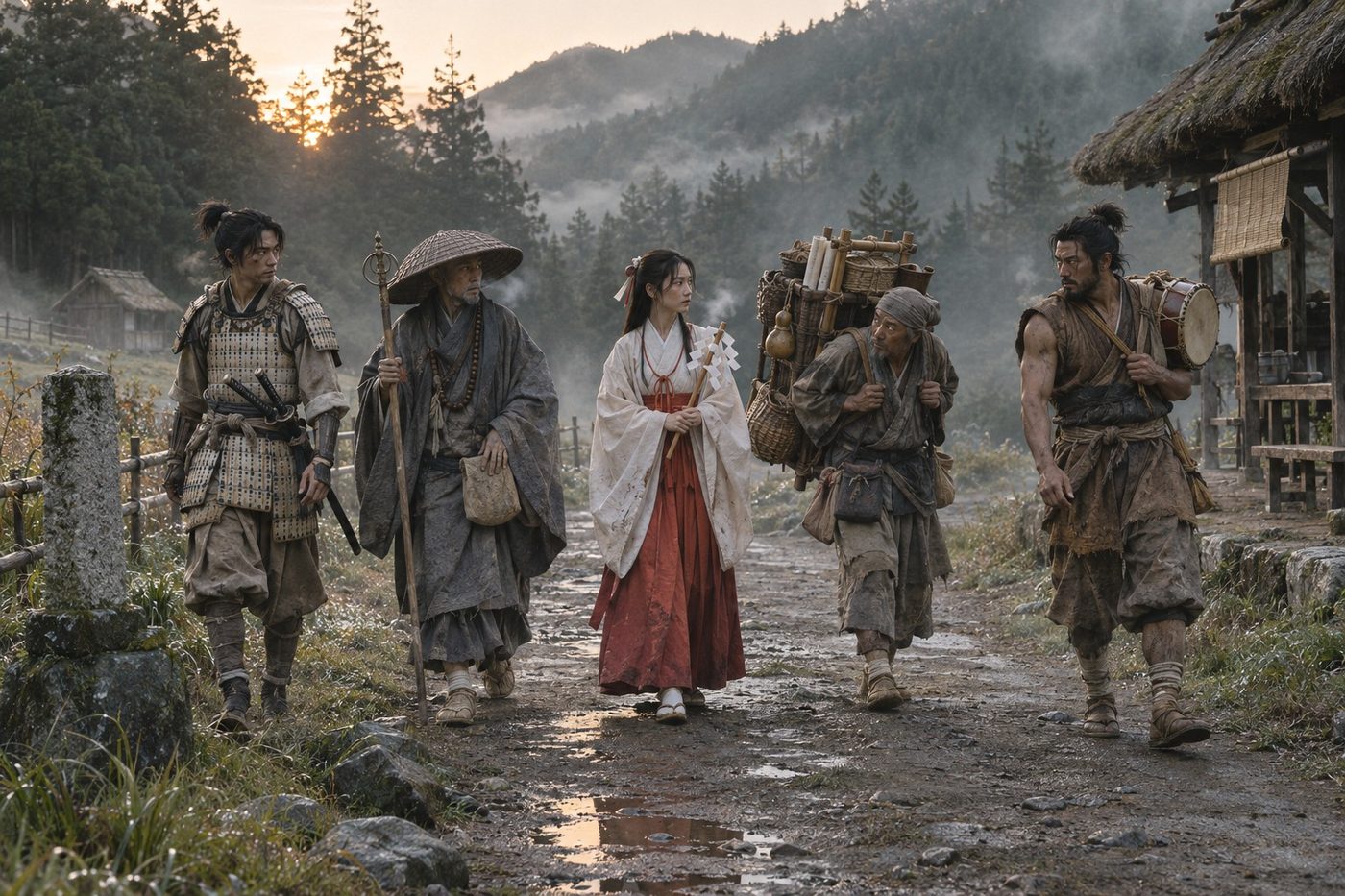
Part 1: Making Heroes#
Who Are You in the Sword Isles?#
Every hero in Tsurugishima begins with three questions that a stranger on the road asks before anything else: Whose are you? What do you owe? What do you want? A samurai answers with a lord's name. A monk answers with a temple. A gambler answers with a boss, or with a laugh. The answers decide where a hero stands, who helps them, and who tries to kill them. This chapter turns those answers into rules.
Making a Hero#
Make heroes as described in the core rules (SWADE pp. 9–11), with the setting changes marked below.
- Concept. Choose what kind of hero you want to play. The Births and Professions map, later in this part, shows which births lead to which professions, and Part 5 gives ready-made archetypes.
- Ancestry. Setting change: everyone is human.
- Birth. New step: choose the family your hero was born into. Birth gives a birthright, a family token, and what the family expects of the hero.
- Profession. New step: choose what your hero does for a living. Not every profession is open to every birth. A profession gives a perk, a starting kit, and a group to belong to.
- Hindrances. Take up to 4 points of Hindrances from Part 3, as usual. No Hindrance comes with birth.
- Attributes. You have 5 points to raise attributes, as usual.
- Skills. You have 12 points for skills from Part 2, as usual. Setting change: the Performance die decides how many arts the hero knows.
- Derived statistics. Work out Pace, Parry, Size, and Toughness as usual.
- Edges. Humans start with one free Edge. Choose from Part 4. A hero may take only one martial school's Style Edge at creation. Setting change: a mystic takes their Arcane Background here, as the free Edge or with Hindrance points, and chooses a Path and starting powers from Chapter 6 (Arcane Backgrounds, below).
- Gear. Every hero starts with 500 mon (SWADE p. 11), plus their family token and their profession's kit. Buy the rest from Part 6. Look up each kit item in Part 6 for its statistics, and check a weapon's Minimum Strength before relying on it.
- Background. Setting change: answer the six questions in Who Your Hero Is, below, which include your hero's name.
- Standing. New step: write down your group, your Status rung in it, and your Honor (Starting Status and Honor, below). Every hero starts Clean (Chapter 4), with no on owed or held unless the GM's ties give one (Chapter 8).
Ancestry#
Every hero in this book is human. Humans start with one free Edge of their choice (SWADE p. 16).
Tsurugishima's legends are full of fox brides, tengu-taught swordsmen, and children born of a mountain kami. In this book, that heritage is a story, not an ancestry. A player who wants a hero with a drop of spirit blood can show it with Edges such as Spirit Sight or Kami's Favor, or with the Haunted Hindrance. Spirit-touched ancestries may come in a later supplement.
Birth and Profession#
Every hero has two answers to "Who are you?" Birth is the family they came from, which no one can change. Profession is what they do now, which the age changes all the time. A general's son can shave his head and become a monk. A farmer's daughter can carry a spear for a lord and come home a captain. Both choices are free, and each gives something different:
- Birth is mostly about standing: who receives the hero, who shelters them, and what their family expects. It gives one family token and no dice bonuses.
- Profession is about work: a perk that helps with the job, the kit the job needs, and the group the hero answers to.
A family's expectation is a story hook, not a Hindrance. Turn it into one, such as Obligation, Vow, or Torn Heart, only if you want the points.
Births#
There are four great divisions of birth, and eight births in all: the court nobles (kuge); the warrior houses (buke), whether great, lesser, or fallen; the commoners (bonge, "ordinary folk"), who are farmers, artisans, or merchants; and the boundary folk (sakaibito). A great-house birth needs the GM's permission, because the heir of a great house can pull a whole campaign toward that house's politics.
| Birth | Who your family is | Birthright | Family token | Your family expects you to |
|---|---|---|---|---|
| Court noble (kuge) | A minor or fallen court family of the Fifth Rank, often living as a provincial lord's guest | The hero holds court rank (see Court Nobles, below). Any lord grants them an audience, and harming them is a crime against the Emperor's court. They speak the court's high speech as a native language. | The patent of the family's rank, and a letter of introduction from the head of the house | Uphold the family's name and precedents, and marry or serve where the house needs it |
| Great house (buke) | One of the realm's great warrior houses: a clan of 200,000 koku or more, or a branch of the Shogun's line. Requires the GM's permission. | The right to wear the long and short swords. The hero is a member of a great house, with the benefits and burdens of the Great House Edge (Part 4). | Formal clothes bearing the house's crest | Bring the house glory, and accept the marriage, hostage-taking, or post the house chooses |
| Lesser house (buke) | A warrior family that has served one great house for generations | The right to wear the long and short swords. The hero's name is in the lord's register, and the family's kin, wherever they serve, take the hero in. | Formal clothes bearing the family's crest and the lord's | Keep the family's place in the lord's service, and never shame it |
| Ronin family (buke) | A warrior family whose lord died, fell, or cast them out | The right to wear the long and short swords. No lord has a claim on the hero, and they know which inns, temples, and dice houses take in masterless warriors without questions. | One relic of the family's lost service: a sword guard, a battle flag, or a lord's letter | Restore the family's name, or avenge the reason it fell |
| Farmer (bonge) | A family of village farmers, fishers, or hunters | Any village of their own province takes the hero in for a night, and their own village speaks for them before the lord's officials. | An amulet from the village shrine | Help pay the tax, and answer for the five households |
| Artisan (bonge) | A family of craftspeople in a village, town, or city | The craft's guild hall in any town takes the hero in, and its members vouch for them. | The craft house's mark, carved on a seal | Keep the craft's secrets, and honor the master of the house |
| Merchant (bonge) | A merchant family in a town or port | The family's seal is good for a loan of up to 500 mon at any house that trades with them. The loan must be repaid by the next New Year. | The family's seal | Serve the house, pay the guild's dues, and marry for the house's profit |
| Sakaibito (boundary folk) | A family of the boundary folk, in a hamlet beside a river or below a castle | Any sakaibito hamlet shelters the hero, and they know the back ways that respectable folk never take. | The hamlet's wooden tally, which every other hamlet honors | Answer to the hamlet's headman, and stand by their own people |
Shrine families and players. Most shrine priesthoods pass from parent to child, and they count as lesser house, farmer, or artisan births, depending on the shrine's standing. Families of traveling players and storytellers are farmers, artisans, or sakaibito, as the player chooses.
Court Nobles#
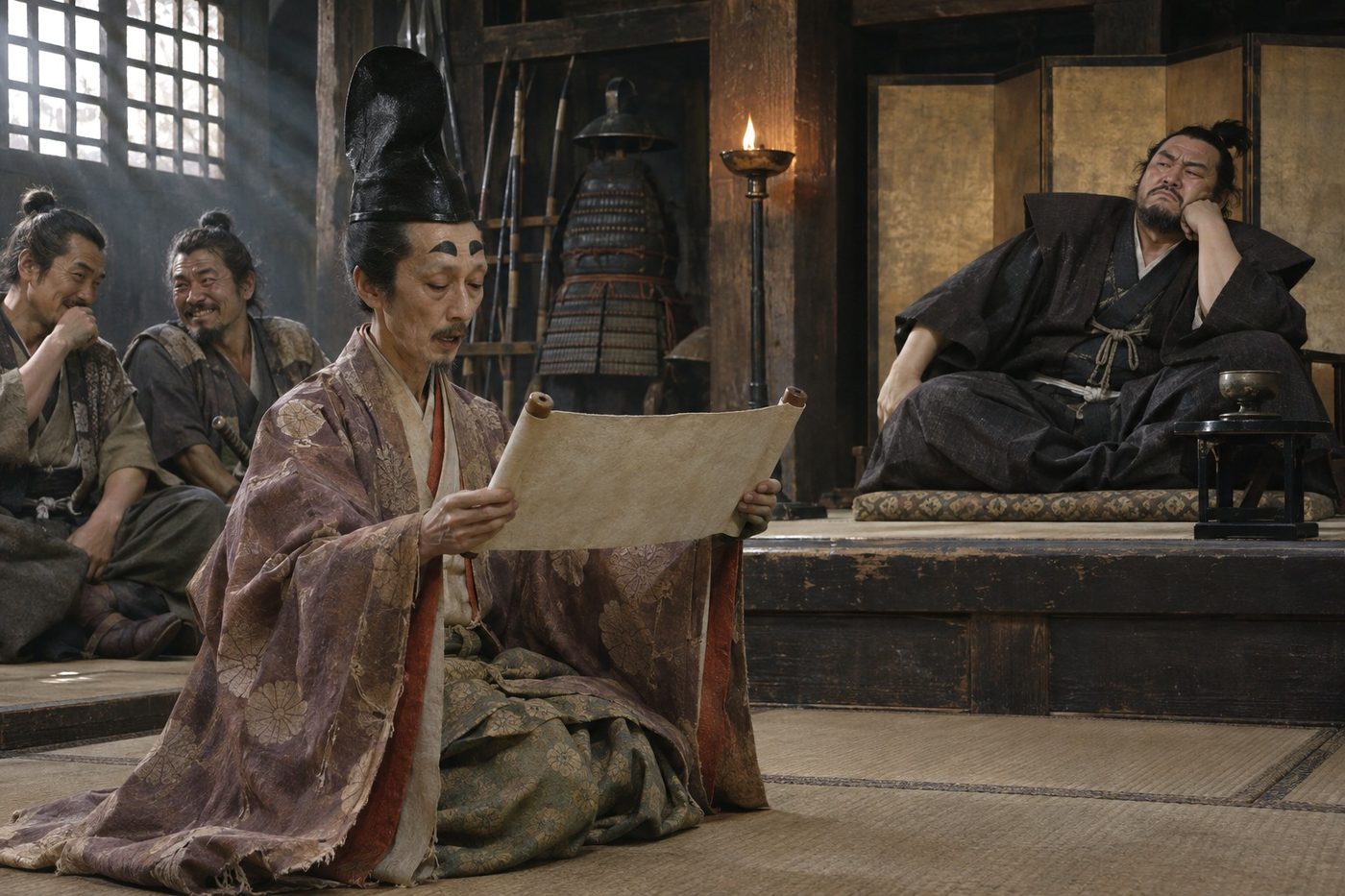
Court nobles climb the ladder of court rank described in Chapter 2 Society, not a clan's. Court noble heroes are poor, proud, and far from the capital. In the warring years, many court families have fled Seikyō to live as the guests of provincial lords, who pay for poetry lessons, letters of introduction, and the glamour of the court. A noble hero has a great deal to offer such a lord, and a great deal to lose. Killing a court noble is a grave matter. The court can't send an army, but it can name a lord a rebel, refuse his titles, and close every door in the capital to his house for a generation. The great court nobles remain the GM's characters.
Professions#
A profession gives:
- A perk: something the hero's work trains into them.
- A kit: what the job needs, on top of the hero's 500 mon.
- A group: the group the hero answers to, from the ladders in Chapter 2 Society. A hero's Status is measured in this group.
Who may take it lists the births a profession is open to. Most professions are open to anyone. Only the warrior professions are gated by birth, and even those gates can be climbed.
Rising above your birth. This is the age when a farmer's son can become a lord. A hero of any birth can take the Samurai or Ronin profession by also taking the Upstart Hindrance (Part 3). Court nobles may take the Samurai or Ronin profession without it, since court families have sent their sons to war before.
Birth and kit. A hero's birth can change what their kit looks like. A great-house child who becomes a monk carries fine robes and a set of the classics in place of a begging bowl, and a farmer who becomes a samurai has plain, borrowed armor. The value stays about the same. A traveler's kit is a back frame, a straw mat and quilt, a bamboo flask, flint and steel, a straw hat, and straw sandals (Part 6).
Kit weapons and Minimum Strength. Kit weapons use Part 6's statistics. Most need Strength d6: the long sword, short sword, common blade, shinobi sword, spear, and half bow. The glaive, the great bow, and the heavy club (an iron club) need d8. The staff, sickle, cudgel, truncheon, and iron fan need only d4. A hero below a weapon's Minimum Strength takes the usual penalty, so a weak hero may swap a kit weapon for another of the same or lower cost, such as a dagger for a gambler's short sword.
Changing profession. When a hero changes profession in play, they lose the old perk and gain the new one, but they keep their goods. Birth never changes, except by adoption, which the Great House Edge covers for those adopted into a great house.
Warriors#
| Profession | Who may take it | Perk | Kit | Group |
|---|---|---|---|---|
| Samurai (retainer) | Buke births and court nobles, or any birth with Upstart | The lord's stipend: in the lord's lands, the hero never pays for food, lodging, or a remount | A long sword, a short sword, a bow or a spear, and light armor | A samurai clan |
| Ronin | Buke births and court nobles, or any birth with Upstart | The hero adds +2 to Common Knowledge rolls about roads, inns, barriers, and who is hiring swords. | A long sword, a short sword, and a traveler's kit | None, or a martial school |
| Gentry (jizamurai) | Buke births or farmer | At home among warriors and farmers alike, the hero never takes a Familiarization penalty for the manners of either. | A spear, light armor, and a pack horse | A village, as the headman's kin, and the lord's muster roll |
| Foot soldier (ashigaru) | Bonge births or sakaibito | The lord feeds and houses the hero while in service, and any lord takes them into the ranks in time of war. | A spear and partial light foot soldier's armor (on loan from the lord), and either a bow or a matchlock if the hero has Shooting | A samurai clan |
| Warrior monk (sōhei) | Any | Anyone who harms the hero brings the temple's anger down on themselves. In robes, the hero passes the realm's barriers without a travel pass. | A glaive, a monk's hood and robes, and light armor worn beneath them | A temple |
Faith#
Buddhist clergy and mountain ascetics who are of buke or court noble birth start one rank higher in their temple: Trusted instead of Member. Temples welcome the sons and daughters of great families, and their families' gifts.
| Profession | Who may take it | Perk | Kit | Group |
|---|---|---|---|---|
| Monk or nun | Any | In robes, the hero passes the realm's barriers without a travel pass, and guards rarely search them. | Robes, prayer beads, a staff, a begging bowl, and a book of sutras | A temple or convent |
| Shrine priest or shrine maiden | Any | Any shrine shelters the hero and feeds them for a day, and other people accept the hero's purification rites as true. | White robes, a purification wand, sacred bells, and a small mirror | A shrine |
| Mountain ascetic (yamabushi) | Any | The hero adds +2 to Survival rolls in the mountains, and the mountain shrines and temples take them in. | A conch-shell trumpet, a ringed staff, an ascetic's robes and cap, and a sword or a short glaive | A temple |
| Yin-yang master (onmyōji) | Any, with Academics d6 or better | Lords and nobles consult the hero before journeys and battles. The hero gets a free reroll on Occult rolls about lucky days, directions, and omens. | A divining board, an almanac, and a writing case | The court or a lord's household |
Sakaibito who take a faith profession serve their hamlet's own shrine or temple, or the wandering orders who refuse no one.
The Court and the Arts#
| Profession | Who may take it | Perk | Kit | Group |
|---|---|---|---|---|
| Courtier (envoy, secretary, or tutor) | Court noble, great house, or lesser house | The hero knows one extra art (Part 2), and lesser lords seat them as an honored guest. | Court robes or formal clothes, a fan, a writing case, and a letter of introduction from their master | The court or a lord's household |
| Artist or player (musician, dancer, storyteller, or painter) | Any | The hero knows one extra art (Part 2), and any inn or teahouse feeds them in return for a performance. | An instrument, a costume, or brushes and ink, as the art needs | A troupe, a teacher's school, or none |
| Physician | Any | The hero adds +2 to Healing rolls to treat illness and poison. | A medicine chest and a set of needles | None, or a temple or lord's household |
Trade and Craft#
| Profession | Who may take it | Perk | Kit | Group |
|---|---|---|---|---|
| Farmer (or fisher or hunter) | Any, though strange for buke and court births (see the map) | The hero adds +2 to Common Knowledge rolls about crops, weather, the land, and village life. | A sickle, a flail, or a fishing net, a straw rain cape, and a sack of rice | A village |
| Artisan (smith, armorer, carpenter, tanner, drum-maker, and the like) | Any, though strange for court nobles (see the map) | The hero adds +2 to Repair rolls in their own craft. | The tools of their craft, and one fine piece of their own work worth up to 300 mon | A craft house or guild |
| Merchant or peddler | Any | The hero knows who owes whom, and gets a free reroll on Common Knowledge rolls about prices, debts, and trade. | 500 mon of trade goods, a pair of scales, and a ledger of small debts owed to them | A merchant house, or an underworld family for peddlers |
The Road and the Underworld#
| Profession | Who may take it | Perk | Kit | Group |
|---|---|---|---|---|
| Gambler | Any | Any dice house of the hero's family, or of one at peace with it, takes the hero in, and they know the signs and greetings of the underworld families. | A dice cup and dice, a short sword, and a traveler's kit | An underworld family |
| Enforcer | Any | The family feeds and lodges the hero in its territory, and the hero adds +2 to Intimidation rolls to collect its debts or keep order there. | A long sword or a heavy club (a buke hero carries both swords), and a traveler's kit | An underworld family |
| Street champion (otokodate) | Any | The common folk of the hero's town hide them from officials and bring them news. | Any one commoner's weapon the hero chooses, such as a club, a staff, a short sword, a sickle, a flail, or an iron-ribbed fan, and fine, bold clothes | A town, or an underworld family |
| Thief-taker | Any | The hero carries a magistrate's iron truncheon, and may make arrests in that magistrate's lands. | An iron truncheon (jitte), a binding rope, and a lantern | A magistrate's service |
| Shinobi | Any | The league hides the hero, feeds them, and gets them out of a province once per adventure, if they can reach one of its safe houses. | The kit of their cover profession, plus a shinobi sword (or a common blade, if the GM leaves the shinobi sword out), a grappling rope, and climbing claws | A shinobi league (secret), and their cover profession's group |
A shinobi takes a cover profession as well, such as monk, artisan, or player, and gets that profession's kit but not its perk.
Professions and Edges of the same name. The Thief-taker and Street champion professions give a hero the standing: the warrant, or the town's trust. The Thief-Taker and Street Champion Edges (Part 4) give the trained skill on top of it. A hero doesn't need the Edge to take the profession, and a hero with both gets the Edge's benefits once, not twice.
Births and Professions Map#
✓ means the profession is open to that birth. U means it is open with the Upstart Hindrance. ★ means the hero starts one rank higher in their group. A great-house birth always needs the GM's permission.
| Profession | Court noble | Great house | Lesser house | Ronin family | Farmer | Artisan | Merchant | Sakaibito |
|---|---|---|---|---|---|---|---|---|
| Samurai | ✓ | ✓ | ✓ | ✓ | U | U | U | U |
| Ronin | ✓ | ✓ | ✓ | ✓ | U | U | U | U |
| Gentry | — | ✓ | ✓ | ✓ | ✓ | — | — | — |
| Foot soldier | — | — | — | — | ✓ | ✓ | ✓ | ✓ |
| Warrior monk | ✓ | ✓ | ✓ | ✓ | ✓ | ✓ | ✓ | ✓ |
| Monk or nun | ★ | ★ | ★ | ★ | ✓ | ✓ | ✓ | ✓ |
| Shrine priest or maiden | ✓ | ✓ | ✓ | ✓ | ✓ | ✓ | ✓ | ✓ |
| Mountain ascetic | ★ | ★ | ★ | ★ | ✓ | ✓ | ✓ | ✓ |
| Yin-yang master | ✓ | ✓ | ✓ | ✓ | ✓ | ✓ | ✓ | ✓ |
| Courtier | ✓ | ✓ | ✓ | — | — | — | — | — |
| Artist or player | ✓ | ✓ | ✓ | ✓ | ✓ | ✓ | ✓ | ✓ |
| Physician | ✓ | ✓ | ✓ | ✓ | ✓ | ✓ | ✓ | ✓ |
| Farmer | — | — | — | ✓ | ✓ | ✓ | ✓ | ✓ |
| Artisan | — | ✓ | ✓ | ✓ | ✓ | ✓ | ✓ | ✓ |
| Merchant or peddler | ✓ | ✓ | ✓ | ✓ | ✓ | ✓ | ✓ | ✓ |
| Gambler | ✓ | ✓ | ✓ | ✓ | ✓ | ✓ | ✓ | ✓ |
| Enforcer | ✓ | ✓ | ✓ | ✓ | ✓ | ✓ | ✓ | ✓ |
| Street champion | ✓ | ✓ | ✓ | ✓ | ✓ | ✓ | ✓ | ✓ |
| Thief-taker | ✓ | ✓ | ✓ | ✓ | ✓ | ✓ | ✓ | ✓ |
| Shinobi | ✓ | ✓ | ✓ | ✓ | ✓ | ✓ | ✓ | ✓ |
A dash doesn't forbid anything outright. It marks a pairing that the world finds strange, such as a great-house heir behind a plow. With the GM's approval, a hero can take it anyway, and should have a good story for how it happened.
Suggested Edges and Hindrances#
| Profession | Suggested Edges | Suggested Hindrances |
|---|---|---|
| Samurai | A school Style, Horse Guard, Command, Lord's Syllable | Code of Honor, Obligation, Loyal |
| Ronin | A school Style, Trademark Weapon | Masterless, Poverty, Shamed |
| Gentry | Command, Sekigawa Style | Obligation, Torn Heart |
| Foot soldier | Soldier, Formation Fighter, Gunner | Obligation, Loyal |
| Warrior monk (sōhei) | Arcane Background (Sōhei), Tamaeda Style, Niō's Wrath | Vow, Partisan |
| Monk or nun | Seated Meditation, Healer, Arcane Background (Gakushō) | Vow, Pacifist |
| Shrine priest or maiden | Arcane Background (Kannagi), Kami's Favor, Sacred Dance | Taboo, Obligation |
| Mountain ascetic | Arcane Background (Yamabushi), Woodsman, Conch of the Mountain | Vow, Taboo |
| Yin-yang master (onmyōji) | Arcane Background (Onmyōji), Scholar | Curious, Taboo |
| Courtier | Court Poet, Artist, Tea Master | Partisan, Hostage, Poverty |
| Artist or player | Artist, Storyteller, Fame | Poverty, Outsider |
| Physician | Healer, Martial Artist (for masseurs) | Blind, Pacifist |
| Farmer | Woodsman, Brawler | Loyal, Poverty |
| Artisan | Swordsmith, Mr. Fix It | Taboo, Stubborn |
| Merchant or peddler | Merchant's Eye, Rich, Streetwise | Greedy, Indebted |
| Gambler | Gambler, Streetwise | Greedy, Indebted |
| Enforcer | Brawler, Menacing, a school Style | Masterless, Loyal, Mean |
| Street champion | Street Champion, Brawler | Heroic, Enemy |
| Thief-taker | Thief-Taker, Investigator | Enemy, Obligation |
| Shinobi | Shinobi, Light Body, Assassin | Secret, Obligation |
Starting Status and Honor#
New heroes start as Members of their profession's group with Honor 0, unless the GM decides otherwise. Buke and court noble clergy start as Trusted (see Faith, above). That choice belongs to the campaign, not to an Edge. A campaign about young pages might start everyone as Newcomers, and a campaign about a lord's council might start everyone as Seniors. A hero whose profession has no group, such as a ronin with no school, has no Status until they join one.
A hero's family is a group too, and the GM may track the hero's place in it when it matters. A great-house child is a Member of their house as well as of the clan they serve, and those may be the same group.
Fallen into the underworld. A hero of buke or court noble birth who becomes a gambler, enforcer, or street champion starts with Honor –2. Their family's name is stained by the work, and old acquaintances let them know it. A shinobi hides their trade and starts at Honor 0, until someone finds out.
Honor runs from –10 (a byword for treachery) to +10 (a name sung in the war tales). Chapter 4 explains how heroes earn and lose Status and Honor, and what they do.
Rich, Filthy Rich, and Connections are open to any hero of any birth or profession. A rich farmer is a figure of jealousy and gossip in their village. A gambler with Connections to a magistrate is a dangerous friend.
Who Your Hero Is#
Answer these six questions, alone or with the GM. They give the GM threads to pull.
- Whose are you? Name your lord, temple, shrine, boss, master, or village, or say why you have none.
- What do you owe? This is your giri: the duty or debt you can't walk away from.
- What does your heart want? This is your ninjō: the love, ambition, or longing that pulls against your duty.
- Which blossom do you favor? The red plum of the Shogun's loyalists, the white plum of Sadatsugu's cause, the temples and leagues of the third power, or none.
- What is your name? Give your hero a name, or build one from the tables in Chapter 2, with family name first. Add a common name, a religious name, or a childhood name if your hero has one.
- Which faith keeps your family? Name your village's kami and your family's temple and its sect (Thunder Peak, Western Light, Still Mind, Lion's Roar, or another). Like most islanders, your hero honors both, and calls on whichever answers the need. If your hero is more devout than that, take the Lay Devotee Edge.
Kami and Buddha. Islanders don't think of themselves as followers of one faith or the other. They clap at the shrine and bow at the temple, often on the same day, and the monks teach that the kami protect the Buddha's Law. Only the clergy, the devout, and the followers of the two exclusive sects, Western Light and Lion's Roar, draw hard lines.
Note for the GM: you may answer some of these for the whole party before play begins. In a samurai campaign, for example, everyone may serve the same lord and wear the same blossom. You can also roll on, or offer a choice from, the tables below.
| d6 | What do you owe? (giri) |
|---|---|
| 1 | Your lord saved your family from ruin, and you have promised your life in return. |
| 2 | Your father's murderer still lives, and your family expects you to avenge him. |
| 3 | A temple raised you after your parents died, and its abbot may call on you at any time. |
| 4 | You swore an oath to a dying friend to protect their child, wherever that child goes. |
| 5 | You owe a boss for a debt, a rescue, or a pardon, and the boss hasn't named the price yet. |
| 6 | Your village chose you to carry its petition to the lord, and they are still waiting for an answer. |
| d6 | What does your heart want? (ninjō) |
|---|---|
| 1 | Someone in an enemy house, whom you love and can't have |
| 2 | To be remembered: a name in the war tales, whatever it costs |
| 3 | To master an art, the sword, or the brush, beyond anyone living |
| 4 | Peace, a farm, and a quiet life, which the age won't allow |
| 5 | To rise higher than your birth, and make your old masters bow |
| 6 | The truth about something the spirits showed you, and no one else saw |
Whose Are You in Kurogane?#
Kurogane, the Starter Province, holds at least one group of every kind, and the GM describes them when the campaign begins there. Three powers hold the province in stalemate: the Amanuma clan of the red plum, who hold the castle and the pass; the Kitamori clan of the white plum, who hold the iron mines of the northern valleys; and the Sekitani League of the third power, which rules the valley farms in the Buddha's name. Every hero born in Kurogane lives in one of their shadows.
Arcane Backgrounds#
Mystics take an Arcane Background from Chapter 6, which describes the Five Paths: the kannagi (shrine priests and shrine maidens), the gakushō (scholar-monks and scholar-nuns), the sōhei (warrior monks), the yamabushi (mountain ascetics), and the onmyōji (yin-yang masters). Anyone who walks a path is a genja. A faith profession doesn't require an Arcane Background, and an Arcane Background doesn't require a faith profession, though they usually go together. A hero may take an Arcane Background after creation by training with a master for two Downtimes and spending an Advance (Chapter 6).
Part 2: Skills#
Skills in Blade and Kami™#
Tsurugishima uses the skill list from the core rules, minus the skills that need machines the isles have never seen. A few skills take on setting-specific uses, and those uses appear below. The game adds no new skills. Instead, Performance becomes the skill of the arts. Pinnacle's World Builder guide warns that each new skill pulls points away from the skills heroes already need. The setting gets its flavor from Edges instead.
Core skills. Every hero starts with Athletics, Common Knowledge, Notice, Persuasion, and Stealth at d4, as usual.
Used as Written#
These skills work exactly as in the core rules:
- Athletics (SWADE p. 29)
- Battle (SWADE p. 29)
- Boating (SWADE p. 29)
- Fighting (SWADE p. 30)
- Gambling (SWADE p. 30)
- Healing (SWADE p. 31)
- Intimidation (SWADE p. 31)
- Notice (SWADE p. 32)
- Persuasion (SWADE p. 33)
- Research (SWADE p. 34)
- Shooting (SWADE p. 35)
- Stealth (SWADE p. 35)
- Survival (SWADE p. 35)
- Taunt (SWADE p. 35)
- Thievery (SWADE p. 35)
Animals. Blade and Kami™ follows the Fantasy Companion: training and commanding animals uses Persuasion or Intimidation, not a separate skill (FC p. 31).
Changed Skills#
Each of these works as written, with the setting notes below.
Academics (SWADE p. 29). Academics covers the Daqian classics, history, law, the Hagane Code, poetry as scholarship, calligraphy, and court precedent. Reading and writing Daqian characters is part of Academics. A hero with Academics d6 or better reads and writes the scholar's script, and anyone without it reads only the island syllabaries.
Common Knowledge (SWADE p. 30). Every hero knows the manners of their own birth and profession. Outside them, the GM may apply a Familiarization penalty (SWADE p. 36) of –2: a farmer at a lord's audience, a samurai at a dice game, or a courtier in a sakaibito hamlet. Knowing which level of speech to use with whom is a Common Knowledge roll, and a Critical Failure gives offense.
Faith (SWADE p. 30). Faith covers the rites of both the shrines and the temples: purification, offerings, funerals, festivals, and sutras. It is the arcane skill for the faith-based Arcane Backgrounds in Chapter 6. Anyone may roll Faith to perform a simple rite correctly, such as purifying hands at a shrine, or knowing which offering a kami expects.
Language (SWADE p. 31). Every hero speaks the island tongue as a native language. Other languages include Daqian, Cheongun, the court's old high speech, and the tongue of the foreign priests at Umikado. The court's high speech is a separate Language for anyone not raised at court: a samurai can follow it, but answers it badly.
Occult (SWADE p. 32). Occult covers yōkai, ghosts, curses, omens, lucky and forbidden directions, the calendar of lucky days, and the lore of yin and yang. It is the knowledge of what lives in the dark, and of how to bargain with it.
Performance (SWADE p. 32). In Tsurugishima, Performance is the skill of the arts, the accomplishments that win a warrior favor in a lord's hall and a courtier advancement at the palace. Shoguns have danced nō on the stage, and upstart warlords have used tea to set the fashion for the old nobility.
A hero knows a number of arts equal to half their Performance die: two at d4, three at d6, four at d8, five at d10, and six at d12. Choose them from the Arts table below. As Performance rises, the hero picks up the new arts at once. Any other art takes a Familiarization penalty of –2 (see Out of Your Depth). The Artist Edge raises the number of arts known to the full value of the die. A hero with no Performance knows no arts and rolls a d4–2 as usual.
Performance still covers playing to an audience (SWADE p. 32), and disguise is acting, so a shinobi posing as a monk rolls Performance with no art needed. Chapter 4's contests of refinement turn the arts into contests for favor, Honor, and Status.
The Arts
| Art | What a contest looks like |
|---|---|
| Tea gathering (chanoyu) | Hosting rivals with grace and perfect form, and choosing the right bowl, scroll, and flower for the season |
| Nō | Performing a role from the masked dance-drama before a lord's guests |
| Court dance (bugaku) | The slow, masked dances of the palace, performed at the court's ceremonies |
| Sacred dance (kagura) | Dancing for the kami at a shrine festival. Also a trapping for shrine maidens' powers in Chapter 6. |
| Festival dance | Leading the village or town dances at festivals and at the Festival of the Dead |
| Lute (biwa) | Accompanying the chanted war tales |
| Flute | The bamboo flute of wandering monks, and the transverse flute of nō and the court |
| Zither (koto) | The long zither of the great houses' halls |
| Drum | The hand drums of nō and the great drums of festivals and war |
| Song and chant | Folk song, court song, and the chanting of the war tales |
| Poetry (waka) | The court's poetry tournaments, where two sides answer each other verse for verse |
| Linked verse (renga) | A chain of verses built by several poets in turn, each link following the last |
| Calligraphy | Brushing a poem or a sign before guests. The beauty of the hand is judged as much as the words. |
| Ink painting | Painting a landscape, a bird, or a bamboo stem in a few strokes |
| Flower arrangement (ikebana) | Arranging flowers and branches so they seem still to be growing |
| Incense comparing (kō-awase) | Naming incenses by scent alone and matching each to its poem |
| Storytelling | Telling ghost tales and war tales to a hushed room |
| Hawking (takagari) | Flying a hawk before a lord's hunting party |
| Heraldry and lineage | Naming the houses behind every crest on a battlefield or at a banquet, and reciting their descent |
| Kick-ball (kemari) | The courtiers' game of keeping a deerskin ball aloft without letting it touch the ground |
Adding arts. With the GM's approval, players may add other arts that can be contested, such as shell-matching or garden design. Go stays a game, played with Smarts, Gambling, or Battle.
Repair (SWADE p. 34). In Tsurugishima, Repair covers making things as well as mending them: smithing, carpentry, armor-lacing, lacquer, paper, and the care of matchlocks. A swordsmith uses Repair, so the game needs no separate craft skill.
Riding (SWADE p. 34). Riding also covers driving an ox-cart or a pack train, since the isles have no other wheeled travel worth a skill.
Out of Your Depth#
Blade and Kami™ doesn't use the optional Skill Specialization rule (SWADE p. 141). Instead, it uses Familiarization (SWADE p. 36) openly: when the story says a hero is out of their depth, the GM applies a –2 penalty, which fades with practice or study. Common cases:
- Academics: a scholar of the Daqian classics asked about court precedent, or the other way around
- Common Knowledge: manners outside the hero's own birth and profession
- Faith: a shrine priest performing a Buddhist rite, or a monk performing a shrine rite
- Fighting and Shooting: a weapon the hero has never trained with, such as a matchlock in an archer's hands, until they've had a few days of practice
- Language: the court's high speech, for anyone not raised at court
- Performance: any art the hero doesn't know
Arcane Skills#
- Faith (SWADE p. 30) is the arcane skill of the kannagi, gakushō, sōhei, and yamabushi (Chapter 6).
- Spellcasting (SWADE p. 35) is the arcane skill of the onmyōji (Chapter 6).
- Focus (SWADE p. 30) isn't used. No Arcane Background in the isles uses it.
Not Used#
These skills don't exist in Blade and Kami™:
| Skill | Why it's gone |
|---|---|
| Driving (SWADE p. 30) | No vehicles beyond carts. Riding covers those. |
| Electronics (SWADE p. 30) | No electricity |
| Hacking (SWADE p. 31) | No computers |
| Piloting (SWADE p. 33) | No aircraft |
| Psionics (SWADE p. 33) | Psychic powers don't fit the setting's magic. |
| Science (SWADE p. 34) | The isles have no science apart from scholarship. Academics and Occult cover natural philosophy. |
| Weird Science (SWADE p. 36) | No gadgeteers |
| Alchemy (FC p. 31, HC p. 7) | No alchemist Arcane Background. Temple medicines are treasures (Chapter 6). The one exception is the Daqian elixir-maker of the Gamemaster's Section (Chapter 9), whose art no hero can learn. |
Part 3: Hindrances#
Flaws Worth Playing#
The best Hindrances in Blade and Kami™ pull a hero between duty and desire. A retainer's oath, a debt that can be called at the worst moment, a kinsman held hostage in an enemy castle, a ghost that won't let go: these give the GM stories to tell and the player Bennies to earn. Choose Hindrances that put your hero in the world, not just in the way.
No Hindrance comes with birth. A hero born among the sakaibito, a woman, a convert to the Black Book, or a farmer's child takes no Hindrance for it unless the player chooses one. The world may treat such heroes unfairly. The rules never do.
Used as Written#
These Hindrances work exactly as in their books.
Savage Worlds core: All Thumbs (p. 22), Anemic (p. 22), Arrogant (p. 22), Bad Eyes (p. 22), Bad Luck (p. 22), Big Mouth (p. 23), Blind (p. 23), Bloodthirsty (p. 23), Can't Swim (p. 23), Cautious (p. 23), Clueless (p. 23), Clumsy (p. 23), Curious (p. 23), Delusional (p. 23), Driven (p. 24), Elderly (p. 24), Enemy (p. 24), Greedy (p. 24), Habit (p. 24), Hard of Hearing (p. 24), Heroic (p. 24), Hesitant (p. 25), Illiterate (p. 25), Impulsive (p. 25), Jealous (p. 25), Loyal (p. 25), Mean (p. 25), Mild Mannered (p. 25), Mute (p. 25), Obese (p. 25), One Arm (p. 26), One Eye (p. 26), Overconfident (p. 26), Pacifist (p. 26), Phobia (p. 26), Poverty (p. 26), Quirk (p. 26), Ruthless (p. 26), Secret (p. 26), Slow (p. 27), Small (p. 27), Stubborn (p. 27), Suspicious (p. 28), Thin Skinned (p. 28), Timid (p. 28), Tongue-Tied (p. 28), Ugly (p. 28), Vengeful (p. 28), and Young (p. 28).
Fantasy Companion: Amorous (p. 28), Arcane Sensitivity (p. 28), Blunderer (p. 28), Cursed (p. 28), Doomed (p. 28), Grim (p. 28), Idealistic (p. 29), Jingoistic (p. 29), and Selfless (p. 29).
Horror Companion: Bleeder (p. 6), Bully (p. 6), Dread (p. 6), Heavy Sleeper (p. 7), Jumpy (p. 7), Night Terrors (p. 7), Screamer (p. 7), Superstitious (p. 7), and Unnatural Appetite (p. 7).
Changed Hindrances#
Each works as written, with the changes below.
Bullet Magnet (HC p. 6). Renamed Arrow Magnet. It applies to bows, thrown weapons, and matchlocks alike.
Code of Honor (SWADE p. 23). For a samurai, this is the way of bow and horse (kyūba no michi), the warrior's code of the age: serve your lord to the death, never flee a fair fight, keep your word, repay every kindness and every insult, and meet death without fear. Monks, shrine priests, underworld bosses, and street champions have codes of their own, and each uses this Hindrance with its own tenets, agreed with the GM.
Death Wish (SWADE p. 23). Common among warriors who want to die beautifully. The hero's goal is often a death worth a song: falling in a famous battle, or paying back a lord's favor with their life.
Doubting Thomas (SWADE p. 24). Renamed Skeptic. Daqian-trained scholars and some Still Mind monks teach that most "spirits" are fear, fever, and fraud. The Skeptic believes them, even when the evidence has teeth.
Obligation (SWADE p. 25). This is giri, the duty owed to a lord, a family, a temple, a school, or an underworld boss. A retainer's Obligation is to their lord's service. A shrine maiden's is to the shrine. A gambler's is to the boss who shared the cup with them.
Outsider (SWADE p. 26). Fits foreigners from Daqian, Cheongun, or beyond; converts to the Black Book; and heroes who live far outside respectable life, such as wandering players. It never comes automatically with birth (see above).
Shamed (SWADE p. 27). The common samurai version is a lost battle, a lord who died while the hero lived, or a vendetta left unfinished.
Wanted (SWADE p. 28). Renamed Otazunemono ("one who is sought"), the old word for a fugitive whose face is posted at every barrier. A Minor otazunemono is sought by one domain's magistrates for a lesser crime; a Major one is sought across the realm, or for a crime that carries death. Chapter 9 describes the magistrates who do the seeking.
Vow (SWADE p. 28). Covers monks' and nuns' vows, ascetic disciplines, pilgrimages, and the registered vendetta (katakiuchi): a Major Vow to kill a kinsman's or lord's murderer, registered with the magistrates.
Arcane Hindrances#
These Hindrances apply only to arcane characters (Chapter 6, Part 2). Armor Interference (FC p. 28), Material Components (FC p. 29, HC p. 7; called Offerings for the faith paths), and Talisman (FC p. 29) are used. Corruption (FC p. 28, HC p. 6) isn't; pollution (Chapter 4) takes its place.
Not Used#
| Hindrance | Why it's gone |
|---|---|
| Victim (HC p. 7) | A slasher-film trope that doesn't fit heroic, mythic play |
New Hindrances#
Haunted (Minor or Major)#
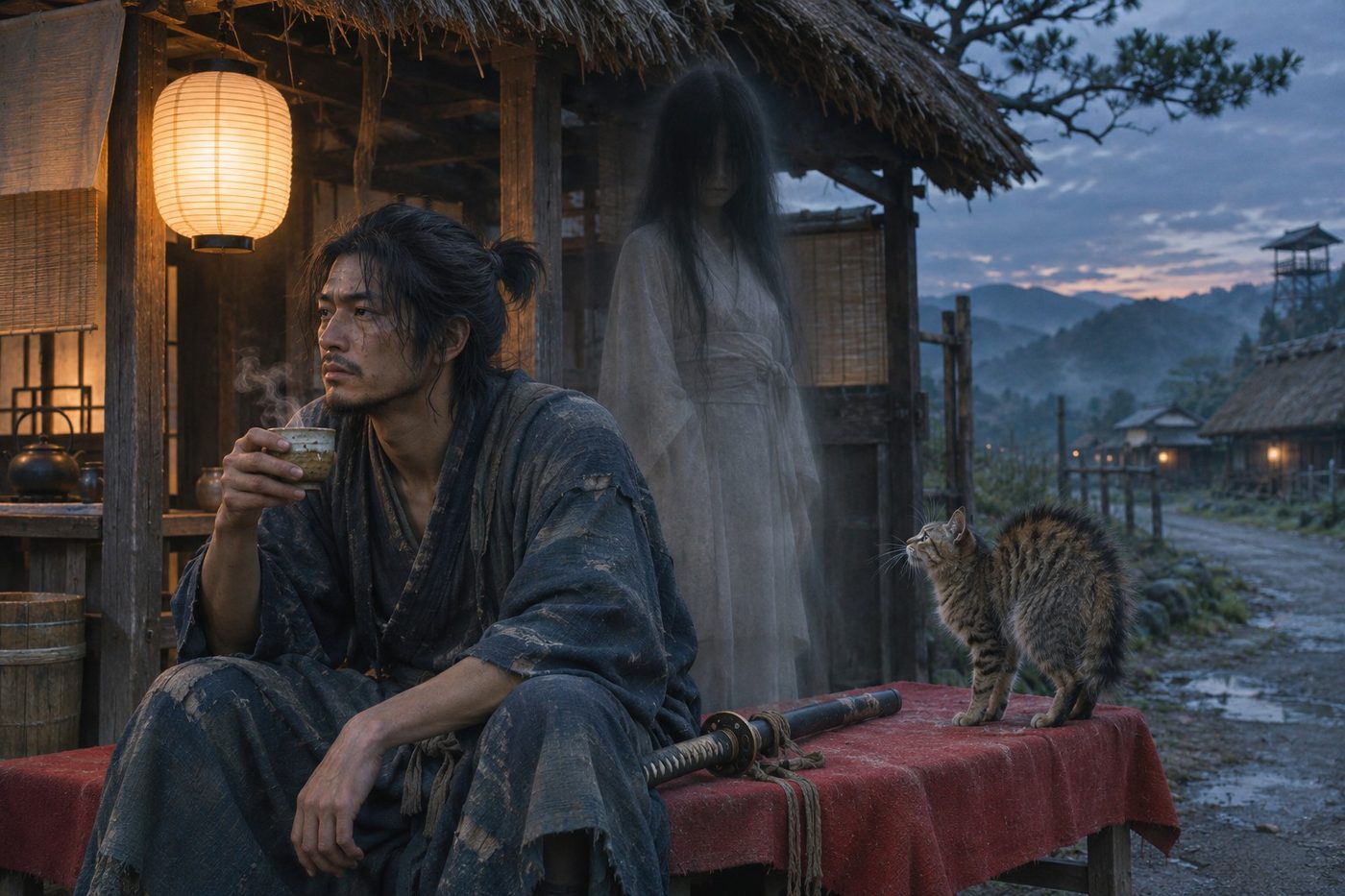
A spirit has attached itself to the hero: a wronged ghost, a jealous kami, or a yōkai that took a liking to them. Others glimpse it at dusk, lamps gutter when the hero sits down, and dogs won't come near. Work out with the GM who the spirit is and what it wants. Laying it to rest is an adventure in itself, and finishing that adventure removes the Hindrance.
As a Minor Hindrance, the spirit is a nuisance. Once per session, the GM may have it interfere, giving the hero a –2 penalty to one Trait roll. As a Major Hindrance, the spirit is dangerous. The GM may interfere twice per session, and other spirits and yōkai can sense the haunt and are drawn to the hero.
Hostage (Minor or Major)#
Lords bind each other with hostages, and the hero is tangled in that net.
As a Minor Hindrance, someone the hero loves, such as a parent, a sibling, or a child, lives as a "guest" in another lord's castle. When the hero acts against that lord's interests, the hostage suffers for it, and the lord makes sure the hero knows. As a Major Hindrance, the hero is the hostage. They were raised in a rival lord's castle, and they remain that lord's guest by treaty. They must answer the lord's summons, can't openly oppose that lord, and put their own family at risk if they run.
Indebted (Minor or Major)#
The hero owes on, a debt of gratitude that no payment can settle. Someone saved their life, raised them, sheltered them in disgrace, or paid their ransom, and someday that person asks for something in return. Unlike an Obligation, an on debt isn't steady work. It sleeps, and then it wakes at the worst time.
As a Minor Hindrance, the creditor calls on the hero about once every few sessions with a request that is inconvenient but rarely deadly. As a Major Hindrance, the creditor is powerful and the requests are dangerous, shameful, or both. Refusing breaks the hero's word, and the hero subtracts 2 from Persuasion rolls with anyone who knows of the refusal.
Masterless (Minor)#
The hero is a ronin, a samurai without a lord. Officials, retainers, and innkeepers treat masterless warriors as trouble waiting to happen: the hero subtracts 2 from Persuasion rolls with officials and with the retainers of any lord. A ronin who takes service with a lord loses this Hindrance, and gains an Obligation in its place, at the same level.
Not every ronin takes this Hindrance. A ronin with a good name, or one who is simply discreet, may not have earned it.
Partisan (Minor or Major)#
The hero wears the red plum blossom of the Shogun's loyalists or the white plum blossom of Sadatsugu's cause, and everyone knows it.
As a Minor Hindrance, the hero is a known partisan. They subtract 2 from Persuasion rolls with the other faction's people, and they must answer when their own side calls for help. As a Major Hindrance, the hero is a sworn and famous partisan. The other side wants them dead or captured, and the hero won't knowingly let an enemy of the cause go unpunished. A partisan of the warrior-monk and sect-league "third power" uses this Hindrance as well.
Taboo (Minor or Major)#
The hero keeps a purity taboo set by a shrine, a vow, or their own family's kami: never touching a corpse, never eating four-legged meat, never crossing running water at night, never drawing blood on a festival day, and so on. A Minor taboo comes up now and then. A Major taboo comes up often, or is very hard to keep in a world at war.
When the hero breaks the taboo, even by accident or to save a life, they subtract 2 from Spirit and Faith rolls until they purify themselves with a full rite at a shrine or temple. Chapter 4's rules for pollution (kegare) can make breaking a taboo worse.
Torn Heart (Minor or Major)#
The hero's heart wants something their duty forbids. This is ninjō against giri: a love in an enemy house, friendship with a hunted outlaw, a child the clan doesn't acknowledge, or a faith the lord has banned. As a Minor Hindrance, the conflict comes up occasionally. As a Major Hindrance, it is at the center of the hero's life, and enemies who learn of it can use it.
Whenever duty and heart collide in play, the player chooses. A hero who follows duty against their heart is Distracted until the end of their next turn. A hero who follows their heart against duty loses 1 Honor when it becomes known (Chapter 4). If the same choice also breaks a sworn oath or another listed duty, apply only the larger loss. Either way, playing out the choice well is worth a Benny.
Upstart (Minor)#
The hero rose above their birth: a farmer's child made a samurai on the battlefield, a merchant adopted into a warrior house, or a gentry family that bought its title. Old houses never forget it. The hero subtracts 2 from Persuasion rolls with court nobles and with samurai of old families who know where they came from. Commoners, and other upstarts, tend to admire them for it.
Part 4: Edges#
Edges in Blade and Kami™#
Most Edges in the core rules and the Companions fit Tsurugishima as written. A few are renamed to sound like the isles, a few vanish with the guns and gadgets of other ages, and 52 are new. The new Edges fall into four groups: martial schools and temple secrets, which turn the sword halls and warrior-monk temples into rules; callings, which make shinobi, gamblers, artists, tea masters, and thief-takers feel like themselves; and a handful of spirit Edges for heroes the kami have noticed.
Used as Written#
Background. Alertness (SWADE p. 37), Ambidextrous (SWADE p. 37), Arcane Resistance (FC p. 31), Improved Arcane Resistance (FC p. 32), Attractive (SWADE p. 38), Very Attractive (SWADE p. 38), Berserk (SWADE p. 38), Brave (SWADE p. 38), Brawny (SWADE p. 38), Brute (SWADE p. 38), Charismatic (SWADE p. 39), Chosen (FC p. 32), Elan (SWADE p. 39), Fame (SWADE p. 39), Famous (SWADE p. 39), Fast Healer (SWADE p. 39), Favored Enemy (FC p. 32), Favored Terrain (FC p. 32), Fleet-Footed (SWADE p. 39), Linguist (SWADE p. 40), Luck (SWADE p. 40), Great Luck (SWADE p. 40), Quick (SWADE p. 40), Rich (SWADE p. 40), Filthy Rich (SWADE p. 40), and Veteran of the Dark World (HC p. 8).
Combat. Block and Improved Block (SWADE p. 40), Brawler (SWADE p. 41), Bruiser (SWADE p. 41), Calculating (SWADE p. 41), Charge (FC p. 33), Close Fighting and Improved Close Fighting (FC p. 33), Combat Reflexes (SWADE p. 41), Counterattack and Improved Counterattack (SWADE p. 41), Dead Shot (SWADE p. 41), Dirty Fighter and Really Dirty Fighter (FC p. 33), Dodge and Improved Dodge (SWADE p. 41), Double Shot (FC p. 33) and Improved Double Shot (FC p. 34), Extraction (SWADE p. 41) and Improved Extraction (SWADE p. 42), Feint (SWADE p. 42), First Strike and Improved First Strike (SWADE p. 42), Formation Fighter (FC p. 34), Free Runner (SWADE p. 42), Frenzy and Improved Frenzy (SWADE p. 42), Giant Killer (SWADE p. 42), Hard to Kill and Harder to Kill (SWADE p. 42), Improvisational Fighter (SWADE p. 42), Iron Jaw (SWADE p. 42), Killer Instinct (SWADE p. 43), Level Headed and Improved Level Headed (SWADE p. 43), Marksman (SWADE p. 43), Martial Artist and Martial Warrior (SWADE p. 43), Martial Flexibility (FC p. 34), Mighty Blow (SWADE p. 43), Nerves of Steel and Improved Nerves of Steel (SWADE p. 43), No Mercy (SWADE p. 43), Opportunistic (FC p. 34), Savagery (FC p. 34), Sneak Attack and Improved Sneak Attack (FC p. 34), Steady Hands (SWADE p. 44), Stunning Blow (FC p. 35), Sunder (FC p. 35), Sweep and Improved Sweep (SWADE p. 44), Take the Hit (FC p. 35), Trademark Weapon and Improved Trademark Weapon (SWADE p. 44), Trick Shot (FC p. 35), Two-Fisted (SWADE p. 44), and Uncanny Reflexes (FC p. 35).
Leadership. Command (SWADE p. 45), Command Presence (SWADE p. 45), Courage (HC p. 9), Fervor (SWADE p. 45), Hold the Line! (SWADE p. 45), Inspire (SWADE p. 45), Natural Leader (SWADE p. 45), Tactician (SWADE p. 45), and Master Tactician (SWADE p. 45).
Professional. Ace (SWADE p. 47, for ships), Acrobat and Combat Acrobat (SWADE p. 48), Assassin (SWADE p. 48), Born in the Saddle (FC p. 38), Explorer (FC p. 38), Investigator (SWADE p. 48), Jack-of-all-Trades (SWADE p. 48), Mount (FC p. 38), Mr. Fix It (SWADE p. 49), Poisoner (FC p. 39), Scholar (SWADE p. 49), Scout (FC p. 39), Soldier (SWADE p. 49), Stonecunning (FC p. 40, for castle masons), Thief (SWADE p. 49), Trap Sense (FC p. 40), Treasure Hunter (FC p. 40, for old tombs and sunken wrecks), and Woodsman (SWADE p. 50).
Social. Bolster (SWADE p. 50), Common Bond (SWADE p. 50), Connections (SWADE p. 50), Deceptive (FC p. 40), Humiliate (SWADE p. 50), Menacing (SWADE p. 50), Monster Hunter (HC p. 9), Provoke (SWADE p. 50), Rabble-Rouser (SWADE p. 50), Reliable (SWADE p. 51), Retort (SWADE p. 51), Streetwise (SWADE p. 51), Strong Willed and Iron Will (SWADE p. 51), and Work the Room and Work the Crowd (SWADE p. 51).
Weird. Aura of Courage (FC p. 40), Beast Bond (SWADE p. 51), Beast Master (SWADE p. 51), Beast Talker (FC p. 40), Champion (SWADE p. 52), Danger Sense (SWADE p. 52), Gallows Humor (HC p. 8), Healer (SWADE p. 52), Liquid Courage (SWADE p. 52), Relentless (HC p. 8), Scavenger (SWADE p. 52), and Visions (HC p. 9).
Legendary. Followers (SWADE p. 53), Home Ground (FC p. 41), Professional, Expert, and Master (SWADE p. 53), Relic (FC p. 41), Sidekick (SWADE p. 53), Tough as Nails and Tougher than Nails (SWADE p. 53), Unstoppable (FC p. 41), Warband (FC p. 41), and Weapon Master and Master of Arms (SWADE p. 53).
Changed Edges#
Each works as written, with the changes below.
Aristocrat (SWADE p. 38). Renamed Great House. Requirements: Novice. A hero born into a great house, with the GM's permission, has this Edge's benefits from birth (Part 1), so the Edge is for a hero who joins one later, by adoption, marriage, or sworn service. The hero belongs to one of the realm's great houses: a clan of 200,000 koku or more, a branch of the Shogun's own line, or one of the old court families such as the Akebana. The "elite" the Edge works with are lords, senior retainers, court nobles, and the abbots of great temples. The house's name also opens doors far beyond its own lands: lesser lords receive the hero as an honored guest, and the house's castles, retainers, and allies take them in anywhere they hold power. The price is that the house's enemies are the hero's enemies, and everything the hero does reflects on the house. Great House doesn't raise the hero's Status: a Member of a great house is still only a Member within it.
Chi (SWADE p. 52). Renamed Ki. The hero's point is a Ki point, drawn from breath and the belly.
Heirloom (FC p. 32). The hero inherits a treasure worth up to 10,000 mon from Chapter 6's Relics and Treasures. Most often it is a blade by a famous smith, but it can be armor, a bow, a mirror, or a sacred scroll. An heirloom carries a family's honor: losing it is a disgrace, and recovering it is an adventure.
Knight (FC p. 38). Renamed Horse Guard (umamawari), the mounted retainers who ride beside a lord in battle. The starting gear is a war horse, a katana, a bow or a spear, and heavy armor or, if the player prefers, light armor (Part 6). Horse guards carry no shield. The required Obligation is to the hero's lord.
Missile Deflection (FC p. 34). Renamed Arrow Cutting (yadomejutsu, the arrow-stopping art). It works against arrows, darts, and thrown weapons, but not against matchlock balls, which fly too fast to see or cut.
McGyver (SWADE p. 49). Renamed Improviser. Same effect.
Roar (FC p. 34). Renamed Kiai, the shout from the belly that freezes a foe's breath. Same effect.
Troubadour (FC p. 40). Renamed Storyteller. Wandering storytellers, often blind lute players, chant the war tales from province to province. Same effect.
Setting Notes#
- Martial Artist (SWADE p. 43) is the wrestling of sumai or the unarmored grappling of yawara. Paired with Stunning Blow (FC p. 35), which counts bare hands as a blunt weapon, it makes atemi-waza, the strikes to vital points that stun a foe or set up a throw. It's the usual pick for jūjutsu and Uchinami students.
- Battle, Command, and Tactician cover generalship (senjō-jutsu). Chapter 5 adds the Castle Builder Edge for fortification and siege, and the Steward Edge for running a domain.
- Healer (SWADE p. 52) makes a physician trained in Daqian medicine. A blind masseur (anma) uses Healing, and a blind masseur who is secretly a master swordsman is a classic hero.
Arcane Edges#
Arcane Background (SWADE p. 37) and the Power Edges appear in Chapter 6 (Part 2: Arcane Backgrounds), which gives the Five Paths' Arcane Backgrounds, renames some Edges (Holy Warrior becomes Niō's Wrath, Battle Magic becomes War Rites, Familiar becomes Spirit Messenger), keeps Soul Drain and Blood Magic for villains, and adds six new arcane Edges. The Edges covered there: Artificer (SWADE p. 45, FC p. 36), Channeling (SWADE p. 46), Concentration (SWADE p. 46), Extra Effort (SWADE p. 46), Holy/Unholy Warrior (SWADE p. 46), New Powers (SWADE p. 47), Power Points (SWADE p. 47), Power Surge (SWADE p. 47), Rapid Recharge and Improved Rapid Recharge (SWADE p. 47), Soul Drain (SWADE p. 47), the Fantasy Companion's Power Edges (FC pp. 36–38, including Mystic Powers), the Edges tied to each Arcane Background (FC pp. 89–104), and Favored Power and Silent Caster (HC p. 9). Following the Fantasy Companion, the Wizard Edge (SWADE p. 47) isn't used (FC p. 35).
Not Used#
| Edge | Why it's gone |
|---|---|
| Double Tap (SWADE p. 41), Rapid Fire and Improved Rapid Fire (SWADE p. 43), Rock and Roll! (SWADE p. 44), Two-Gun Kid (SWADE p. 44) | Matchlocks fire one shot and take a long time to reload |
| Gadgeteer (SWADE p. 46) | No weird science |
| Mentalist (SWADE p. 46) | No psionics |
| Defender (FC p. 33), Shield Wall (FC p. 34) | Warriors of the isles don't carry hand shields. Foot soldiers use standing wooden shields, covered in Gear. |
| Fey Blood (FC p. 32), Rapid Change (FC p. 41), Scorch (FC p. 34), Wing Gust (FC p. 35), the Monstrous Edges (HC pp. 10–23) | Humans are the only ancestry |
| Scream Queen/King (HC p. 9) | A slasher-film trope |
New Edges#
Background Edges#
Hostage-Raised#
Requirements: Novice
The hero grew up as a "guest" in another lord's castle, a living pledge of their family's good behavior. Choose that clan. The hero knows its castle, its customs, and its people as well as their own, adding +2 to Common Knowledge rolls about the clan and +2 to Persuasion rolls with members who knew them as a child. Whether they think of the hero as a friend or a hostage is up to the story.
Keeper of the Dead#
Requirements: Novice, Spirit d6+
The hero has washed the dead, dug graves, kept a prison, or walked execution grounds since childhood, work that the sakaibito do for everyone else. Death holds few terrors. The hero adds +2 to Fear checks caused by corpses, ghosts, and the walking dead, and gets a free reroll on Healing or Notice rolls to learn how someone died.
Lay Devotee#
Requirements: Novice, Spirit d6+
The hero isn't ordained, but keeps the faith more strictly than their neighbors: daily prayers, fast days, pilgrimages, and gifts to one temple or shrine. Choose one sect of the Buddha's Law, or one great shrine and its kami. The hero gains:
- Friends of the faith. +2 to Persuasion rolls, including Networking, with that faith's clergy and devotees.
- Shelter. The faith's temples or shrines give the hero a meal and a place to sleep, and keep their secrets.
- Strength in the faith. +1 to Fear checks, and to Spirit rolls to resist powers used by spirits, yōkai, and the restless dead. The bonus is lost while the hero is Polluted or Defiled (Chapter 4).
- Sworn follower. The hero counts as sworn to the sect for its Temple Secret Edge.
The exclusive sects. A devotee of Western Light or Lion's Roar has turned from every other faith. Their bonus to Fear checks and resistance rises to +2. But they refuse the rites, charms, and blessings of any other sect or shrine. A genja of another faith can't use a beneficial power on them unless they accept it, and if they accept, they lose the Edge's benefits until they make amends: a week of prayer and an offering at their own temple. A physician's medicine isn't a rite, and is always allowed. A devotee of a shrine and its kami follows the open rules: the shrines of the isles never forbade the Buddha's help.
Combat Edges#
Gunner#
Requirements: Novice, Shooting d6+
The hero trained in a matchlock company and loads by drill: powder, ball, ramrod, and match, without looking down. Reduce the Reload value of matchlocks by 1 (to a minimum of 1). The hero also gets a free reroll on any roll Chapter 4 calls for to keep a match lit in wind or rain.
Gap Strike#
Requirements: Novice, Fighting d8+
Armored warriors rarely die from a cut. They die from a point slipped into a gap. With a thrusting weapon, such as a spear, a sword's point, or a knife, the hero reduces the penalty for a Called Shot to an Unarmored Area (SWADE p. 98) by 2.
Light Body#
Requirements: Seasoned, Agility d8+, Athletics d8+
The hero has trained in karumijutsu, the art of the light body. They leap from roof to roof and drop from walls like a cat. The hero gains the Leaper ancestral ability (SWADE p. 19), and takes no damage from the first 4" (8 yards) of any fall.
Martial Schools#
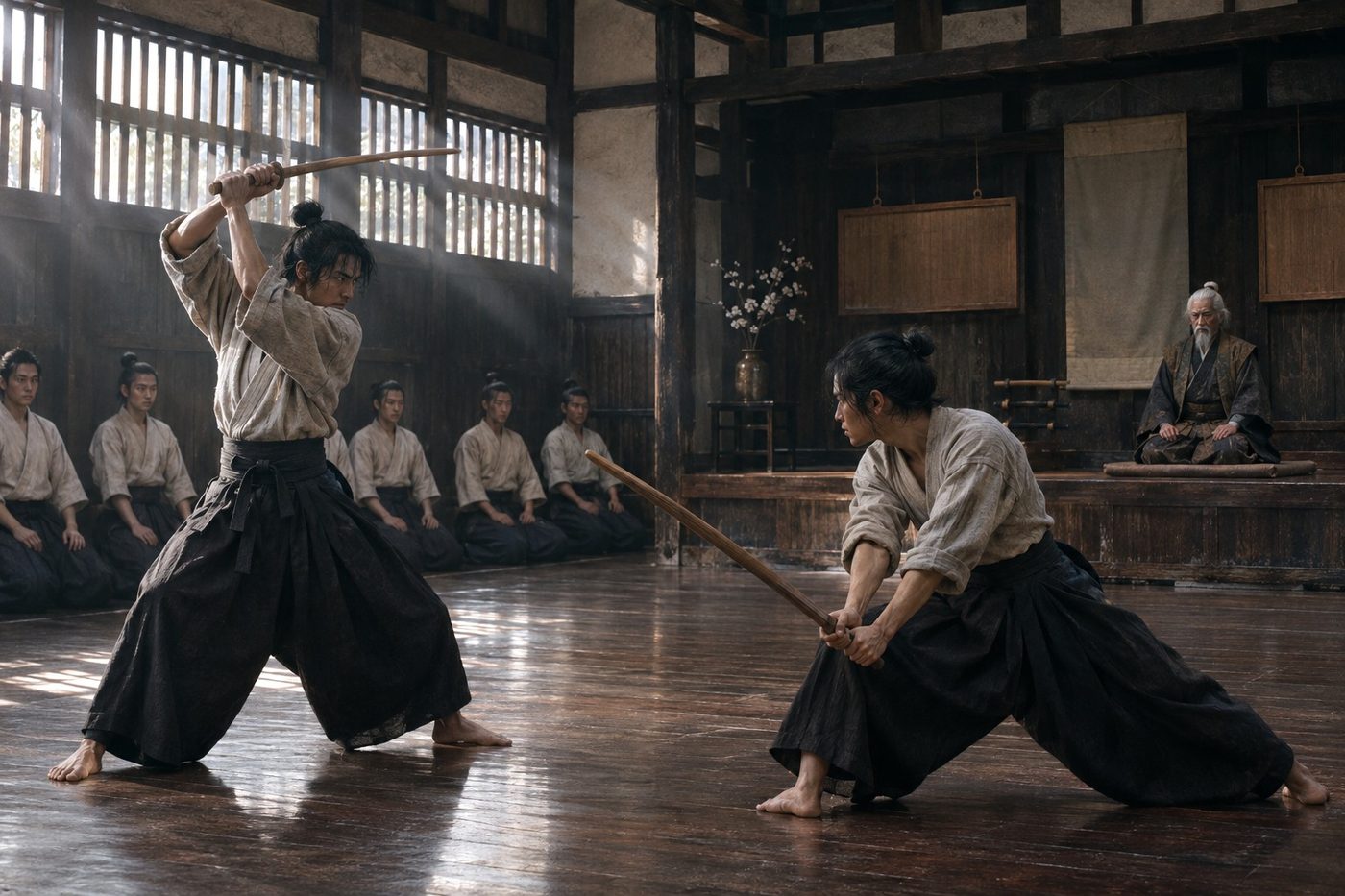
Every serious fighter in Tsurugishima learned from a school (ryūha), and every school guards a secret. Each school below has two Edges. The Style Edge makes the hero a sworn student and teaches the school's signature technique. The Secret Edge comes later, from the school's hidden scrolls, and marks the hero as a senior student.
A hero can take only one Style Edge at character creation. Learning a second school requires a teacher, a fee or service, and the GM's approval, and the first school may not take it well. Taking a Secret Edge requires the school's Style Edge. Chapter 4's rules for duels, and the Society ladder for schools (Chapter 2), build on these Edges.
The Kiritani School teaches the draw-cut (iai): the sword leaves the scabbard and strikes in a single motion.
Kiritani Style#
Requirements: Novice, Agility d8+, Fighting d6+
When the hero begins their turn with a sword in its scabbard and draws it to attack that turn, the attack adds +2 damage. Students of the Kiritani School count as trained in the draw-cut for Chapter 4's duels.
Kiritani Secret: Before the Thought#
Requirements: Seasoned, Kiritani Style, Fighting d8+
Once per encounter, when the hero's sword is sheathed and their Action Card beats an adjacent foe's, their draw-cut against that foe gets The Drop (SWADE p. 100).
The Ōnuma School fights with the long sword in one hand and the short sword in the other.
Ōnuma Style#
Requirements: Novice, Agility d8+, Fighting d8+
While the hero holds a long blade in one hand and a short blade in the other, they add +1 to Parry.
Ōnuma Secret: Fire and Stones#
Requirements: Seasoned, Ōnuma Style, Two-Fisted
Once per round, when an adjacent foe fails a Fighting roll against the hero, the hero catches the weapon between their crossed blades and strikes to break it. Make a free Fighting roll. On a success, roll damage against the weapon as described in Breaking Things (SWADE p. 98). Sunder (FC p. 35) adds its bonus as usual.
The Kanemori School is a battlefield school of the great two-handed sword, made for cutting through armor and horsemen.
Kanemori Style#
Requirements: Novice, Strength d8+, Fighting d8+
With a two-handed sword, the hero's attacks get AP 2 more against foes in heavy armor (+3 or more).
Kanemori Secret: Horse-Cutter#
Requirements: Seasoned, Kanemori Style
With a two-handed sword, the hero adds +2 damage against a mounted foe or their mount. If a rider or mount is Shaken or Wounded by the attack, the rider must make a Riding roll or fall.
The Amanoki School is the waiting sword. Its students let the foe move first, and then make them regret it.
Amanoki Style#
Requirements: Novice, Smarts d6+, Fighting d8+
When the hero takes the Defend action (SWADE p. 99), the first adjacent foe who misses them with a Fighting roll before their next turn is Distracted.
Amanoki Secret: The Empty Sword#
Requirements: Veteran, Amanoki Style
While Defending, the hero gets a Free Attack (SWADE p. 101) against each adjacent foe who fails a Fighting roll against them, up to two per round. This doesn't stack with Counterattack. Use whichever gives more attacks.
The Sekigawa School teaches the spear, the weapon that actually wins battles.
Sekigawa Style#
Requirements: Novice, Strength d6+, Fighting d6+
With a spear, the hero gets one Free Attack per round against a foe who moves into the spear's Reach. If the hero also has First Strike, they can use this against two foes each round.
Sekigawa Secret: Thicket of Spears#
Requirements: Seasoned, Sekigawa Style, Sweep
When the hero Sweeps with a spear, the attack reaches every foe within the spear's Reach, not only those adjacent.
The Asaoka School keeps the oldest warrior art of all: shooting the bow from a galloping horse.
Asaoka Style#
Requirements: Novice, Riding d6+, Shooting d6+
The hero ignores the Unstable Platform penalty (SWADE p. 109) when shooting a bow from horseback, and ignores the running penalty when their mount runs.
Asaoka Secret: Rider's Eye#
Requirements: Seasoned, Asaoka Style, Shooting d8+
When the hero shoots a bow, they reduce Called Shot penalties (SWADE p. 98) by 2.
The Tamaeda School teaches the glaive (naginata). Samurai daughters, warrior monks, and castle guards fill its halls.
Tamaeda Style#
Requirements: Novice, Agility d6+, Fighting d8+
With a glaive, the hero can Sweep as if they had the Sweep Edge. If they already have Sweep, they ignore its penalty when using a glaive.
Tamaeda Secret: Reaping the Legs#
Requirements: Seasoned, Tamaeda Style
When the hero hits a foe's legs with a Called Shot from a glaive, the foe is also knocked prone. Against a horse, the rider must make a Riding roll or fall.
The Uchinami School teaches wrestling in armor (kumiuchi): throw the foe down, pin them, and finish them with a knife.
Uchinami Style#
Requirements: Novice, Strength d6+, Athletics d6+
The hero adds +2 to Athletics rolls to grapple a foe who wears armor. While the hero has a foe Entangled or Bound, the hero's attacks with a knife ignore that foe's armor.
Uchinami Secret: Throw and Pin#
Requirements: Seasoned, Uchinami Style
When the hero gets a raise on a roll to grapple (SWADE p. 101), the foe is also thrown prone and Shaken.
Temple Secrets#
The great sects keep fighting traditions of their own, taught only to their warrior monks and sworn followers. Each sect has one secret Edge. To take it, the hero must be sworn to that sect: an ordained monk or nun with a Vow, or a lay follower with the Lay Devotee Edge. A hero who breaks with the sect loses the Edge.
Thunder Peak Secret: Wheel of Flame#
Requirements: Seasoned, sworn to Thunder Peak, Spirit d8+, Fighting d8+
The warrior monks of Raihō-ji chant the Immovable King's mantra as they fight. Once per encounter, as a free action, the hero begins the chant. For the rest of the encounter, their attacks with a glaive or staff add +2 damage against spirits, yōkai, and the walking dead.
Western Light Secret: Calling the Name#
Requirements: Seasoned, sworn to Western Light, Spirit d8+
League fighters march into battle calling the name of the Buddha of Boundless Light, certain of paradise. While the hero calls the name aloud, which they can't do while hiding, they ignore one point of Wound penalties and add +2 to Fear checks.
Still Mind Secret: No-Mind#
Requirements: Seasoned, sworn to Still Mind, Spirit d8+, Fighting d8+
The hero empties their mind the way they were taught on the meditation cushion. Once per encounter, as a free action, they ignore being Distracted, and ignore up to 2 points of Multi-Action penalties, until the end of their next turn.
Lion's Roar Secret: Drum and Sutra#
Requirements: Seasoned, sworn to Lion's Roar, Spirit d8+, Performance d6+
Lion's Roar townsmen fight to the beat of the preacher's drum and the title of their one true sutra. Once per encounter, as an action, the hero beats the drum and chants. Allies within 5" (10 yards) who can hear add +2 to Spirit rolls and Fear checks for the rest of the encounter.
Masters and Clans#
Hermit's Secret#
Requirements: Seasoned, GM's approval
This Edge can't be chosen freely. The GM offers it only as the reward for an adventure, after the hero finds a wandering master, a hermit on a mountain, or a tengu in the high cedars, and earns a lesson. The hero learns one technique from the list in Chapter 10. Each technique is unique in a campaign. A hero may take this Edge more than once, each time for a new technique from a master's adventure, but no more than once per Rank.
The techniques. Masters and their stories are in Chapter 10 (Rewards and the Rules). Each technique below is one Advance and one Hermit's Secret.
| Technique | Requirements |
|---|---|
| Cutting the Shadow | Fighting d8+, Spirit d6+ |
| Empty Hands Take the Blade | Martial Artist, Fighting d8+ |
| Falling Leaf | Agility d8+, Athletics d8+ |
| Moon in the Water | Notice d8+, Fighting d8+ |
| Reading the Heart | Notice d8+, Persuasion d6+ |
| Returning Arrow | Arrow Cutting, Athletics d8+ |
| The Ghost's Step | Agility d8+, Stealth d8+ |
| The Mountain's Breath | Vigor d8+, Spirit d6+ |
| The Sleeping Crane | Notice d6+, Agility d8+ |
| Snow Without Tracks | Agility d8+, Stealth d6+ |
| Stone in the River | Fighting d8+, Vigor d8+ |
| Wings of the Tengu | Heroic, Agility d10+, Fighting d10+ |
Clan Secret Edges#
Each great clan keeps a secret of its own: a family sword style, a riding tradition, an archery corps, or a way of reading the land for war. To take one, the hero must belong to the clan and hold Status of Trusted or higher within it. A hero who leaves or disgraces the clan loses the Edge. Kurogane's two houses aren't great clans, but their secrets are given for starter play. Chapter 9 describes each clan.
Kagamino of Hagane: The Founder's Oath#
Requirements: Seasoned, Kagamino of Hagane, Trusted, Persuasion d6+
The hero can call on the oath the housemen's ancestors swore to the first Shogun. The hero adds +2 to Persuasion rolls with houseman families (gokenin) when speaking in the Shogun's name. Once per session, a houseman family the hero visits gives lodging, fresh horses, and up to 2d6 armed retainers (soldiers, Bestiary) for one day, whatever its lord thinks of the Shikken.
Kagamino of Kasumi: Cheongun Discipline#
Requirements: Seasoned, Kagamino of Kasumi, Trusted, Battle d6+
Sadatsugu's officers learned their trade in a war that never let up. Allied Extras under the hero's command add +1 to Spirit rolls to recover from being Shaken. In a mass battle where the hero commands an army or a company (Chapter 5), their side may reroll one failed Morale roll per battle.
Ōtaki: The Ledger#
Requirements: Seasoned, Ōtaki, Trusted, Smarts d8+
The hero was taught to keep accounts of people. They add +2 to Persuasion and Intimidation rolls with officials, toll keepers, magistrates, and merchants. Once per session, with a Smarts roll, the hero recalls one debt the official in front of them owes: whom they owe, and roughly how much. On a raise, they also know one thing the official would pay to keep quiet.
Kuzuhara: Northern Riders#
Requirements: Seasoned, Kuzuhara, Trusted, Riding d8+
The riders of Tsukikage cross their vast province in the saddle. The hero and their mount travel half again as far in a day as other riders, and suffer no Fatigue from long riding or forced marches on horseback. A party or company led by the hero gains the same benefit.
Mizusawa: Snow Riders#
Requirements: Seasoned, Mizusawa, Trusted, Riding d6+, Vigor d6+
The hero fights in winter as easily as in summer. They and their mount ignore Difficult Ground caused by snow and ice, and the hero adds +2 to Vigor rolls to resist Cold (SWADE p. 125). In a mass battle fought in snow, the hero's side adds +1 to its Battle rolls if the hero commands it.
Tokumoto: Never Retreat#
Requirements: Seasoned, Tokumoto, Trusted, Spirit d8+
The Tokumoto guard have never retreated, and they don't intend to start. While the hero holds their ground (doesn't move away from foes on their turn), allies within 5" (10 yards) who can see them add +2 to Fear checks and to rolls to resist Intimidation. In a mass battle where the hero fights with their army, the army ignores the first failed Morale roll of the battle. The price: a hero with this Edge who retreats from a fight while able to stand loses the Edge until they redeem themselves with a great deed (+2 Honor or more).
Kanezaki: The Salt Road#
Requirements: Seasoned, Kanezaki, Trusted, Persuasion d6+
The Kanezaki are more merchant than warrior, and proud of it. The hero can find passage on any Kanezaki or friendly merchant ship along the Inland Sea at no cost, and adds +2 to Persuasion rolls when bargaining in any Inland Sea port. Once per season, the hero can draw up to 2,000 mon of credit from a Kanezaki factor, to be repaid by the next season (unpaid debts become a Minor on owed to the clan).
Kayamori: Lake Barges#
Requirements: Seasoned, Kayamori, Trusted, Boating d6+
The Kayamori fight from boats on the great lake. The hero ignores the Unstable Platform penalty (SWADE p. 109) when fighting or shooting from a boat, and adds +2 to Boating rolls in a Chase on water.
Nishioka: Foreign Guns#
Requirements: Seasoned, Nishioka, Trusted, Shooting d6+
The Nishioka were the first to buy the far westerners' guns, and the first to learn them well. The hero can buy far-western matchlocks, powder, and shot without the Port Commissioner's license, at the price of island-made ones. They add +2 to Repair rolls on firearms. With a matchlock of far-western make, the hero's Range increments increase by half (a 15/30/60 matchlock becomes 22/45/90, rounding down).
Hatakura: Furumiya Learning#
Requirements: Seasoned, Hatakura, Trusted, Academics d6+
The Hatakura were raised among the old temples of Furumiya and their libraries. The hero adds +2 to Academics and Research rolls about history, old records, old temples, and tombs, and is welcome in Furumiya's temple libraries. Once per adventure, at an old site, the GM gives the hero one true fact about its history that no one living remembers.
Akebana: The Regent's Precedent#
Requirements: Seasoned, Akebana, Trusted, Persuasion d8+
The Akebana have ruled the court for seven centuries by knowing what was done before. In a Social Conflict at court or before nobles, the hero may cite precedent once to gain +2 to one roll. Once per session, the hero can secure an audience with any court noble below the Regent, or an official of the Shogunate, within a day.
Amanuma: The Iron Gate#
Requirements: Seasoned, Amanuma, Trusted, Fighting d8+
The Amanuma have held Kurogane Pass for nine generations. While the hero defends a gate, door, bridge, or passage no more than 2" (4 yards) wide, they add +1 to Parry, and foes attacking them gain no more than +1 from Gang Up.
Kitamori: The Deep Galleries#
Requirements: Seasoned, Kitamori, Trusted, Notice d6+
The Kitamori grew up in the mines. Underground, the hero halves penalties for Dim and Dark Illumination (SWADE p. 102), and adds +2 to Notice and Survival rolls to sense bad air, coming cave-ins, and hidden passages.
Professional Edges#
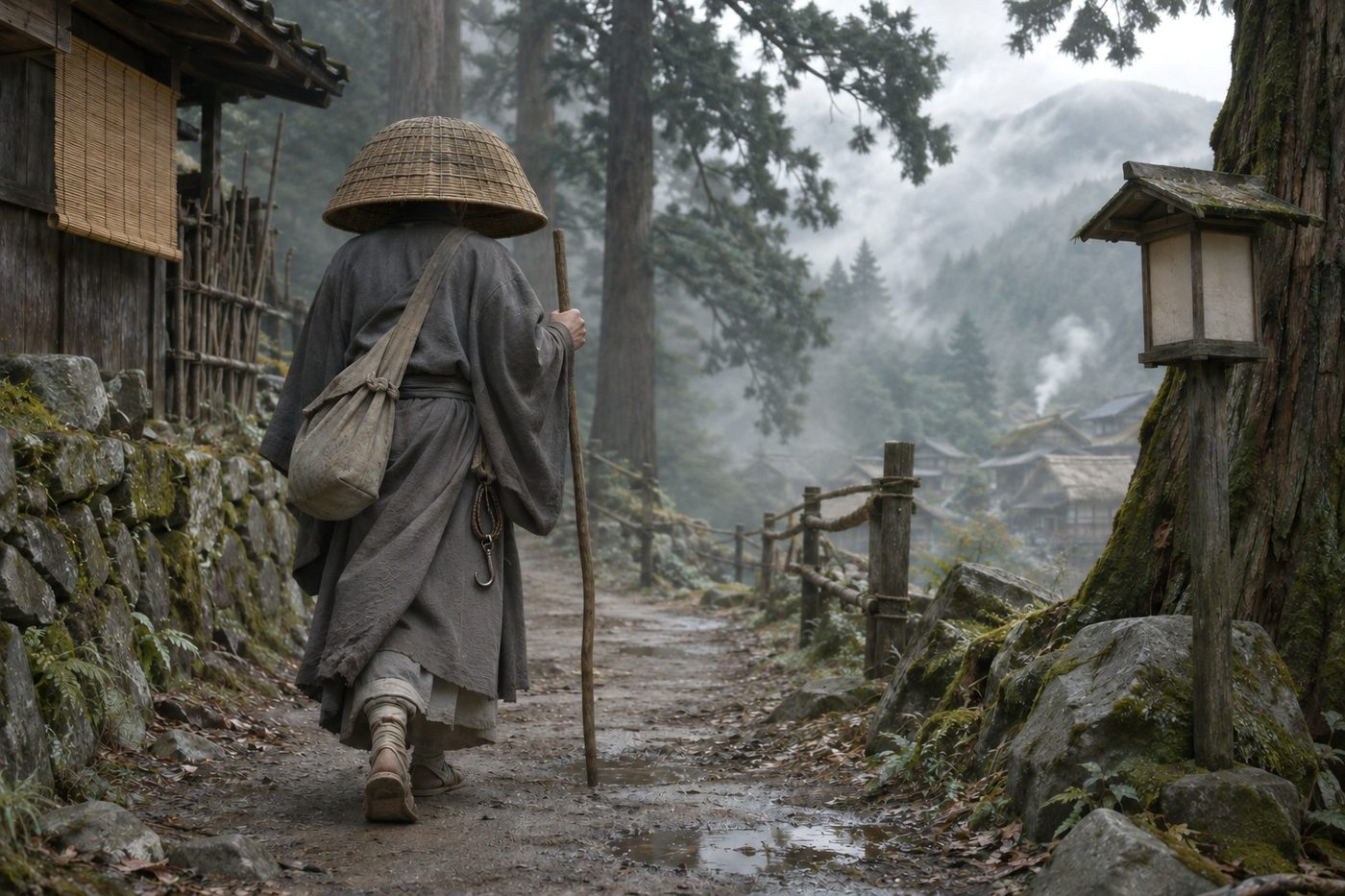
Gambler#
Requirements: Novice, Smarts d6+, Gambling d8+
The hero has run the dice in a hundred post-station back rooms. They get a free reroll on Gambling rolls, and add +2 to Notice rolls to spot someone else cheating.
Merchant's Eye#
Requirements: Novice, Smarts d6+, Persuasion d6+
The hero knows what things are worth and what people will pay. They add +2 to Notice rolls to appraise goods or spot a fake. When buying or selling, a successful Persuasion roll shifts the price 10% in the hero's favor, or 20% with a raise.
Shinobi#
Requirements: Novice, Agility d8+, Stealth d6+
The hero was raised in the hidden leagues of the mountains. They add +2 to Performance rolls to keep up a disguise as a monk, peddler, player, or pilgrim. A hooked cord counts as full climbing gear in their hands. Once per session, the hero may reveal one small item, such as a knife, a dart, or a dose of poison, that a search failed to find.
Swordsmith#
Requirements: Novice, Smarts d8+, Repair d8+
The hero forges blades, a craft honored above all others. With a forge, materials, and a month of work, the hero makes fine weapons and armor (see Gear) at half the usual price, and can name the maker of any blade with a Repair roll.
Tea Master#
Requirements: Novice, Spirit d6+, Performance d8+
The hero hosts the tea gathering, where swords stay outside and rivals sit knee to knee. When the hero serves tea to others before a negotiation or Social Conflict (SWADE p. 143), they add +2 to their first Persuasion roll. The hero also gets a free reroll on Common Knowledge rolls about etiquette.
Thief-Taker#
Requirements: Novice, Notice d6+, Fighting d6+
The hero carries a magistrate's warrant and an iron truncheon (jitte). They may arrest commoners in the magistrate's name, add +2 to Fighting rolls to Disarm (SWADE p. 100) a blade with a truncheon, and get a free reroll on Notice rolls to recognize a wanted face. Thief-takers also learn the binding art (hojōjutsu): the hero can tie up a Bound foe with a cord as a limited free action, and the foe subtracts 2 from rolls to escape the knots.
Social Edges#
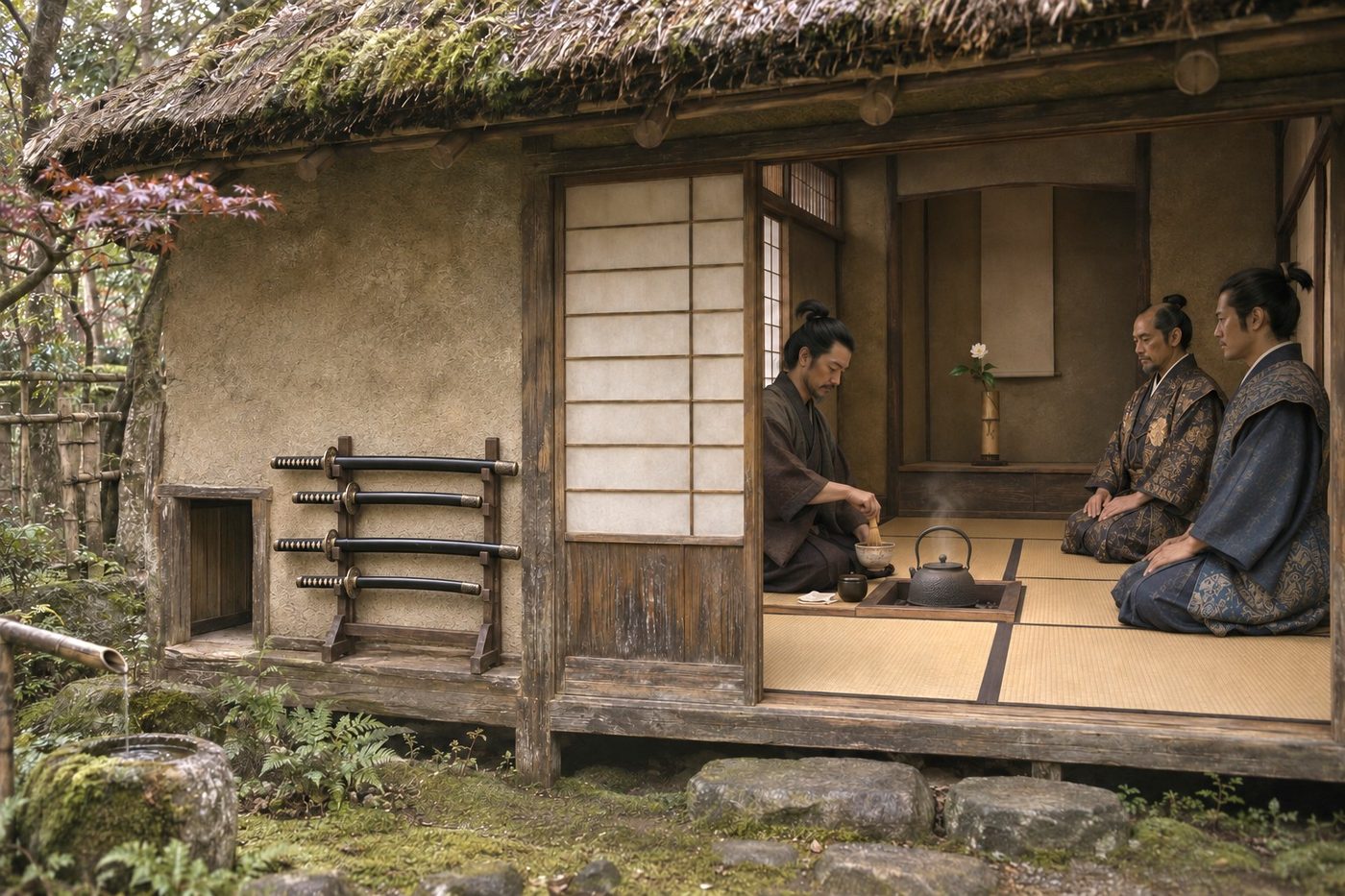
Artist#
Requirements: Novice, Spirit d6+, Performance d6+
The hero has devoted themselves to the arts. They know a number of arts equal to the full value of their Performance die (six at d6, eight at d8, and so on), instead of half (see Performance, Part 2).
Court Poet#
Requirements: Novice, Smarts d6+, Performance d8+
At court, at banquets, and in any gathering where poems are traded, the hero may use Performance instead of Persuasion or Taunt in a Social Conflict. A good verse wins an argument that a good reason can't.
Lord's Syllable#
Requirements: Novice, Obligation to a lord
The hero's lord granted them a syllable of the lord's own name, a public mark of favor. The hero adds +2 to Persuasion and Intimidation rolls with the lord's retainers and subjects who know what the name means. If the hero shames the lord, the lord takes the syllable back, and the hero loses this Edge.
Street Champion#
Requirements: Novice, Spirit d6+, Fighting d6+
The hero stands up for the common folk of a town or city quarter (otokodate), and they love the hero for it. In that place, the hero adds +2 to Persuasion rolls with commoners, who hide them from the magistrates when asked. Once per session, the hero can call out a crowd of townsfolk to block a street, start a brawl, or bear witness.
Weird Edges#
Seated Meditation#
Requirements: Novice, Spirit d8+
The hero practices seated meditation (zazen). After an hour of undisturbed meditation, the hero recovers from one lasting Fear effect or one level of Fatigue caused by lack of sleep, and gets a free reroll on their next Spirit roll to resist a power.
Kami's Favor#
Requirements: Novice, Spirit d6+
The kami of a sacred place took a liking to the hero. Once per session, when the hero prays at a shrine or before a sacred tree, rock, or waterfall bound with straw rope (shimenawa), they get a Benny that must be spent before the session ends. A polluted hero (Chapter 4) can't call on the kami until they are purified.
Spirit Sight#
Requirements: Novice, Spirit d8+
The hero sees what hides from ordinary eyes. They add +2 to Notice rolls to detect spirits and ghosts, or to see through a yōkai's disguise. Spirits that are invisible appear to the hero as a shimmer in the air, and the hero halves the penalty to attack them.
Notes#
- Unarmed fighting (the grappling, throws, and strikes to vital points) draws on F. J. Norman, The Fighting Man of Japan (1905).
Part 5: Archetypes#
Ready to Play#
Each archetype below is a complete Novice hero, built with the rules in Part 1: a birth, a profession, 5 attribute points, 12 skill points, up to 4 points of Hindrances, and one free Edge. Pick one, give them a name from Chapter 2, answer the six questions in Who Your Hero Is (Part 1), and play. Every choice can be swapped for another of the same cost.
Every archetype starts as a Member of their group with Honor 0, unless the entry says otherwise. Each one's gear is their profession's kit, plus what they bought with their 500 mon.
Mystic archetypes. The shrine maiden, scholar-nun, sōhei, mountain ascetic, and yin-yang master each walk one of the Five Paths (Chapter 6). Hindrances marked "from the Arcane Background" come with the path and don't count toward the 4 points. Powers are listed by island name, with the game name in parentheses. The wandering monk has no Arcane Background; their power is in their fists.
Samurai Retainer#
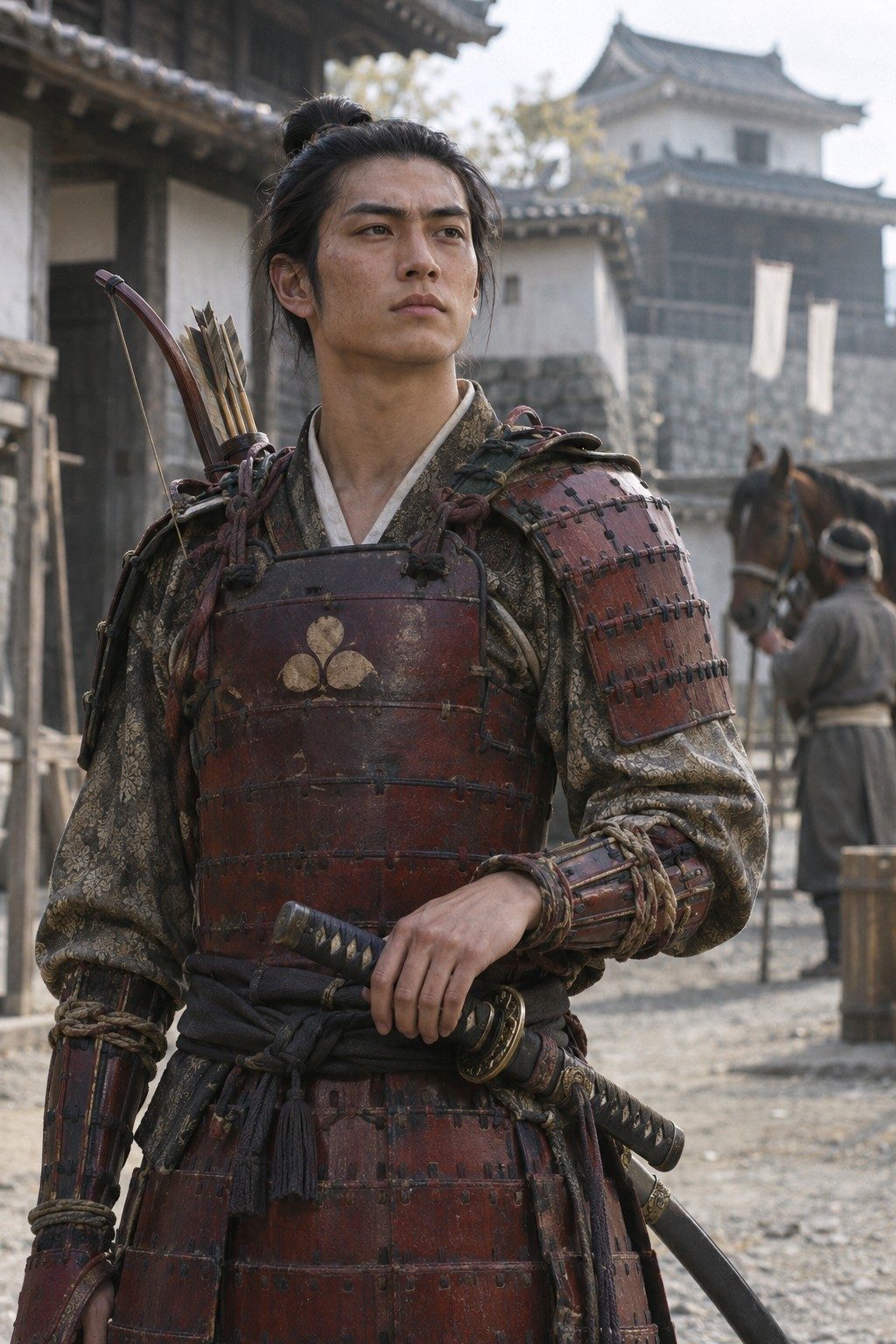
Birth: lesser house. Profession: Samurai.
Your family has served the same lord for six generations, and you're the first of them to be trusted with a horse. You practice the draw-cut every morning, and you'd die tomorrow for the lord who gave you a syllable of his name.
Attributes: Agility d8, Smarts d6, Spirit d6, Strength d6, Vigor d6
Skills: Athletics d6, Common Knowledge d6, Fighting d8, Intimidation d6, Notice d6, Persuasion d4, Riding d6, Shooting d6, Stealth d4
Pace: 6; Parry: 6; Toughness: 7 (2)
Hindrances: Code of Honor (Major), Loyal (Minor), Obligation (Minor: the lord)
Edges: Kiritani Style, Lord's Syllable
Gear: Long sword (Str+d6, or Str+d6+1 two-handed), short sword (Str+d6), half bow (12/24/48, 2d6) and 20 arrows, light armor (+2), formal clothes with the family crest, 490 mon.
Ronin (浪人)#
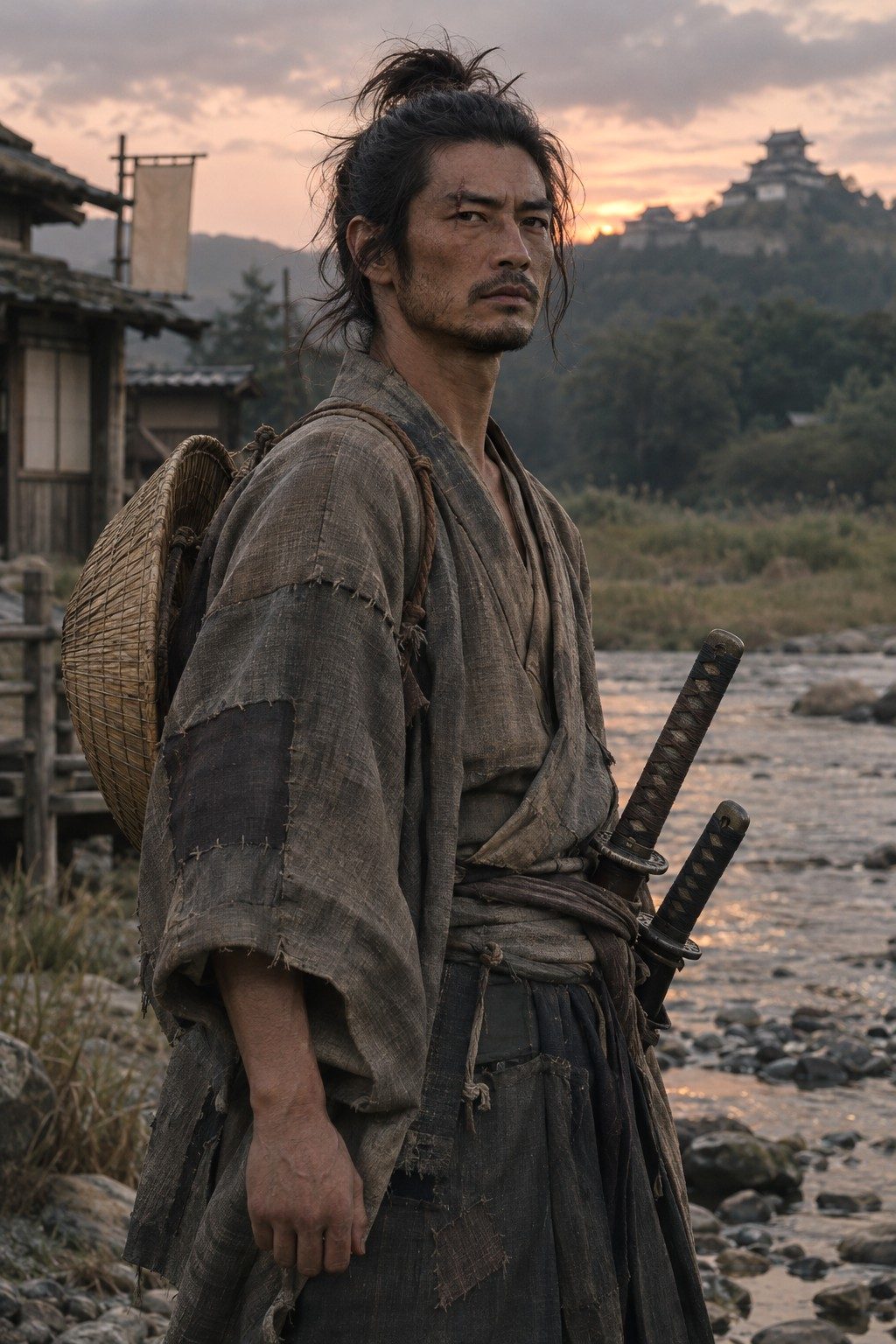
Birth: ronin family. Profession: Ronin.
Your father's lord fell at a river crossing twenty years ago, and the man who betrayed him now sits in his castle. You sell your sword to whoever pays, and you wait.
Attributes: Agility d8, Smarts d6, Spirit d6, Strength d6, Vigor d6
Skills: Athletics d6, Common Knowledge d4, Fighting d8, Gambling d6, Intimidation d6, Notice d6, Persuasion d4, Riding d4, Stealth d6, Survival d4
Pace: 6; Parry: 7; Toughness: 5
Hindrances: Masterless (Minor), Poverty (Minor), Vengeful (Major)
Edges: Amanoki Style, Trademark Weapon (long sword)
Gear: Long sword (Str+d6, or Str+d6+1 two-handed), short sword (Str+d6), traveler's kit, the guard of your father's sword, 250 mon (halved by Poverty).
Sōhei (warrior monk, 僧兵)#
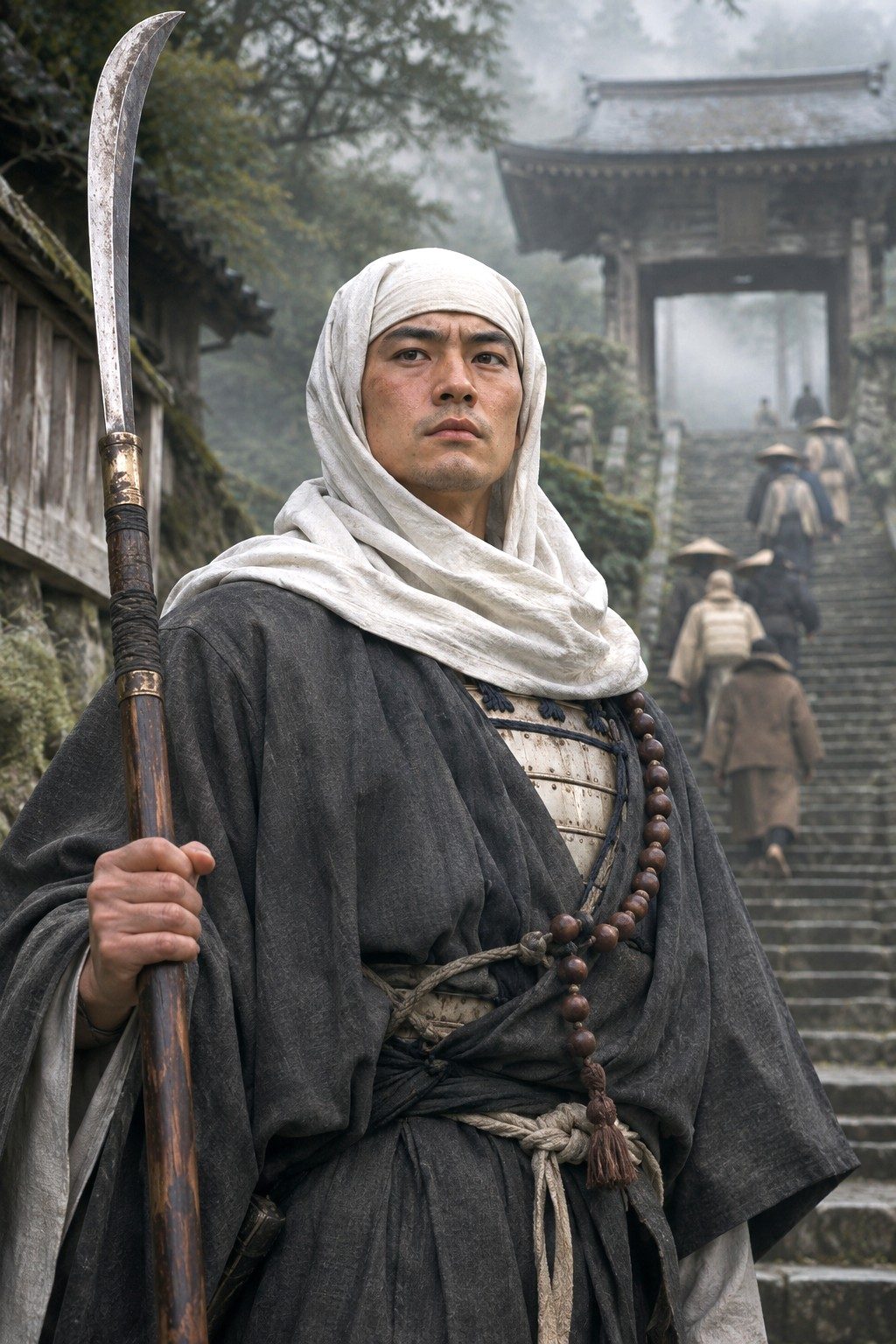
Birth: farmer. Profession: Warrior monk. Path: Sōhei.
The temple took you in when the famine took your family, and it put a glaive in your hands at twelve. Now you guard pilgrims on the mountain road, and you'll guard the league's farms against any lord who comes for them. When you chant the guardian kings' names, your glaive burns.
Attributes: Agility d6, Smarts d4, Spirit d6, Strength d8, Vigor d6
Skills: Athletics d6, Battle d4, Common Knowledge d4, Faith d6, Fighting d8, Healing d4, Intimidation d6, Notice d4, Persuasion d6, Stealth d4
Pace: 6; Parry: 6; Toughness: 7 (2)
Hindrances: Partisan (Major: the third power), Stubborn (Minor), Vow (Minor: the temple's rule, from the Arcane Background)
Edges: Arcane Background (Sōhei), Tamaeda Style
Powers: Burning Steel (smite), Body Ward (protection). 10 Power Points.
Gear: Glaive (Str+d8, Reach 1), monk's head-cowl and robes, light armor (+2) worn beneath them, the village amulet, 500 mon.
Advancing: At Seasoned, Spirit d8 and Niō's Wrath (Part 2).
Wandering Monk#
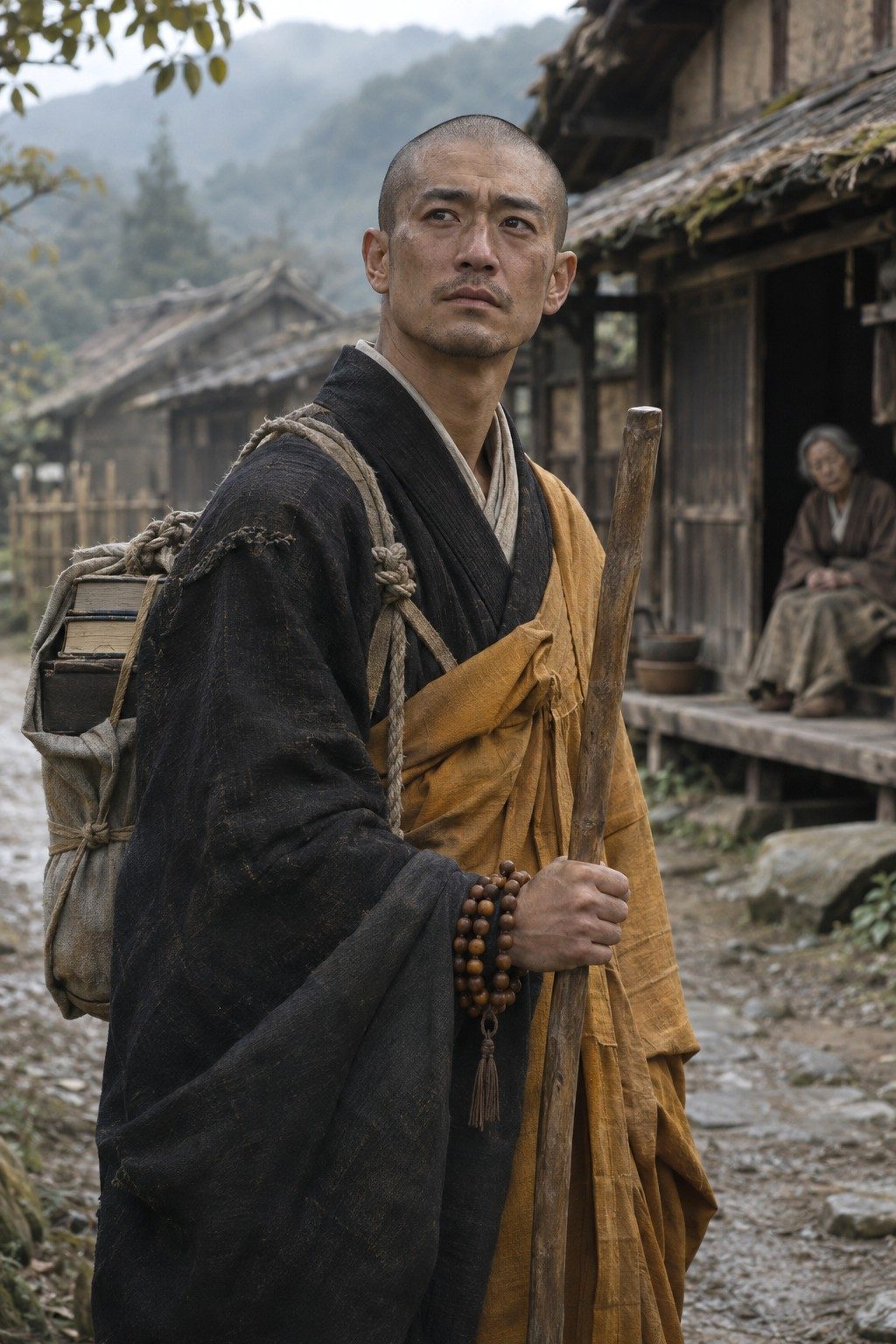
Birth: lesser house. Profession: Monk.
You were your father's second son, and your older brother still serves your lord. You gave up the sword for the robe, but some days your heart is still in that hall. You walk the roads healing the sick, and your fists remember what your sword teacher taught you.
Attributes: Agility d6, Smarts d6, Spirit d8, Strength d4, Vigor d6
Skills: Academics d6, Athletics d6, Common Knowledge d4, Faith d8, Fighting d6, Healing d6, Notice d6, Persuasion d6, Stealth d4
Pace: 6; Parry: 6; Toughness: 5
Hindrances: Pacifist (Minor), Torn Heart (Minor), Vow (Major: the monk's vows)
Edges: Healer, Martial Artist, Seated Meditation
Gear: Staff (Str+d4, Parry +1, Reach 1), fine robes, prayer beads, a book of sutras and a set of the classics, 500 mon.
Status: Trusted in the temple, because of a buke birth.
Mountain Ascetic (Yamabushi, 山伏)#
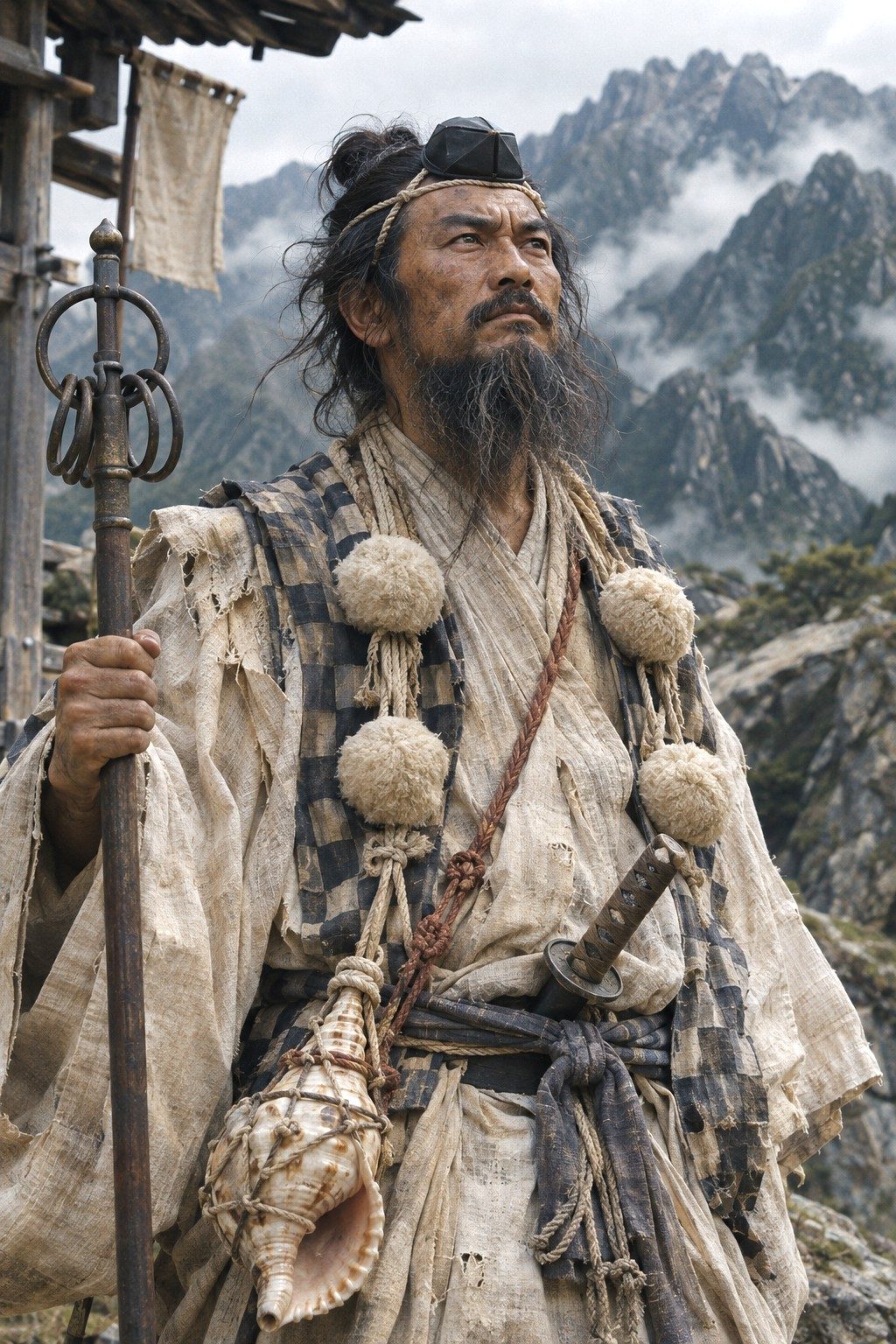
Birth: farmer. Profession: Mountain ascetic. Path: Yamabushi.
You've stood under winter waterfalls and walked the ridges for a hundred days without meat or a roof. The mountain kami know your conch, the crows talk to you, and the villages below send for you when something walks their fields at night.
Attributes: Agility d4, Smarts d6, Spirit d8, Strength d6, Vigor d6
Skills: Athletics d6, Common Knowledge d4, Faith d8, Fighting d6, Healing d4, Notice d4, Persuasion d4, Stealth d4, Survival d8
Pace: 6; Parry: 6; Toughness: 5
Hindrances: Taboo (Minor: no meat of four-legged beasts), Vow (Major: the ascetic's disciplines), Armor Interference (Minor, from the Arcane Background), Quirk (Minor: answers the crows aloud, from the Arcane Background)
Edges: Arcane Background (Yamabushi), Conch of the Mountain
Powers: Spirit Ward (arcane protection), Soothing (relief), Purification (harai), Strengthen and Doom (boost/lower Trait), Burning Steel (smite). 10 Power Points.
Gear: Ringed staff (Str+d4, Parry +1, Reach 1), short sword (Str+d6), conch trumpet (fetish), ascetic's robes and small black cap, the village amulet, 500 mon.
Advancing: At Seasoned, Spirit d10 and Hand Seals.
Yin-Yang Master (Onmyōji, 陰陽師)#
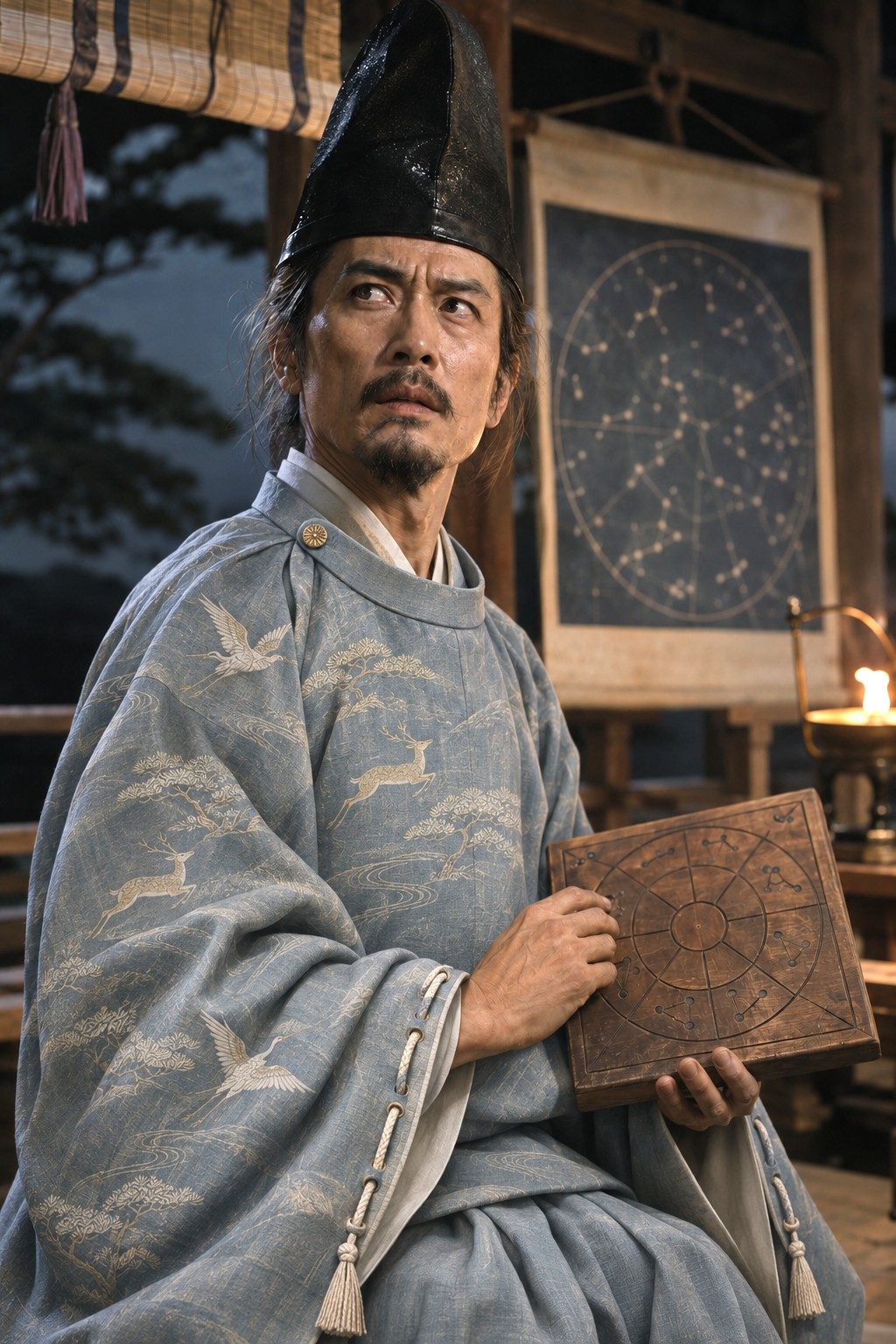
Birth: court noble. Profession: Yin-yang master. Path: Onmyōji.
Your family once read the stars for the Emperor himself. Now you read them for a provincial lord who can't tell a poem from a grocery list. He pays you well to name the lucky days for his battles, and you always want to know more than you should. Your paper servant, a little bird folded from a page of your grandfather's almanac, goes everywhere with you.
Attributes: Agility d6, Smarts d8, Spirit d8, Strength d4, Vigor d6
Skills: Academics d8, Athletics d4, Common Knowledge d4, Notice d4, Occult d6, Performance d4, Persuasion d4, Research d8, Spellcasting d8, Stealth d4
Pace: 6; Parry: 2; Toughness: 5
Hindrances: Curious (Major), Poverty (Minor), Taboo (Minor: never travels in an unlucky direction), Armor Interference (Major, from the Arcane Background), Material Components (paper, ink, and seals, from the Arcane Background)
Edges: Arcane Background (Onmyōji), Scholar (Occult)
Phase: Water (ice, mist, and black rain).
Powers: Spirit Sight and Veil (detect/conceal arcana), Unbinding (dispel), Spirit Servant (summon ally, a shikigami), Arrows (bolt, shards of ice), Body Ward (protection), Seal and Open (lock/unlock). 15 Power Points.
Arts: Calligraphy and poetry (waka). Speaks the court's high speech.
Gear: Compass board, almanac and star charts, writing case with paper, cinnabar, and seals, the patent of the family's court rank and a letter of introduction, 250 mon (halved by Poverty).
Advancing: At Seasoned, Artificer (free with the Arcane Background) and Shikigami.
Shrine Maiden (Miko, 巫女)#
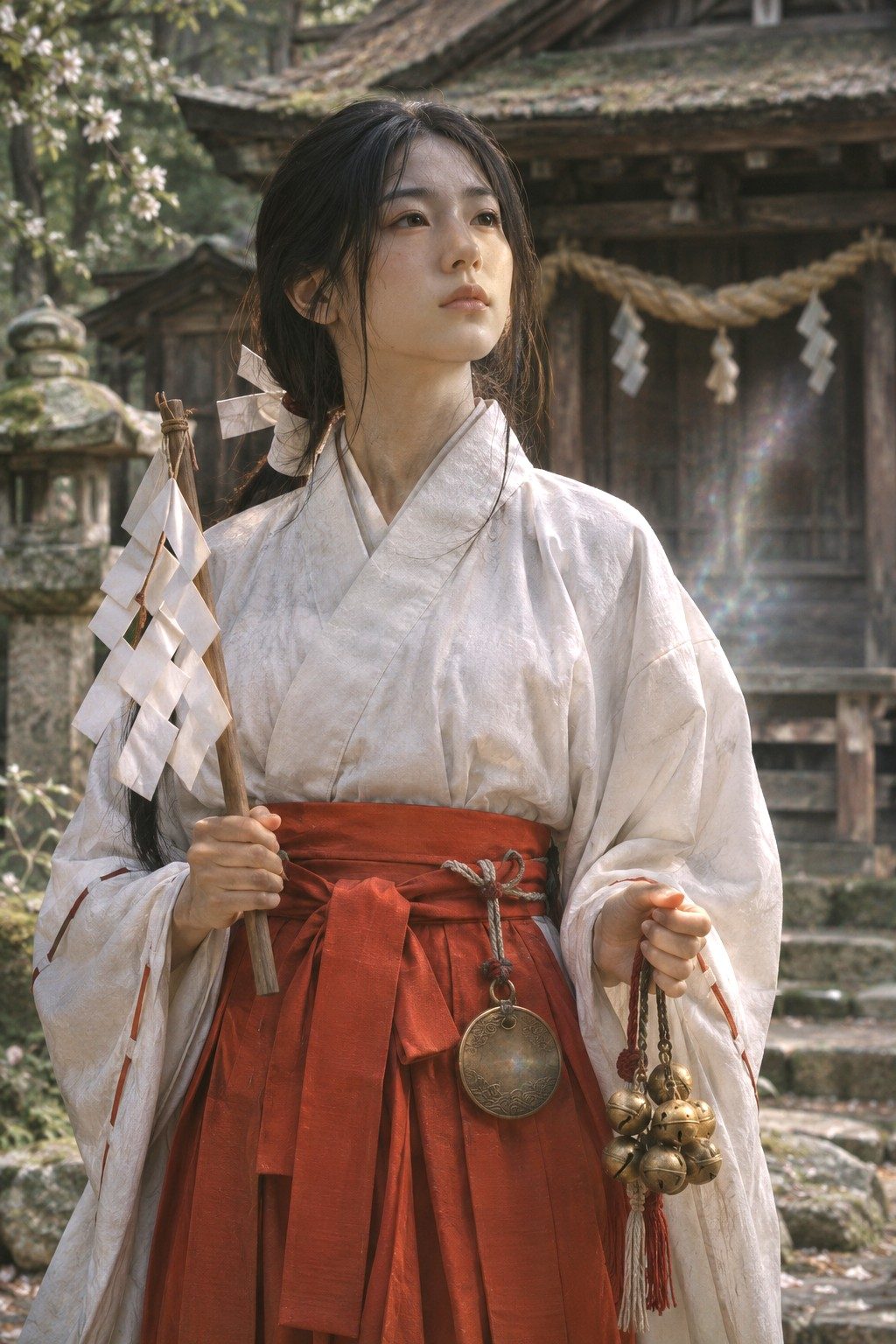
Birth: farmer (a village shrine family). Profession: Shrine maiden. Path: Kannagi.
Your family has kept the village shrine for longer than anyone remembers. You dance for the rice kami at every festival, and lately the kami has started dancing back. Last spring, in front of the whole village, it spoke through you.
Attributes: Agility d6, Smarts d6, Spirit d8, Strength d4, Vigor d6
Skills: Athletics d6, Common Knowledge d6, Faith d8, Healing d6, Notice d6, Occult d6, Performance d8, Persuasion d6, Stealth d4
Pace: 6; Parry: 2; Toughness: 5
Hindrances: Loyal (Minor), Obligation (Minor: the shrine), Taboo (Major: never touches the dead), Vow (Major: serve the kami and keep the shrine pure, from the Arcane Background)
Edges: Arcane Background (Kannagi), Sacred Dance
Kami: the village's rice kami (Rice and Harvest nature).
Powers: Purification (harai), Mending (healing), Spirit Ward (arcane protection), Soothing (relief), Strengthen and Doom (boost/lower Trait). 10 Power Points.
Arts: Sacred dance, song and chant, flute, calligraphy.
Gear: White robes and red trousers, purification wand (holy symbol), sacred bells, small mirror, the village amulet, 500 mon.
Advancing: At Seasoned, Spirit d10 and Oracle let the kami answer questions in trance.
Scholar-Nun (Ama, 尼)#
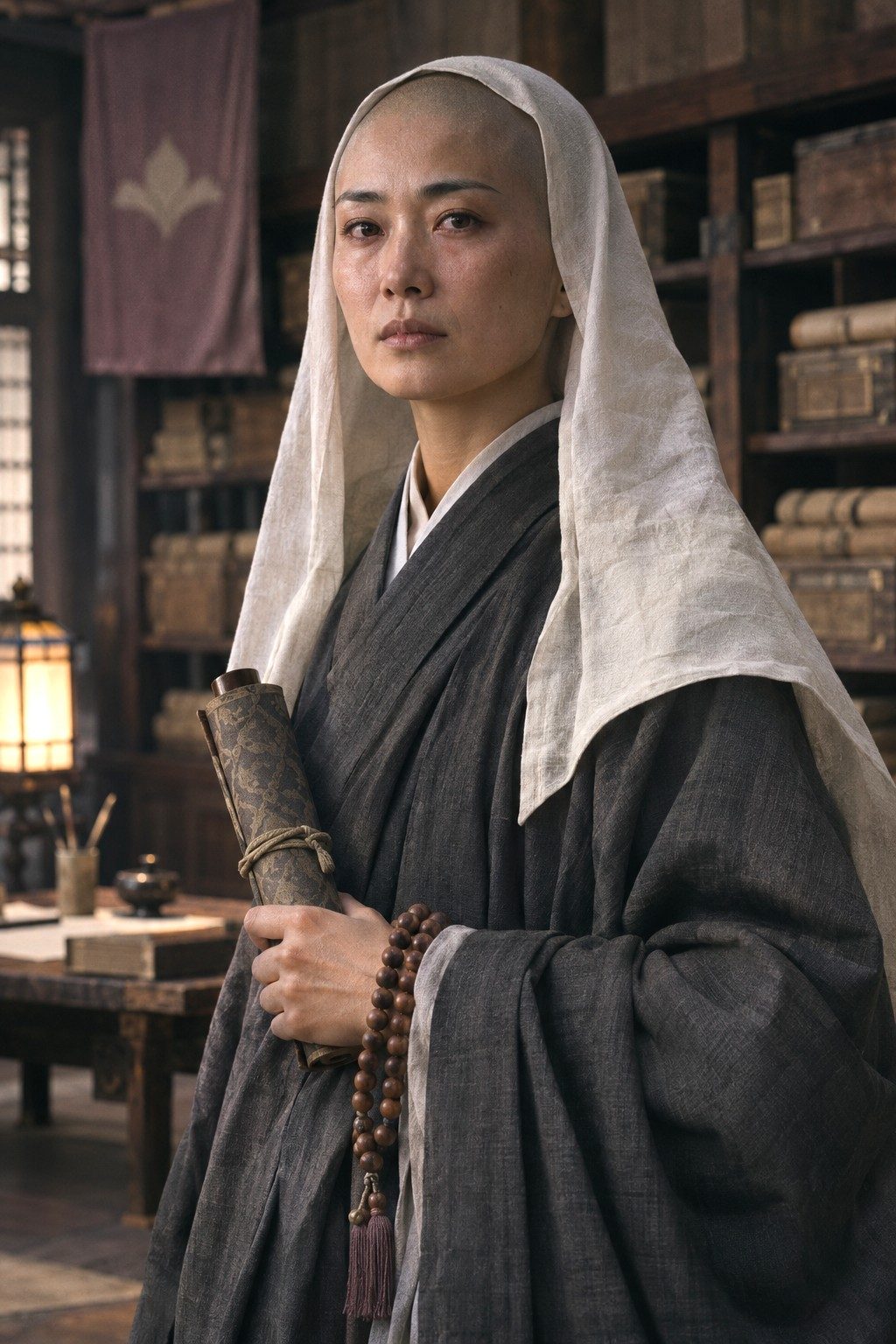
Birth: lesser house. Profession: Nun. Path: Gakushō.
Your husband died on the walls of a castle that fell anyway. You cut your hair the same month and entered the convent, meaning to pray for him and nothing else. But the abbess saw what the sutras did in your hands, and she sent you out on the roads, where the dead outnumber the living.
Attributes: Agility d4, Smarts d8, Spirit d8, Strength d4, Vigor d6
Skills: Academics d8, Athletics d4, Common Knowledge d6, Faith d8, Healing d6, Notice d6, Occult d4, Persuasion d6, Stealth d4
Pace: 6; Parry: 2; Toughness: 5
Hindrances: Heroic (Major), Pacifist (Minor), Torn Heart (Minor), Vow (Major: the precepts, and the rites for any who ask, from the Arcane Background)
Edges: Arcane Background (Gakushō), Compassion, Healer
Powers: Mending (healing), Feeding the Hungry Ghosts (segaki), Spirit Ward (arcane protection), Perceive Truth (mind reading), Shelter (sanctuary). 10 Power Points.
Arts: None yet, since she has no Performance (Part 2). Her calligraphy and her reading of the classics are Academics, and her chanting is Faith.
Gear: Nun's robes and hood, prayer beads (holy symbol), a sutra scroll, a begging bowl, writing case, her husband's memorial tablet, 500 mon.
Status: Trusted in the convent, because of a buke birth.
Advancing: At Seasoned, Calling the Guardians (shōshō) and Sutra Skin (grave shroud).
Shinobi (忍び)#
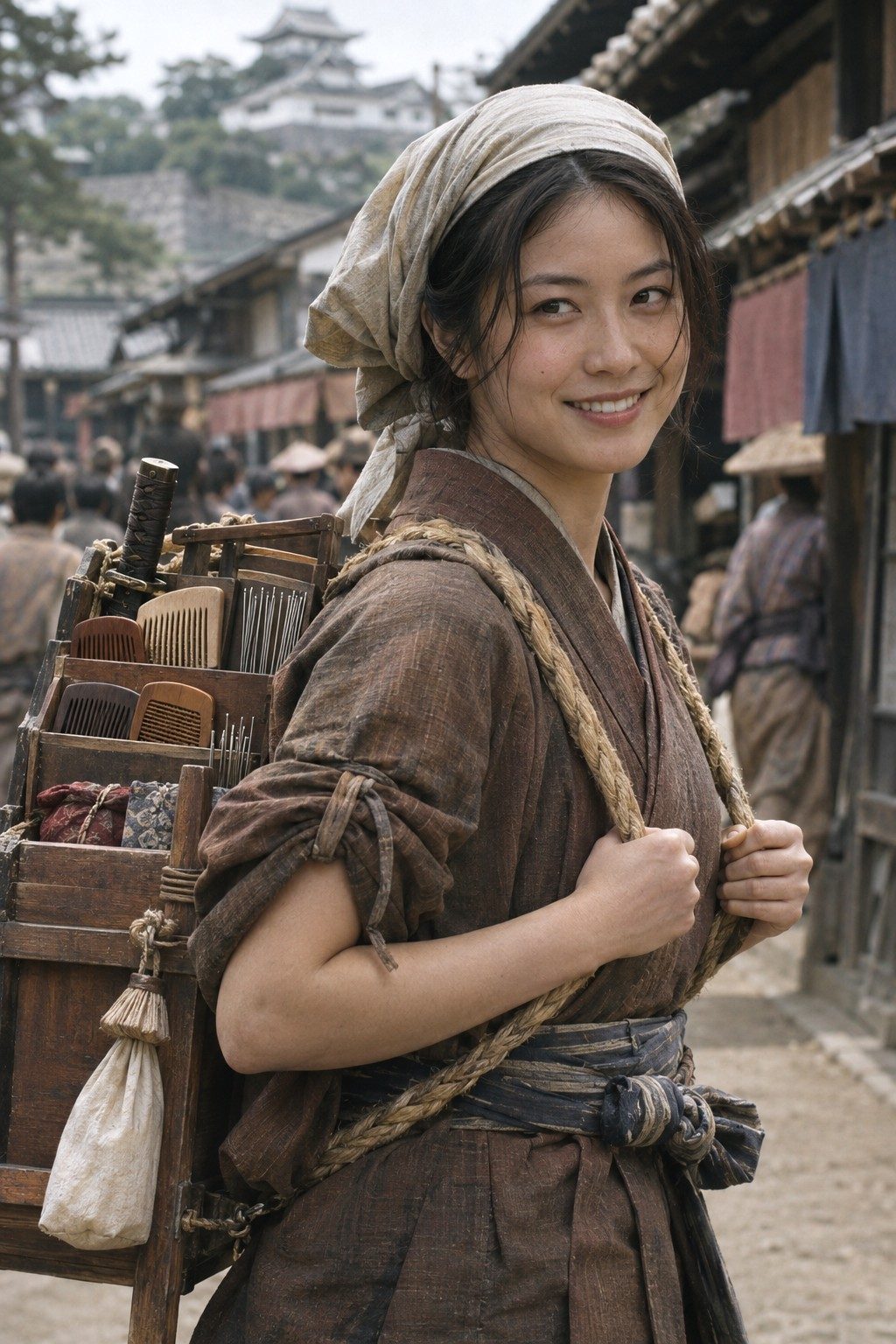
Birth: artisan. Profession: Shinobi (cover: peddler).
The league raised you in the misty hollows above the pass. In the town below, you're a cheerful peddler of combs and needles. You're also very careful, because a shinobi who is caught never leaves.
Attributes: Agility d8, Smarts d6, Spirit d4, Strength d6, Vigor d6
Skills: Athletics d8, Common Knowledge d6, Fighting d6, Notice d6, Performance d6, Persuasion d4, Stealth d8, Thievery d8
Pace: 6; Parry: 5; Toughness: 5
Hindrances: Cautious (Minor), Obligation (Minor: the league), Secret (Major: the league)
Edges: Assassin, Shinobi
Arts: Festival dance, song and chant, storytelling.
Gear: Shinobi sword (Str+d6), grappling rope, climbing claws, 10 throwing blades (3/6/12, Str+d4), a peddler's 500 mon of trade goods, scales, and ledger, the craft house's seal, 450 mon.
Merchant#
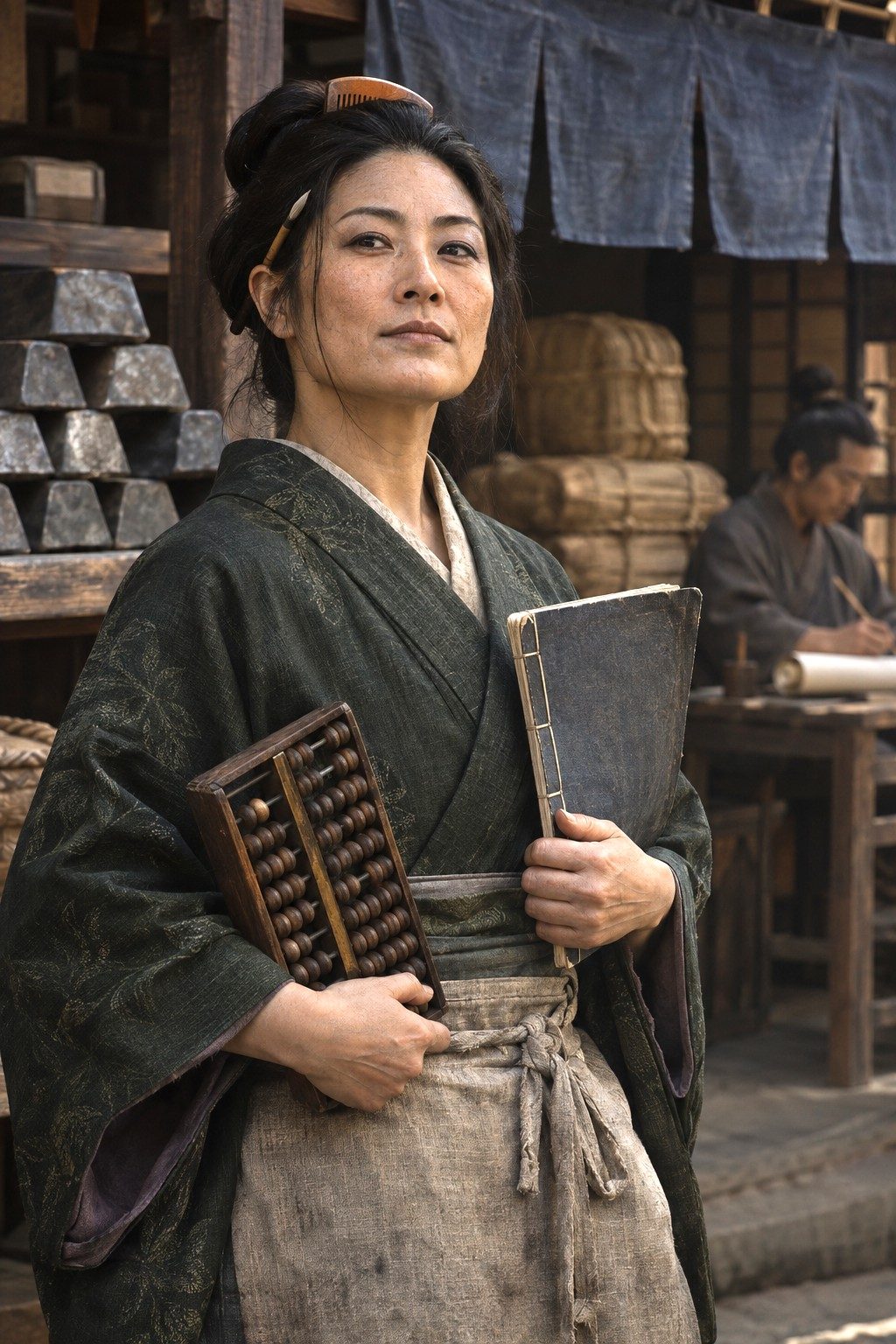
Birth: merchant. Profession: Merchant.
Your house buys iron from both sides of the war, and lends money to both. You've learned to read a price, a debt, and a face. You owe a great deal to an uncle who expects a great deal back.
Attributes: Agility d6, Smarts d8, Spirit d6, Strength d4, Vigor d6
Skills: Academics d6, Athletics d4, Common Knowledge d6, Fighting d4, Gambling d6, Language (Daqian) d6, Notice d6, Persuasion d8, Riding d4, Stealth d4
Pace: 6; Parry: 4; Toughness: 5
Hindrances: Cautious (Minor), Greedy (Minor), Indebted (Minor: an uncle in the house)
Edges: Merchant's Eye, Rich
Gear: Dagger (Str+d4), 500 mon of trade goods, scales, ledger of small debts, abacus, the family seal, 1,420 mon (Rich triples the starting funds).
Sakaibito Spirit Hunter#
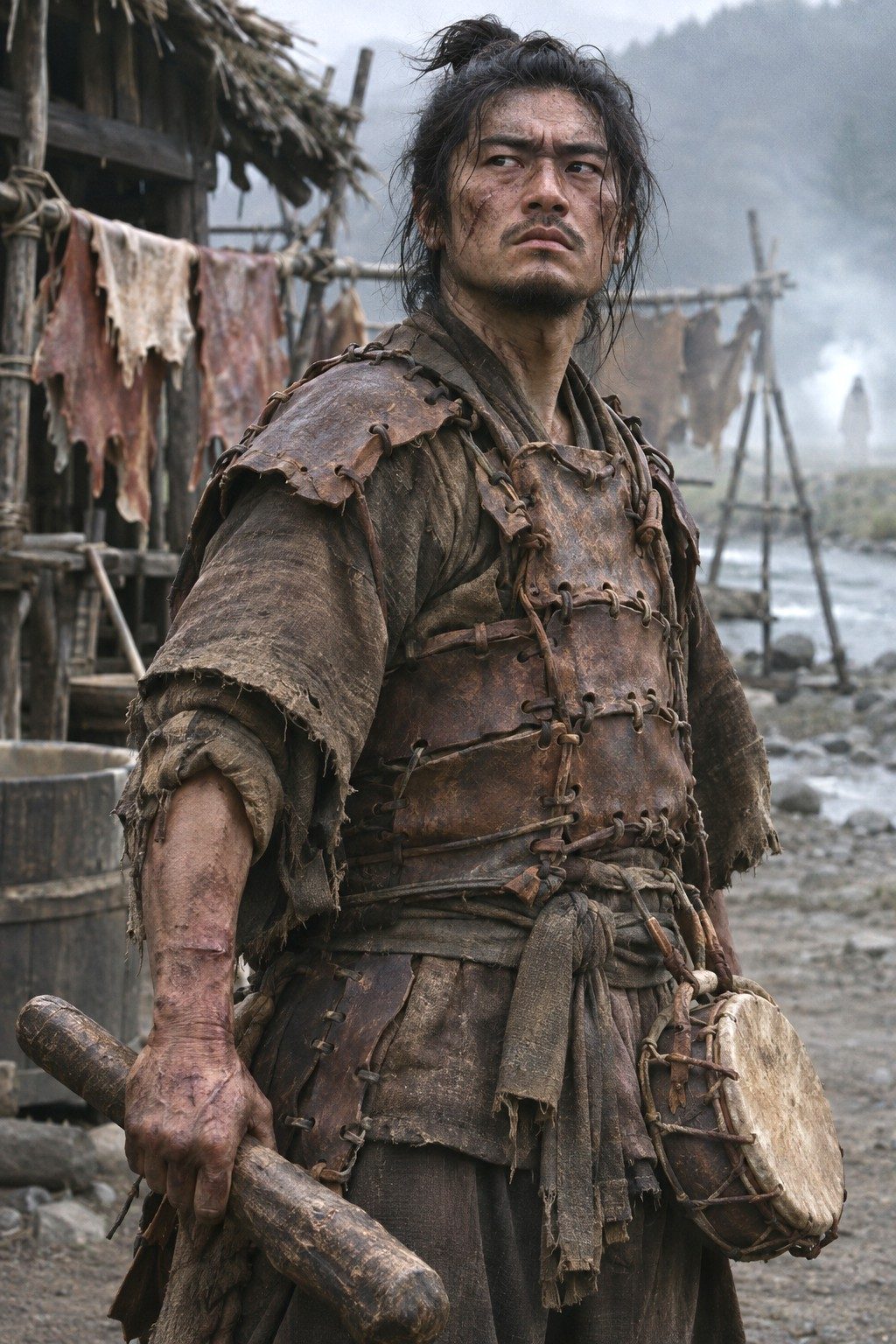
Birth: sakaibito. Profession: Artisan (drum-maker).
You've stretched hides for war drums and washed the dead since you could walk. When a ghost killed your sister, the priests wouldn't come to the hamlet. So you went after it yourself, and now it won't leave you alone.
Attributes: Agility d6, Smarts d4, Spirit d8, Strength d6, Vigor d6
Skills: Athletics d6, Common Knowledge d4, Fighting d6, Intimidation d6, Notice d6, Occult d6, Persuasion d4, Repair d6, Stealth d4
Pace: 6; Parry: 5; Toughness: 7 (2)
Hindrances: Haunted (Minor), Vengeful (Major)
Edges: Keeper of the Dead, Spirit Sight
Gear: Cudgel (Str+d4), light armor of your own make (+2), drum-maker's tools, the hamlet's tally, 475 mon.
Gambler (Bakuto, 博徒)#
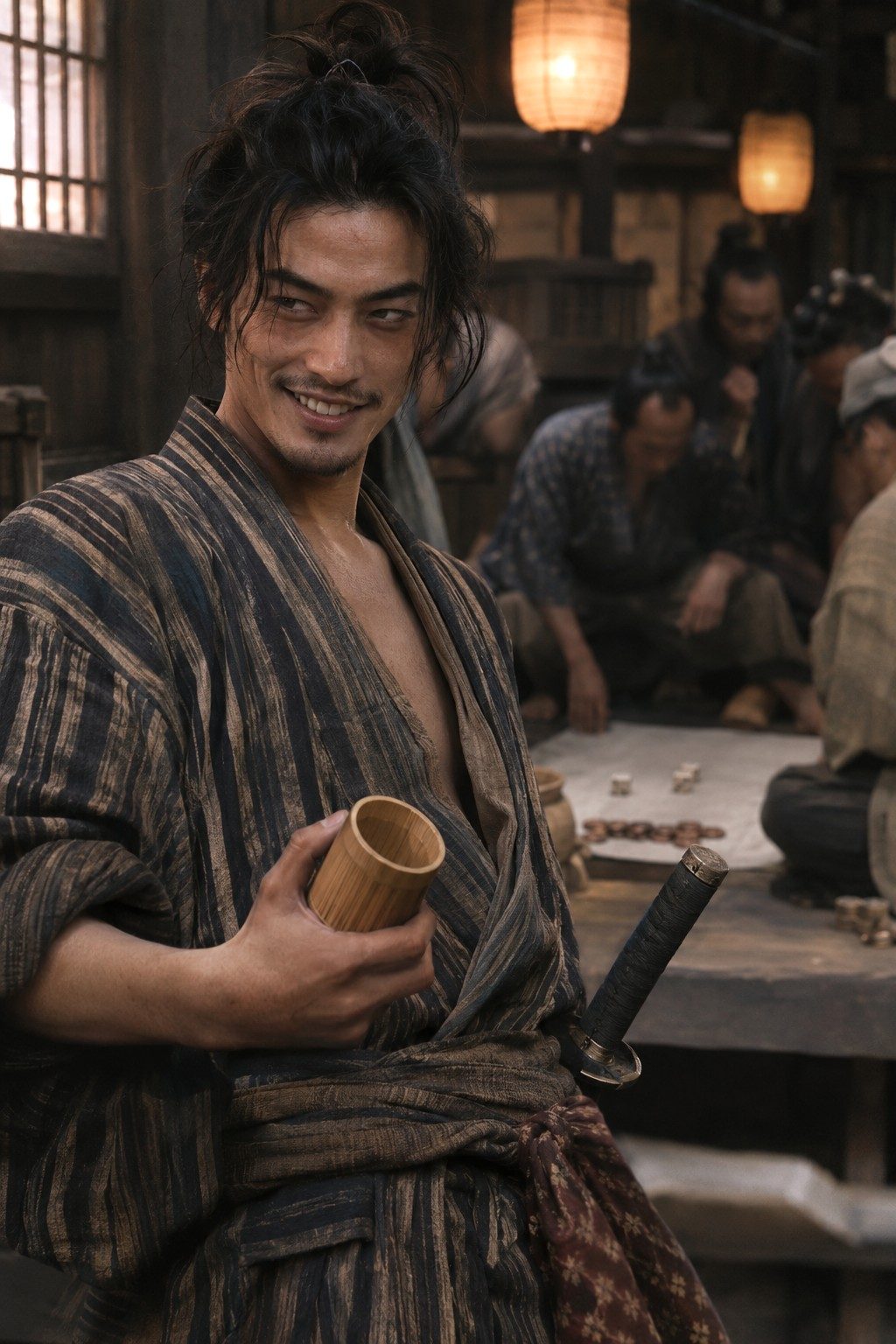
Birth: farmer. Profession: Gambler.
You ran from the rice fields at fifteen and never looked back. The boss of the dice houses below the pass took you in. He paid your debts and saved your neck, and one day he'll name the price.
Attributes: Agility d6, Smarts d8, Spirit d4, Strength d6, Vigor d6
Skills: Athletics d6, Common Knowledge d4, Fighting d6, Gambling d8, Notice d6, Persuasion d6, Stealth d6, Taunt d6, Thievery d6
Pace: 6; Parry: 5; Toughness: 5
Hindrances: Big Mouth (Minor), Greedy (Minor), Indebted (Major: the boss)
Edges: Gambler, Streetwise
Gear: Common blade (Str+d6), dice cup and dice, traveler's kit, the village amulet, 500 mon.
Gentry Captain#
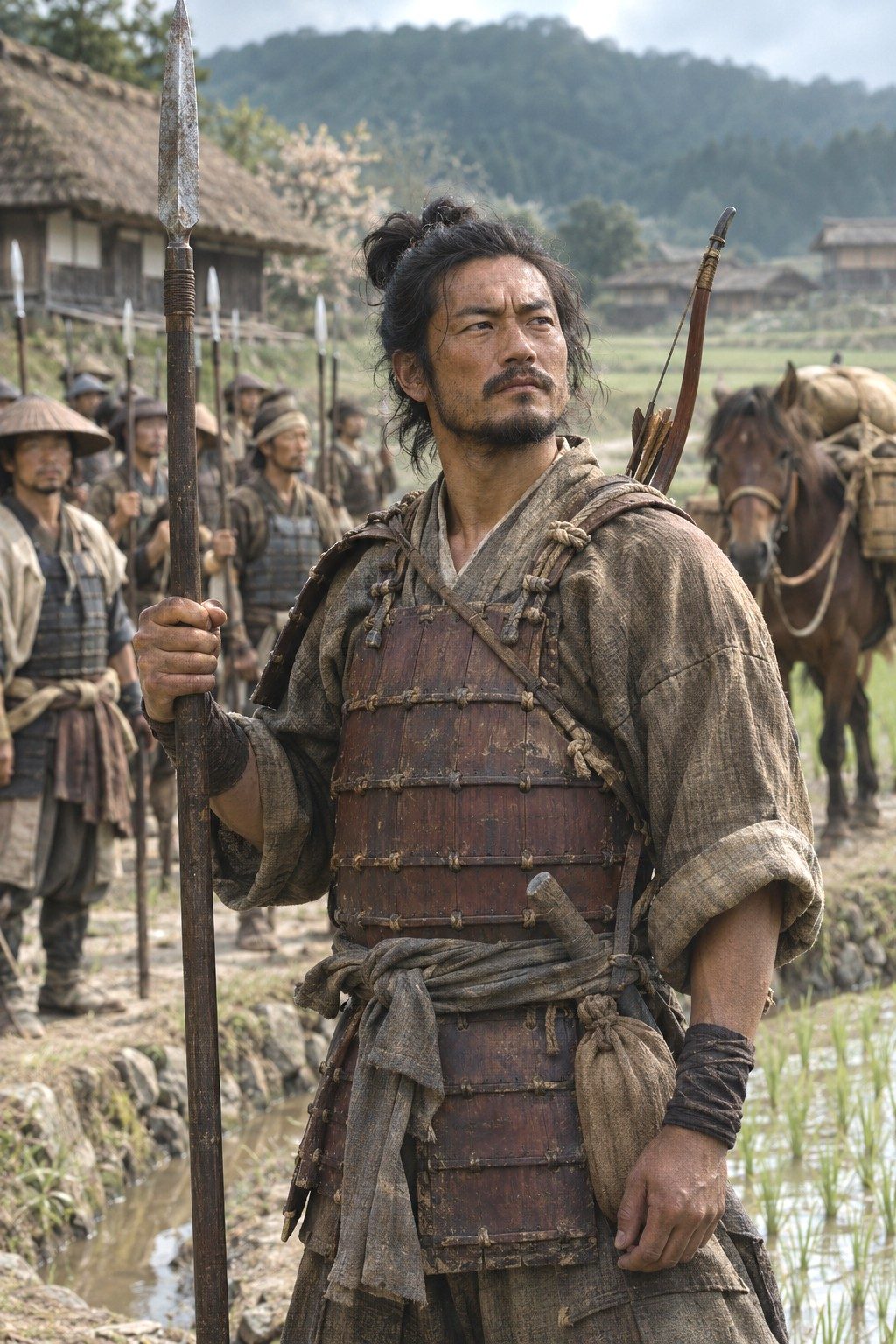
Birth: farmer (headman's family). Profession: Gentry.
You lead your village's spearmen when the lord calls, and you speak for the village when the tax collector comes. What the lord doesn't know is that your father pays the sect league, too, and you've sworn to keep that secret.
Attributes: Agility d6, Smarts d6, Spirit d6, Strength d6, Vigor d6
Skills: Athletics d6, Battle d6, Common Knowledge d6, Fighting d6, Notice d6, Persuasion d6, Riding d6, Shooting d6, Stealth d4, Survival d4
Pace: 6; Parry: 6; Toughness: 7 (2)
Hindrances: Obligation (Minor: the village), Torn Heart (Major: the lord or the league)
Edges: Command, Sekigawa Style
Gear: Spear (Str+d6, Reach 1, Parry +1 two-handed), half bow (12/24/48, 2d6) and 20 arrows, light armor (+2), pack horse, the village amulet, 340 mon.
Foot Soldier (Ashigaru, 足軽)#
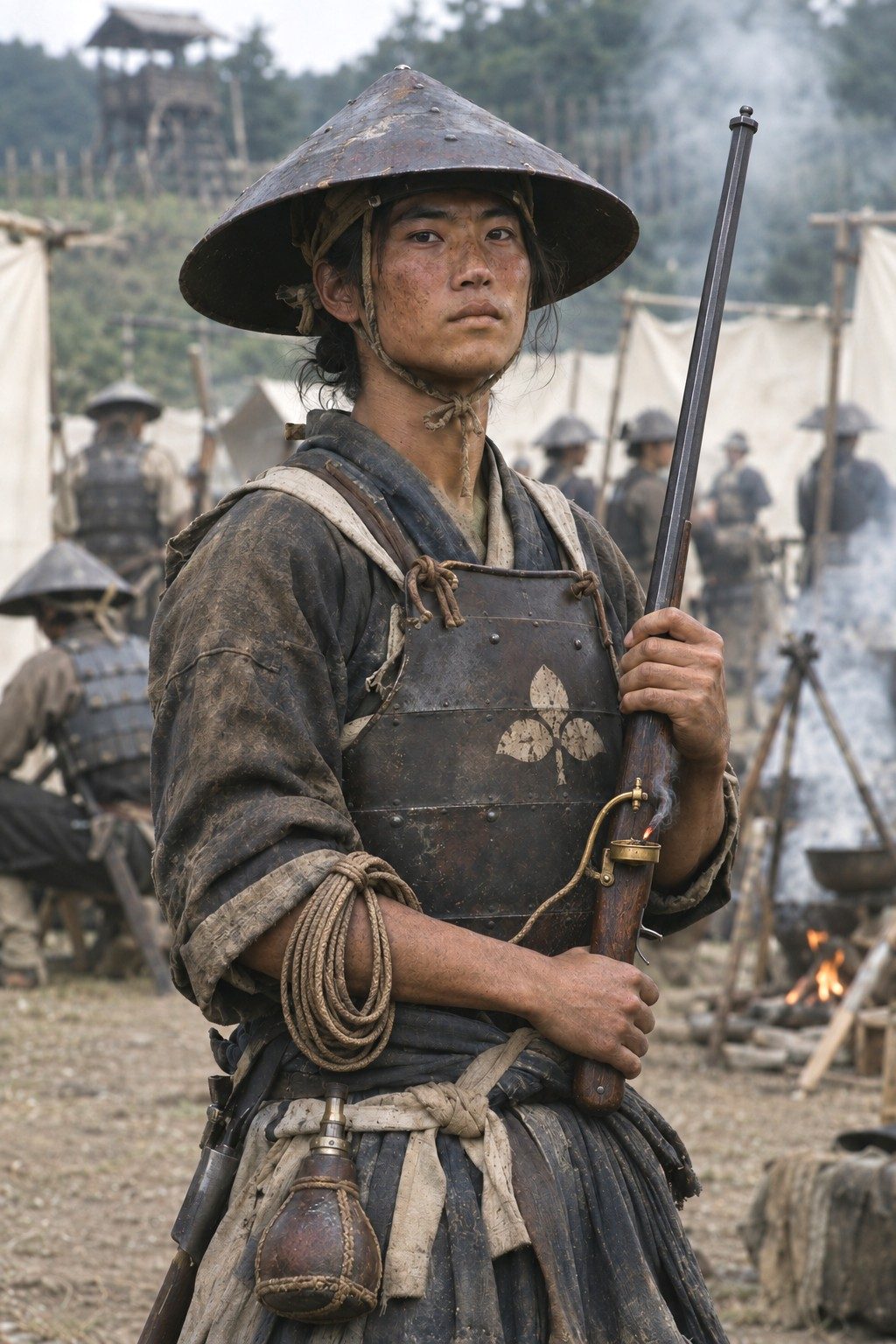
Birth: farmer. Profession: Foot soldier.
The lord's men came through your village with a drum and a promise of rice, and you went. A gunnery sergeant from Hagane taught you the matchlock, and you can load it in the dark. You're loyal to the men beside you, and to the captain who keeps you fed.
Attributes: Agility d6, Smarts d4, Spirit d6, Strength d6, Vigor d8
Skills: Athletics d6, Battle d4, Common Knowledge d4, Fighting d6, Gambling d4, Notice d6, Persuasion d4, Shooting d8, Stealth d6, Survival d4
Pace: 6; Parry: 6; Toughness: 8 (2)
Hindrances: Loyal (Minor), Obligation (Minor: the captain), Poverty (Minor)
Edges: Gunner, Soldier
Gear: Spear (Str+d6, Reach 1, Parry +1 two-handed), matchlock (10/20/40, 2d8, AP 2, Reload 2 with Gunner) with shot and powder for 20, partial light foot soldier's armor (+2, on loan from the lord), the village amulet, 248 mon (halved by Poverty).
Enforcer#
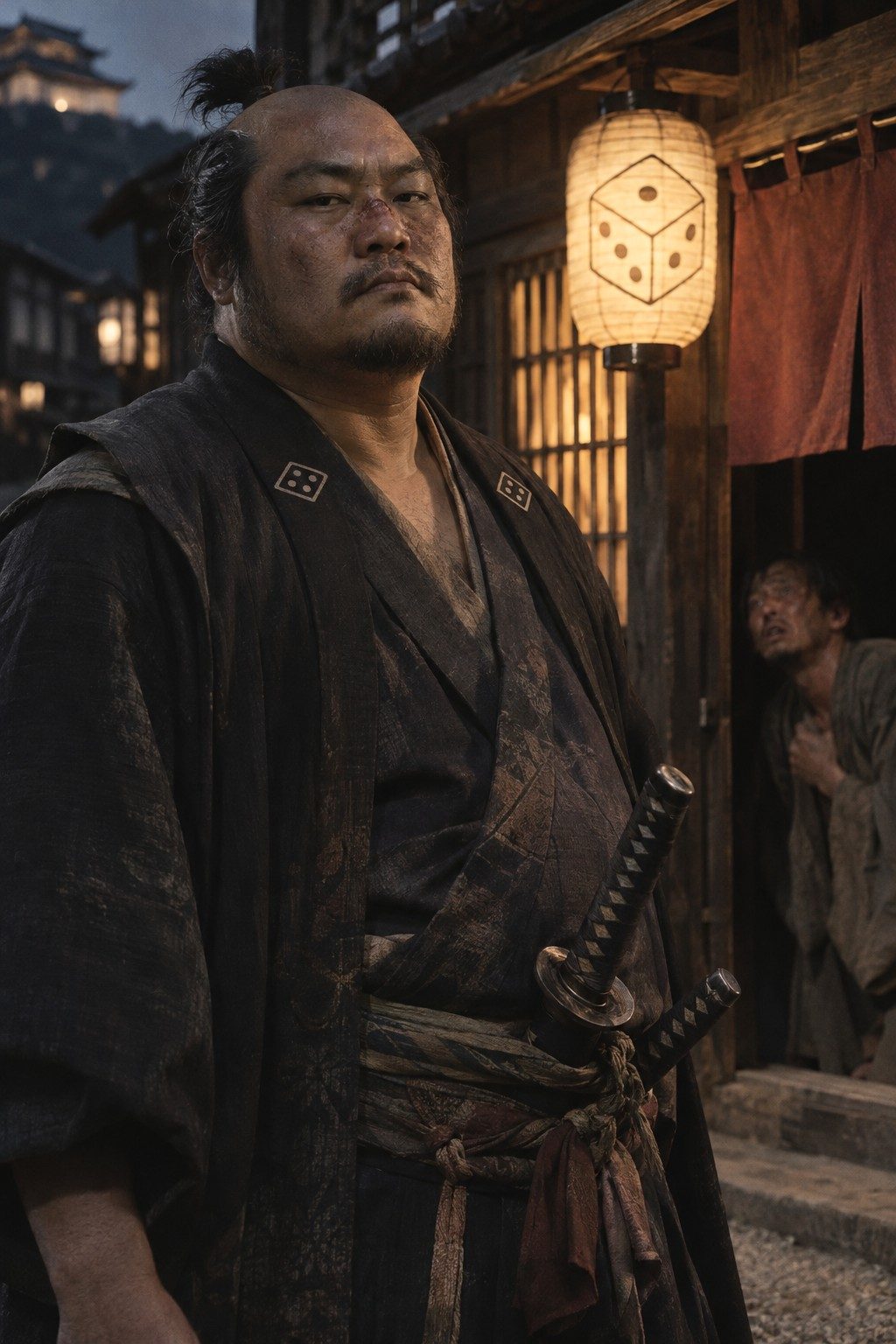
Birth: ronin family. Profession: Enforcer.
Your grandfather wore a lord's crest. You wear the dice house's. When a debtor won't pay or a rival boss gets ideas, the family sends you, and you don't have to draw the sword very often. Your old friends from the warrior houses cross the street when they see you.
Attributes: Agility d6, Smarts d4, Spirit d6, Strength d8, Vigor d8
Skills: Athletics d6, Common Knowledge d4, Fighting d8, Gambling d4, Intimidation d8, Notice d6, Persuasion d4, Stealth d4
Pace: 6; Parry: 6; Toughness: 7
Hindrances: Mean (Minor), Obligation (Major: the boss), Vengeful (Minor: the house that cast out his grandfather)
Edges: Brawler, Menacing
Gear: Long sword (Str+d6, or Str+d6+1 two-handed), short sword (Str+d6), traveler's kit, your grandfather's war banner, 500 mon.
Honor: –2, for a buke hero in the underworld.
Court Poet#
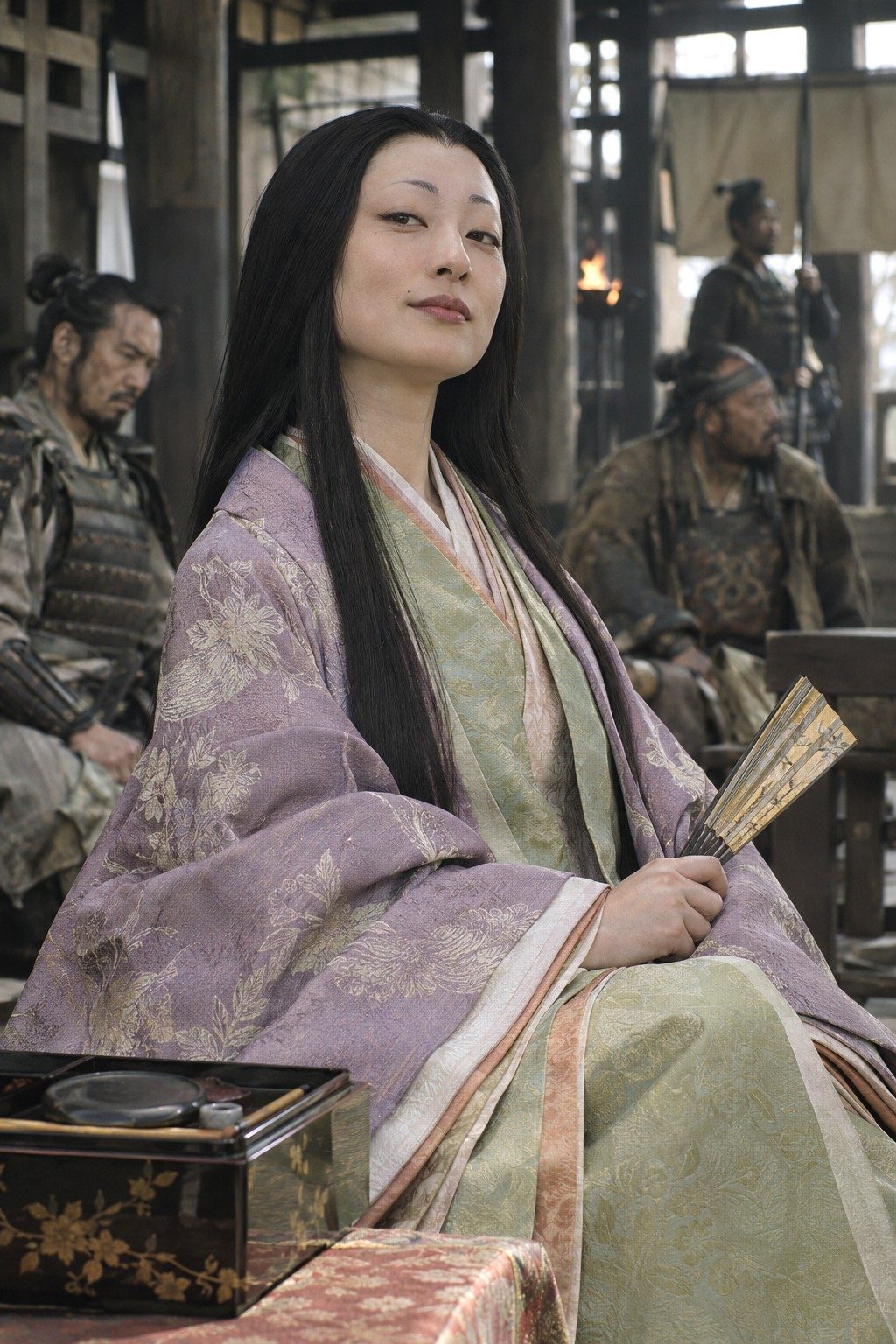
Birth: court noble. Profession: Courtier.
Your family fled the burning capital when you were a child, and a provincial lord took you in as an ornament for his hall. You teach his daughters poetry, write his letters to the court, and smile at his crude retainers. You've never forgiven the red plum for the fire.
Attributes: Agility d6, Smarts d8, Spirit d8, Strength d4, Vigor d6
Skills: Academics d6, Athletics d4, Common Knowledge d6, Fighting d4, Notice d6, Performance d8, Persuasion d8, Stealth d4, Taunt d6
Pace: 6; Parry: 4; Toughness: 5
Hindrances: Arrogant (Major), Partisan (Minor: the white plum), Poverty (Minor)
Edges: Artist, Court Poet
Arts: Poetry, linked verse, calligraphy, court dance, zither, incense comparing, tea gathering, kick-ball, and heraldry and lineage (nine: the full Performance die with Artist, plus one from the profession). Speaks the court's high speech.
Gear: Court robes, fan, writing case, a letter of introduction from the lord, the patent of the family's court rank, 250 mon (halved by Poverty).
Peasant Martial Artist#
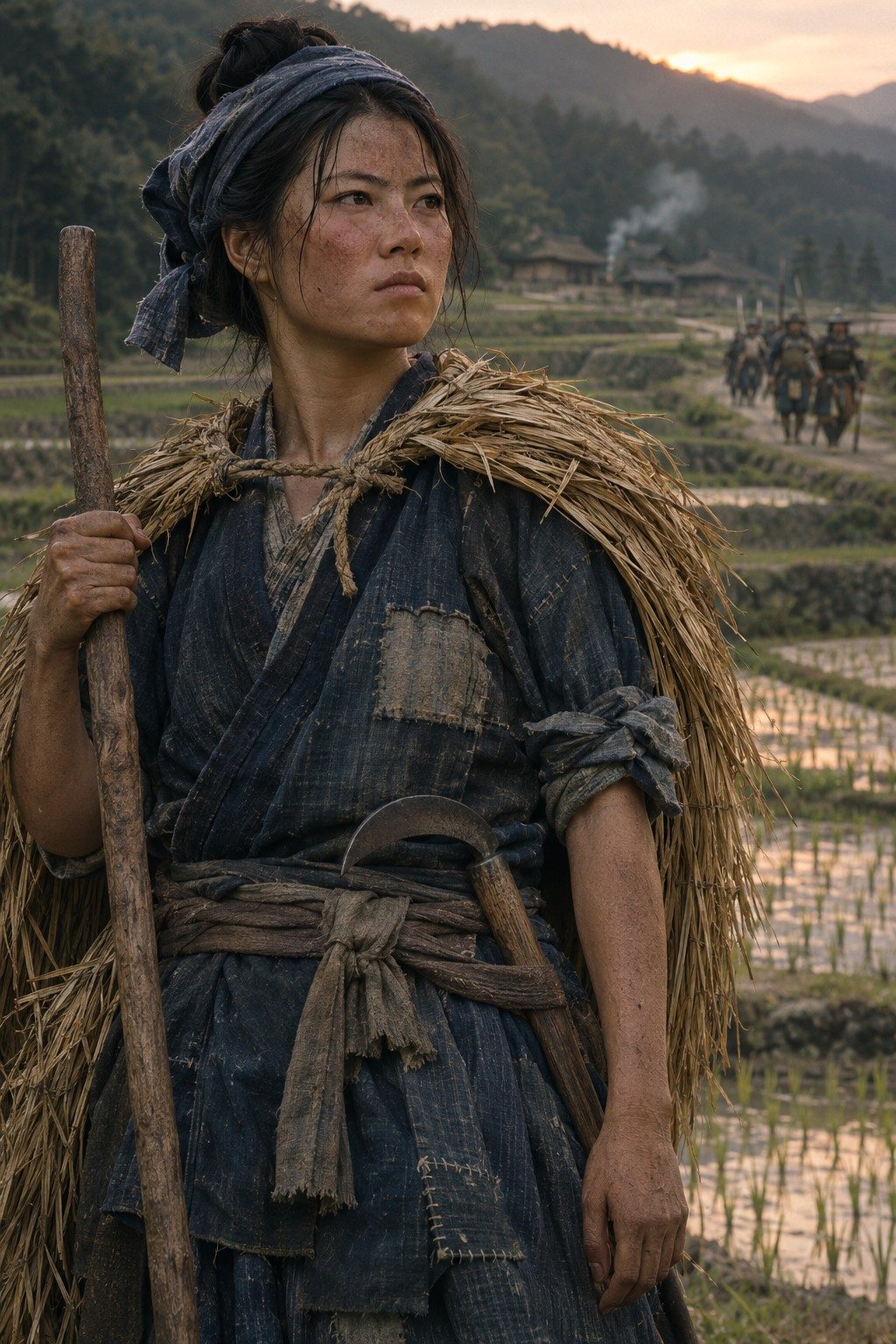
Birth: farmer. Profession: Farmer.
Farmers aren't allowed swords, so your grandfather taught you to fight without one, and with the staff, the sickle, and the flail. You still work your family's fields. But when bandits or a lord's drunken soldiers come to the village, you're the one who walks out to meet them, whether it's wise or not.
Attributes: Agility d8, Smarts d4, Spirit d6, Strength d6, Vigor d8
Skills: Athletics d8, Common Knowledge d4, Fighting d8, Intimidation d4, Notice d6, Persuasion d4, Stealth d6, Survival d6
Pace: 6; Parry: 7; Toughness: 6
Hindrances: Heroic (Major), Poverty (Minor), Stubborn (Minor)
Edges: First Strike, Martial Artist
Gear: Staff (Str+d4, Parry +1, Reach 1), sickle (Str+d4), straw rain cape, a sack of rice, the village amulet, 240 mon (halved by Poverty).
Advancing: At Seasoned, Strength d8 and Stunning Blow (Fantasy Companion p. 35) give the striking art (atemi-waza) described in Part 4.
Parties#
| Party | Suggested archetypes |
|---|---|
| Retainers in a lord's service | Samurai retainer, foot soldier, court poet, yin-yang master, shinobi |
| The underworld | Gambler, enforcer, ronin, merchant, shinobi |
| Commoners | Gentry captain, peasant martial artist, foot soldier, sōhei, shrine maiden, sakaibito spirit hunter |
| Spirit hunters | Mountain ascetic, shrine maiden, scholar-nun, wandering monk, sakaibito spirit hunter |
| A temple league | Sōhei, scholar-nun, wandering monk, peasant martial artist, mountain ascetic |
Part 6: Gear#
Arms of the Sword Isles#
Tsurugishima is a land at war, and its smiths have had two centuries to perfect the tools of killing. The samurai's swords are the most famous blades in the world, but most battles are won by spears, bows, and now matchlocks, carried by foot soldiers in the thousands. This part lists the weapons, armor, clothing, and goods of the isles. Weapons and armor use the core rules (SWADE pp. 69–73).
Prices. Prices are in copper mon, and 1 mon is worth $1 in the core rules, so core prices carry over unchanged. Items taken from the Fantasy Companion cost 20 mon for each gold piece listed there. (A family's crest is also called a mon, written with a different character. This book calls it a crest, to keep the two apart.)
Kits. Every hero's profession gives a kit (Part 1), which costs nothing. The hero's 500 mon buy everything else.
Who May Carry What#
- The two swords (daishō), a long sword with a short sword, mark a warrior. Only heroes of buke or court noble birth, or of the Samurai or Ronin profession, may wear them in public. A commoner wearing two swords is either a fool or about to fight someone.
- One short sword, a knife, or a cudgel is allowed to anyone on the road, since the roads are dangerous. Gamblers, peddlers, pilgrims, and townsmen all carry one.
- Spears, bows, glaives, and matchlocks belong to war. Carrying one through a lord's town in peacetime draws guards. Monks and shrine guards carry glaives openly, and no guard is eager to ask them why.
- In a lord's hall, guests leave their long swords at the door, or with an attendant. The short sword stays in the sash. Only the iron fan and the pipe go everywhere.
Melee Weapons#
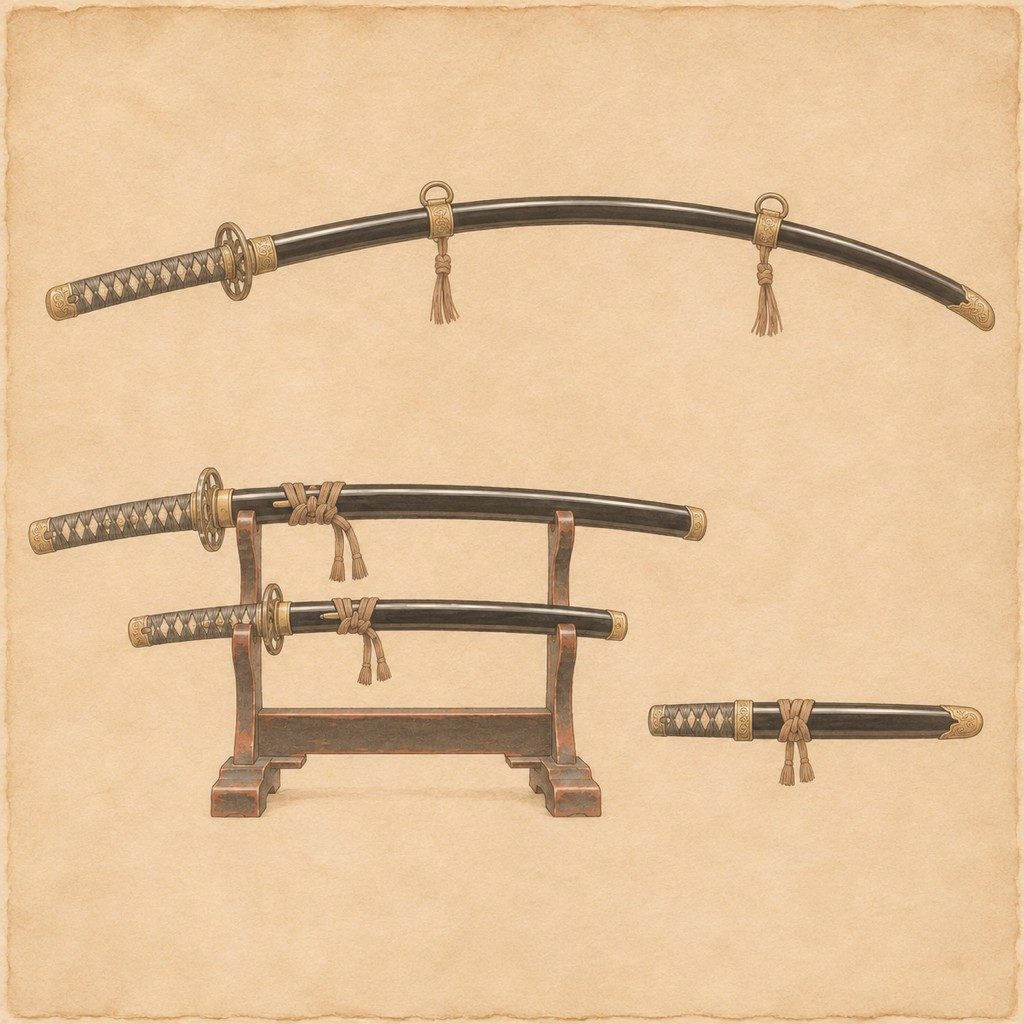
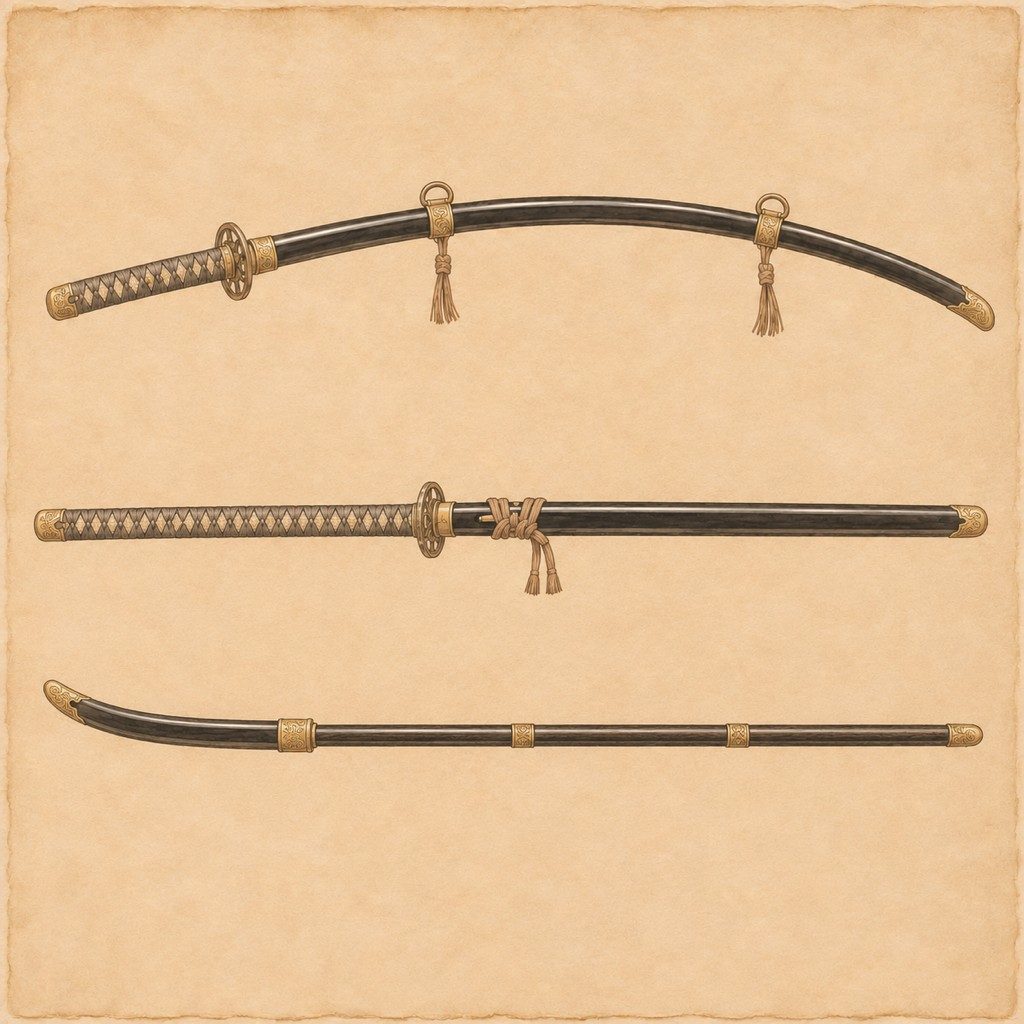
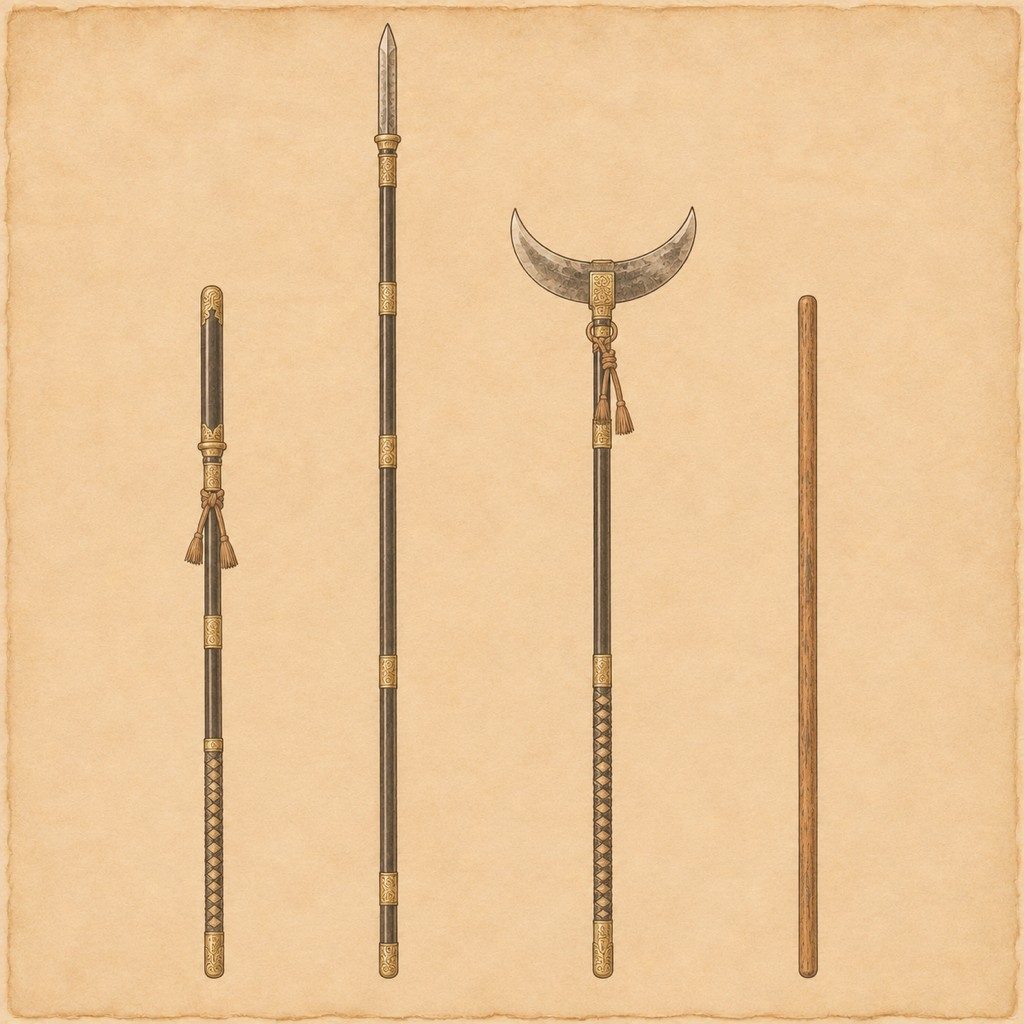
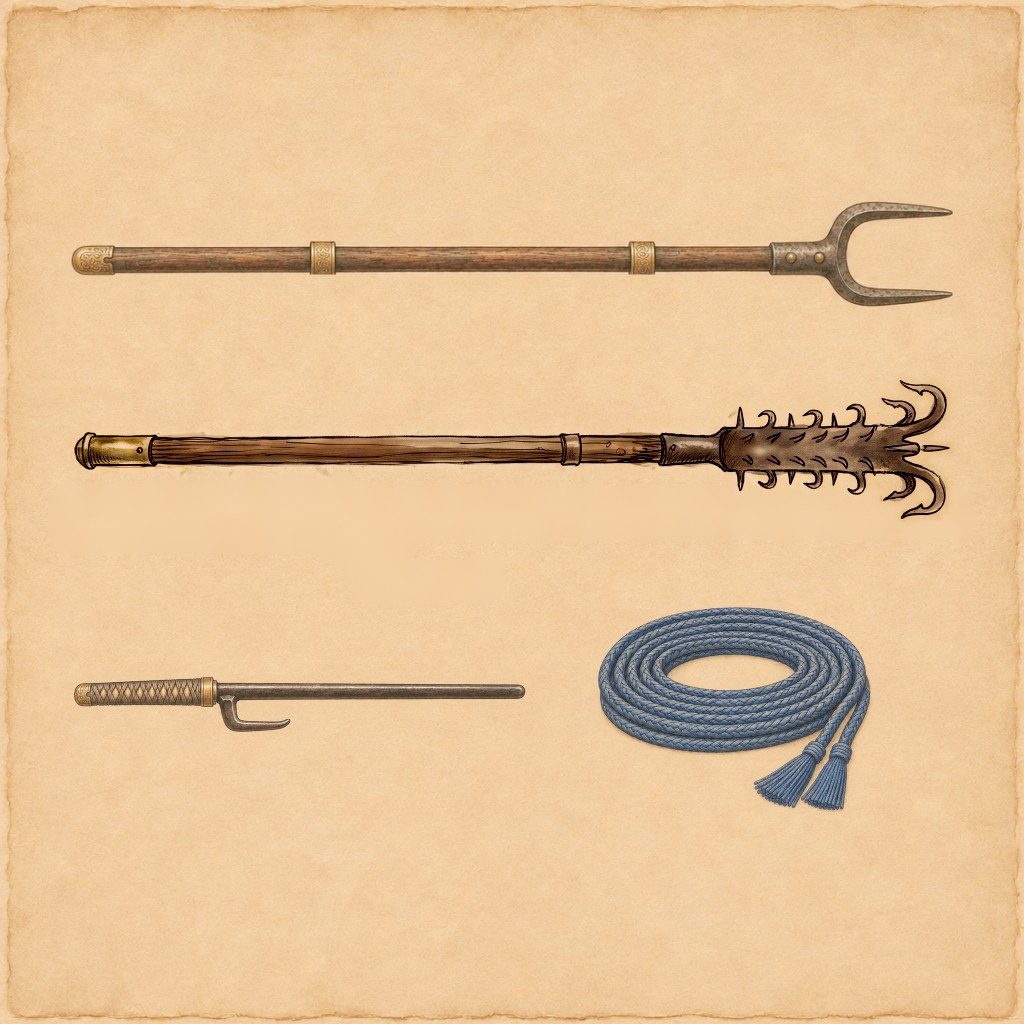
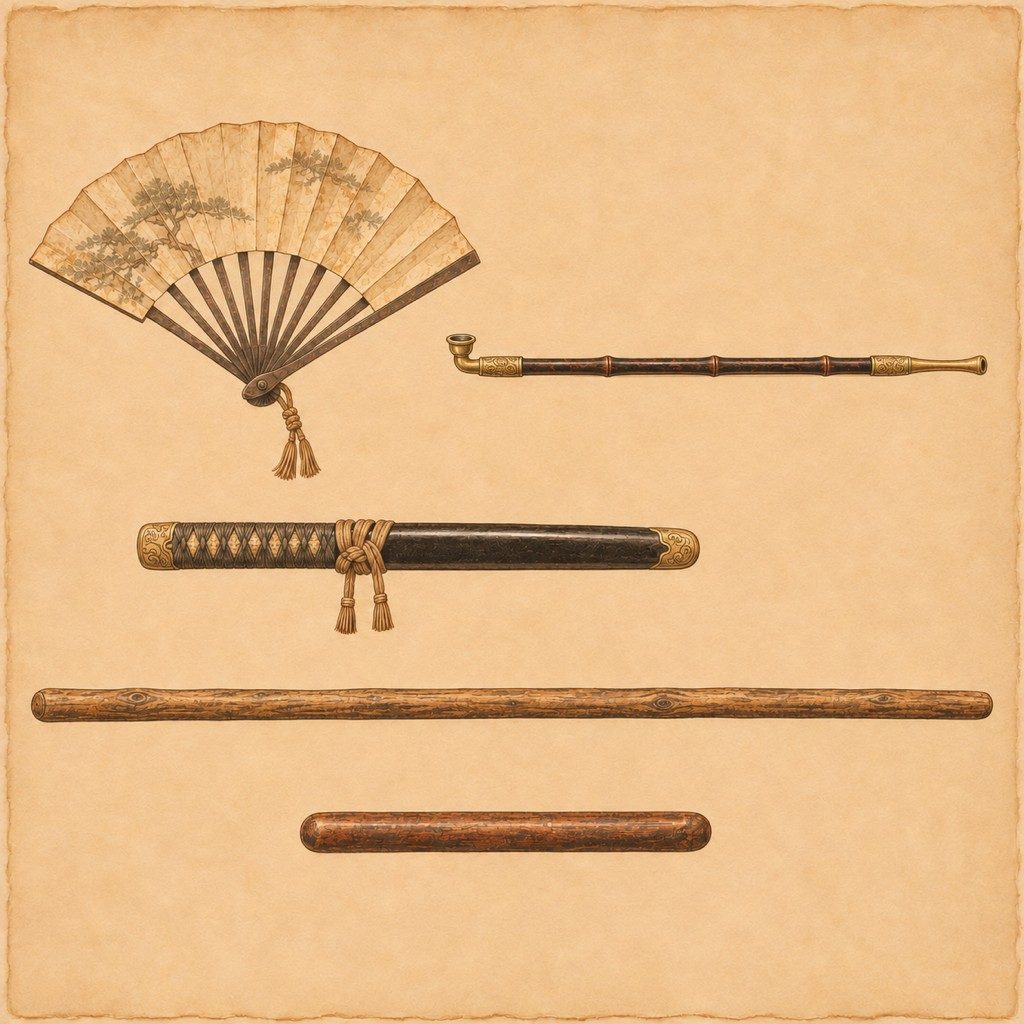
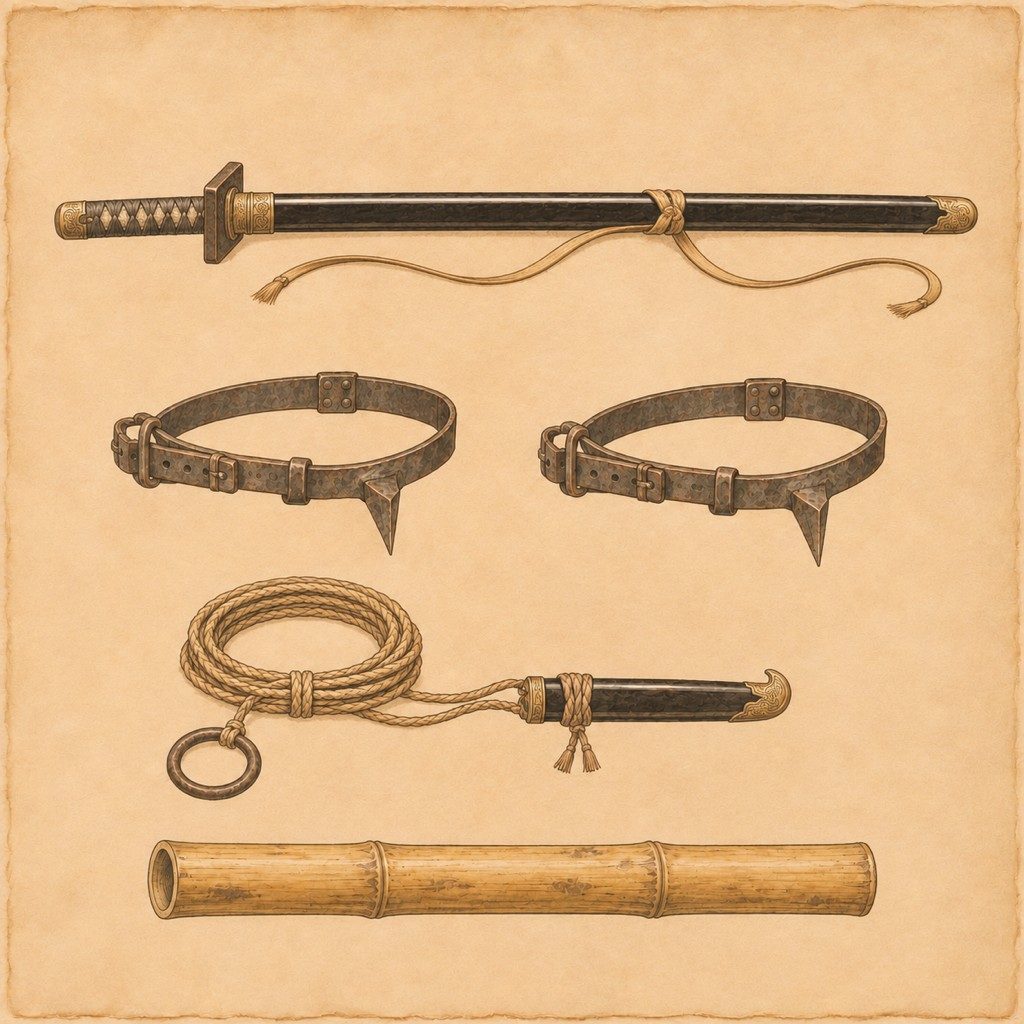
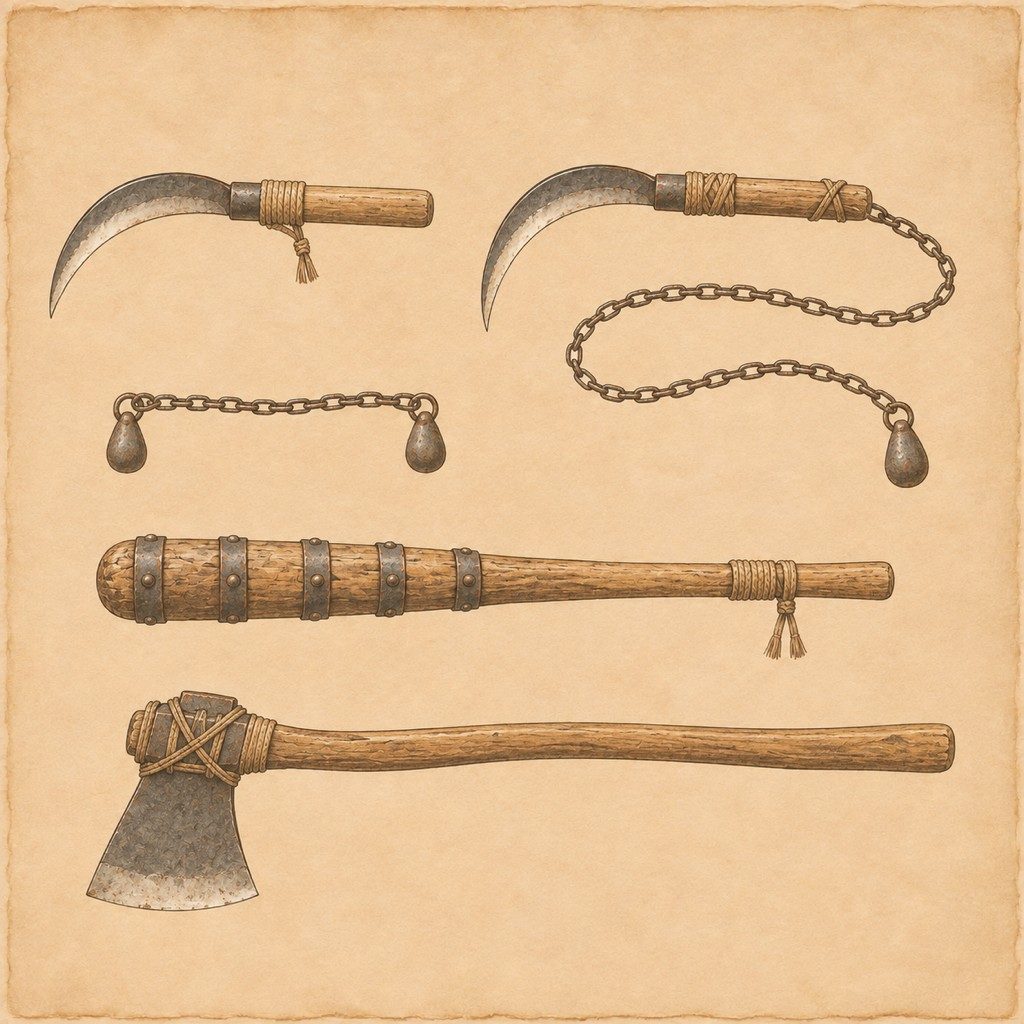
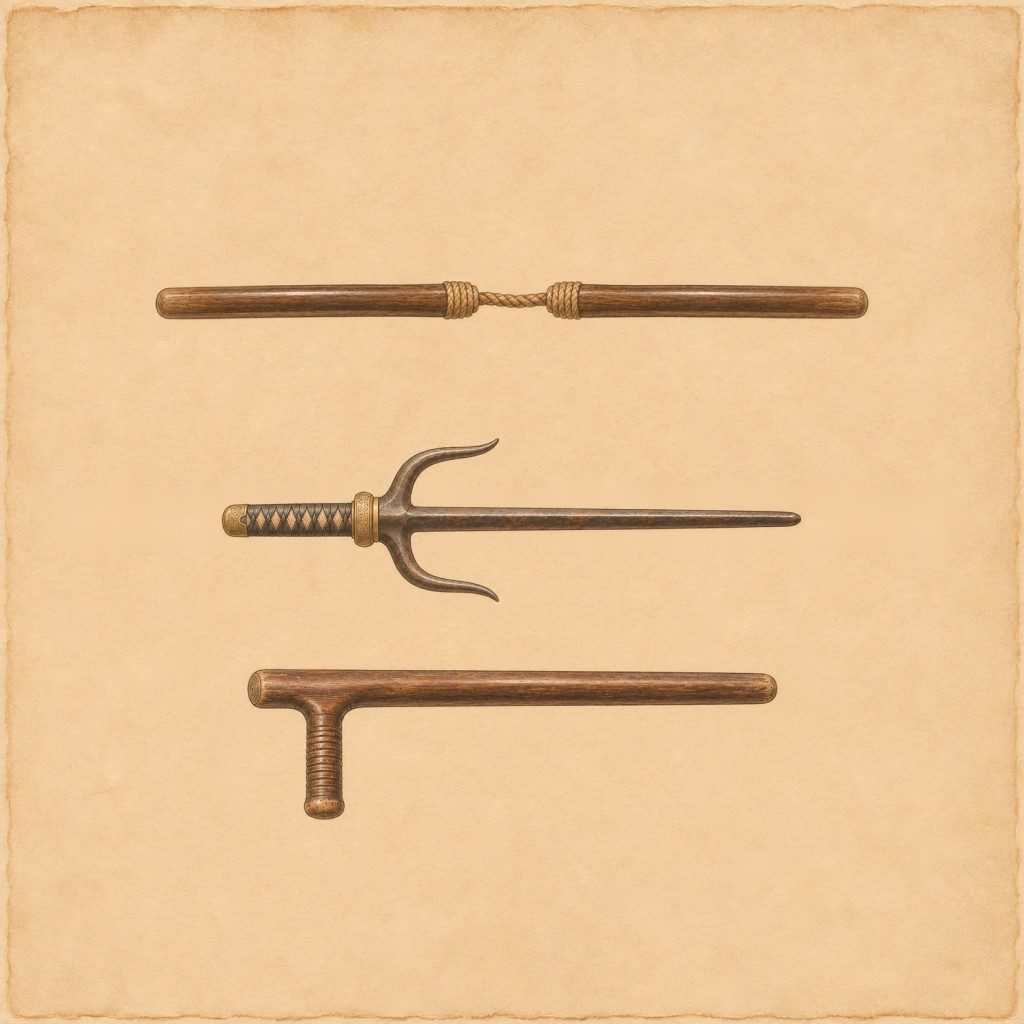
| Weapon | Damage | Min. Str. | Weight | Cost | Notes |
|---|---|---|---|---|---|
| Swords | |||||
| Long sword (katana) | Str+d6 | d6 | 3 | 1,000 | One or two hands. Two-handed, it adds +1 damage. |
| Slung sword (tachi) | Str+d8 | d8 | 4 | 1,200 | One or two hands. Two-handed, it adds +1 damage. The older, longer, more curved horseman's sword, now carried mostly as an heirloom |
| Long-hilted sword (nagamaki) | Str+d8 | d8 | 5 | 600 | Two hands, Parry +1. A sword blade on a hilt as long as the blade itself |
| Great sword (nodachi) | Str+d10 | d10 | 6 | 1,500 | Two hands. Too long to draw from the sash: drawing it from the back or from an attendant's hands takes an action. |
| Short sword (wakizashi) | Str+d6 | d6 | 2 | 300 | The companion blade of the two swords |
| Shinobi sword (ninjatō) | Str+d6 | d6 | 2 | 300 | A short, straight blade worn on the back. Its long scabbard doubles as a step for climbing walls. |
| Common blade | Str+d6 | d6 | 2 | 100 | A plain short sword, carried by gamblers and travelers |
| Cane sword (shikomi-zue) | Str+d6 | d6 | 3 | 400 | Looks like a walking staff. Searchers subtract 2 from Notice rolls to spot the blade. |
| Wooden sword (bokutō) | Str+d6 | d6 | 2 | 20 | Nonlethal damage (SWADE p. 104). Used for training and for matches between schools |
| Knives | |||||
| Dagger (tantō) | Str+d4 | d4 | 1 | 50 | — |
| Guardless knife (aikuchi) | Str+d4 | d4 | 1 | 40 | Searchers subtract 2 from Notice rolls to find it. Can be thrown (see Ranged Weapons). |
| Hooked knife and cord (kyoketsu-shōge) | Str+d4 | d4 | 2 | 60 | Swung on its cord, it has Reach 2, and on a raise the victim is Entangled instead of taking the bonus damage. Doubles as a grappling hook. |
| Polearms | |||||
| Glaive (naginata) | Str+d8 | d8 | 6 | 250 | Reach 1, two hands |
| Spear (yari) | Str+d6 | d6 | 3 | 100 | Reach 1. Parry +1 if used two-handed. |
| Long spear (nagae-yari) | Str+d8 | d8 | 12 | 200 | Reach 2, two hands. The foot soldier's pike. |
| Great axe (ōno) | Str+d10 | d10 | 7 | 400 | AP 2, Parry –1, two hands. A warrior monk's favorite. |
| Catch pole (sasumata) | Str+d4 | d6 | 8 | 150 | Reach 2, two hands. On a raise, the victim is pinned and Entangled instead of taking the bonus damage. |
| Sleeve-tangler (sodegarami) | Str+d4 | d6 | 8 | 300 | Reach 2, two hands. Barbed, so on a raise the victim is Bound instead of taking the bonus damage. |
| Staff (bō) | Str+d4 | d4 | 4 | 10 | Parry +1, Reach 1, two hands |
| Clubs, Axes, and Chains | |||||
| Iron club (tetsubō) | Str+d8 | d8 | 10 | 200 | AP 1, two hands |
| Cudgel | Str+d4 | d4 | 2 | 25 | — |
| Broad axe (masakari) | Str+d8 | d8 | 4 | 300 | A woodsman's tool and a mountain bandit's weapon |
| Sickle (kama) | Str+d4 | d4 | 2 | 20 | — |
| Chain sickle (kusarigama) | Str+d4 | d6 | 3 | 150 | Two hands. Swung by its chain, it has Reach 2, and on a raise the victim is Entangled instead of taking the bonus damage. |
| Weighted chain (kusari-fundō) | Str+d4 | d4 | 2 | 50 | Reach 1. On a raise, the victim is Entangled instead of taking the bonus damage. Searchers subtract 2 from Notice rolls to find it. |
| Hidden and Lawful Weapons | |||||
| Truncheon (jitte) | Str+d4 | d4 | 1 | 25 | Parry +1. The badge of a thief-taker. |
| Iron fan (tessen) | Str+d4 | d4 | 1 | 50 | Counts as a fan, not a weapon. It may be carried where blades must be left at the door. |
| Iron pipe (kiseru) | Str+d4 | d4 | 1 | 30 | Counts as a pipe, not a weapon. Tobacco is a new fashion, brought by the foreign traders, and the bold carry heavy iron pipes for a reason. |
| Fist stick (yawara) | Str+d4 | d4 | — | 10 | A short rod gripped in the fist. Attacks with it count as unarmed, so Martial Artist (SWADE p. 43) applies. |
| Climbing claws (shuko) | Str+d4 | d4 | 1 | 30 | Iron bands with spikes, worn on the palms. Can't be disarmed, and the wearer adds +2 to Athletics rolls to climb. |
| Weapons from Daqian | |||||
| Jointed flail (nunchaku) | Str+d4 | d4 | 1 | 50 | +1 to Fighting rolls to Disarm |
| Prong truncheon (sai) | Str+d4 | d4 | 2 | 60 | Parry +1. +1 to Fighting rolls to Disarm a blade. |
| Side-handled baton (tonfa) | Str+d4 | d4 | 2 | 40 | Parry +1 |
The long sword. The core rules' katana (SWADE p. 72) is a two-handed weapon. In Tsurugishima, a long sword deals Str+d6 in one hand and Str+d6+1 in two, so a hero can fight with long sword and short sword together, as the Ōnuma School teaches.
Weapons from Daqian. Daqian's boxing schools teach the flail, the prong, and the baton, and a few of their students teach in Umikado and Kanagura. They are rare in the isles, and a hero who wants one needs a teacher from Daqian or a good story.
Note for the GM: weapons out of their time. The shinobi sword, the jointed flail, the prong truncheon, and the side-handled baton don't belong to the real warring-states age. No shinobi sword survives from before the 20th century, and the other three come from Okinawa in later centuries. The police tools (truncheon, catch pole, and sleeve-tangler) are mostly from the peaceful age that followed. They are here because players expect them and they are fun. A GM who wants a stricter feel is free to leave any of them out.
The core rules' clubs, flails, and hammers (SWADE p. 72) also exist, mostly as tools pressed into service. Lances, rapiers, and European swords don't.
Ranged Weapons#
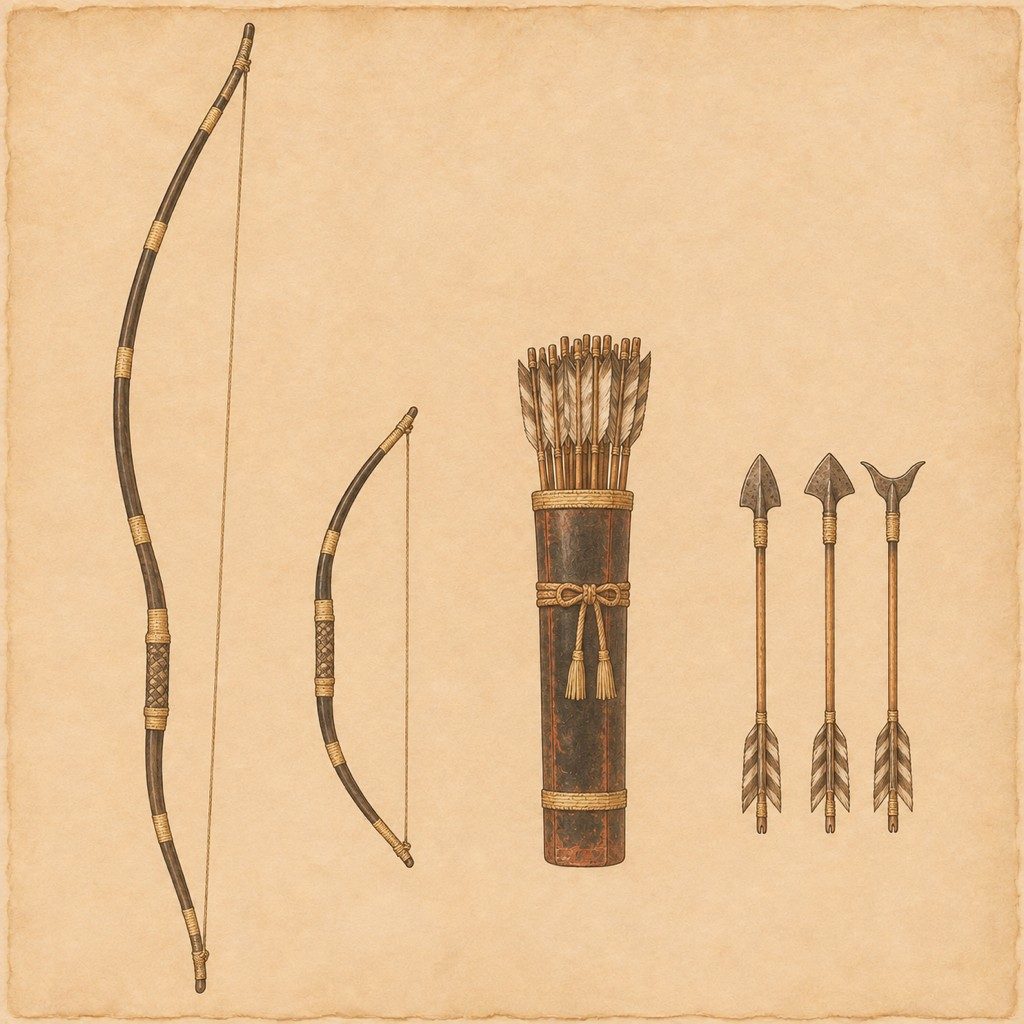
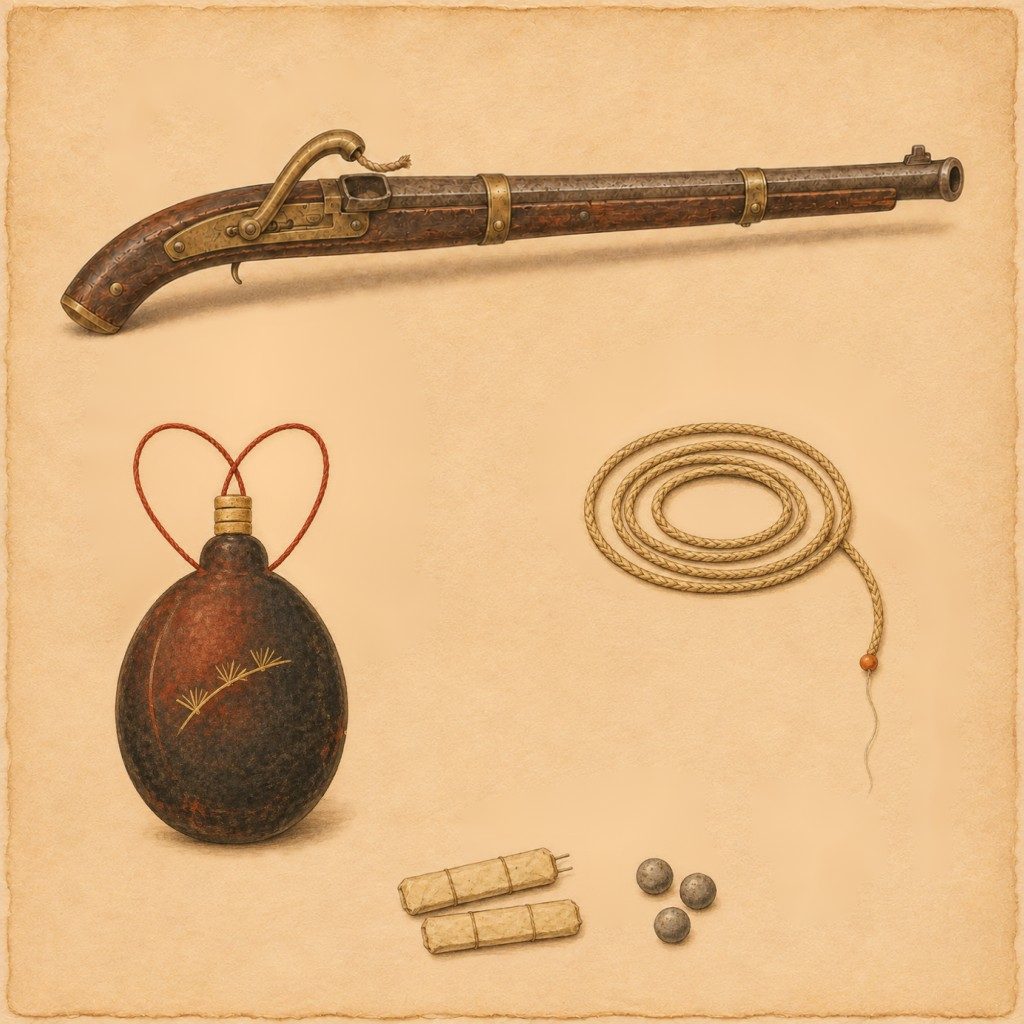
| Weapon | Range | Damage | AP | ROF | Min. Str. | Weight | Cost |
|---|---|---|---|---|---|---|---|
| Great bow (yumi) | 15/30/60 | 2d6 | 1 | 1 | d8 | 3 | 300 |
| Half bow (hankyū) | 12/24/48 | 2d6 | — | 1 | d6 | 2 | 150 |
| Matchlock (teppō) | 10/20/40 | 2d8 | 2 | 1 | d6 | 10 | 1,500 |
| Throwing blades (shuriken) | 3/6/12 | Str+d4 | — | 1 | d4 | — | 5 each |
| Guardless knife (aikuchi) | 3/6/12 | Str+d4 | — | 1 | d4 | 1 | 40 |
| Hand arrow (uchi-ne) | 4/8/16 | Str+d4 | 1 | 1 | d4 | 1 | 20 |
| Javelin (nage-yari) | 3/6/12 | Str+d6 | — | 1 | d6 | 3 | 100 |
| Blowgun (fukiya) | 3/6/12 | d4–2 | — | 1 | d4 | 1 | 40 |
| Fire pot (hōroku) | 3/6/12 | 2d6 | — | 1 | d4 | 2 | 100 each |
| Foreign pistol | 5/10/20 | 2d6 | 1 | 1 | d4 | 3 | 3,000 |
Great bow. The tall, asymmetrical bow of the samurai, gripped below the middle so that it can be shot from horseback, as no ordinary long bow can.
Half bow. A short bow that can be shot kneeling, from a window, or from behind a standing shield. Shinobi and castle guards favor it.
Matchlock. The teppō came to the isles with the foreign traders at Umikado, and the smiths of Hagane now make them by the thousand. A matchlock is Reload 3 (SWADE p. 73). Its slow match must stay lit: in rain or high wind, the gunner rolls to keep the match lit and the powder dry (Chapter 4, Combat), and in Dim or Dark light, foes add +2 to Notice rolls to spot a gunner by the glow and the smell of the match. Arrow Cutting (Part 4) doesn't work against its balls.
Foreign pistol. A short matchlock from the black ships, rare and costly, sold only at Umikado and only to those the Port Commissioner licenses. Like the matchlock, it is Reload 3, and its match must stay lit. Islanders don't make them yet.
Hand arrow. A short, heavy arrow with fletching, thrown by hand. Guards keep a bundle by the gate, and warriors keep one in the sheath of their short sword.
Blowgun. Its darts carry poison (Fantasy Companion p. 53) more often than they cause harm on their own.
Fire pot. A clay pot packed with powder and lit by a fuse, thrown with Athletics. It explodes in a Small Blast Template and may set flammable things alight. Pirates and sect-league fighters use them against ships and gates.
Ammunition. Arrows and matchlock shot and powder cost what they do in the core rules (SWADE p. 68). Fire arrows work as Flammable Arrows (Fantasy Companion p. 57).
Armor#
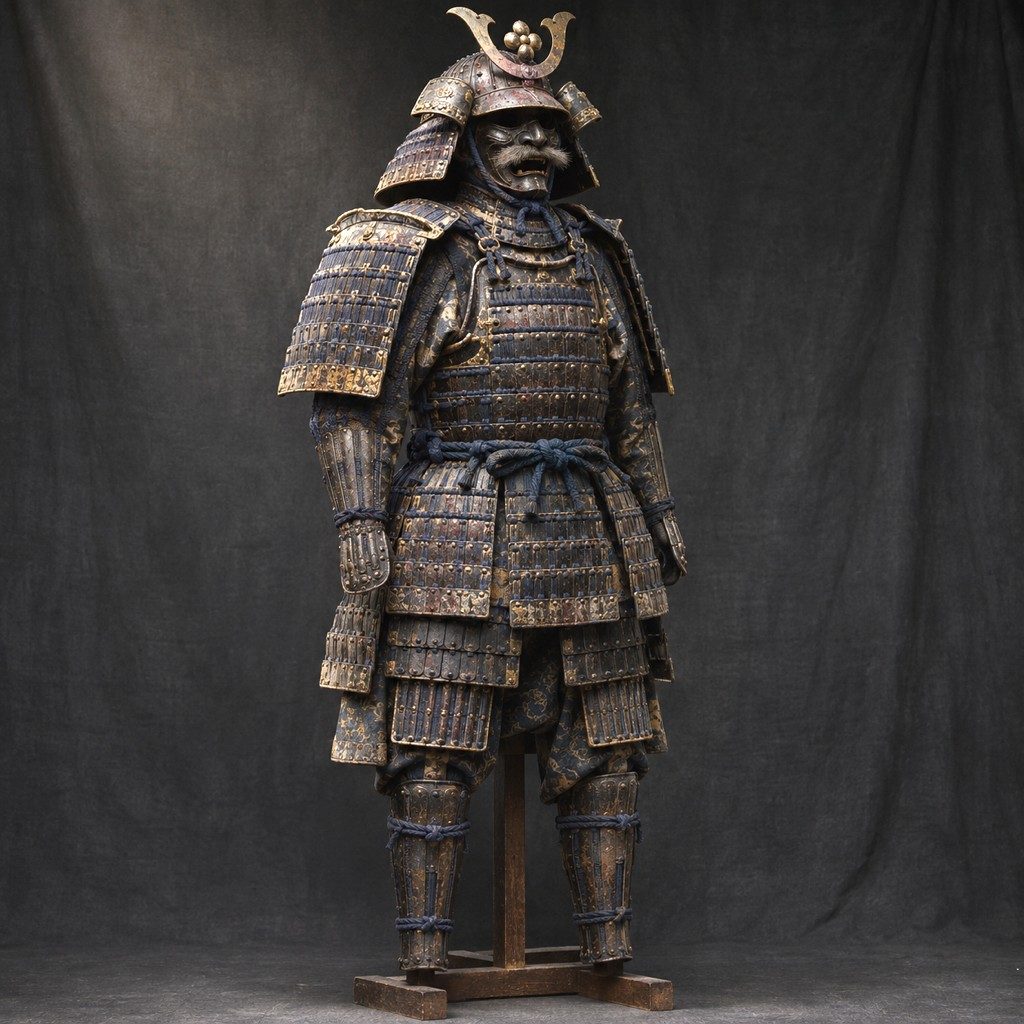
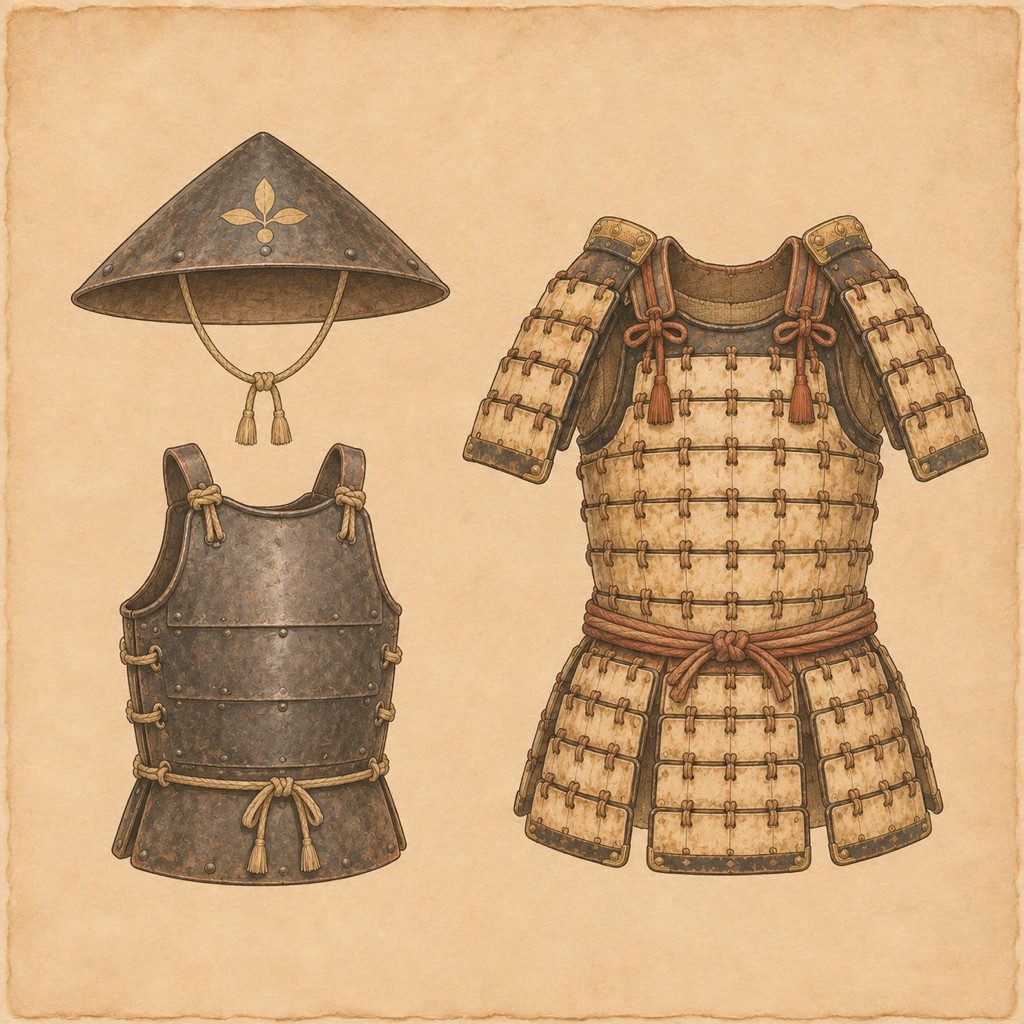
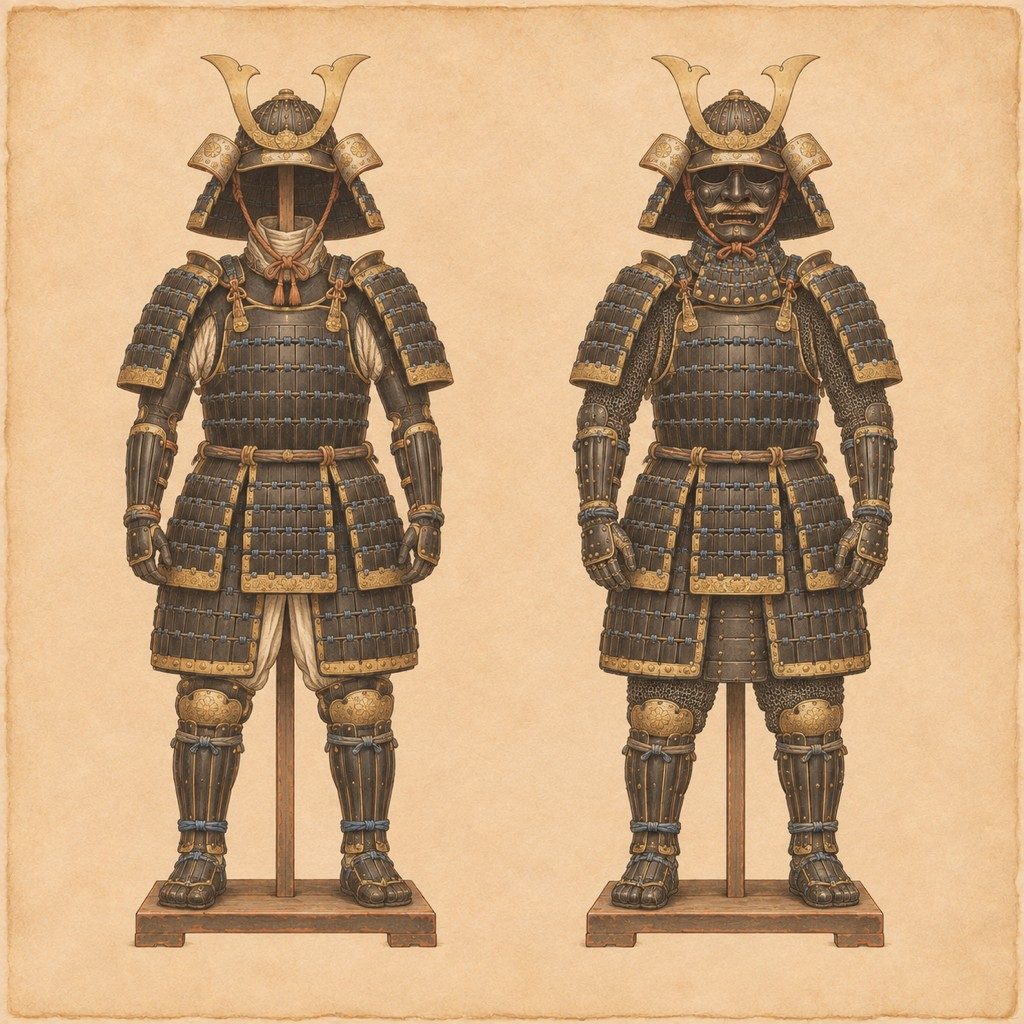
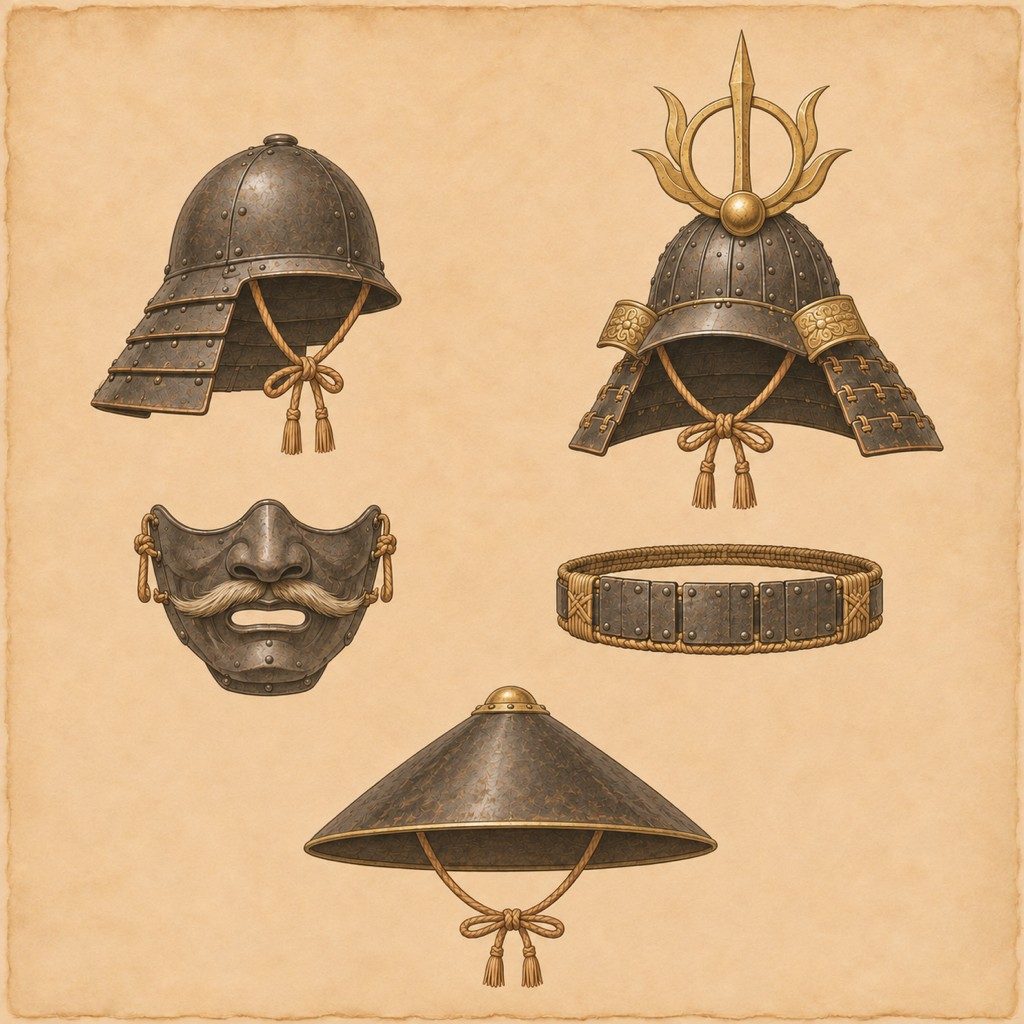
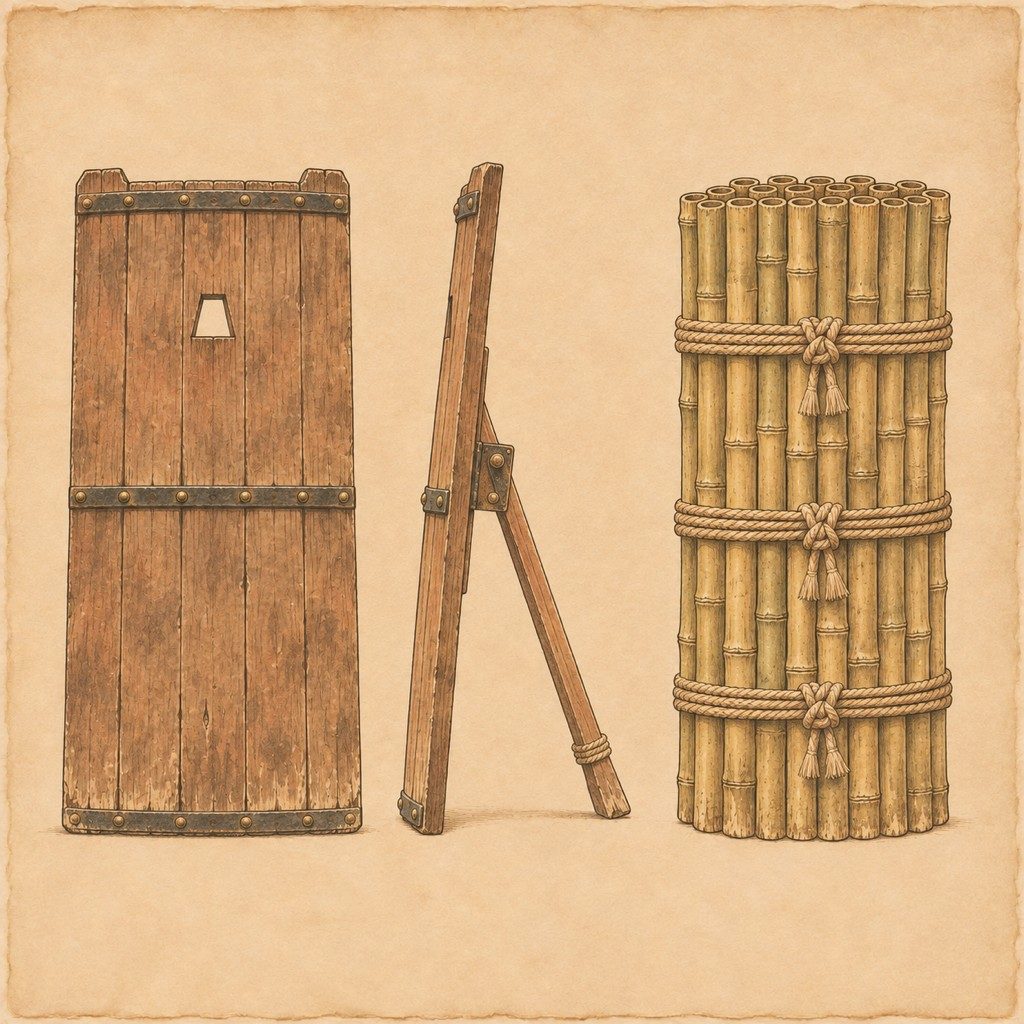
Armor in Tsurugishima is made of small plates of rawhide or iron, lacquered against the damp and laced together with silk or leather cord. The colors of the lacing and the crest on the helmet tell friend from foe across a battlefield. Most warriors buy their armor as a suit. Each suit below protects the locations listed, as in the core rules (SWADE p. 69).
| Suit | Torso | Arms | Legs | Head | Min. Str. | Weight | Cost |
|---|---|---|---|---|---|---|---|
| Partial light foot soldier's armor | +2 | — | — | +2 | d6 | 10 | 130 |
| Partial light samurai armor | +2 | — | — | +3 | d6 (helmet d8) | 13 | 180 |
| Light armor | +2 | +2 | +2 | +2 or +3 | d6 (helmet d8) | 22 | 300 |
| Partial heavy armor | +3 | — | — | +3 | d8 | 20 | 350 |
| Heavy armor | +3 | +3 | +3 | +3 | d8 | 34 | 600 |
| Complete armor | +3 | +3 | +3 | +3 | d8 | 40 | 900 |
| Superior heavy armor | +3 | +3 | +3 | +3 | d6 | 30 | 2,500 |
| Master armor | +4 | +3 | +3 | +3 | d6 | 32 | 5,000 |
- Light armor is lacquered rawhide. Heavy armor is iron lamellar or plate.
- Partial suits protect the body and the head only. A foot soldier's suit has a broad iron war hat (jingasa) and a plain cuirass, often lent by the lord with the lord's crest on the front. A samurai's partial suit has a full helmet (kabuto).
- Light and heavy suits add sleeves and shin guards, but leave gaps at the upper arms and thighs.
- Complete armor adds shoulder guards, thigh guards, and a face mask, and narrows the gaps to the armpits, the throat, and the backs of the knees.
- Superior heavy armor is complete armor made to fit one wearer, of thinner and better-tempered plates. It costs more and weighs less, and its Minimum Strength is d6.
- Master armor is superior armor by a famous armorer. It counts as masterwork (Fantasy Companion p. 51), and its plate cuirass has been proven by a matchlock ball: the dent is left on the front as a mark of pride.
- Striking past armor. A blow lands on the armor unless the attacker aims for a gap with a Called Shot to an Unarmored Area (SWADE p. 98). The penalty depends on the suit: partial –2 (the limbs are bare), light or heavy –3, complete or superior heavy –4, and master –6. Gap Strike (Part 4) reduces the penalty by 2.
- Putting on a light suit takes about five minutes. A heavy or complete suit takes about ten minutes with a helper, and twice as long without one.
Other armor
| Armor | Armor | Min. Str. | Weight | Cost |
|---|---|---|---|---|
| Padded winter clothes (torso, arms, legs) | +1 | d4 | 5 | 100 |
| Hidden mail (kusari katabira) (torso, arms) | +2 | d6 | 10 | 250 |
| Iron headband (hachigane) (head) | +2 | d4 | 1 | 20 |
| Face mask (menpō) | — | — | 1 | 100 |
Hidden mail. A shirt of fine chain sewn into a jacket, worn by those who must look unarmed. Searchers subtract 2 from Notice rolls to spot it.
Face mask. A lacquered iron mask, often with a snarling face and a horsehair moustache. It extends the helmet's protection to the face, and the wearer adds +1 to Intimidation rolls while wearing it. Complete, superior, and master armor include one.
Shields. The isles' warriors don't carry hand shields. Foot soldiers set up standing shields (tate), wooden walls on props that give Heavy Cover (–4) to anyone crouched behind them, and bamboo bundles (takeba), which stop matchlock balls as well as arrows. Both are Hardness 10 and can't be carried while fighting. A standing shield costs 50 mon, and a bamboo bundle costs 20.
Horse armor. Few warhorses wear armor. Those that do use the barding rules in the Fantasy Companion (p. 55), most often lacquered rawhide (+2).
Fine Arms#
Weapons made by famous smiths use the masterwork rules in the Fantasy Companion (p. 51). In Tsurugishima, a masterwork weapon costs 1,000 mon more than usual, and a masterwork piece of armor costs 300 mon more. A hero with the Swordsmith Edge (Part 4) can make them for less. Blades with names and stories of their own are relics, found in Chapter 6.
Clothing#
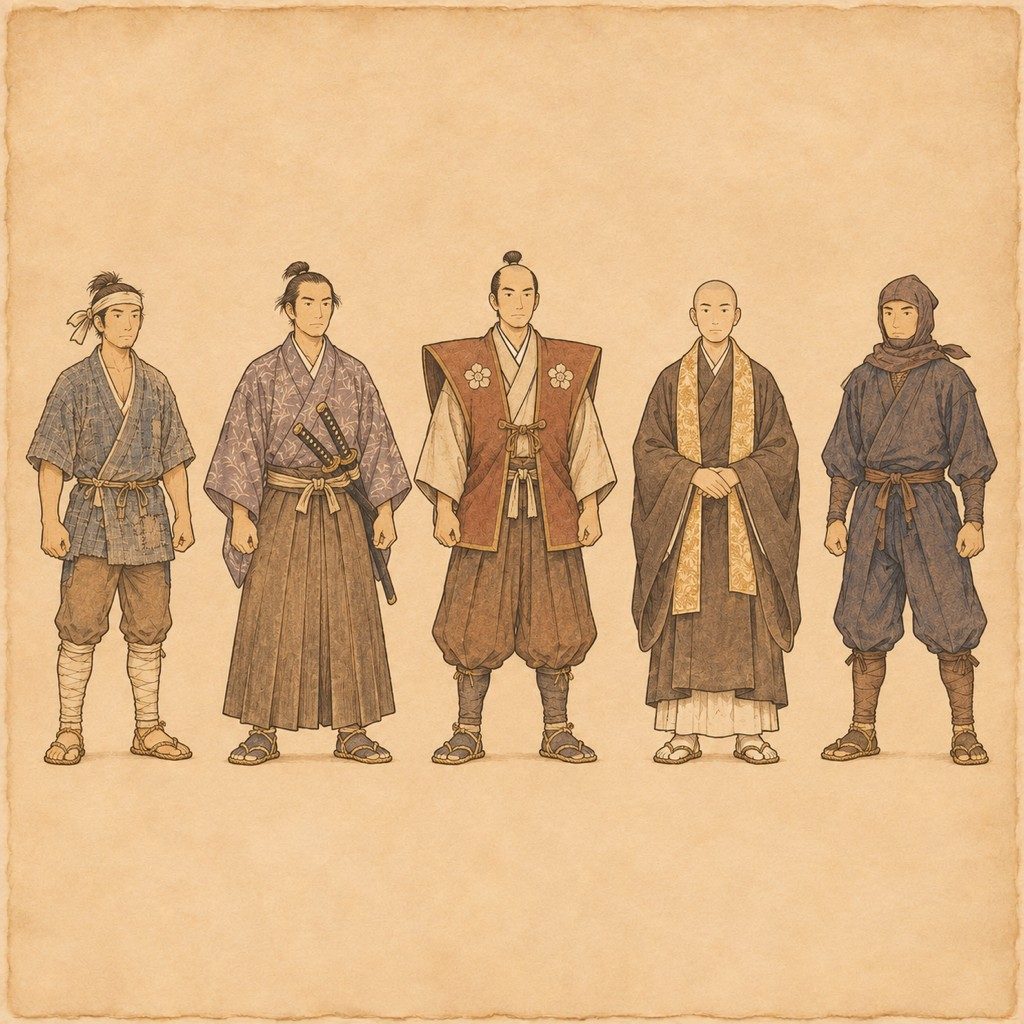
| Clothing | Cost | Notes |
|---|---|---|
| Common clothes | 20 | Loincloth (fundoshi), a short jacket, and trousers or leggings |
| Warrior's clothes | 50 | Loincloth, kimono, and wide trousers (hakama) |
| Formal clothes (kamishimo) | 200 | Warrior's clothes with a stiff sleeveless jacket (kataginu) bearing the family's crest. Needed to appear before a lord without giving offense. |
| Court robes | 400 | The layered silk robes and tall black cap of the court |
| Monk's robes | 20 | Plain robes and a stole |
| Ceremonial vestments | 150 | Worn by priests and monks for rites and festivals |
| Padded winter clothes | 100 | Padded versions of any of the above. They count as cloth armor (+1) and protect against cold (SWADE p. 126). |
| Shinobi garb | 50 | Close-fitting clothes of dark blue or brown, and a hood. The wearer adds +1 to Stealth rolls in Dim or Dark light, but anyone who sees them knows what they are. |
| Straw hat (kasa) | 5 | A broad hat against sun and rain |
| Deep woven hat (fukaamigasa) | 10 | Hides the whole face. Wandering monks wear them, and so do people who don't want to be recognized. |
| Straw sandals (waraji) | 1 | Worn out in a few days on the road |
| Wooden clogs (geta) | 10 | Loud on a hard floor. Wearers subtract 1 from Stealth rolls. |
Goods#
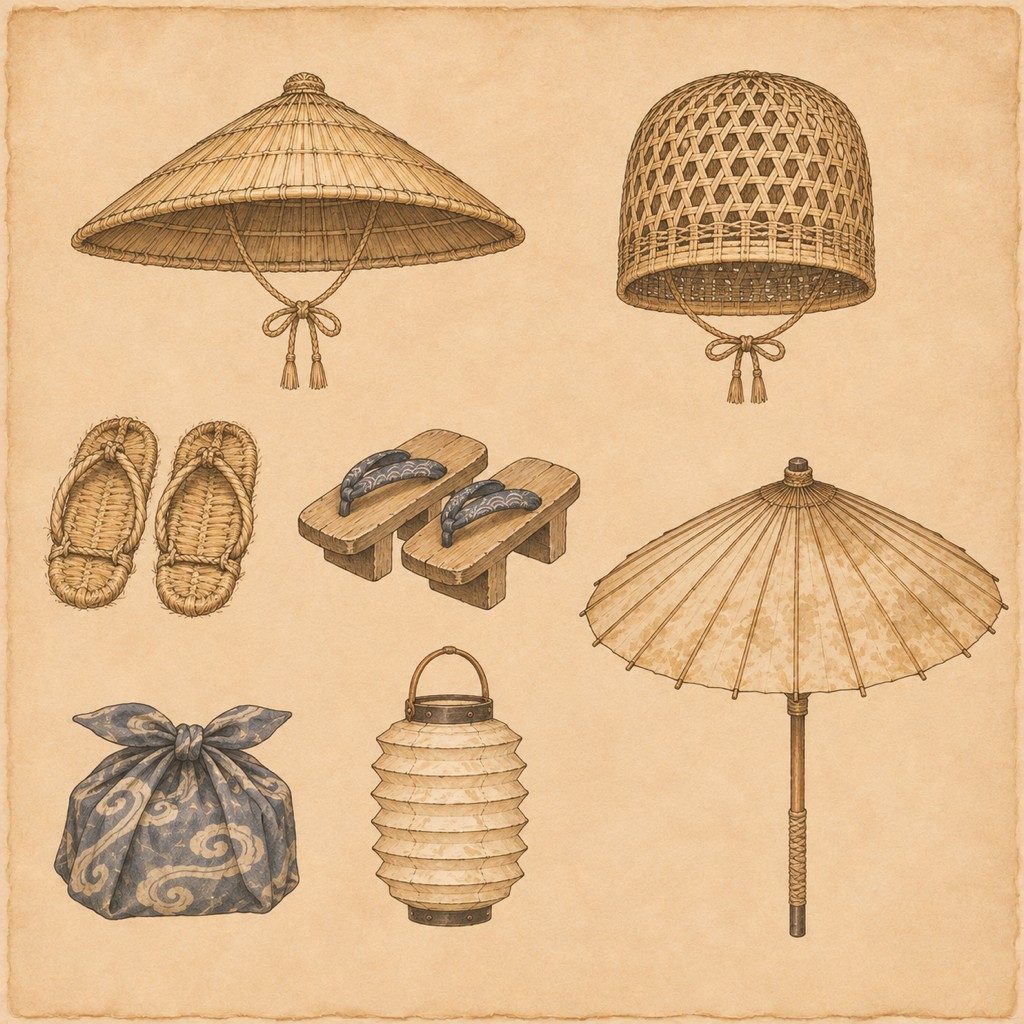
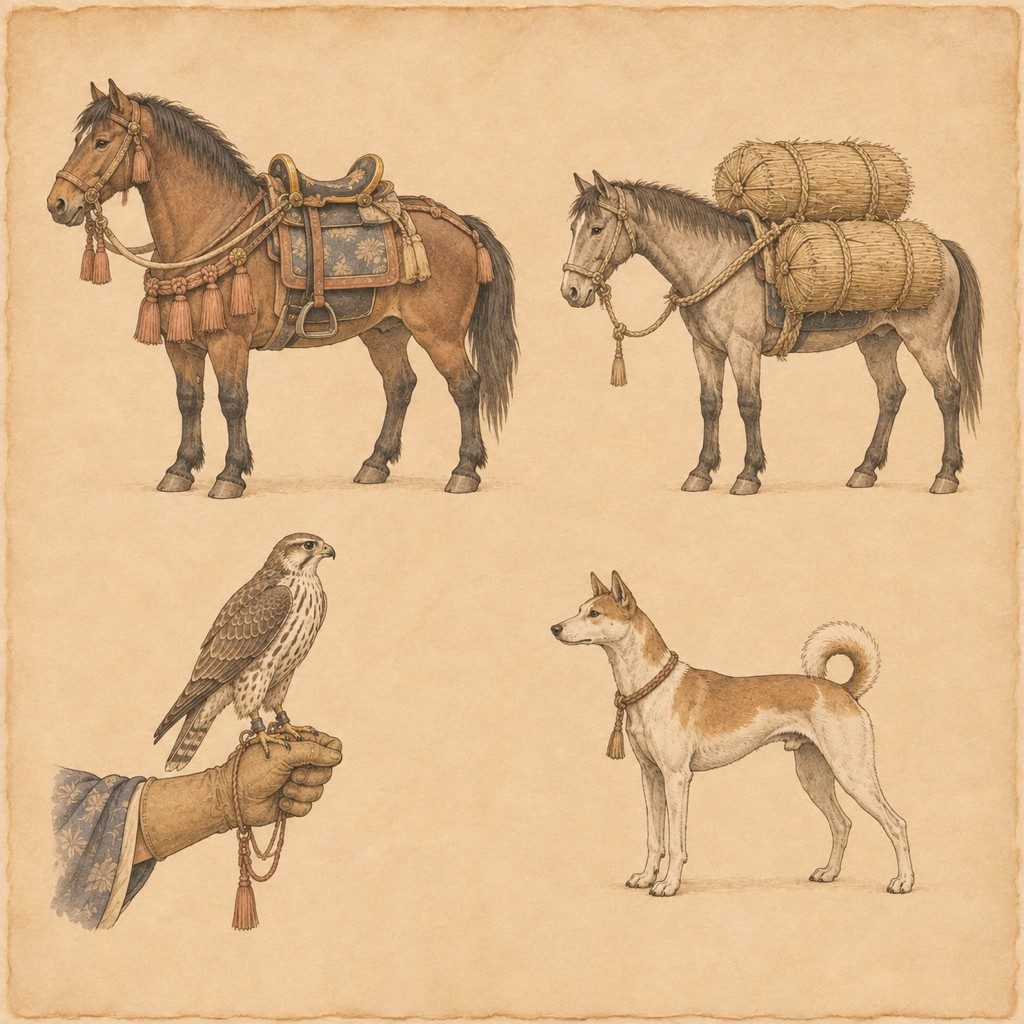
| Item | Cost | Notes |
|---|---|---|
| Tools and Kits | ||
| Armorer's kit | 200 | Needed to repair armor in the field. Without it, the hero subtracts 2 from Repair rolls for armor. |
| Armorer's workshop | 2,000 | Needed to make armor. Not portable. |
| Bowyer's kit | 200 | Strings, glue, and tools for bows and arrows. Without it, the hero subtracts 2 from Repair rolls for bows. |
| Bowyer's workshop | 2,000 | Needed to make bows. Not portable. |
| Bandages | 10 | Three uses, as a First Aid Kit (SWADE p. 67) |
| Physician's kit | 100 | Herbs, needles, and moxa. Five uses, as a Medic Kit (SWADE p. 67): +1 to Healing rolls. Refills cost 25 mon. |
| Medicines | 20 per dose | Herbal remedies for illness and fever. Poisons follow the Fantasy Companion (p. 53). |
| Diviner's almanac and charts | 300 | Without them, a diviner subtracts 2 from Occult rolls about lucky days and directions. |
| Make-up and disguise kit | 50 | Paints, powders, wigs, and a mirror. +1 to Performance rolls for disguise. |
| Writing case | 50 | Brush, ink stick, inkstone, paper, and a seal |
| Ink painting set | 50 | Brushes, inkstone, and fine paper for ink painting (suibokuga) |
| Ink stick | 5 | — |
| Book | 500 | Hand-copied. Allows Research rolls on its subject. |
| Tea set | 50 | Kettle, bowls, whisk, and scoop for a tea gathering. A famous tea bowl can be worth more than a castle, and such pieces are treasures, found in Chapter 6. |
| Travel | ||
| Travel pass (kasho) | 10 | Needed at the realm's barriers. A forged one costs 200. |
| Wrapping cloth (furoshiki) | 1 | Carries anything, from a lunch box to a severed head |
| Porter's trunk | 30 | A wooden chest with a carrying pole |
| Strongbox | 100 | Iron-bound, with a lock. Hardness 10, and Thievery rolls to open it subtract 2. |
| Paper lantern (chōchin) | 10 | Light in a 4" radius. Painted with the owner's crest. |
| Oil-paper umbrella | 5 | — |
| Rice and dried fish | 10 | Trail rations for five meals |
| Drink | ||
| Sake | 1 a cup, 10 a flask | — |
| Shōchū | 5 a cup, 30 a flask | A fierce spirit distilled from rice or millet in the southwest. Priests have been known to hide it from their carpenters. |
| Animals | ||
| Riding horse | 300 | — |
| War horse | 750 | Island horses are small and tough. |
| Pack horse | 200 | Carries up to 200 pounds |
| Saddle and tack | 50 | — |
| Falcon | 1,000 | A trained hawk, with glove and hood, for hawking (Part 2). A gift fit for a lord. |
| Watchdog | 100 | — |
Gear from the Core Rules and Companions#
Any item in the gear lists of the core rules (SWADE pp. 67–68), the Fantasy Companion (pp. 47–51), and the Horror Companion (pp. 25–28) exists in the isles if a traveler of the warring-states age could own it. Use its price, converting Fantasy Companion gold pieces at 20 mon each. Most go by island names:
| Core or Companion item | In the isles |
|---|---|
| Backpack | Back frame (oi), or a pack wrapped in cloth |
| Bedroll and blanket | Straw mat and quilt |
| Canteen or waterskin | Bamboo flask or gourd |
| Handcuffs or manacles | Binding rope (see Thief-Taker, Part 4). The isles don't use iron cuffs. |
| Lockpicks or thieves' tools | Thief's tools |
| Holy symbol | Prayer beads or a shrine amulet (see below) |
| Neck protector, metal | Throat guard (nodowa), worn under the helmet |
| Corpse catcher | Catch pole |
| Tent | Field curtains (jinmaku), for a warlord's camp |
| Lifestyle, lodging, and food (Fantasy Companion pp. 49–51) | Inns, teahouses, temple lodgings, and meals at the same converted prices |
| Hirelings (Fantasy Companion p. 50) | Porters, guides, guards, and hired spears, at the same converted wages |
Not in the isles: anything powered or mechanical, hourglasses, magnifying glasses, spyglasses, airships, camels, and elephants. Crossbows are known from Daqian but never caught on. Silver, cold iron, and holy water aren't known; the isles' own spirit-banes (salt, peach wood, mirrors, bells, sacred rope, and sacred spring water) are in Chapter 6.
Gear for Every Calling#
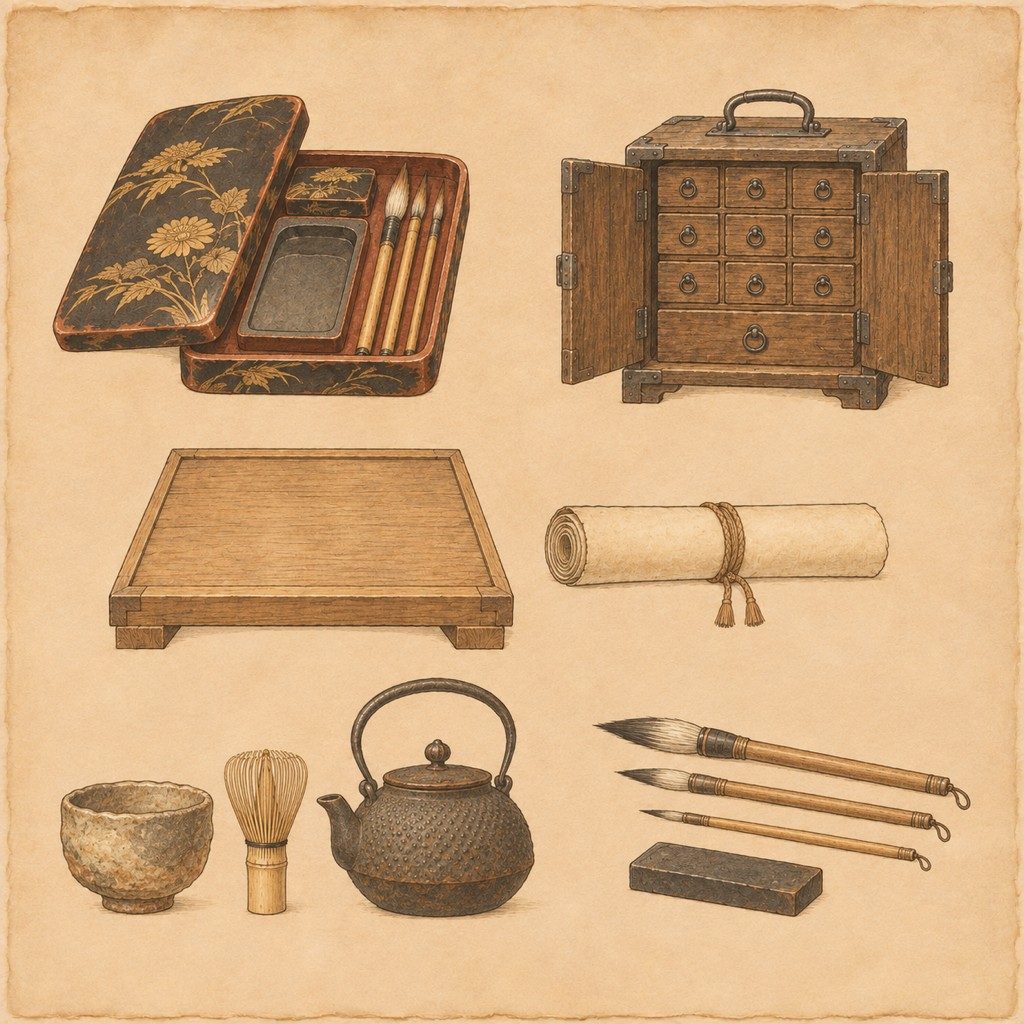
| Item | Cost | Notes |
|---|---|---|
| Faith | ||
| Prayer beads (juzu) | 10 | — |
| Shrine amulet (omamori) | 5 | A charm in a brocade bag. Chapter 6 gives the blessed kind. |
| Purification wand (ōnusa) | 20 | A wooden wand hung with paper streamers |
| Sacred bells (suzu) | 20 | Shaken in sacred dance |
| Ringed staff (shakujō) | 50 | A staff (see Melee Weapons) topped with iron rings that jingle to warn small creatures away |
| Conch trumpet (horagai) | 50 | Mountain ascetics blow it to call to each other, and armies to signal |
| Begging bowl | 5 | — |
| Sutra scroll | 100 | — |
| Incense (a bundle) | 5 | — |
| The Arts | ||
| Lute (biwa) | 300 | — |
| Bamboo flute | 30 | — |
| Zither (koto) | 500 | — |
| Hand drum | 100 | — |
| Folding fan | 10 | — |
| Fine poem paper | 10 | Twenty sheets |
| Incense-comparing set | 300 | A box of rare woods and the burner for kō-awase |
| Flower vase and shears | 50 | — |
| Kick-ball | 20 | Deerskin, for kemari |
| Go board and stones | 100 | — |
| Dice and cup | 5 | — |
| Trade | ||
| Abacus (soroban) | 30 | A new import from Daqian, and a merchant's pride |
| Balance scales | 50 | — |
| Personal seal | 20 | Carved with the owner's name, and used to sign |
| War | ||
| Back banner (sashimono) | 30 | Worn on the back of the armor, so captains can see who fought well |
| Commander's war fan (gunbai) | 50 | Lacquered, for signaling troops |
| Armor chest | 50 | Carries a suit of armor on a pole or a horse |
| Throat guard (nodowa) | 120 | +3 Armor against Called Shots to the neck |
| Field curtains (jinmaku) | 200 | Cloth walls bearing the lord's crest, around a camp or a command post |
| Shinobi and Thieves | ||
| Thief's tools | 200 | Without them, the hero subtracts 2 from Thievery rolls to pick locks. |
| Caltrops (makibishi) | 10 a bag | As caltrops (Fantasy Companion p. 47). Shinobi use iron ones, or dried water chestnuts. |
| Blinding powder (metsubushi) | 20 a dose | Thrown from an eggshell or a tube. An Athletics Test against one adjacent foe. |
| Hooked rope ladder | 50 | — |
| Grappling hook and rope | 110 | — |
| The Road | ||
| Back frame (oi) | 50 | — |
| Straw mat and quilt | 25 | — |
| Bamboo flask | 5 | — |
| Flint and steel | 3 | — |
| Lacquered lunch box | 10 | — |
Notes#
- Sword fittings follow Helen C. Gunsaulus, Japanese Sword-Mounts (1923).