Chapter 4
Setting Rules: The Way of the Warrior
Part 1: Honor, Status, and On#
Name, Rank, and Debt#
Three questions follow every hero through Tsurugishima. What is your name worth? That is Honor, the reputation the world gives you. Where do you stand? That is Status, your rung on your group's ladder. Whom do you owe, and who owes you? That is on, the debts of gratitude that bind people together more tightly than any contract.
All three are tracked on the character sheet. None of them adds to a die roll in a fight. They decide who opens the gate, who listens, who lends the horse, and who comes when the hero calls.
Honor#
Honor measures what people say about the hero when the hero isn't in the room. It runs from –10 to +10, and most heroes start at 0 (Chapter 3).
| Honor | Reputation | What people say |
|---|---|---|
| +8 to +10 | Renowned | The hero's deeds are sung in the war tales, and children play at being them. |
| +4 to +7 | Honored | Lords know the hero's name and trust their word. |
| +1 to +3 | Respected | The hero has done something worth repeating. |
| 0 | Unknown | The hero is one more sword, monk, or traveler on the road. |
| –1 to –3 | Stained | Something unpleasant follows the hero's name. |
| –4 to –7 | Disgraced | Doors close. Old friends look away. |
| –8 to –10 | Infamous | The hero's name is a byword for treachery. |
Who Cares About Honor#
Honor matters most to buke, court nobles, clergy, and the gentry and headmen who rule villages. Farmers, artisans, and merchants care about it too, but they judge a hero more by how the hero treats them than by the war tales.
The underworld keeps its own accounts. Underworld families, shinobi leagues, and the sakaibito hamlets judge a person by how they keep faith with their own. Among them, a hero's negative Honor carries no penalty. A gambler who cheats their own family still loses standing with it (Status, or the family's Attitude), as the GM decides. Outside the underworld, Honor still counts: samurai, priests, and magistrates who care about Honor judge an underworld hero by it like anyone else.
What Honor Does#
Reputation. When the hero deals with people who care about Honor and who know the hero's name, the hero adds +1 to Persuasion and Intimidation rolls at Honor +4 or higher, and +2 at Honor +8 or higher. At Honor –4 or lower, they subtract 1 from those rolls instead, and at –8 or lower they subtract 2. A stranger in a far province doesn't know the hero's name until someone tells them.
A word that is believed. A hero with Honor +4 or higher is taken at their word. Their sworn statement counts as evidence before a magistrate, and a lord accepts their promise without hostages. A hero at Honor –4 or lower can't stand surety for anyone, and their oath counts for nothing.
Rising in rank. Each rung on a group's ladder needs a minimum Honor before the head promotes the hero (see Status, below).
Cast out. A hero who falls to Honor –10 is cast out of every respectable group they belong to. Their lord dismisses them, their school strikes their name from its roll, and their family may disown them. Underworld families and shinobi leagues make their own choices (see above).
Gaining and Losing Honor#
Honor is reputation, so it changes only when a deed becomes known. A brave act in an empty forest changes nothing until a witness tells the tale, and a shameful act stays hidden until someone finds out. When a secret comes out, the GM applies the change then.
Small deeds move Honor by 1. Great deeds and great disgraces move it by 2 or 3. Serving the Emperor in person earns 3 to 5, and treachery costs 4 or more. Several small deeds of the same kind in one session count as one. Honor never goes above +10 or below –10.
The limit per adventure. A hero gains at most +2 Honor in one adventure from ordinary deeds (the +1 and +2 lines), however many they do. One great deed (the +3 line, or serving the Emperor) adds its own award once more, on top of that limit. Losses always apply in full. Rewards from other chapters (mass battles, domains, the Savage Tales) count toward the same limit.
One score. Honor is one score, the hero's name across the realm. When a deed angers or pleases one group in particular, show it with that group's Attitude (SWADE p. 33), the hero's Status in it, or an on, not with a second Honor score.
| Change | Deeds that raise Honor |
|---|---|
| +1 | Keep a promise at real cost. Win a formal duel. Win a contest of refinement before a lord. Repay a Minor on in front of witnesses. Spare a beaten foe who asks for mercy. Defend a host, a guest, or a traveler in your care. |
| +2 | Take the head of a famous enemy in battle. Win a duel against a renowned fighter. Repay a Major on. Save the life of your lord or your lord's family. Complete a registered vendetta. |
| +3 | A deed for the war tales: hold the bridge alone, turn the tide of a battle, or avenge a murdered lord. |
| +3 to +5 | Serve the Emperor in person: carry out the Emperor's own command, save an Imperial rite from failure, or protect the Emperor, his family, or the sacred treasures of the throne (Chapter 8). +3 when the deed becomes known, +4 when the court proclaims it (a proclamation or address by the Regent or the Chancellor), and +5 if the Emperor himself mentions it. The greatest reward for any single deed. |
| Change | Deeds that lower Honor |
|---|---|
| –1 | Break a small promise. Insult a superior through bad manners. Refuse a challenge from an equal. Brawl or carouse in public while wearing your lord's crest. Lose a contest of refinement badly before a lord. |
| –2 | Refuse a Minor on. Flee a fair fight. Lie under oath. Strike someone who has surrendered. Lose a family heirloom. |
| –3 | Break a sworn oath. Abandon an ally in danger. Desert your lord in battle. |
| –4 or more | Refuse a Major on (–4). Murder a guest or a host (–4). Spoil an Imperial rite, harm the Emperor's messenger, strike inside the palace walls, or harm a temple's sacred palanquin (–4 or more). Betray your lord to the enemy (–6). |
Codes of honor. Each group judges by its own code. A monk loses Honor for breaking their vows in public, a shrine priest for polluting a shrine, and a street champion for abandoning the townsfolk who trust them. The GM uses the tables above as a guide and adjusts them to the hero's group. A hero with the Code of Honor Hindrance faces both the Hindrance and these losses.
Atonement. A stain can be washed out. A hero who makes amends in public, with a formal apology, gifts to the wronged party, a shaved head, a pilgrimage, or service to the one they wronged, regains up to the Honor that one deed cost. The GM decides how great the atonement must be. A grave disgrace may call for a vendetta or for death (Part 6).
Status#
Status is the hero's rung on the ladder of the group they belong to. Chapter 2 Society gives each group's ladder and its titles, and Chapter 3 tells which group each profession answers to. Most heroes start as Members.
| Rung | Honor to be promoted | What the hero can expect |
|---|---|---|
| Head | +6 | The group's resources are the hero's to command, and the group's enemies are the hero's too. |
| Seniors | +4 | Command of a band of Members, a voice in the group's council, and an audience with the head when needed. |
| Trusted | +2 | Command of a few Newcomers, a share of the group's secrets, and the group's backing in a dispute. |
| Members | None | Food and lodging at any house of the group, a letter of introduction, and help from other Members. |
| Newcomers | None | A place to sleep and a chance to prove themselves. |
A shinobi league has no Trusted rung, and a village has no Trusted rung either. Their members step from Member straight to Senior.
Underworld families and shinobi leagues promote by their own standards, not by Honor. Their heads ask whether the hero keeps faith with the family, not what the war tales say.
What Status Does#
Status gives authority and favors. It never adds to a die roll.
Authority. A hero's orders carry weight with members of their group on lower rungs. A Trusted retainer can tell a foot soldier to hold the gate, and the foot soldier holds it. Giving orders outside the hero's group, or to someone of higher rank, is a matter for Persuasion or Intimidation.
Favors. Once per adventure, each hero can ask their group for a favor suited to their rung (the favor refreshes for each hero, not for the party). A reasonable request is granted without a roll. A request one rung above the hero's needs a Persuasion roll, and the hero must give a good reason. A request two rungs above is refused, unless the hero holds an on over the person they ask.
| Rung | Favors the group grants |
|---|---|
| Members | Lodging and meals, borrowing ordinary gear, a guide, or a letter of introduction |
| Trusted | Up to 500 mon, a horse, two to four Newcomers for a few days, or a meeting with a Senior |
| Seniors | Up to 2,000 mon, a squad of 5 to 10 Members for a mission, or an audience with the head |
| Head | Whatever the group can give, at the risk of the group itself |
Duties. Every rung carries duties. A retainer stands guard, a student sweeps the hall and practices, and a shrine maiden dances at the festivals. A hero who neglects their duties faces the head's judgment.
Rising#
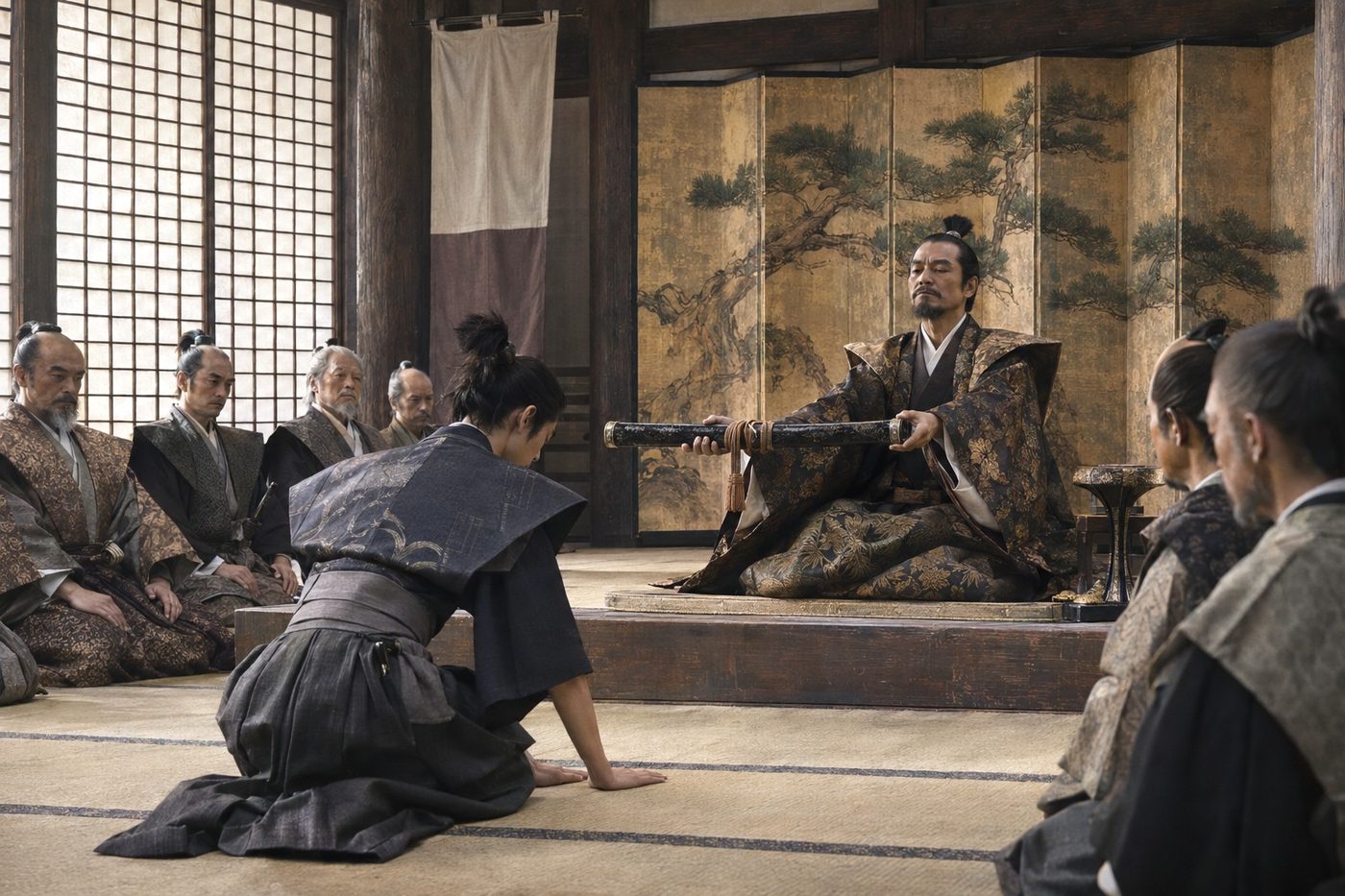
To rise one rung, the hero needs three things:
- Honor equal to the new rung's minimum (except in underworld families and shinobi leagues).
- A deed that serves the group, usually an adventure's worth: winning a battle for the lord, defending the school's name, or bringing the family a new territory.
- The head's approval, or the approval of a Senior with the head's leave. Many groups mark it with a ceremony: a new sword from the lord, a license scroll from the headmaster, or a second cup with the boss.
A hero rarely rises more than one rung for each Rank they gain. A hero who joins a new group starts there as a Newcomer, or as a Member if someone of rank vouches for them.
Pleading Your Case#
The GM may play out a rise or a fall as a Social Conflict (SWADE p. 143) between the hero and the head of their group, or the Senior who speaks for them. The hero makes their case over three rounds, and the hero's friends can support. Gifts suited to the head, a performance of the arts, a contest of refinement won in the head's sight (Part 4), witnesses to the hero's deeds, and an on the head owes the hero can each earn a bonus or a reroll, as the GM decides. Rivals and enemies argue the other side.
- Seeking promotion: the hero must still meet the Honor minimum and have a deed to show. A win means the head promotes the hero. A loss means "not yet," and the hero can try again after their next great deed.
- Facing judgment: a win means a pardon or a light penance. A loss means demotion, and a heavy loss means the hero is cast out.
Falling#
The Honor minimum is a bar for promotion, not for keeping a rung. A hero who falls 3 or more points below their rung's minimum, or who fails the group in a grave way, is called before the head. The head may pardon them, set a penance, demote them one rung, or cast them out. The GM decides, or plays out the judgment as a Social Conflict (see above).
Status Between Groups#
Status counts inside a hero's own group. Between groups, birth, title, and court rank decide who bows first (Chapter 2 Society). A Senior of an underworld family is a great figure in the dice houses, but they still step aside for a samurai of any rung in the street.
On and Giri#
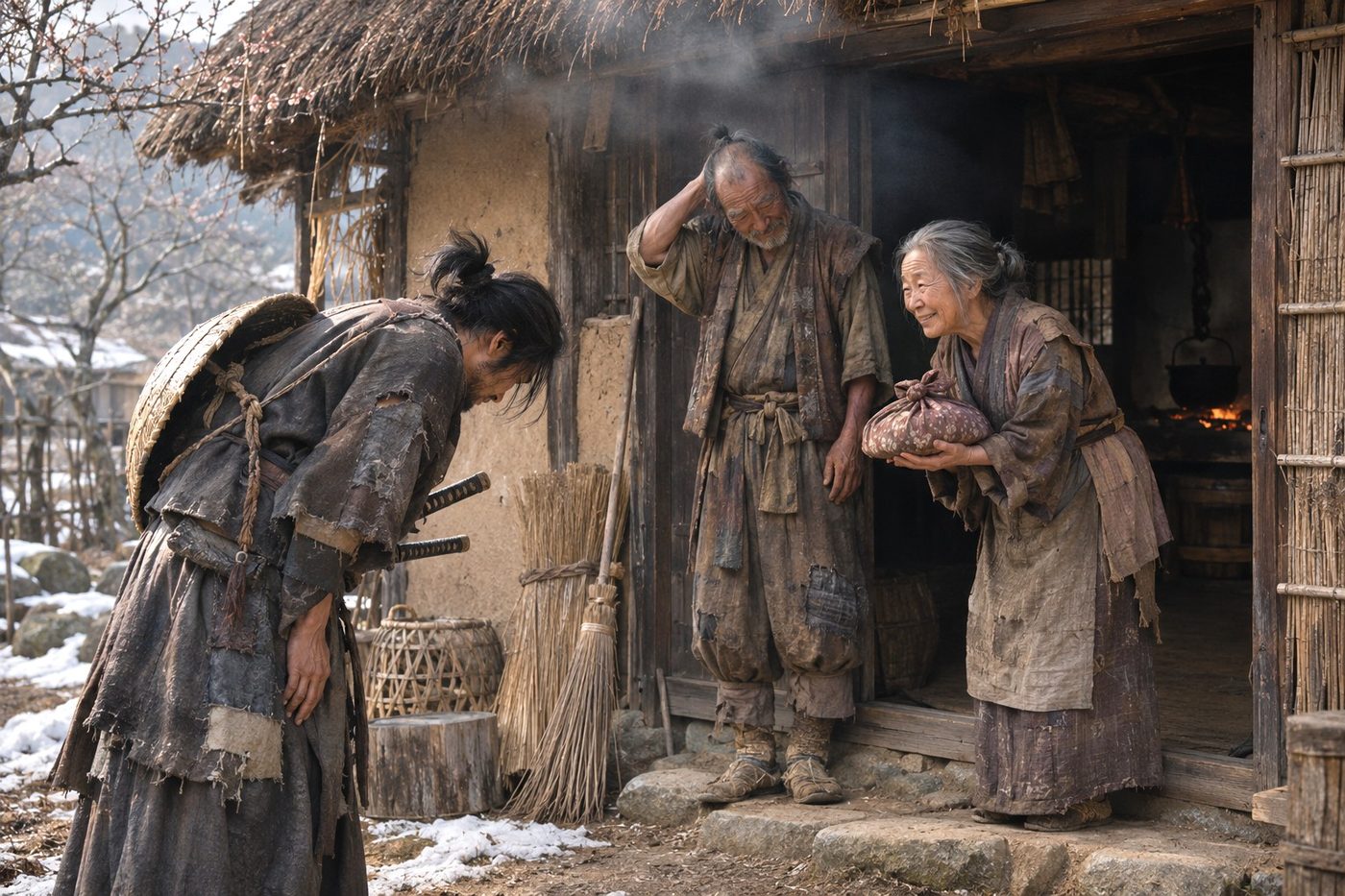
On is a debt of gratitude. It comes into being when someone does the hero a kindness that can't be paid off with money: saving the hero's life, sheltering them in disgrace, teaching them a secret, or sparing them on the battlefield. It works both ways. When the hero does such a kindness for someone else, that person owes the hero on.
Giri is the duty that grows from on: the duty to a lord who feeds you, a teacher who trained you, and a family that raised you. Steady, lifelong duty is the Obligation Hindrance (Chapter 3), and a great debt that never sleeps is the Indebted Hindrance. The rules below cover the debts heroes earn and pay during play.
Tracking On#
Each hero keeps two short lists on their sheet: on owed and on held. Each entry names the person and marks the debt as Minor or Major.
| Debt | Examples |
|---|---|
| Minor | A warning in time, a night's shelter while hunted, a loan in hard times, an introduction to a powerful person, help in a brawl |
| Major | Saving a life, ransoming a captive, granting land or a famous sword, teaching a secret technique, sparing a beaten foe, hiding someone from their enemies at great risk |
The GM decides whether a kindness creates on, and whether it is Minor or Major. Heroes can owe on to each other as well.
Calling In a Debt#
A hero who holds on can call it in once. The debtor either grants a reasonable favor without a roll, or the hero adds +2 to one Persuasion or Intimidation roll with that person (+4 for a Major debt). A Minor debt buys shelter, a loan, information, or a day's help. A Major debt buys help at the risk of the debtor's life, the loan of soldiers, or a secret the debtor swore to keep. Either way, the debt is then cleared.
On at a glance.
- A kindness is done. The GM decides whether it creates on, Minor or Major. The receiver writes it under on owed, the giver under on held.
- The holder calls it in, once. If the hero holds the debt, the debtor grants a reasonable favor without a roll, or the hero takes +2 (+4 for Major) on one Persuasion or Intimidation roll with them. The debt is cleared either way.
- The debtor answers. If the hero owes the debt, they must answer the call (below). Answering clears it and earns a Benny, and Honor if done before witnesses.
- Or refuses. A refusing hero loses 2 or 4 Honor, and the debt stays.
- A debt buys only its size. A Minor debt buys what Calling In a Debt says a Minor debt buys. Asking more of it is a new request, not a call, and the GM judges the size.
Repaying a Debt#
When a creditor calls in an on the hero owes, the hero is bound to answer. A hero who answers and does what was asked clears the debt and gets a Benny. Repaying in front of witnesses also earns Honor (see the tables above).
Refusing. A hero who refuses loses 2 Honor for a Minor debt, or 4 for a Major one, and the debt stays on their sheet. Word spreads that the hero is onshirazu, "one who doesn't know gratitude," which is among the worst things anyone can say of a person in the isles.
When debts collide. Sometimes a creditor asks for something that betrays the hero's lord, or two creditors ask for opposite things. This is the heart of many old tales. The hero chooses, and pays the price of the debt they leave unpaid. A hero with Torn Heart (Chapter 3) earns its Benny when the choice is played well.
Part 2: Kegare#
Dirt on the Spirit#
Chapter 2 describes what everyone in the isles believes: pollution is not sin, but something closer to dirt on the spirit, caught from death, blood, and decay. In Blade and Kami™ that belief is true. The kami turn away from the polluted, the dead and the yōkai are drawn to them, and a hero who carries too much of it starts to feel the cold of the other world.
Pollution is common and usually brief. A warrior who rinses their hands and mouth after a fight is clean again. The danger is the hero who has no time to wash, who wades through a battlefield, an execution ground, or a haunted house, and keeps going.
No one is polluted by birth. A sakaibito, a butcher's child, or a foreigner starts as clean as a princess. Acts and places pollute, never people. When a sakaibito buries the dead, they are polluted just as a samurai who buries the dead is, and they cleanse it in the same way. The shunning the sakaibito suffer is the world's prejudice, not a rule of the game.
The Pollution Track#
Each hero has a pollution track with four steps. Heroes start Clean. The GM doesn't track pollution for Extras, unless it matters to the story.
| Step | Name | Effects |
|---|---|---|
| 0 | Clean | None. |
| 1 | Touched | Until cleansed, the hero may not enter a shrine's inner precincts, use the Kami's Favor Edge, or use the powers Calling Down the Kami (kami-oroshi), Calling the Guardians, or Kami Riding (Chapter 6). Nothing else changes: Faith rolls, other powers, and Fear checks are as normal. |
| 2 | Polluted | As Touched, and the hero subtracts 1 from Faith rolls and from Fear checks. Animals shy from the hero, and the spirits of the place notice them. |
| 3 | Defiled | As Touched, and the hero subtracts 2 from Faith rolls and from Fear checks. The hero suffers a level of Fatigue that can't be recovered until they are cleansed to Polluted or better. Restless dead and hungry yōkai seek the hero out. |
Beyond Defiled. A Defiled hero who gains more pollution stays at Defiled, but makes an immediate Fear check at –2. The GM may also give the hero the Haunted Hindrance (Chapter 3) as a temporary Minor Hindrance, until the hero is fully cleansed. A hero who stays Defiled draws the restless dead and hungry yōkai to them, scene after scene, as the table says, and the haunting builds until they find a cleansing.
Example. A kannagi kills a bandit at a river ford and is Touched. She can't call down the kami until she rinses, so she washes at the ford when the fight ends and is Clean again before the next scene. Had a ghost Wounded her in the same fight, she would be Polluted instead: the rinse does nothing for that, and she subtracts 1 from Faith rolls until cold water or a priest's purification clears her.
Arcane skills. The Faith penalty also applies to any arcane skill that calls on the kami or the buddhas. Chapter 6 says which Arcane Backgrounds that covers.
Becoming Polluted#
When a hero does one of the following, they move one step down the track (two steps for the worst acts, as noted). A single scene never costs more than two steps, however many things happen in it.
| Source | Pollution |
|---|---|
| Touching or handling a corpse, or preparing one for burial | 1 |
| A bloody fight in which the hero kills someone or takes a Wound (once per fight) | 1 |
| Being Wounded by one of the restless dead, a demon (oni), or a cursed weapon | 1 |
| Eating the flesh of a four-legged animal | 1 |
| Breaking a Taboo (Chapter 3), in addition to the Hindrance's own penalty | 1 |
| Entering polluted ground without protection (see below) | 1 |
| Murder, desecrating a grave, a shrine, or a temple, or another grave crime | 2 |
The rinse after a fight. A bloody fight leaves a hero Touched, and the rinse at the end of the fight is assumed: unless the scene says otherwise (no clean water, no time, the heroes still running), the hero is Clean again before the next scene. Nobody needs to mark it. In practice, the table tracks kegare only from Polluted up.
How sources stack. The scene cap of two steps covers every source on this table and the Polluting ability (Chapter 12). The Polluting ability replaces the "Wounded by one of the restless dead" line for the creature that has it, so one hit never counts twice. A fight with oni or the restless dead always counts as a bloody fight (Chapter 12).
- A ghost fight, no Wound: the bloody fight gives 1 step. The hero is Touched, and the rinse clears it.
- Wounded by an oni without Polluting: the bloody fight and the Wound give 2 steps. The hero is Polluted.
- Shaken by a Polluting ghost on profane ground: the bloody fight, Polluting, and the ground would give 3 steps, but the scene cap holds it at 2. The hero is Polluted.
Hunters, soldiers, and the hungry. Venison and boar are common fare in the mountains and in camp. A rinse clears the pollution (see below), so most people eat and wash without worry. Only the strict and the pious refuse the meat outright.
Lore without rules. Chapter 2 also describes the pollution of mourning and childbirth. These are customs that shape daily life, such as staying away from shrines for 49 days after a death in the family, and they carry no game rules.
Polluted and Sacred Ground#
Places gather pollution too. This book uses the Horror Companion's rules for Consecrated and Profane Ground (HC p. 41):
- Consecrated ground: the inner precincts of a shrine, the main hall of a temple, and any place bound with a straw rope (shimenawa) and kept pure.
- Profane ground: an old battlefield, an execution ground, a plague village, a well where someone drowned, and any place where great pollution has built up and never been cleansed.
A hero who enters profane ground without protection gains one step of pollution. A ward from a priest or an onmyōji (Chapter 6) protects the hero while it lasts. A place can be cleansed only by a full rite (Chapter 6).
Cleansing#
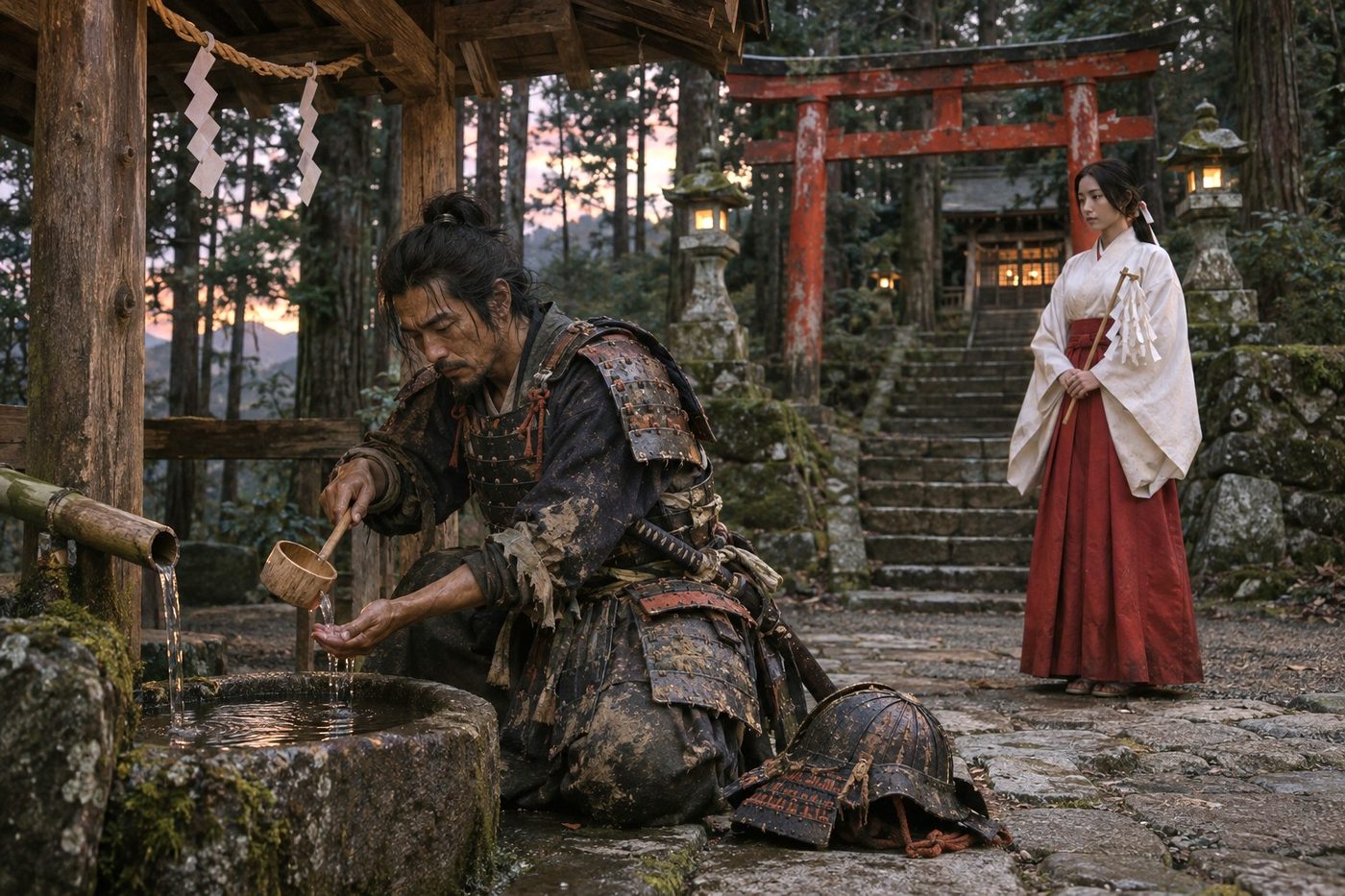
Simple purification is part of daily life, and anyone can do it. The full rites, and the powers that cleanse a place or a possessed person, are in Chapter 6.
A rinse. Rinsing the hands and mouth with clean water, or scattering salt over the body, takes a few minutes and clears a Touched hero (step 1 to 0). It does nothing for deeper pollution. Every shrine has a basin at its gate for this purpose.
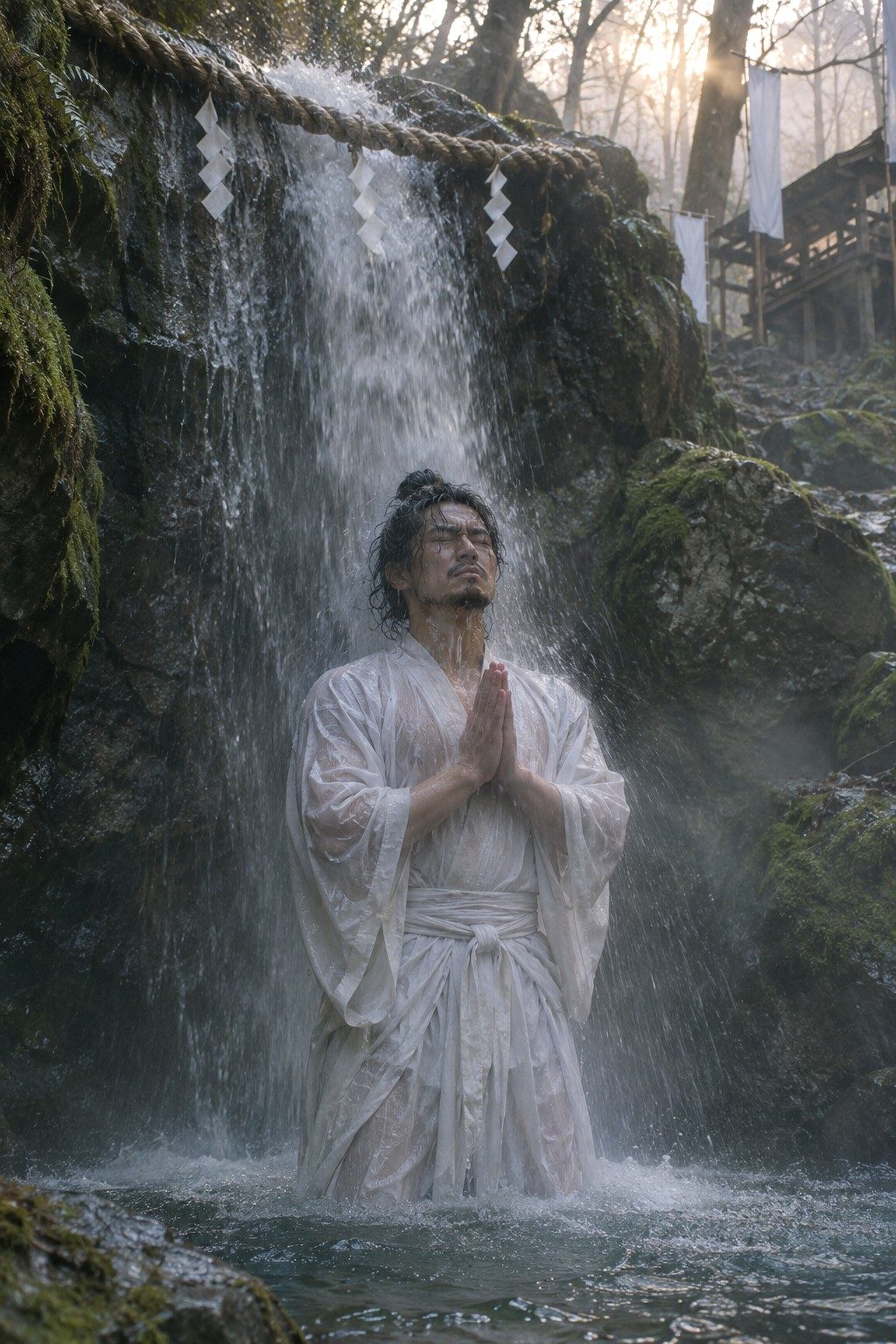
Cold water (misogi). The hero stands under a cold waterfall, or in the sea or a river, at dawn or dusk, and makes a Vigor roll. Success moves the hero one step toward Clean, and a raise moves them two steps. Failure means the hero suffers a level of Fatigue from the cold, which recovers normally. A hero can try misogi only once a day.
A priest's purification (harai). A shrine priest, a shrine maiden, or a monk waves the purification wand over the hero, or recites the rites, and makes a Faith roll. Success clears the hero to Clean. A shrine asks for an offering, usually 10 to 100 mon, depending on the shrine and the pollution. A hero with Faith can perform the rite for their companions. Chapter 6 gives more powerful rites.
The rite and the power. The harai rite above and the Purification power (Chapter 6) share a name, but not a use.
| The rite (harai) | The power (Purification) | |
|---|---|---|
| Who | Anyone with Faith | A genja with the power |
| Time | A few minutes | One action, even in a fight |
| Cost | An offering at a shrine; free from a companion | 2 Power Points |
| Success | The hero is Clean | Two steps toward Clean |
| Raise | The hero is Clean | The hero is Clean |
| Also | Nothing else | Can drive back the restless dead and demons |
Use the rite after the fight, and the power during it.
The great purifications. Everyone who takes part in a shrine's great purification, in the Sixth and Twelfth Months, is cleansed to Clean.
Notes#
- Pollution and purification follow W. G. Aston, Shinto: The Way of the Gods (1905).
Part 3: Iaijutsu Duels#
One Breath, One Cut#
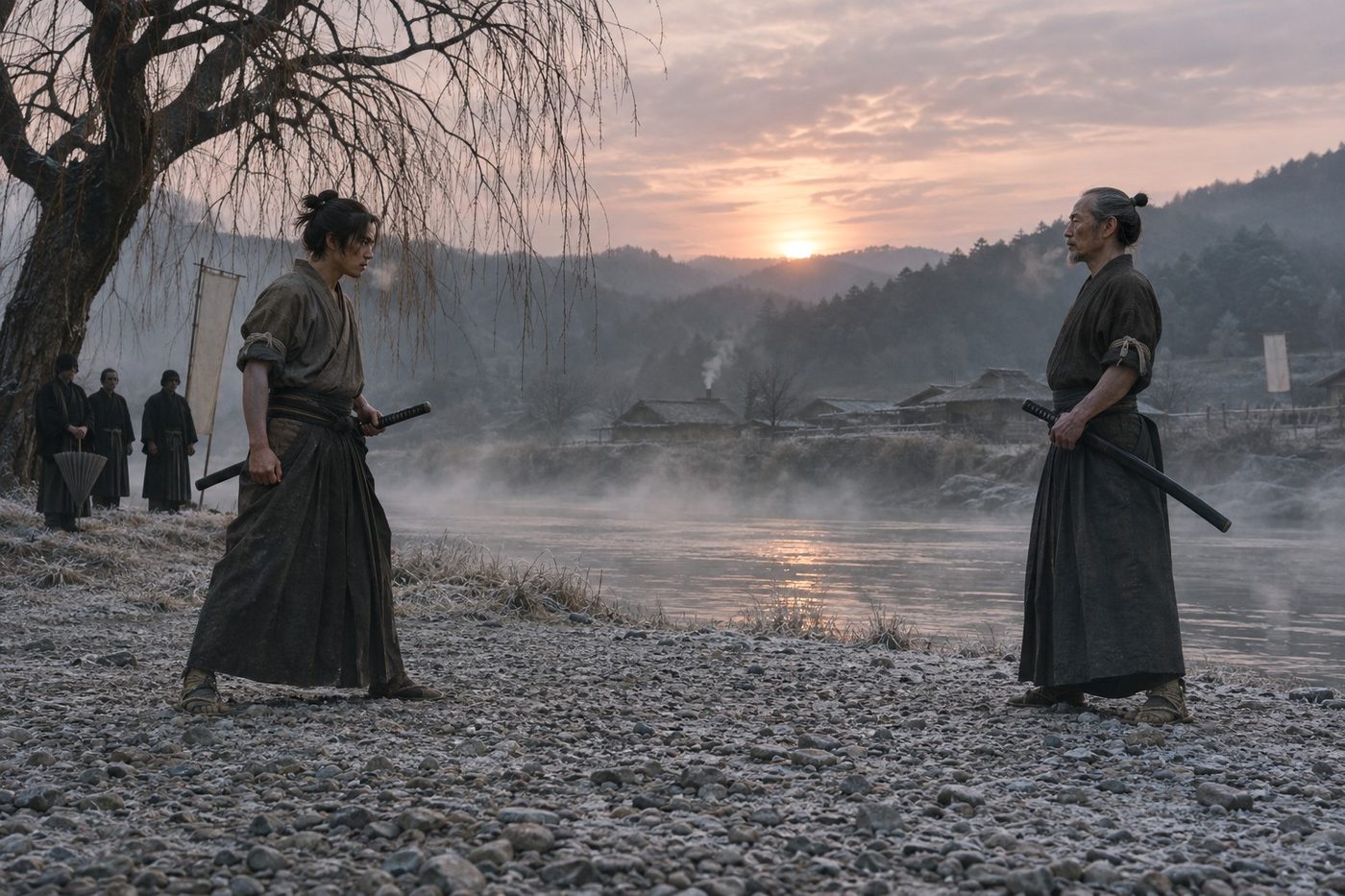
Two swordsmen face each other across a few paces of raked gravel, hands loose, blades still in their scabbards. Neither moves. The crowd stops breathing. Then there is a flash, a sound like tearing silk, and one of them is falling.
The formal duel is the heart of the warrior's legend in Tsurugishima. Most battles are won by spears and matchlocks, but reputations are made in the space of a single draw. These rules turn that moment into a short, tense scene. Any fight can stay ordinary combat. Use these rules when both sides agree to a formal duel with blades sheathed.
The Challenge#
A duel begins with a challenge, spoken or written, and an acceptance. The challenger names the reason, and the two sides agree on a place, a time, the witnesses, and the terms.
Who may challenge whom. A challenge between equals must be answered: refusing one costs 1 Honor (Part 1). A hero can ignore a challenge from someone of much lower birth or rank without shame, though the world may wonder why. Challenging a superior is bold, and the superior may send a retainer to answer it.
The law. Most lords forbid private duels inside their castle towns, so duels happen at dawn on riverbanks, crossroads, and temple grounds outside the walls. A duel fought with the lord's leave, or a school's formal match, is lawful. Killing a foe in an unlicensed duel can bring the magistrates.
The terms. Before the duel, the duelists agree on one of three terms in front of the witnesses:
- First blood: the duel ends when either duelist suffers a Wound. Being Shaken isn't enough.
- Yield: the duel ends when a duelist yields or is Incapacitated.
- To the death: the duel ends when a duelist dies. Witnesses usually let a beaten duelist ask for mercy, and sparing them earns Honor (Part 1).
A duelist who breaks the terms, such as cutting down a foe who has already yielded, breaks a sworn oath and loses 3 Honor. An onlooker who interferes in a formal duel loses 3 Honor too, and shames the duelist they helped.
Wooden swords. Schools test each other with wooden swords (bokutō). A wooden sword does Str+d6 and its damage is nonlethal (SWADE p. 104), though a strong blow still breaks bones. The same three steps apply.
The Three Steps#
Step 1: The Staredown#
The duelists face each other at sword's distance, with their blades sheathed. Each one tries to break the other's nerve and read the moment the foe will move.
Each duelist rolls Spirit or Intimidation, as their player chooses, in an opposed roll. Kiai (FC p. 34) can be used here in place of Intimidation.
- Win: the winner has found the opening and adds +2 to their Fighting roll in Step 3.
- Win with a raise: as above, and the loser is also Vulnerable during Step 3.
- Tie: neither finds an opening.
A duelist may bow and yield during the staredown, before any blade is drawn. This counts as losing the duel, but it costs no Honor unless the duelist made the challenge.
Step 2: The Draw#
Deal each duelist an Action Card. Quick (SWADE p. 40), Level Headed, and Improved Level Headed (SWADE p. 43) work as usual.
Trained in the draw-cut. A duelist trained in the draw-cut, such as a student of the Kiritani School (Chapter 3), is dealt one extra card and keeps the best. This adds to Level Headed and Improved Level Headed. Quick then works as usual on the card the duelist keeps: if it is a Five or lower, they may discard it and draw again.
The mutual strike. If both cards have the same value (ignoring suit), both duelists strike at the same instant (aiuchi). Resolve both attacks in Step 3 before applying either result. The old masters say this is the most beautiful ending and the worst.
Step 3: The Strike#
The duelist with the higher card draws and strikes first, with one Fighting roll.
One sweep of the blade. The draw and the cut are so fast that each duelist gets a single action in this step: one attack, and nothing else. No Multi-Actions, no Frenzy or Improved Frenzy, no Counterattack or Improved Counterattack, no Sweep, and no Defend. Because the two cuts come almost at once, neither duelist gets a Parry bonus from a weapon or shield, or from Block or Improved Block (SWADE p. 40), during this step. The duel is meant to be deadly.
The Kiritani Style's +2 damage applies, and the Kiritani Secret gives The Drop as described in Chapter 3. Called Shots are allowed. Most duelists fight without armor, so Unarmored Hero (SWADE p. 141) usually helps both of them soak the blow.
If the second duelist isn't Shaken or Incapacitated after the first strike, they draw and strike back in the same way, under the same limits.
After the Strike#
Check the terms. If the duel is over, it is over. If both duelists are still standing and the terms aren't met, the blades are out: the fight continues as ordinary combat, starting with a new deal of Action Cards. Weapon Parry bonuses, Block, Counterattack (SWADE p. 41), Frenzy, and Multi-Actions now work as usual. In a duel to first blood, a duelist who has already drawn blood may choose not to use a Counterattack.
Honor and Duels#
Part 1 lists the Honor a duel can win or lose. In short:
- Winning a formal duel earns 1 Honor, and beating a renowned fighter earns 2.
- Losing a fair duel costs no Honor. A brave loss can even win the loser some respect.
- Refusing a challenge from an equal costs 1 Honor, and fleeing a duel already begun costs 2.
- Breaking the terms, or interfering in another's duel, costs 3.
A school's honor rides on its students. When a student of one school beats a student of another in a public match, the winning school gains students and the losing school loses them. Many a feud between schools began with a single cut.
Duels With Extras#
An Extra in a duel is out at the first Wound, so these duels are usually over in one step. The GM may skip the staredown for a nameless thug, and use the full duel for a named swordsman who matters to the story.
Part 4: Contests of Refinement and Court Intrigue#
The Other Battlefield#
A warlord who can't hold a tea bowl properly is a bandit with a castle. Every lord in Tsurugishima knows it, and so the halls of the great houses are battlefields of another kind. A retainer who brushes a fine poem before the lord's guests is remembered at the next promotion. A rival who fumbles the incense game is laughed at for a year. Envoys judge a clan by how its people serve tea.
The arts are part of Performance (Chapter 3). This part turns them into contests of refinement, and gives a few rules for the courtesy and cruelty of court.
Contests of Refinement#
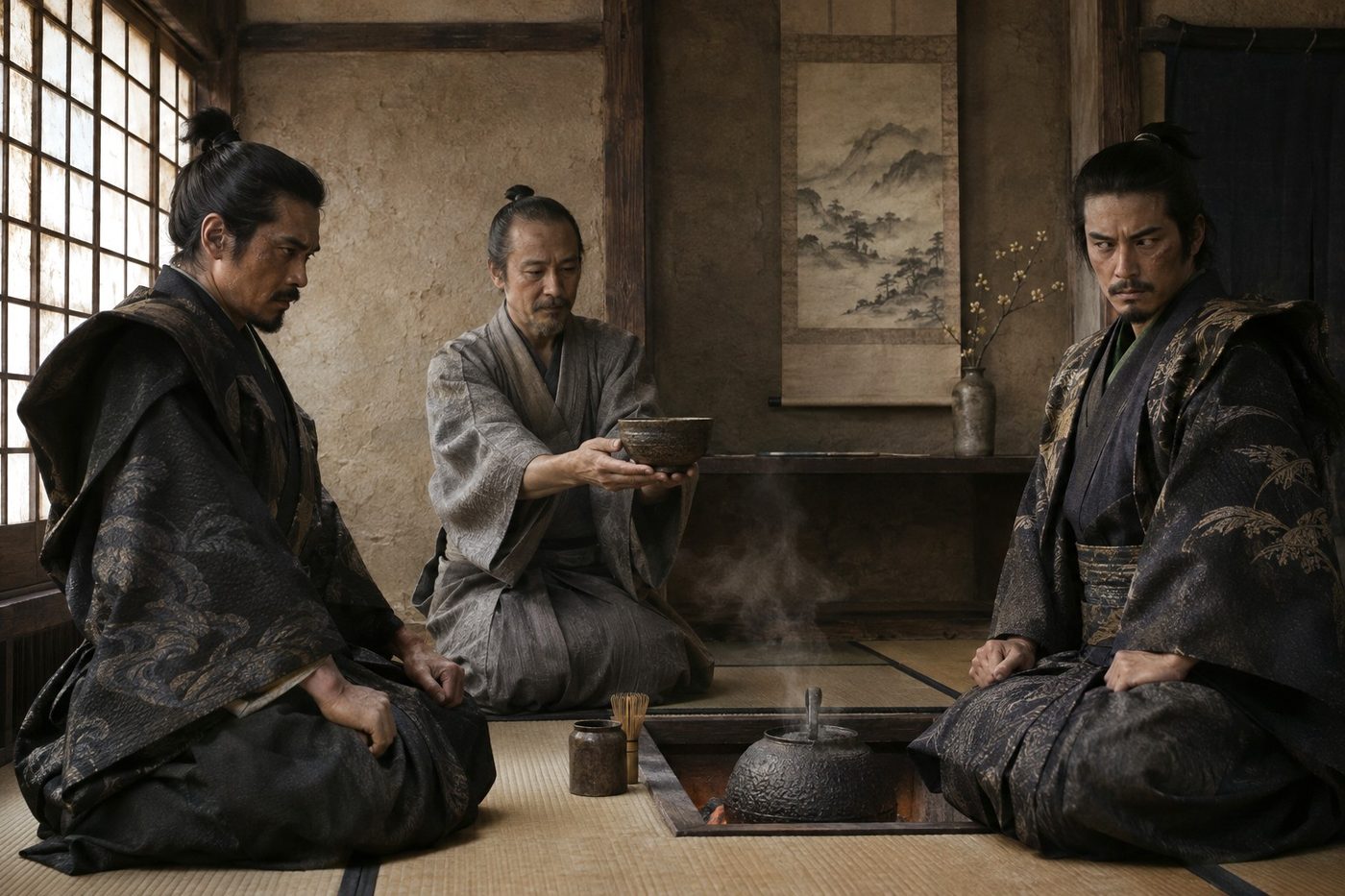
A contest of refinement is a formal match in one of the arts, held before a judge: a lord, a court noble, an abbot, a famous master, or the host of the gathering. Some contests have a single winner, such as an incense game or a tea gathering where rival hosts serve the same guest. Others have two sides, such as a poetry tournament of left against right.
The Stakes#
The host announces the prize before the contest: a famous tea bowl, a sword, a horse, a post in the lord's household, or simply the lord's notice. Rivals can also set their own stakes between them, such as a favor, a debt, or a public apology.
The Three Movements#
A contest runs over three rounds, called movements. Each art has its own three movements, described in the table below. Each movement is a chance for the player to describe what their hero does, and for the GM to describe what the judge notices.
In each movement, every contestant rolls Performance in the art. A contestant who doesn't know the art rolls at –2 (Out of Your Depth, Chapter 3).
- Each success earns the contestant one mark of favor from the judge, and each raise earns another.
- A Critical Failure is a gaffe: the contestant earns nothing that movement and loses one mark already earned.
Modifiers. The GM adjusts rolls for the situation, as in a Social Conflict (SWADE p. 143). A fine description of the hero's verse, bowl, or dance can add +1 to +4. Fine tools add +1: a famous tea bowl, a masterwork flute, a hawk from a famous mews. The judge's own taste matters too. A judge who loves the old styles subtracts 1 from a contestant who shows off the new fashion, and a judge who despises the contestant's clan subtracts 2. Hindrances such as Upstart apply where they fit. A hero with the Tea Master Edge adds +2 to their first movement in a tea gathering.
Support. A contestant's allies can Support them (SWADE p. 106) with a related roll: a servant who chose the perfect flowers, a drummer who keeps the dancer's time, or a teammate in a poetry tournament.
Unsettling a rival. Once per contest, instead of rolling Performance in a movement, a contestant can try to unsettle a rival with a cutting remark, a pointed silence, or an allusion to an old scandal. This is a Taunt or Intimidation Test (SWADE p. 108) against the rival. If it succeeds, the rival rolls at –2 in their next movement (Distracted). If it fails, the judge notices the bad manners, and the contestant loses one mark.
Cheating. Bribing the judge's servant, peeking at the incense labels, or passing off another's poem as one's own is a Thievery or Persuasion roll, as the GM decides. A contestant caught cheating loses the contest and 2 Honor.
The Result#
After the third movement, the contestant with the most marks wins. If there's a tie, the tied contestants roll once more, and the higher total wins.
| Result | What happens |
|---|---|
| Triumph (win by 3 or more marks) | The hero wins the prize, and the judge's favor: once, the hero may ask the judge for a favor as if they held one rung higher in the judge's group (Part 1). Before a lord, the hero gains 1 Honor. |
| Win | The hero wins the prize. Before a lord, the hero gains 1 Honor. |
| Loss | Nothing is lost but the prize. A graceful loser earns quiet respect. |
| Disgrace (zero marks) | Before a lord, the hero loses 1 Honor, and the story of the hero's failure goes round the hall. |
Contests and Status. A triumph before the head of the hero's own group can help when the hero pleads for promotion (Part 1): the GM may give +2 to one roll in that Social Conflict.
The Arts in Contest#
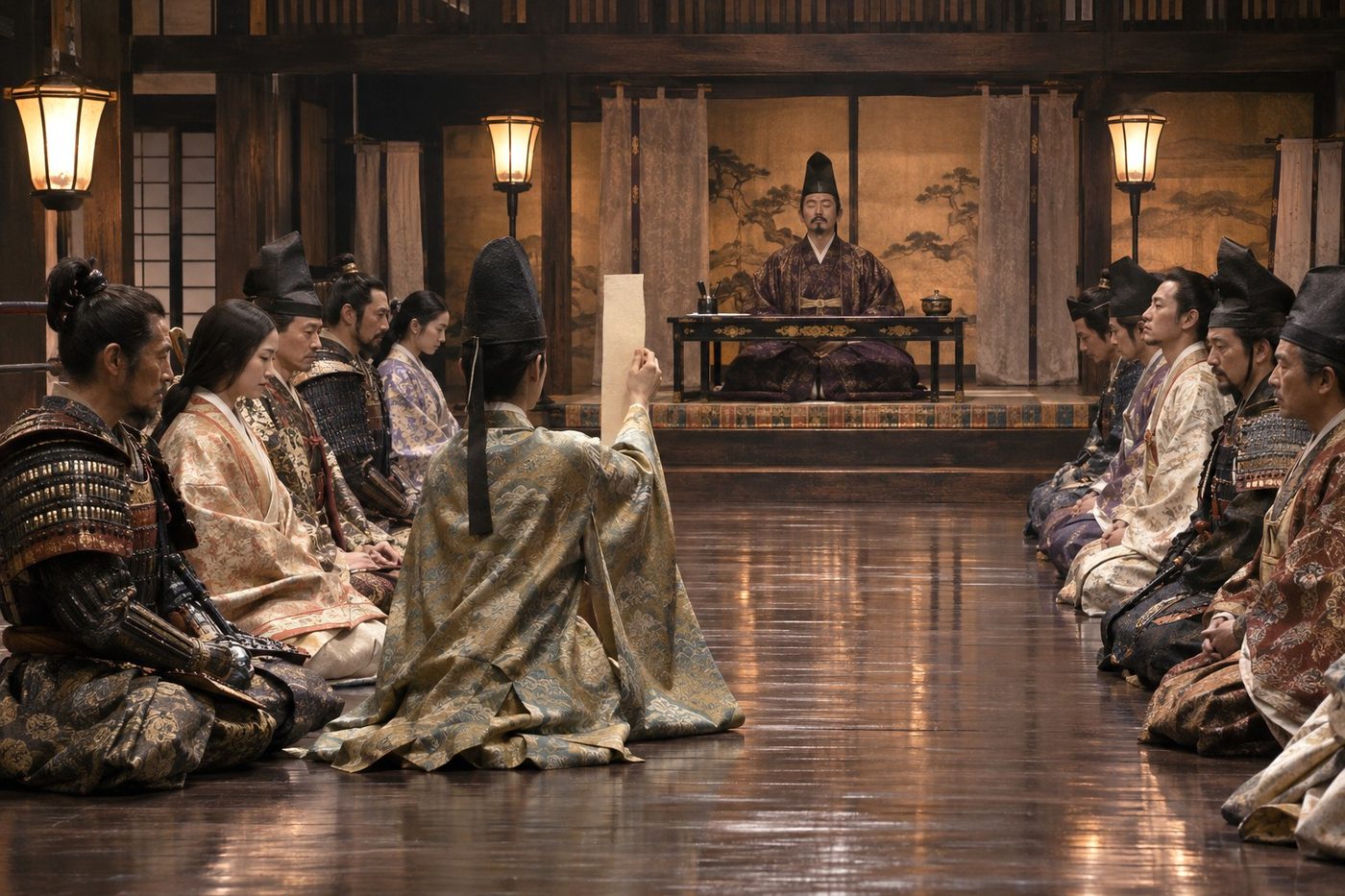
| Art | First movement | Second movement | Third movement |
|---|---|---|---|
| Tea gathering | Choosing the scroll, flower, and bowls for the season | Preparing and serving the tea in perfect form | Guiding the talk so that every guest leaves at peace |
| Nō | The entrance along the bridgeway | The central dance of the role | The final scene, when the mask seems to change its expression |
| Court dance | The slow opening steps | The figures of the dance, in perfect time with the musicians | The closing bow before the high seats |
| Sacred dance | Purifying the stage | The dance that calls down the kami | The dance that sends the kami home |
| Festival dance | Drawing the crowd into the circle | Leading the dance as the drums quicken | Ending it as the lanterns burn low |
| Lute | The opening notes that hush the room | The battle passage of the war tale | The slow, sad close |
| Flute | A melody for the season | An answer to another player's tune | A long note held into silence |
| Zither | A classic piece the judge knows well | A variation that surprises the judge | A closing piece suited to the hour |
| Drum | The opening call | The rising rhythm that the dancers follow | The final strokes |
| Song and chant | A well-known song, sung well | A difficult passage that shows the voice | A song chosen for the occasion |
| Poetry | A verse on the set theme | An answer to the rival's verse | A final verse that the judge will remember |
| Linked verse | Opening the chain, or answering the first link | Turning the chain in a new direction | Closing the chain so that it feels complete |
| Calligraphy | The poem chosen | The brushing, before the guests | The finished scroll, judged for its spirit |
| Ink painting | The subject chosen | The few strokes that make it | The empty space left on the paper |
| Flower arrangement | Choosing branches and flowers | The arrangement | The placing of it in the alcove, with the right scroll |
| Incense comparing | Naming the first scents | Matching each scent to its poem | The last, hardest scent |
| Storytelling | Setting the scene | The terror or the battle | The ending that leaves the room silent |
| Hawking | Releasing the hawk | The stoop on the quarry | The hawk's return to the glove |
| Heraldry and lineage | Naming the crests | Reciting the descent of the houses | Naming the feuds and marriages between them |
| Kick-ball | The opening kicks | The longest rally | The final kick, caught on the instep |
Court Intrigue#
Most talk at court is ordinary Persuasion, Intimidation, and Taunt. Long arguments, petitions, and trials use Social Conflict (SWADE p. 143). The rules below add the customs of the isles.
Etiquette#
Every birth has its own manners, and the court's are the hardest of all. A hero dealing with people of another birth rolls Common Knowledge at –2 to know the right forms (Out of Your Depth, Chapter 3). Court nobles and heroes born into a great house know court manners without the penalty.
A hero who gets the forms wrong commits a faux pas. The GM gives a penalty of –1 to –4 to the hero's next social roll in that scene, as SWADE suggests for an insult or a faux pas in a Social Conflict. A grave faux pas before a lord, such as wearing a sword into the wrong room or speaking before being addressed, can also cost 1 Honor.
Gifts#
No one goes to a lord empty-handed. A well-chosen gift, suited to the person who receives it and worth at least 100 mon (far more for a great lord), adds +1 to one roll in a Social Conflict, or +2 if it is exceptional: a famous tea bowl, a sword by a known smith, or a rare hawk. A poorly chosen gift is a faux pas. A gift that is plainly a bribe insults a person of Honor.
Insults#
An insult, spoken in public, demands an answer. When a hero is insulted by an equal or a superior in front of witnesses, they must answer by the end of the scene, or lose 1 Honor. The hero can answer in one of three ways:
- Demand an apology. If the insulter apologizes, the matter ends with no loss to either side. If they refuse, the insult stands.
- Answer in kind. A duel of words (below) settles the matter without blood.
- Challenge. A formal duel (Part 3).
An insult from someone far below the hero in birth or rank needs no answer, though the hero may answer it anyway.
Duels of Words#
At court, rivals fight with verses and courtesies sharp enough to cut. A duel of words is a Social Conflict between two rivals, with the onlookers as the audience. It runs for three rounds.
- In each round, both rivals roll Persuasion or Taunt in an opposed roll. A hero who knows Poetry or Linked Verse may roll Performance instead, and so may a hero with the Court Poet Edge.
- The winner of each round earns one mark, or two with a raise.
- After three rounds, the rival with more marks wins the duel. If the hero started the duel to answer an insult, a win wipes out the insult. A win by 3 or more marks before a lord earns 1 Honor, and the loser leaves the hall to laughter.
A duel of words can turn into a formal challenge if the loser can't bear it. That's often how the GM's villains like it.
Part 5: Combat in Blade and Kami™#
War in the Sword Isles#
Combat in Blade and Kami™ uses the core rules, with the Setting Rules listed in Part 7. This part adds what makes a fight in the isles feel like the warring age: armor with gaps, matchlocks that hate the rain, archers on galloping horses, swords drawn on tatami floors, and heads presented to a lord after the battle.
Armor and Its Gaps#
Samurai armor is built in layers: a cuirass, then sleeves and shin guards, then shoulder and thigh guards and a face mask. Chapter 3 Gear gives the suits.
A blow lands on the armor unless the attacker aims for a gap. Aiming for a gap is a Called Shot to an Unarmored Area (SWADE p. 98), with a penalty that depends on the suit:
| Armor | Called Shot penalty |
|---|---|
| Partial light or partial heavy | –2 (the limbs are bare) |
| Light or heavy | –3 |
| Complete or superior heavy | –4 |
| Master | –6 |
Gap Strike (Chapter 3) reduces the penalty by 2 with a thrusting weapon. No hit-location roll is used.
Fighting unarmored. Unarmored Hero (Part 7) gives a Wild Card without armor +2 to Soak rolls. Any armor cancels it, even hidden mail, padded winter clothes, or an iron headband. Monks in robes, martial artists, and duelists in plain clothes keep it.
Matchlocks#
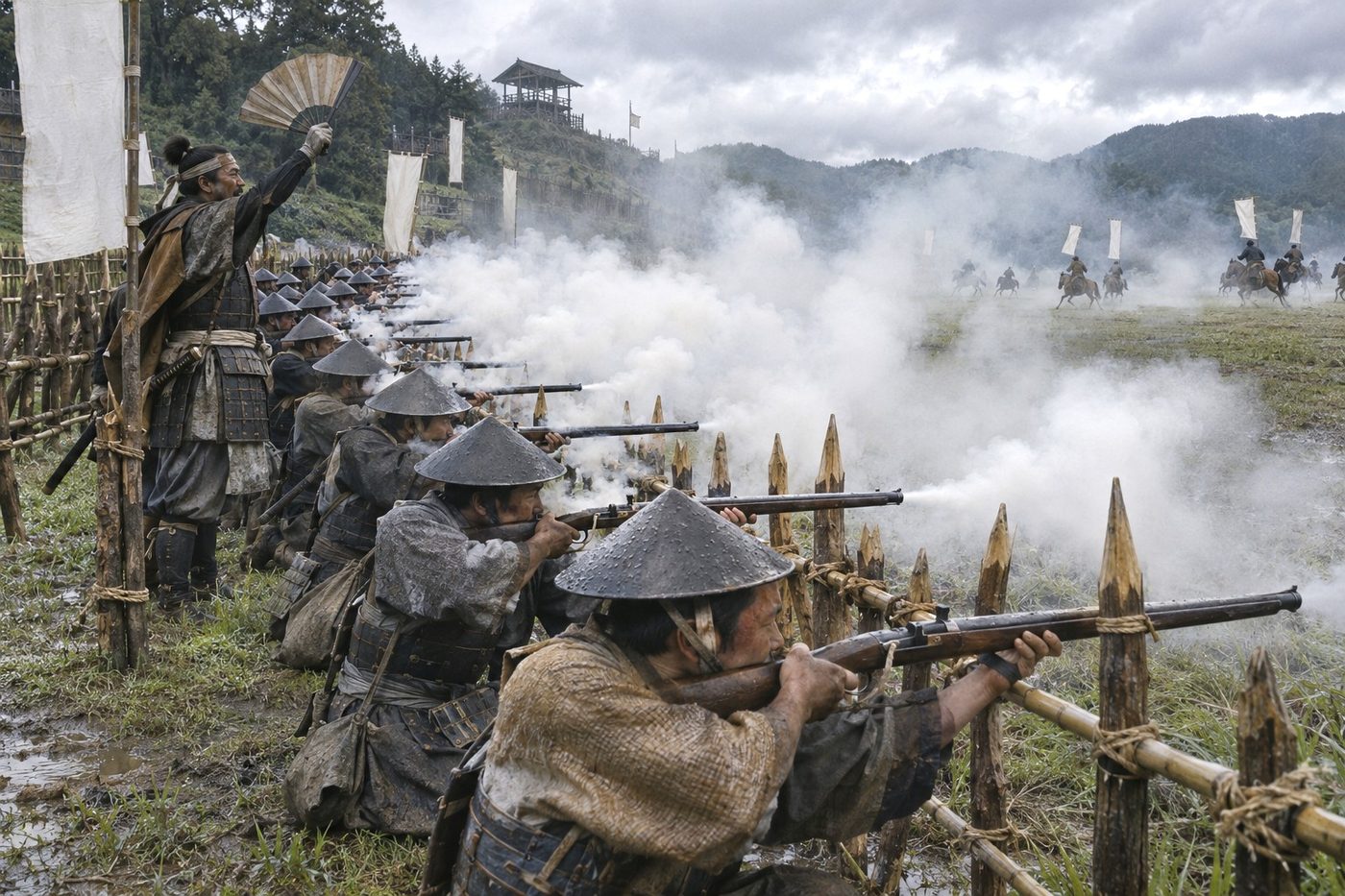
The matchlock (teppō) is changing war in the isles. Chapter 3 gives its statistics. These rules cover what it is like to use one.
The match. A matchlock fires only with a lit slow match. Lighting the match from a fire pot, a flint, or another gunner's match takes an action. A gunner who expects a fight keeps the match lit, and a lit match gives the gunner away: in Dim or Dark light, foes add +2 to Notice rolls to spot them by the glow and the smell.
Rain and wind. In rain, high wind, or after the gunner wades or swims, the gunner makes an Agility roll each time they fire, or –2 in a downpour or a storm. On a failure, the powder in the pan is wet or the match is out. The shot doesn't fire, and the gunner must spend an action to relight the match or dry the pan before the next attempt. The Gunner Edge gives a free reroll on this roll. Under a roof, a straw rain cape, or a lacquered match cover, the GM may skip the roll.
Smoke. Black powder makes thick white smoke. After a volley of five or more matchlocks, the air in front of the gunners counts as Dim light (–2) until the end of the next round, unless a wind clears it.
Volley fire. Matchlock companies fire in ranks on command, and so do companies of archers (see Archery Volleys, below). Five or more gunners who are Extras, on Hold under a leader, can fire a volley at a group of foes instead of firing one by one. The leader places a Medium Blast Template (SWADE p. 97) within the matchlocks' Medium Range, and makes one Shooting roll for the whole group, using the gunners' skill. Every target under the template is hit on a success, and takes 2d8 damage, AP 2. A raise adds +1d6 damage as usual. The gunners then begin reloading. A group of 10 or more gunners can fire two templates, and 20 or more can fire three.
Thunder. The roar of a volley frightens horses and anyone who has never heard it. A rider whose mount is within 12" of a volley makes a Riding roll, or the horse bolts or rears and the rider is Shaken. Extras who have never faced matchlocks make a Spirit roll, or they are Shaken.
Against the gun. Arrow Cutting doesn't work against matchlock balls (Chapter 3). Standing shields and bamboo bundles stop them (Chapter 3 Gear).
Horse and Bow#
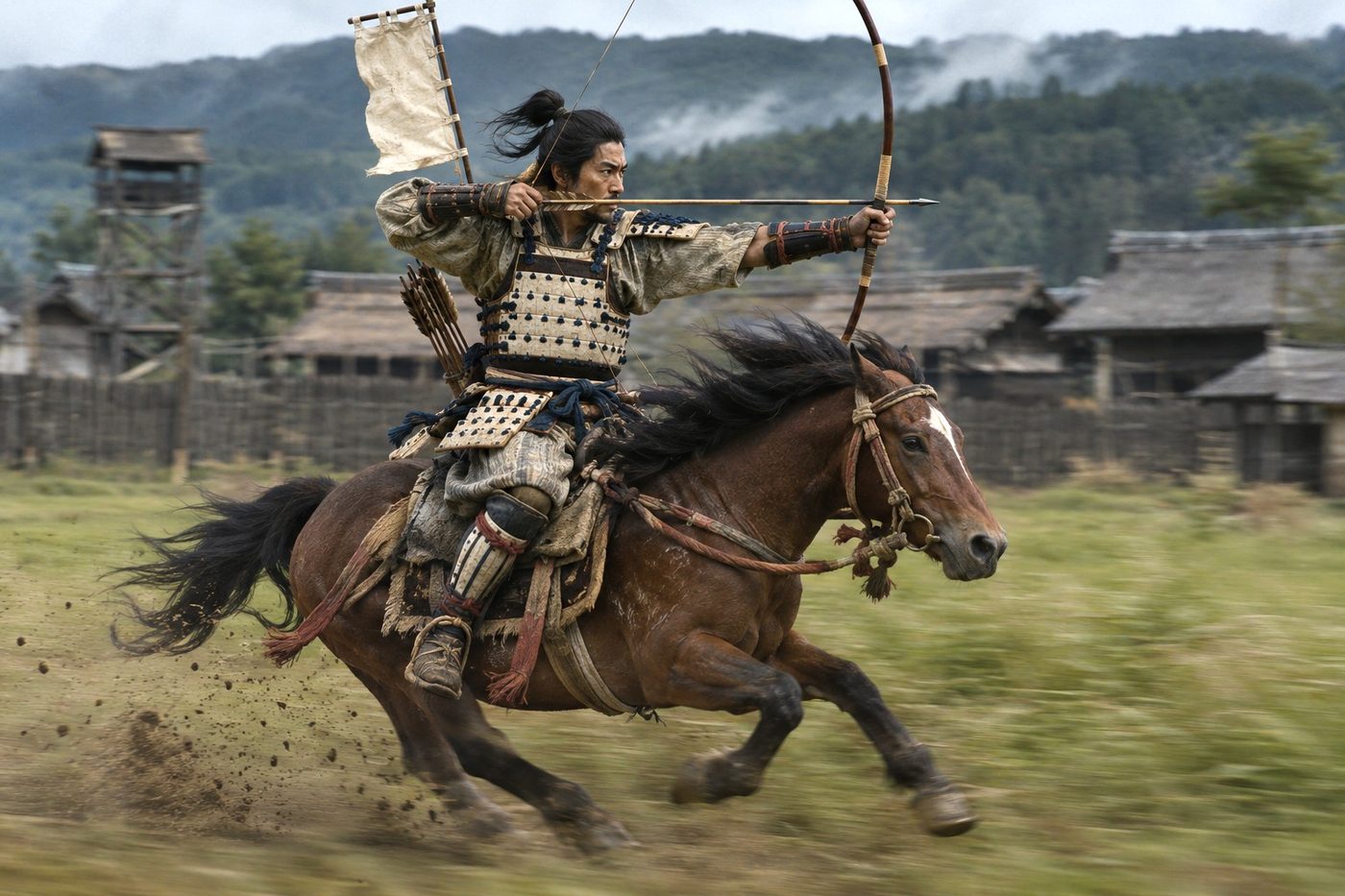
The oldest warrior art of the isles is shooting the great bow from a galloping horse. Fighting from horseback uses the core rules for Mounted Combat (SWADE p. 103). A rider who shoots a bow from the saddle suffers the Unstable Platform penalty (SWADE p. 109), and the running penalty if the mount runs. The Asaoka School (Chapter 3) teaches its students to ignore both.
Only the great bow can be shot from a horse. The half bow is too short to draw at a gallop, and a matchlock can't be reloaded in the saddle.
Naming yourself. Before a battle, warriors of the old style ride out, call out their names, lineage, and deeds, and ask for a worthy foe. This is a matter of Honor, not of dice. A hero who calls their name before a battle may draw a famous enemy to face them in single combat, which is a fine way to win Honor (Part 1) and a fine way to die. Matchlock companies have little patience for the custom.
Fighting Indoors#
The houses and castles of the isles are built of wood, paper, and straw mats. Fights there are close and sudden.
Low ceilings and narrow halls. Indoors, the long weapons are hard to swing. A hero using a glaive, a long-hilted sword, a great sword, a great axe, or a long spear subtracts 2 from Fighting rolls, and can't Sweep. Spears can still thrust down a corridor without the penalty. This is why samurai leave the long sword at the door and keep the short sword in the sash.
Paper walls. A sliding paper door hides whoever stands behind it but stops nothing. Attacking someone through a paper door suffers the penalty for darkness (SWADE p. 102): –4 if the attacker can't see them at all, or –2 if a lamp throws their shadow on the paper. A spear through the wall is the assassin's oldest trick.
Seated. Guests, retainers, and councilors sit on their knees on the mats. A seated hero is treated as prone (SWADE p. 104): rising costs 2" of movement.
Creaking floors. Some castles have floors laid to squeak at every step. A hero trying to move quietly across one subtracts 2 from Stealth rolls.
Taking Heads#
In the warring age, a warrior proves a kill by bringing the foe's head to the lord. After the battle, the lord views the heads in a solemn ceremony, and rewards each warrior by the rank of the foe they defeated. The ceremony is grave, not gruesome, and the heads are washed, dressed, and named with respect.
Rewards. Taking the head of a famous enemy earns 2 Honor (Part 1) and a reward from the lord: a sword, a horse, gold, or land, depending on the foe's rank. A lord who sees a common soldier's head presented as a general's punishes the lie.
Pollution. Handling the dead brings pollution (Part 2), so warriors purify themselves before the ceremony.
Taking a head takes a few minutes, after the fighting moves on. The GM keeps it off screen. Two warriors who claim the same head may settle it before the lord, or with a duel (Part 3).
Archery Volleys#
Most battles in the isles still open with arrows: whistling arrows to call the kami's attention, then clouds of shafts from both lines. Archers use the volley rule above. Five or more archers who are Extras, on Hold under a leader, fire one Medium Blast Template within the bows' Medium Range, with one Shooting roll for the group. Each target under the template takes the bow's damage (2d6, with AP 1 for great bows). As with matchlocks, 10 or more archers fire two templates, and 20 or more fire three. Bows need no reload and make no smoke, so a company of archers can loose a volley every round.
Standing shields and bamboo bundles stop arrows as well as balls (Chapter 3 Gear).
Fire#
The towns and castles of the isles are built of wood, paper, straw, and bamboo, and they burn fast. Use the core rules for Fire (SWADE p. 127). In addition:
- A paper screen, straw mat, or thatched roof catches fire at once, with no roll.
- A fire that isn't fought spreads to the next building every few minutes in still air, and every round in a strong wind. A whole quarter of a castle town can burn in an hour.
- Fire arrows work as Flammable Arrows (FC p. 57), and are the besieger's favorite weapon against thatch and wooden walls.
- Smoke inside a burning building counts as Dim light (–2), or Dark (–4) where it is thick.
Setting fire to a town is a grave act. Burning homes with people inside them pollutes the one who does it (Part 2) and costs Honor (Part 1).
Surrender and Ransom#
Not every fight ends in death. A foe who throws down their weapon and kneels has yielded, and the victor decides what happens next.
- Spare them. Letting a beaten foe go earns 1 Honor (Part 1), and the foe owes the victor a Major on.
- Take them captive. A captive of rank can be ransomed by their family or lord. The price depends on rank, from a few strings of coins for a common retainer to a fortune for a lord's heir. Captives are guests, by custom, until the ransom is paid.
- Take them into service. In the warring age, a beaten warrior often swears to the victor and fights for them the next day. A Wild Card who yields may be offered service. An Extra who yields usually accepts.
- Grant them an honorable death. A captive of rank may ask to die by their own hand instead of living in shame (Part 6).
Striking down a foe who has yielded costs 2 Honor (Part 1), unless they broke a truce or yielded falsely.
Optional: Sworn Guards#
The core Setting Rule Fanatics (SWADE p. 138) fits the sworn bodyguards of a great lord, a sect's fanatical defenders, or a shinobi master's hidden servants. The GM may use it for a great villain whose retainers would die for them. It isn't a default rule of the setting.
Part 6: Death and Its Customs#
Meeting Death Without Fear#
The warrior's code of the age asks a samurai to meet death without fear. The war tales are full of warriors who chose the manner of their end: the old general who holds the bridge so his lord can escape, the captain who opens his own belly rather than surrender the castle, the son who walks across three provinces to kill his father's murderer. In Blade and Kami™ these stories are part of the game, and Honor follows the dead.
A note on tone. Death in Blade and Kami™ is grave, not gory. These rules deal with the meaning of a death and what it does to a name, and the GM keeps the act itself off screen. Talk with your group before play about how much of this they want at the table. A hero only dies by their own hand if their player chooses it.
A Good Death#
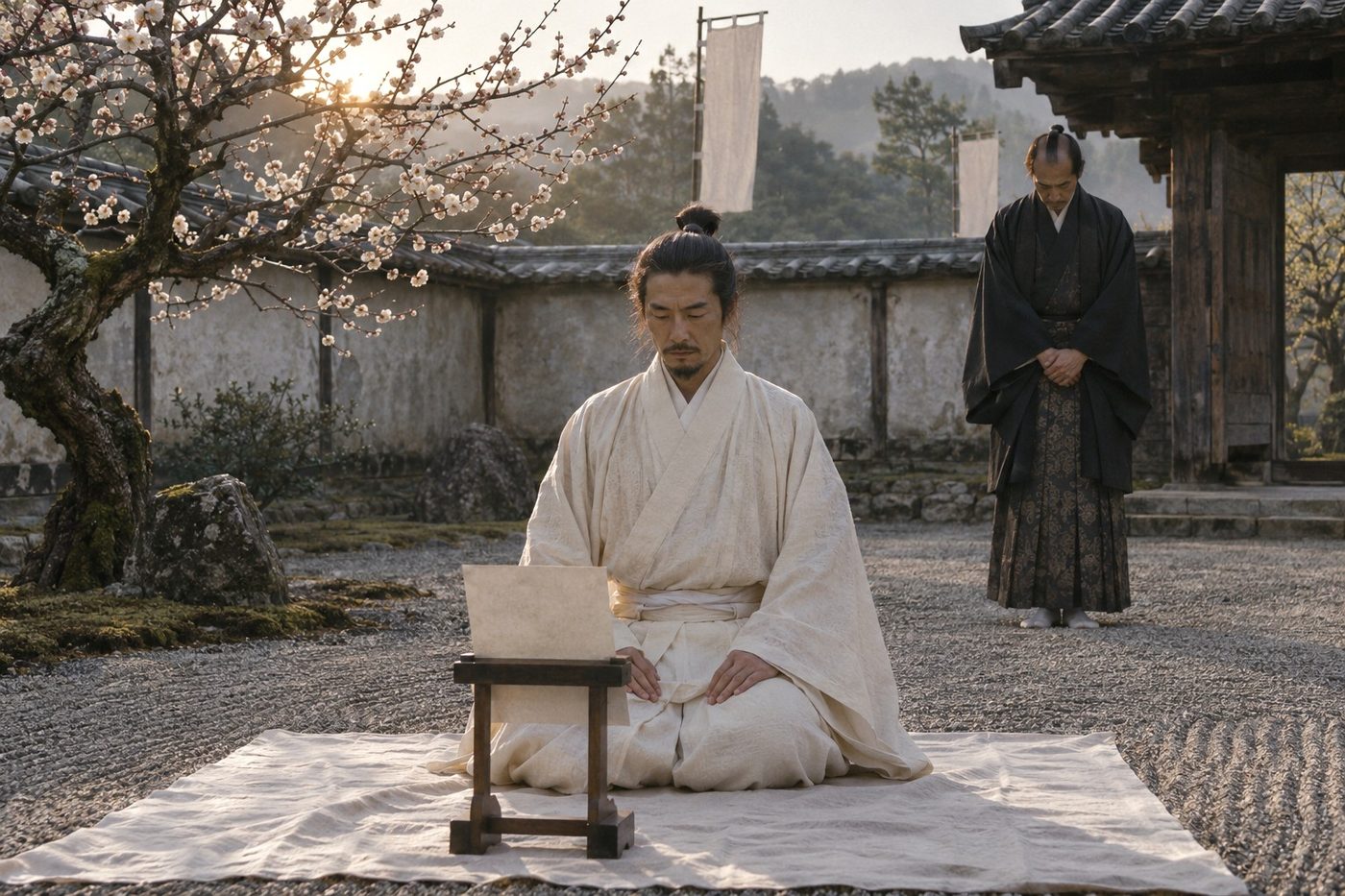
A hero who dies doing a deed worth a song, such as holding the bridge, saving their lord, or taking a famous enemy with them, dies well. The Honor for the deed (Part 1) still counts, and their name is spoken with respect.
Legacy. When a hero dies well, the player's next hero may be their child, younger sibling, student, or sworn comrade. With the GM's approval, that new hero starts with Honor +2 instead of 0, because the family name carries the dead hero's glory. The new hero also inherits any on that others owed the dead, and, with the GM's approval, the dead hero's weapons, armor, heirlooms, and other goods. The GM decides how much of the dead hero's money, stipend, or land passes down, since a lord must confirm any inheritance of a fief.
The death poem. In the old tales, warriors write a last poem (jisei) before battle or before death. A player who writes a short death poem for their dying hero, in any form, gets a Benny at the start of their next hero's first session.
A Stained Name#
Honor doesn't die with the hero. A hero who dies with negative Honor leaves the stain on their family:
- The heir's start. If the player's next hero is the dead hero's kin, they start with half the dead hero's Honor, rounded toward zero (a hero who died at –5 leaves an heir at –2). A student or sworn comrade carries no stain.
- The family's rank. At Honor –4 or lower, the lord may cut the family's stipend, take back a fief, or demote the head of the house one rung. At –8 or lower, the lord may dissolve the house entirely, and its members become ronin.
- Debts. The on the dead hero owed passes to their kin, and creditors come to collect.
This is why seppuku matters. A hero who chooses it lifts the stain: their Honor counts as 0, so the heir starts clean and the family keeps its rank (see below).
Seppuku (切腹)#
Seppuku is death by one's own blade, a privilege of the buke and the one death that can wash out a stain on a warrior's name. It is never shown in detail. It is always a choice.
Why a Warrior Chooses It#
- Atonement. To answer for a failure or a disgrace: a lost castle, a lord's death that the hero failed to stop, or an order the hero could not carry out.
- Sentence. A lord may sentence a buke retainer to seppuku instead of execution. It is a mercy, because it spares the family.
- Remonstrance. To protest a lord's folly, when nothing else will make the lord listen.
- Defeat. To avoid capture, or at the end of a siege, to buy the lives of the castle's people.
- Following the lord. To follow a lord in death. Many lords now forbid it, since it costs a house its best retainers.
What It Does#
- The stain is washed out. The hero's Honor counts as 0 if it was lower, and as earned if it was higher. Their family suffers no further loss of Honor or rank for the hero's failure, and an heir starts clean (see A Stained Name, above).
- The family is spared. A lord who sentenced a retainer to seppuku, rather than execution, by custom does not seize the family's stipend or lands.
- Remonstrance is heard. When a hero dies to protest a lord's decision, the hero's allies add +4 to all rolls in a Social Conflict with that lord to change the decision. A lord who ignores such a protest loses 2 Honor.
Refusing a sentence. A hero sentenced to seppuku who refuses or flees becomes an outlaw. They lose 4 Honor, and their family is punished in their place.
The second. By custom, a trusted friend stands by as the second (kaishakunin), to make sure the end is quick. Being asked to serve as second is a mark of deep trust, and it creates a Major on between the families.
Commoners and court nobles don't practice seppuku. A sentence for them is exile, a shaved head and a temple, or the executioner.
Revenge#
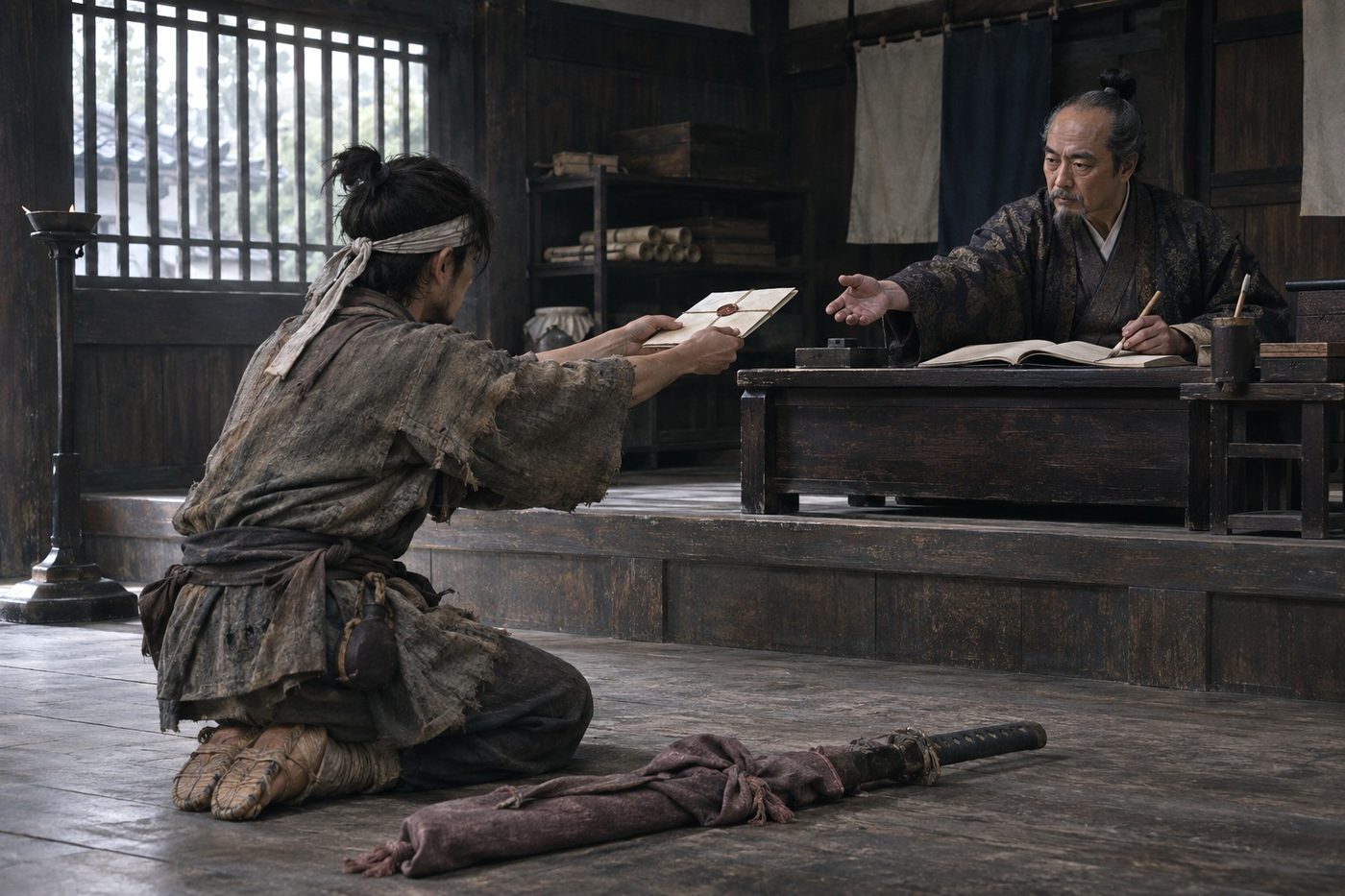
The law of the isles allows one kind of killing outside a battle: the registered vendetta (katakiuchi). Chapter 2 describes the custom. These are the rules.
Who may avenge whom. The avenger must be junior to the victim: a child for a parent, a younger sibling for an elder, a student for a teacher, or a retainer for a lord. No one may avenge a criminal executed by law.
Registering. The avenger goes to the magistrates of their domain and asks for a license. A clear case is granted with a Persuasion roll. A doubtful case, such as a killing in a fair duel, is a Social Conflict before the magistrate. The license names the murderer and the avenger. A Shogun's license holds in every domain that honors the Hagane Code; a domain's license holds only in that domain, unless its lord asks his neighbors to honor it.
What the license does. A licensed avenger may kill the named murderer openly, without being tried for it. The murderer's kin may not take revenge on the avenger in turn. Bystanders who help the murderer escape break the law.
The Hindrance. A registered vendetta is a Major Vow (Chapter 3). It ends when the murderer dies, or when the avenger dies trying.
Honor. Completing a registered vendetta earns 2 Honor. Giving it up breaks a sworn oath and costs 3. A killing without a license is murder in the eyes of the law, whatever the world thinks of it, and the magistrates hunt the killer like any other.
The Dead#
The temples bury and burn the dead, and give them new names for the world beyond (Chapter 2). A death pollutes the house and the mourners (Part 2). The dead who are left unburied, murdered and unavenged, or forgotten by their families do not always rest. Chapter 12 describes what they become.
Notes#
- The ritual of seppuku and the vendetta draw on "An Account of the Hara-Kiri" and "The Forty-Seven Rōnins" in A. B. Mitford, Tales of Old Japan (1871).
Part 7: Setting Rules From the Core and Companions#
Choosing the Rules#
Savage Worlds offers a menu of Setting Rules that change the feel of a game. Blade and Kami™ picks the ones that make a warring, haunted, honor-bound land: deadly steel, sudden betrayal, creeping dread, and heroes who rise to the moment. The tables below list every rule, with its page. Rules marked Optional are left to each group.
Savage Worlds Core Rules#
| Setting Rule | Page | In Blade and Kami™ | Why |
|---|---|---|---|
| Born a Hero | SWADE p. 136 | Not used | Heroes start as Novices and earn their Edges. |
| Conviction | SWADE p. 136 | Used | Triumph and tragedy are the stuff of the war tales. |
| Creative Combat | SWADE p. 137 | Used | Martial artists, throws, and clever swordplay. |
| Dumb Luck | SWADE p. 138 | Not used | Failure in the warring age has consequences. |
| Dynamic Backlash | SWADE p. 138 | Not used | Each path has its own Critical Failure table (Chapter 6). |
| Fanatics | SWADE p. 138 | Optional | For a great villain's sworn guards (Part 5). |
| Fast Healing | SWADE p. 139 | Not used | |
| Gritty Damage | SWADE p. 139 | Optional | For campaigns that want lasting scars and lost eyes. |
| Hard Choices | SWADE p. 139 | Not used | |
| Heroes Never Die | SWADE p. 140 | Not used | Death is real, and a good death matters (Part 6). |
| High Adventure | SWADE p. 140 | Not used | |
| More Skill Points | SWADE p. 140 | Not used | Heroes start with 12 skill points (Chapter 3). |
| Multiple Languages | SWADE p. 140 | Not used | Every hero speaks the island tongue, and other languages are learned (Chapter 3). |
| No Power Points | SWADE p. 140 | Not used | |
| Skill Specialization | SWADE p. 141 | Not used | Familiarization is used instead (Chapter 3). |
| Unarmored Hero | SWADE p. 141 | Used | Any armor cancels it, even hidden mail, padded clothes, or an iron headband (Part 5). |
| Wound Cap | SWADE p. 141 | Not used | Duels are meant to be deadly. |
Fantasy Companion#
| Rule | Page | In Blade and Kami™ | Why |
|---|---|---|---|
| Bound and Entangled (updated rules) | FC p. 75 | Used | Thief-takers, ropes, and catch poles depend on it. |
| Limited Actions | FC p. 76 | Used | |
| Desperate Attack | FC p. 76 | Used | A frantic cut when nothing else will land. |
| Stream Template | FC p. 76 | Used | |
| High Altitude | FC p. 76 | Used | The sacred peaks and the passes of the mountain ascetics. |
| Betrayal | FC p. 76 | Used | Assassins, poisoned cups, and treacherous hosts. See below. |
| Difficult Healing | FC p. 76 | Optional | For grim campaigns where healing magic should be rare. |
| Downtime | FC p. 77 | Used | See below. |
| Giant Foes | FC p. 79 | Used | Giant oni, great serpents, and mountain-sized kami. |
| Villainous Conviction | FC p. 79 | Used | For great villains only. |
Horror Companion#
| Rule | Page | In Blade and Kami™ | Why |
|---|---|---|---|
| Buckets of Blood | HC p. 38 | Not used | Blade and Kami™ is PG-13. |
| Difficult Healing | HC p. 39 | Optional | As the Fantasy Companion version, above. Use one, not both. |
| Downtime (Rest) | HC p. 39 | Used | Rest and quiet heal the scars of Fear. |
| Consecrated and Profane Ground | HC p. 41 | Used | Shrines, temples, battlefields, and execution grounds (Part 2). |
| Expanded Fear Effects | HC p. 43 | Used | Yōkai, the restless dead, and pollution (Part 2). |
| Wards and Binds, Binding Circles | HC p. 48 | Changed | Island spirit-banes and seals, which also hold spirits (Chapter 6). |
Notes for the Isles#
Betrayal and duels. Betrayal applies only when the victim is truly taken by surprise: a host who strikes a guest at dinner, or a servant with a hidden knife. A formal duel is never a betrayal, even when the Kiritani Secret gives a duelist The Drop (Part 3). Treachery costs the betrayer Honor (Part 1) if it becomes known.
Conviction and the war tales. Conviction comes from triumph and tragedy. Typical sources in the isles include winning a famous duel, taking a great enemy's head, completing a vendetta, losing a lord, being shamed before the court, and seeing a friend die well.
Downtime in the Isles#
Between adventures, heroes go home to their lord's castle, their school, their temple, or the dice house. Blade and Kami™ uses the Downtime rules of both Companions (FC p. 77, HC p. 39). When the GM calls for Downtime, usually a week or so, each hero chooses one activity. Unless an activity says otherwise, its benefit comes once per Downtime. The activities below give each one's island form, and its price in mon. Anything not mentioned works as written in the Companions. Chapter 5's seasonal turn uses these activities too.
Activities From the Companions#
Carouse (FC p. 77, HC p. 39). Banquets, moon-viewing parties, tea gatherings, an evening at the theater, or rounds of sake with the men of the dice house. The hero spends 50 mon as a Novice, 100 at Seasoned, 200 at Veteran, 400 at Heroic, and 800 at Legendary. The favor the hero gains is a Minor on (Part 1) held over someone in the town.
Center (FC p. 78, HC p. 39). Viewing the cherry blossoms or the autumn leaves, a week of seated meditation, writing poetry in a mountain hut, a visit home, or quiet days with someone the hero loves. As written.
Earn (FC p. 78, HC p. 39). Guarding a merchant's goods (Fighting), teaching at a school (Fighting or the art), performing at festivals (Performance), working a craft (Repair), running a game (Gambling), selling charms at a shrine festival (Faith), or copying sutras and letters (Academics). Success earns 200 mon as a Novice, 400 at Seasoned, 600 at Veteran, 800 at Heroic, and 1,000 at Legendary, and a raise doubles it. A buke hero who takes common work for pay in public risks gossip, at the GM's call.
Enchant (FC p. 78). Used as written, for making permanent talismans in a workshop (Chapter 6).
Research (FC p. 78, HC p. 40). A temple library, a court archive, a school's secret scrolls (with the head's leave), or the memories of old soldiers and village grandmothers. Both parts work as written: a genja may use any power of their path and Rank for one encounter, or change a trapping (Chapter 6).
Rest (FC p. 78, HC p. 40). A hot spring in the mountains, a quiet temple, or a week in bed under a physician's care. Use the Horror Companion's version, which also lets a hero shake off the effects of Fear.
Train (FC p. 78, HC p. 40). Training at the hero's own school (Chapter 3) costs nothing but sweat. Training at another school needs an introduction and a gift to the master of about 50 mon, and the hero's own school may not like it.
Learning by doing. When a hero succeeds on an untrained skill roll in a situation that matters (not a practice roll), the GM notes the skill. At the next Downtime, the hero may Train to open that skill at d4 instead of gaining the usual reroll. A hero can open only one skill this way per Downtime.
New Activities#
Contest. The hero enters a contest of refinement (Part 4): a poetry gathering, an incense game, or a lord's tea. The contest is played out as described in Part 4, and its prize and Honor are the hero's benefit.
Retreat. The hero spends the week at a shrine or a temple, or in the mountains as an ascetic: fasting, praying, and standing under cold water at dawn. They make an offering of 100 mon. The hero is cleansed to Clean (Part 2), and gets one free reroll on a Fear check before the next Downtime.
Serve the House. The hero spends the week on duty to their group: standing guard at the castle gate, carrying the lord's letters, sweeping the school's hall, or keeping the books of the merchant house. The hero may ask their group for one extra favor (Part 1) before the next Downtime.
Duty#
Belonging to a group has a price in time. By default, duty is light. Once per story arc, each hero's group asks one consequential service of them: the GM writes it into a patron's request or an adventure hook, so it is played, not counted. Or, if the party shares a lord, the party chooses Serve the House together once per arc. Either way, the Obligation Hindrance (SWADE p. 25) shows here: a hero with Obligation is the one their group asks first.
Optional Rule: Full Duty. For a campaign about service and rank, a hero must choose Serve the House at least as often as the table below says, using whichever line asks the most of them. The Obligation Hindrance already takes 20 or 40 hours of the hero's week, and this is how it shows in Downtime.
| Who | Must Serve the House |
|---|---|
| Newcomers and Members | 1 Downtime in 3 |
| Trusted | 1 Downtime in 2 |
| Seniors and Heads | 2 Downtimes in 3 |
| Obligation (Minor) | 1 Downtime in 2 |
| Obligation (Major) | 2 Downtimes in 3 |
The duty grows with rank, and so do the favors a rank can ask (Part 1). Under either rule, a hero who skips a required duty loses 1 Honor when the obligation was clear and the missed service becomes known, because their group knows and talks. Under light duty, only the one consequential service the hero accepted counts: declining a request they never accepted is not skipping a duty. A hero who skips it twice in a row is called before the head (Pleading Your Case, Part 1). Ronin, wanderers, and others with no group owe no duty, which is both the freedom and the poverty of the road.